Is Taker Protocol (TAKER) a good investment?: A comprehensive analysis of tokenomics, use cases, and market potential
Introduction: Taker Protocol (TAKER)'s Investment Position and Market Outlook
Taker Protocol (TAKER) represents a notable asset in the cryptocurrency sector, having been deployed since 2025 within the Bitcoin ecosystem incentive protocol space. As of February 05, 2026, TAKER maintains a market capitalization of approximately $634,780 with a circulating supply of 170,000,000 tokens, currently trading at around $0.003734. Positioned as a Bitcoin Incentive Layer protocol designed to democratize Bitcoin yields for fractional BTC holders, TAKER has attracted backing from notable entities including Electric, DCG, Dragonfly, Spartan, and other institutional supporters. The project's approach to scaling Bitcoin adoption through multiple reward frameworks has positioned it as a subject of interest when investors evaluate "Is Taker Protocol (TAKER) a good investment?" This article provides a comprehensive analysis of TAKER's investment characteristics, historical price movements, future price projections, and associated investment risks to serve as reference material for potential investors.
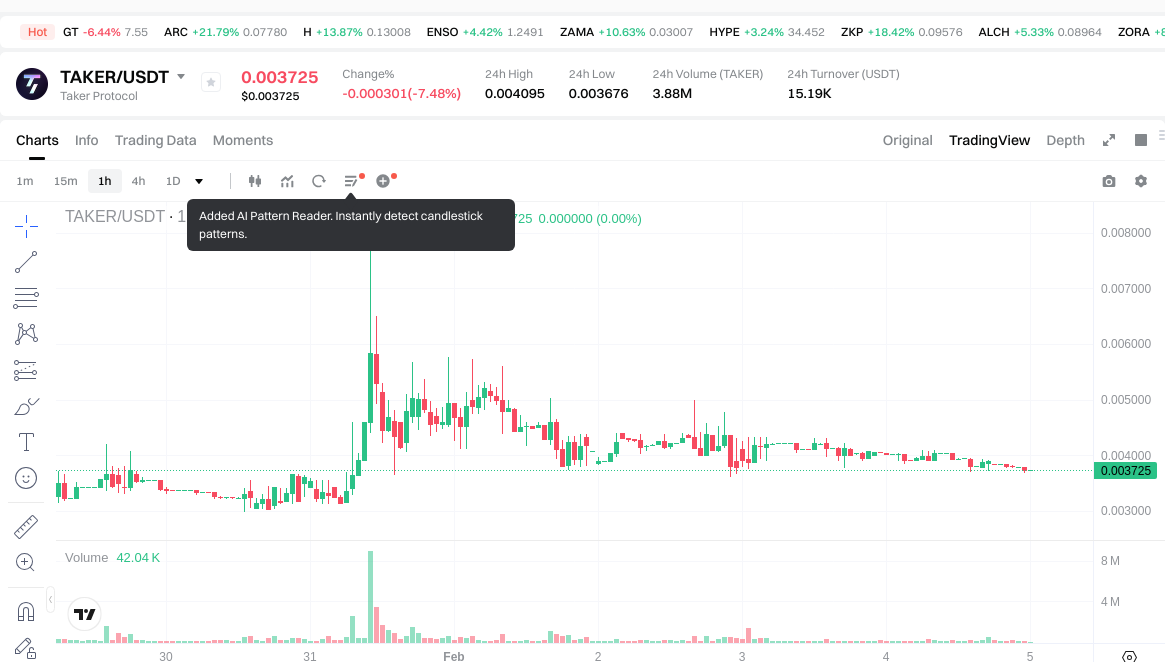
I. Taker Protocol (TAKER) Price History Review and Current Investment Status
TAKER Historical Price Performance and Investment Returns
- 2025: TAKER launched on July 18, 2025, with an initial offering price of $0.1, reaching a peak price of $0.2252 on the same day. Early investors experienced significant price movements during the launch period.
- 2025: Between July and December 2025, TAKER price fluctuated considerably, declining from its launch peak to $0.001687 by December 16, 2025, representing a substantial correction phase.
- 2026: As of early February 2026, TAKER traded at approximately $0.003734, showing recovery from the December 2025 levels but remaining significantly below the July 2025 peak.
Current TAKER Investment Market Status (February 2026)
- TAKER current price: $0.003734
- 24-hour trading volume: $15,223.42
- Circulating supply: 170,000,000 TAKER (17% of total supply)
- Market capitalization: $634,780
- Fully diluted valuation: $3,734,000
- Current holder count: 3,389 addresses
- Trading availability: Listed on 5 exchanges, including Gate.com
Click to view real-time TAKER market price
Recent Price Performance:
- 1-hour change: -0.24%
- 24-hour change: -7.64%
- 7-day change: -8.93%
- 30-day change: +30.74%
- 1-year change: -92.93%
Technical Overview: TAKER operates on the BNB Smart Chain (BSC) utilizing the BEP-20 standard, with a contract address available for verification on BSCScan. The project positions itself as a Bitcoin ecosystem incentive protocol, backed by notable investors including Electric, DCG, Dragonfly, Spartan, and other venture capital firms.
II. Core Factors Affecting Whether TAKER is a Good Investment (Is Taker Protocol(TAKER) a Good Investment)
Supply Mechanism and Scarcity (TAKER investment scarcity)
- Maximum supply capped at 1,000,000,000 tokens with current circulating supply of 170,000,000 (17% circulation ratio) → influences price dynamics and investment value
- The token's historical price movements show notable volatility, with a recorded low of $0.001687 and fluctuations reflecting market response to supply dynamics
- Investment significance: The relatively low circulation ratio suggests potential scarcity dynamics as demand increases, which may serve as a factor in long-term investment considerations
Institutional Investment and Mainstream Adoption (Institutional investment in TAKER)
- Institutional backing trends: Taker Protocol has secured support from notable investors including Electric Capital, DCG (Digital Currency Group), Dragonfly Capital, Spartan, Ascensive, Big Brain Holding, Polygon, Sfermion, The LAO, 7X, Shima Capital, Delta Blockchain Fund, Morningstar Ventures, BitScale, BitDAO (Mantle), and Oneblock
- The diverse backing from established crypto-focused investment firms and venture capital entities may contribute to enhanced credibility within the investment community
- Current holder count stands at 3,389 addresses, reflecting the current level of decentralized ownership
Macroeconomic Environment's Impact on TAKER Investment
- As a Bitcoin ecosystem incentive protocol, TAKER's investment profile may be influenced by broader trends affecting Bitcoin and cryptocurrency adoption
- Market positioning as part of the Bitcoin incentive layer suggests correlation with Bitcoin-related investment sentiment and regulatory developments
- The protocol's focus on Bitcoin derivatives and yield generation positions it within the evolving DeFi landscape, where macroeconomic factors affecting digital asset adoption play a role
Technology and Ecosystem Development (Technology & Ecosystem for TAKER investment)
- Core technological framework: Taker Protocol operates as a Bitcoin ecosystem incentive protocol utilizing multiple reward frameworks to encourage Bitcoin adoption and utilization
- Ecosystem expansion: The protocol aims to democratize Bitcoin gains for fractional Bitcoin holders through its incentive layer structure
- Application scope: Integration with Bitcoin and its derivatives for yield generation purposes, targeting expansion of the Bitcoin community through incentivized participation mechanisms
III. TAKER Future Investment Forecast and Price Outlook (Is Taker Protocol(TAKER) worth investing in 2026-2031)
Short-term Investment Forecast (2026, short-term TAKER investment outlook)
- Conservative forecast: $0.00279 - $0.00373
- Neutral forecast: $0.00372 - $0.00410
- Optimistic forecast: $0.00450 - $0.00518
Mid-term Investment Outlook (2027-2028, mid-term Taker Protocol(TAKER) investment forecast)
-
Market phase expectation: The token may experience gradual growth as the Bitcoin ecosystem incentive mechanism develops and user adoption expands. Market dynamics will likely be influenced by Bitcoin's broader ecosystem performance and Taker Protocol's ability to scale its reward frameworks.
-
Investment return forecast:
- 2027: $0.00378 - $0.00619
- 2028: $0.00330 - $0.00670
-
Key catalysts: Bitcoin ecosystem development, user adoption rate, effectiveness of incentive mechanisms, partnerships with ecosystem participants, and overall cryptocurrency market conditions.
Long-term Investment Outlook (Is TAKER a good long-term investment?)
- Base scenario: $0.00306 - $0.00649 (assuming steady ecosystem development and moderate user growth)
- Optimistic scenario: $0.00495 - $0.00952 (assuming successful mainstream adoption and favorable market conditions)
- Risk scenario: Below $0.00280 (under extreme market downturns or failure to achieve adoption targets)
Click to view TAKER long-term investment and price forecast: Price Prediction
2026-02-05 - 2031 Long-term Outlook
- Base scenario: $0.00337 - $0.00649 (corresponding to steady progress and mainstream application gradual improvement)
- Optimistic scenario: $0.00495 - $0.00952 (corresponding to large-scale adoption and favorable market environment)
- Transformative scenario: Above $0.00952 (if ecosystem achieves breakthrough progress and mainstream popularization)
- 2031-12-31 forecast high: $0.00952 (based on optimistic development assumptions)
Disclaimer: The forecasts presented are based on historical data analysis and market trends. Cryptocurrency investments carry substantial risk, and actual prices may vary significantly from predictions. This information should not be construed as investment advice.
| Year | Predicted High Price | Predicted Average Price | Predicted Low Price | Price Change |
|---|---|---|---|---|
| 2026 | 0.00517775 | 0.003725 | 0.00279375 | 0 |
| 2027 | 0.00618741125 | 0.004451375 | 0.00378366875 | 19 |
| 2028 | 0.0067024353375 | 0.005319393125 | 0.0032980237375 | 42 |
| 2029 | 0.00697266050825 | 0.00601091423125 | 0.003065566257937 | 60 |
| 2030 | 0.008504241454372 | 0.00649178736975 | 0.00337572943227 | 73 |
| 2031 | 0.009522478303317 | 0.007498014412061 | 0.00494868951196 | 100 |
IV. TAKER Investment Strategy and Risk Management (How to invest in TAKER)
Investment Methodology (TAKER investment strategy)
Long-term Holding (HODL TAKER)
For conservative investors seeking stable exposure to Bitcoin ecosystem incentive protocols, a long-term holding strategy may be considered. TAKER's positioning as a Bitcoin Incentive Layer suggests potential alignment with broader Bitcoin adoption trends. However, investors should note the token's significant price fluctuation history, with values ranging from $0.001687 to $0.2252 since its July 2025 launch.
Given the current circulating supply of 170 million tokens (17% of total supply) and a market capitalization of approximately $634,780, investors should carefully evaluate the token's liquidity profile and market depth before committing to long-term positions.
Active Trading
Active trading strategies for TAKER require careful technical analysis due to notable price volatility. Recent data shows:
- 1-hour change: -0.24%
- 24-hour change: -7.64%
- 7-day change: -8.93%
- 30-day change: +30.74%
Traders should monitor the 24-hour price range ($0.003676 to $0.004095) and daily trading volume ($15,223.42) when planning entry and exit points. The limited exchange availability (5 exchanges) may impact execution quality and slippage for larger orders.
Risk Management (Risk management for TAKER investment)
Asset Allocation Ratios
Conservative Investors: Consider limiting TAKER exposure to 1-3% of total crypto portfolio allocation, given the token's early-stage nature and high volatility profile.
Aggressive Investors: May allocate 5-10% of crypto holdings, but should maintain strict stop-loss levels and regular rebalancing schedules.
Professional Investors: Should conduct thorough due diligence on the protocol's reward frameworks, tokenomics structure, and competitive positioning within the Bitcoin ecosystem before determining appropriate allocation levels.
Risk Hedging Strategies
Investors may consider:
- Maintaining diversified exposure across multiple Bitcoin ecosystem projects
- Balancing TAKER positions with established assets like BTC or ETH
- Implementing position sizing rules based on volatility metrics
- Setting predetermined exit criteria for both profit-taking and loss limitation
Secure Storage Solutions
Given TAKER's deployment on BSC (BEP-20 standard), investors should:
- Cold Storage: Use hardware wallets supporting BSC network (e.g., Ledger, Trezor with BSC compatibility)
- Hot Wallets: For active trading, consider reputable BSC-compatible wallets with multi-signature support
- Verification: Always verify the correct contract address (0xc19539eb93444523ec8f1432624924d2e6226546) before any transaction
- Security Practices: Enable two-factor authentication and maintain separate wallets for long-term holdings versus trading activities
V. TAKER Investment Risks and Challenges (Risks of investing in TAKER)
Market Risks
High Volatility: TAKER has demonstrated substantial price fluctuations, with a recorded decline of approximately 92.93% from its initial levels over the measured period. The token's relatively low market capitalization ($634,780) and limited circulating supply may contribute to price sensitivity.
Liquidity Concerns: With trading activity concentrated across only 5 exchanges and 24-hour volume of approximately $15,223, investors may face challenges when executing larger orders or during periods of market stress.
Regulatory Risks
Investors should consider:
- Jurisdictional Variations: Bitcoin-related incentive protocols may face different regulatory treatment across jurisdictions, particularly regarding yield generation mechanisms and token classification.
- Policy Uncertainty: Evolving regulatory frameworks for crypto assets could impact TAKER's operational model or accessibility in certain markets.
- Compliance Requirements: The protocol's reward distribution mechanisms may attract regulatory scrutiny in jurisdictions with strict securities or financial promotion rules.
Technical Risks
Network Security: As a BSC-based token, TAKER is subject to the security considerations of the underlying blockchain infrastructure. Investors should monitor for any reported vulnerabilities or network incidents.
Smart Contract Risks: The protocol's incentive mechanisms rely on smart contract execution. Any bugs, exploits, or unexpected behavior in the contract code could impact token functionality or value.
Upgrade Risks: Future protocol modifications or transitions could introduce technical challenges or temporary disruptions to services.
Integration Challenges: The success of TAKER's incentive framework depends on continued adoption and integration within the Bitcoin ecosystem, which involves coordination across multiple platforms and protocols.
VI. Conclusion: Is TAKER a Good Investment?
Investment Value Summary
TAKER represents an early-stage protocol attempting to address Bitcoin ecosystem incentivization, backed by notable investors including Electric, DCG, Dragonfly, and Spartan. The project's positioning as a Bitcoin Incentive Layer suggests potential alignment with broader Bitcoin adoption trends.
However, investors should carefully weigh several considerations:
- The token has experienced significant volatility, with substantial price movements over short periods
- Limited circulating supply (17% of total) suggests potential for future dilution as additional tokens enter circulation
- Relatively low trading volumes and exchange availability may impact liquidity
- The protocol's success depends on continued adoption and effectiveness of its reward frameworks
Investor Recommendations
✅ Beginners:
- Consider starting with small allocations through dollar-cost averaging
- Prioritize secure storage using hardware wallets compatible with BSC network
- Thoroughly research the protocol's mechanics and competitive landscape before investing
- Verify contract addresses through official channels before any transactions
✅ Experienced Investors:
- Monitor technical indicators and volume patterns for potential trading opportunities
- Maintain disciplined position sizing relative to overall portfolio risk tolerance
- Track protocol development updates and ecosystem adoption metrics
- Consider hedging strategies within a broader crypto asset allocation framework
✅ Institutional Investors:
- Conduct comprehensive due diligence on protocol mechanics, team background, and competitive positioning
- Evaluate liquidity requirements against current market depth and exchange infrastructure
- Assess regulatory implications across relevant jurisdictions
- Consider staged entry approaches given limited circulating supply and potential for increased token distribution
⚠️ Important Notice: Cryptocurrency investments involve substantial risks, including potential loss of principal. TAKER's price history shows significant volatility, and past performance does not indicate future results. This analysis is provided for informational purposes only and does not constitute investment advice. Investors should conduct independent research and consult with financial advisors before making investment decisions.
VII. FAQ
Q1: What is Taker Protocol (TAKER) and how does it generate value for investors?
Taker Protocol is a Bitcoin ecosystem incentive protocol deployed on BSC that aims to democratize Bitcoin yields for fractional BTC holders through multiple reward frameworks. The protocol generates value by creating an incentive layer that encourages Bitcoin adoption and utilization, allowing participants to earn rewards based on their engagement with Bitcoin and its derivatives. However, investors should note that the token has experienced significant volatility since its July 2025 launch, with current trading around $0.003734 compared to an initial price of $0.1, and value realization depends heavily on continued ecosystem adoption and effectiveness of its incentive mechanisms.
Q2: Is TAKER suitable for long-term investment or short-term trading?
TAKER presents challenges and opportunities for both strategies, but requires different risk considerations. For long-term investment, the token's backing from notable investors (Electric, DCG, Dragonfly, Spartan) and positioning within the Bitcoin ecosystem suggest potential alignment with broader Bitcoin adoption trends; however, the 17% circulating supply ratio and significant price volatility (-92.93% from initial levels) indicate substantial risk. For short-term trading, the token shows notable price movements (30-day change: +30.74%), but limited liquidity ($15,223 daily volume) and availability on only 5 exchanges may impact execution quality. Conservative investors should limit exposure to 1-3% of portfolio allocation, while more experienced traders may consider 5-10% with strict risk management protocols.
Q3: What are the main risks associated with investing in TAKER?
The primary risks include: (1) High volatility risk – the token has demonstrated substantial price fluctuations, declining approximately 92.93% from initial levels; (2) Liquidity risk – low trading volume ($15,223 daily) and limited exchange availability (5 exchanges) may create execution challenges; (3) Supply dilution risk – only 17% of total supply currently circulates, potentially leading to price pressure as additional tokens enter the market; (4) Technical risks – smart contract vulnerabilities or BSC network issues could impact functionality; (5) Regulatory uncertainty – Bitcoin-related yield generation mechanisms may face varying regulatory treatment across jurisdictions. Investors should implement appropriate position sizing and risk management strategies, particularly given the token's relatively low market capitalization of $634,780.
Q4: What is TAKER's price forecast for 2026-2031?
Based on historical data analysis and market trend projections, TAKER's price outlook varies significantly across scenarios: For 2026, conservative forecasts suggest $0.00279-$0.00373, neutral forecasts $0.00372-$0.00410, and optimistic forecasts $0.00450-$0.00518. Mid-term forecasts show potential ranges of $0.00378-$0.00619 for 2027 and $0.00330-$0.00670 for 2028. Long-term projections for 2031 range from base scenario ($0.00337-$0.00649) to optimistic scenario ($0.00495-$0.00952), with a predicted high of $0.00952 under favorable conditions. These forecasts assume varying degrees of ecosystem development, user adoption, and market conditions; however, cryptocurrency investments carry substantial uncertainty, and actual prices may deviate significantly from predictions.
Q5: How should I securely store TAKER tokens?
TAKER operates on BSC using the BEP-20 standard (contract address: 0xc19539eb93444523ec8f1432624924d2e6226546), requiring BSC-compatible storage solutions. For long-term holdings, investors should use hardware wallets supporting BSC network (such as Ledger or Trezor with BSC compatibility) for maximum security through cold storage. For active trading, reputable BSC-compatible hot wallets with multi-signature support provide necessary accessibility while maintaining security. Critical security practices include: always verifying the correct contract address before transactions, enabling two-factor authentication on all platforms, maintaining separate wallets for long-term holdings versus trading activities, and never sharing private keys or seed phrases. Given the token's limited liquidity and exchange availability, proper storage becomes particularly important for protecting assets.
Q6: What institutional backing does TAKER have and why does it matter for investment decisions?
TAKER has secured backing from notable cryptocurrency-focused investors including Electric Capital, DCG (Digital Currency Group), Dragonfly Capital, Spartan, Ascensive, Big Brain Holding, Polygon, Sfermion, The LAO, 7X, Shima Capital, Delta Blockchain Fund, Morningstar Ventures, BitScale, BitDAO (Mantle), and Oneblock. This institutional support matters for several reasons: (1) Enhanced credibility within the investment community through association with established firms; (2) Potential access to strategic resources, partnerships, and ecosystem connections; (3) Demonstrated institutional conviction in the protocol's vision and technology. However, investors should note that institutional backing does not guarantee investment success, as evidenced by the token's significant price decline since launch. The diverse backing provides some confidence in the project's legitimacy, but individual investors must still conduct independent due diligence on the protocol's fundamentals, market positioning, and competitive landscape.
Q7: What factors should I monitor to evaluate TAKER's investment potential?
Key monitoring factors include: (1) Protocol adoption metrics – track the number of holders (currently 3,389), transaction volume, and ecosystem participation rates to gauge user adoption; (2) Token supply dynamics – monitor the release schedule of the remaining 83% of total supply and its potential impact on price; (3) Bitcoin ecosystem developments – as a Bitcoin incentive protocol, TAKER's success correlates with broader Bitcoin adoption and DeFi trends; (4) Liquidity indicators – watch daily trading volume, exchange listings, and market depth for improvements or deterioration; (5) Technical developments – follow protocol upgrades, partnership announcements, and integration progress; (6) Competitive positioning – assess how TAKER differentiates from other Bitcoin ecosystem incentive protocols; (7) Regulatory landscape – monitor policy developments affecting Bitcoin-related yield generation mechanisms. Regular evaluation of these factors helps investors make informed decisions about position sizing and timing.
Q8: How does TAKER compare to other cryptocurrency investment opportunities?
TAKER represents a specialized niche within the cryptocurrency market – Bitcoin ecosystem incentivization – which distinguishes it from broader categories like layer-1 blockchains, DeFi protocols, or meme tokens. Compared to established assets like BTC or ETH, TAKER carries significantly higher risk due to its early-stage status, limited liquidity, and concentrated focus. Its market capitalization of $634,780 is substantially smaller than most tracked cryptocurrencies, indicating higher volatility potential but also greater price impact from relatively modest capital flows. Unlike more diversified DeFi protocols, TAKER's success depends specifically on Bitcoin adoption trends and effectiveness of its incentive mechanisms. The institutional backing provides some credibility advantage over purely community-driven projects, but the token's 92.93% decline from initial levels demonstrates that backing alone does not guarantee price performance. Investors should view TAKER as a high-risk, speculative position within a diversified cryptocurrency portfolio rather than a core holding.
Share
Content
Introduction: Taker Protocol (TAKER)'s Investment Position and Market Outlook
I. Taker Protocol (TAKER) Price History Review and Current Investment Status
II. Core Factors Affecting Whether TAKER is a Good Investment (Is Taker Protocol(TAKER) a Good Investment)
III. TAKER Future Investment Forecast and Price Outlook (Is Taker Protocol(TAKER) worth investing in 2026-2031)
IV. TAKER Investment Strategy and Risk Management (How to invest in TAKER)
V. TAKER Investment Risks and Challenges (Risks of investing in TAKER)
VI. Conclusion: Is TAKER a Good Investment?
VII. FAQ
How to Buy Cryptocurrency


Trending Cryptocurrencies



XZXX: A Comprehensive Guide to the BRC-20 Meme Token in 2025

Bitcoin Fear and Greed Index: Market Sentiment Analysis for 2025

5 ways to get Bitcoin for free in 2025: Newbie Guide

Top Crypto ETFs to Watch in 2025: Navigating the Digital Asset Boom
Bitcoin Market Cap in 2025: Analysis and Trends for Investors
2025 Bitcoin Price Prediction: Trump's Tariffs' Impact on BTC

Comprehensive Guide to APR vs APY in Cryptocurrency

What Is Slippage? How Can You Prevent Slippage in Crypto Trading?
Free Bitcoin Mining

What is Crypto DePIN? DePIN's Potential for Web3

Understanding Bull Flag and Bear Flag Patterns in Trading