This comprehensive analysis evaluates TEN Protocol (TEN), a privacy-focused Layer 2 solution for Ethereum, as an investment opportunity in 2024-2026. The article examines TEN's market positioning, institutional backing from Republic Capital and R3, and current valuation of approximately $1.27 million with trading on Gate.com. Key investment factors include the protocol's Trusted Execution Environment (TEE) technology enabling programmable privacy across gaming, DeFi, AI, and institutional finance sectors. Price forecasts range from $0.0077-$0.0122 short-term to $0.0157-$0.0191 long-term through 2031, though significant risks exist including market volatility, regulatory uncertainty, and technical implementation challenges. The analysis recommends conservative allocations of 1-3% for beginners, active trading strategies for experienced investors, and comprehensive due diligence for institutions before committing capital to this early-stage Layer 2 privacy solution.
Introduction: TEN Protocol (TEN) Investment Position and Market Outlook
TEN Protocol represents a privacy-focused Layer 2 solution within the cryptocurrency landscape, designed to bring smart transparency to Ethereum smart contracts through Trusted Execution Environments (TEEs). As of February 2026, TEN maintains a market capitalization of approximately $1.27 million with a circulating supply of 133.9 million tokens, currently trading at around $0.009466. The token ranks #2348 in the broader cryptocurrency market, with a market dominance of 0.00034%. Founded by a team with blockchain development experience including work on the Corda platform, TEN Protocol aims to enable programmable privacy applications across gaming, DeFi, AI, and institutional finance sectors. The project has garnered support from institutional backers including Republic Capital, R3, BigBrain Ventures, and DWF Labs among others. This analysis examines TEN's investment characteristics, historical performance, price trends, and associated risk factors to provide market participants with research-based insights.
I. TEN Protocol (TEN) Price History Review and Current Investment Value Status
- November 2025: TEN Protocol launched on Gate.com and entered circulation with an initial trading phase, representing the token's official market debut following the project's transition from its earlier development stages.
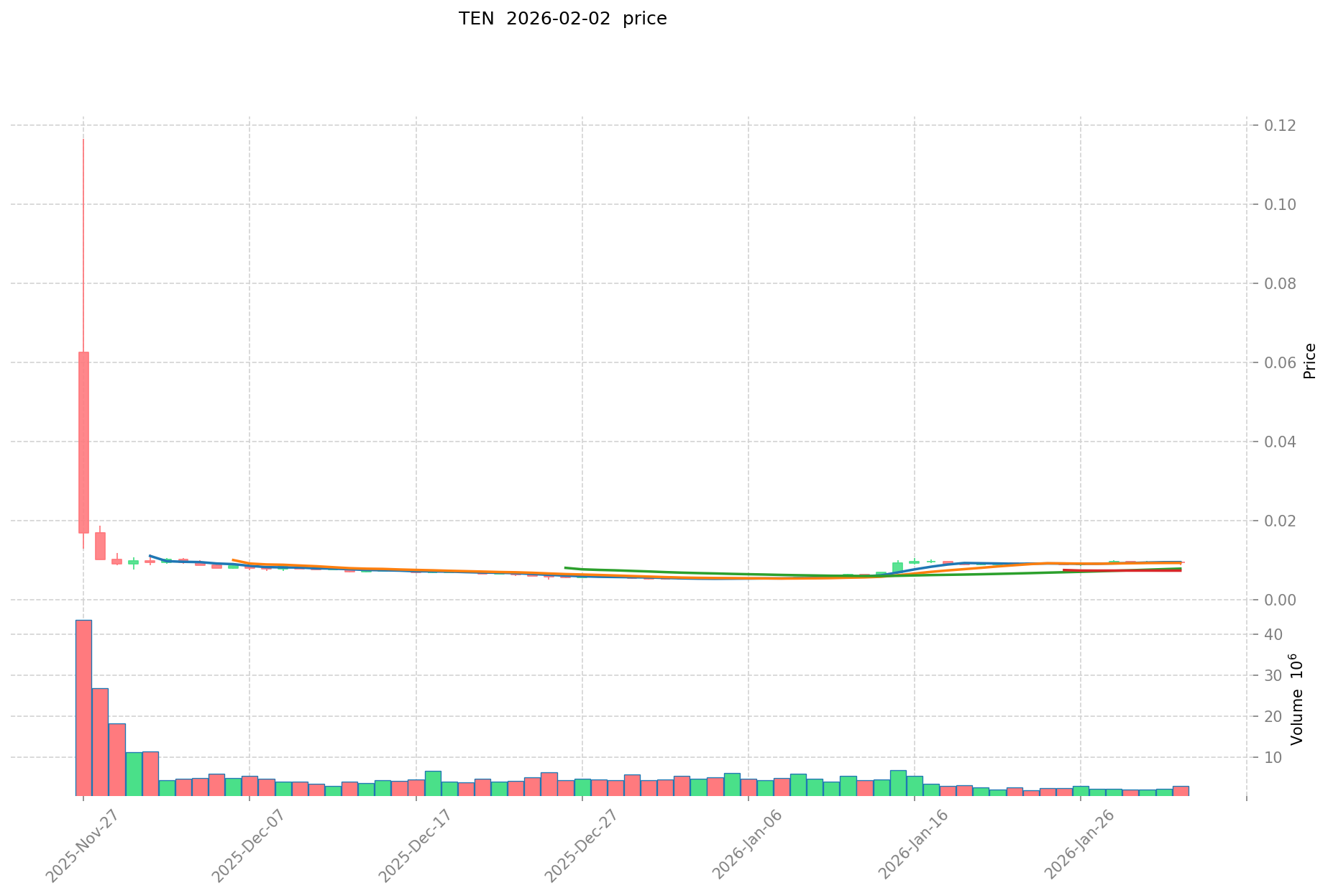
- Late November 2025: The token experienced notable price appreciation in its early trading days, reaching approximately $0.1166 per TEN, reflecting initial market enthusiasm for the privacy-focused Layer 2 solution.
- December 2025: TEN underwent a substantial price correction, declining to approximately $0.005094, demonstrating the volatility characteristic of newly launched tokens in the crypto asset space.
- Early 2026: The token has shown signs of recovery and stabilization, with price movements suggesting ongoing market discovery as the project continues development of its privacy infrastructure for Ethereum.
Current TEN Investment Market Status (February 2026)
- TEN Current Price: $0.009466 (as of February 2, 2026)
- Market Sentiment: Positive short-term momentum indicated by 24-hour price increase of 4.17% and 7-day gain of 6.97%, though 1-year performance shows -49.43% decline from initial trading levels
- 24-Hour Trading Volume: $24,942.54
- Circulating Supply: 133,900,000 TEN (13.39% of total supply)
- Market Capitalization: Approximately $1.27 million
- Fully Diluted Valuation: $9.47 million
- Price Range (24h): High $0.009494 / Low $0.008731
- Total Supply: 1,000,000,000 TEN
- Current Market Ranking: #2348
Click to view real-time TEN market price
Note: TEN Protocol represents a privacy-focused Layer 2 solution for Ethereum leveraging Trusted Execution Environment (TEE) technology. The project is backed by Republic Capital, R3, BigBrain Ventures, DWF Labs, and other institutional supporters. The founding team includes veterans from R3 who previously built Corda, a blockchain platform managing over $10 billion in on-chain assets. Current market data reflects early-stage token distribution with 13.39% of total supply in circulation.
II. Core Factors Affecting Whether TEN is a Good Investment (Is TEN Protocol(TEN) a Good Investment)
Supply Mechanism and Scarcity (TEN investment scarcity)
- TEN Protocol has a maximum supply of 1,000,000,000 tokens with a current circulating supply of 133,900,000 tokens, representing approximately 13.39% of the total supply
- The token utilizes an ERC-20 standard on the Ethereum blockchain, providing a transparent and verifiable supply mechanism
- Investment significance: The controlled token release and relatively low circulation ratio may contribute to scarcity dynamics as adoption increases
Institutional Investment and Mainstream Adoption (Institutional investment in TEN)
- TEN Protocol has secured backing from notable institutional investors and strategic advisors including Republic Capital, R3, BigBrain Ventures, Builder Capital, Cogitent Ventures, Magnus Capital, One Block Capital, DWF Labs, Master Ventures, GTS Ventures, Jets Capital, Outlier Ventures, and Legion x Nozomi
- The project's founding team previously built Corda at R3, a blockchain platform with over $10 billion in on-chain assets, demonstrating credibility in institutional blockchain solutions
- The focus on privacy solutions for gaming, DeFi, AI, and institutional finance positions TEN to potentially attract enterprise-level adoption
Macroeconomic Environment's Impact on TEN Investment
- As a privacy-focused Layer 2 solution, TEN's value proposition may strengthen during periods when data security and regulatory compliance become increasingly prioritized by institutions
- The project's emphasis on programmable privacy and encryption technology aligns with growing concerns about data protection in financial applications
Technology and Ecosystem Development (Technology & Ecosystem for TEN investment)
- Trusted Execution Environment (TEE) Technology: TEN leverages TEE infrastructure to enable encrypted applications with programmable privacy, allowing developers granular control over data transparency
- Smart Transparency Framework: The protocol introduces a novel approach where developers can define what information remains public versus private at a detailed level
- Application Expansion: TEN's technology architecture aims to unlock use cases across gaming, decentralized finance, artificial intelligence, and institutional finance sectors that were previously constrained by privacy limitations
- The protocol's design as an Ethereum Layer 2 solution positions it within the broader Ethereum ecosystem while addressing specific privacy requirements
III. TEN Future Investment Forecast and Price Outlook (Is TEN Protocol (TEN) worth investing in 2026-2031)
Short-term Investment Forecast (2026, short-term TEN investment outlook)
- Conservative forecast: $0.0077 - $0.0087
- Neutral forecast: $0.0087 - $0.0095
- Optimistic forecast: $0.0095 - $0.0122
Mid-term Investment Outlook (2027-2028, mid-term TEN Protocol (TEN) investment forecast)
- Market stage expectation: TEN Protocol may enter a phase of ecosystem expansion and developer adoption, with privacy-focused dApps potentially driving demand.
- Investment return forecast:
- 2027: $0.0062 - $0.0132
- 2028: $0.0117 - $0.0159
- Key catalysts: Mainnet stability, developer base growth, strategic partnerships, and broader Layer 2 adoption trends.
Long-term Investment Outlook (Is TEN a good long-term investment?)
- Base scenario: $0.0094 - $0.0182 (assuming steady ecosystem development and moderate adoption)
- Optimistic scenario: $0.0157 - $0.0191 (assuming accelerated adoption and favorable market conditions)
- Risk scenario: Below $0.0062 (in case of technical challenges or adverse market sentiment)
Click to view TEN long-term investment and price forecast: Price Prediction
2026-02-02 - 2031 Long-term Outlook
- Base scenario: $0.0094 - $0.0157 (corresponding to steady progress and gradual mainstream application growth)
- Optimistic scenario: $0.0157 - $0.0191 (corresponding to large-scale adoption and favorable market environment)
- Transformative scenario: Above $0.0191 (if ecosystem achieves breakthrough progress and mainstream penetration)
- 2031-12-31 forecasted high: $0.0191 (based on optimistic development assumptions)
Disclaimer: The above forecasts are based on historical data and market analysis models and do not constitute investment advice. Cryptocurrency markets are highly volatile, and actual prices may differ significantly from predictions. Investors should conduct independent research and assess their risk tolerance before making investment decisions.
| Year |
Predicted High Price |
Predicted Average Price |
Predicted Low Price |
Price Change |
| 2026 |
0.01221243 |
0.009467 |
0.00766827 |
0 |
| 2027 |
0.0132244523 |
0.010839715 |
0.00617863755 |
14 |
| 2028 |
0.015882350418 |
0.01203208365 |
0.0116711211405 |
27 |
| 2029 |
0.01856309865522 |
0.013957217034 |
0.00935133541278 |
47 |
| 2030 |
0.018211376785963 |
0.01626015784461 |
0.015284548373933 |
71 |
| 2031 |
0.019131701719968 |
0.017235767315286 |
0.013616256179076 |
82 |
IV. TEN Investment Strategy and Risk Management (How to invest in Layer 2 Privacy Solutions)
Investment Methodology (TEN investment strategy)
-
Long-term Holding (HODL TEN): Suitable for conservative investors who believe in the fundamental value proposition of privacy-focused Layer 2 solutions. This approach involves holding TEN tokens over extended periods, anticipating potential appreciation as the protocol matures and adoption increases across gaming, DeFi, AI, and institutional finance sectors.
-
Active Trading: Relies on technical analysis and swing trading strategies. Given TEN's price movements (with a 30-day change of 74.75% and 7-day change of 6.97% as of February 2, 2026), traders may identify entry and exit points based on market momentum, support and resistance levels, and volume patterns. The 24-hour trading volume of approximately $24,942 suggests relatively limited liquidity, which traders should consider when executing larger positions.
Risk Management (Risk management for TEN investment)
V. TEN Investment Risks and Challenges (Risks of investing in Layer 2 Privacy Solutions)
-
Market Risks: TEN has exhibited significant price volatility, with a recorded range between $0.005094 and $0.11662 since its launch in November 2025. The current market capitalization of approximately $1.27 million and ranking of 2348 indicate a relatively small market presence, which can contribute to price manipulation risks and limited liquidity during market stress periods.
-
Regulatory Risks: Privacy-focused blockchain solutions face varying regulatory scrutiny across jurisdictions. While the founding team includes members with experience contributing to UK government cryptocurrency regulatory frameworks, ongoing policy developments regarding privacy-preserving technologies could impact TEN's adoption and operational viability in different markets.
-
Technical Risks: As a Layer 2 solution leveraging Trusted Execution Environment (TEE) technology, TEN faces implementation challenges including potential vulnerabilities in TEE security, smart contract bugs, or integration issues with the Ethereum mainnet. The protocol's ability to deliver on its programmable privacy features while maintaining security and performance remains subject to ongoing technical validation.
VI. Conclusion: Is Layer 2 Privacy Solutions a Good Investment?
-
Investment Value Summary: TEN represents an emerging approach to blockchain privacy through its Layer 2 architecture and TEE implementation. The protocol is backed by institutional investors including Republic Capital, R3, and DWF Labs, and its founding team brings relevant experience from R3 and the Corda platform. However, with a market cap-to-FDV ratio of 13.39%, significant token supply remains unvested, and the project is in early stages with only 7,118 holders and trading on 3 exchanges as of February 2, 2026.
-
Investor Recommendations:
- ✅ Beginners: Consider dollar-cost averaging with small allocations while storing tokens in secure hardware wallets. Focus on understanding the fundamentals of privacy Layer 2 solutions before committing significant capital.
- ✅ Experienced Investors: May explore swing trading opportunities given recent volatility patterns, while maintaining diversified exposure across multiple Layer 2 protocols. Monitor development milestones and adoption metrics.
- ✅ Institutional Investors: Conduct comprehensive technical and team due diligence, assess competitive positioning against other privacy solutions, and evaluate long-term viability of TEE-based approaches before strategic allocation.
⚠️ Disclaimer: Cryptocurrency investments carry substantial risk. This analysis is provided for informational purposes only and does not constitute investment advice. Conduct thorough research and consult with financial advisors before making investment decisions.
VII. FAQ
Q1: What makes TEN Protocol different from other Layer 2 privacy solutions?
TEN Protocol uniquely combines Trusted Execution Environment (TEE) technology with programmable privacy controls, allowing developers to define granular transparency levels within their applications. Unlike traditional privacy solutions that operate on an all-or-nothing basis, TEN's "smart transparency" framework enables developers to specify exactly which data remains encrypted and which becomes publicly visible. Additionally, the founding team's experience building Corda at R3—a platform managing over $10 billion in on-chain assets—provides credibility in delivering institutional-grade privacy infrastructure.
Q2: Why is TEN's circulating supply only 13.39% of total supply?
TEN Protocol currently has 133.9 million tokens in circulation out of a total supply of 1 billion tokens, representing a 13.39% circulation ratio. This controlled release schedule is typical for newly launched protocols aiming to balance early liquidity with long-term ecosystem incentives. The remaining 86.61% of tokens are allocated for team vesting, ecosystem development, strategic partnerships, and future community rewards. Investors should monitor the unlock schedule as increased token circulation could create selling pressure or, conversely, demonstrate growing ecosystem participation.
Q3: Is TEN Protocol a good short-term or long-term investment?
TEN presents different risk-reward profiles depending on investment horizon. For short-term traders (2026), the token has shown volatility with a 30-day change of 74.75% and 7-day gains of 6.97%, creating swing trading opportunities, though limited liquidity ($24,942 daily volume) may complicate execution. For long-term investors (2026-2031), TEN offers exposure to privacy-focused blockchain infrastructure with institutional backing, but faces execution risks given its early development stage and small market cap ($1.27 million). Conservative investors should allocate no more than 1-3% of their crypto portfolio, while understanding that the project requires time to demonstrate technical viability and adoption.
Q4: What are the main risks of investing in TEN Protocol?
Primary risks include: (1) Market Risk—extreme volatility evidenced by the price range from $0.005094 to $0.11662 since launch, with a current ranking of #2348 indicating limited market depth; (2) Regulatory Risk—privacy technologies face uncertain regulatory treatment across jurisdictions despite team members' experience with UK cryptocurrency policy frameworks; (3) Technical Risk—TEE implementation vulnerabilities, potential smart contract bugs, and Ethereum Layer 2 integration challenges could affect protocol security and performance; (4) Liquidity Risk—trading on only 3 exchanges with modest daily volume may result in significant slippage for larger transactions.
Q5: How should beginners approach investing in TEN Protocol?
Beginners should start with small allocations using dollar-cost averaging to mitigate entry point risk, investing only capital they can afford to lose completely. Before purchasing, understand the fundamentals of Layer 2 solutions and privacy-preserving technologies. Store tokens in secure hardware wallets (Ledger, Trezor) compatible with ERC-20 tokens rather than leaving them on exchanges. Monitor project development through official channels and track metrics such as holder count (currently 7,118), exchange listings, and partnership announcements. Avoid emotional trading during volatility and maintain realistic expectations given TEN's early-stage status and small market capitalization.
Q6: What factors could drive TEN Protocol's price higher in the coming years?
Key growth catalysts include: (1) Mainnet Stability—successful deployment and operation of the privacy-focused Layer 2 without major security incidents; (2) Developer Adoption—increased dApp development leveraging TEN's programmable privacy features across gaming, DeFi, AI, and institutional finance sectors; (3) Strategic Partnerships—collaborations with established blockchain projects or traditional financial institutions requiring privacy solutions; (4) Exchange Listings—expanded availability on major cryptocurrency exchanges improving liquidity and accessibility; (5) Market Conditions—broader Layer 2 adoption trends and increased institutional interest in privacy-preserving technologies; (6) Token Utility Expansion—new use cases for TEN within the ecosystem driving organic demand.
Q7: How does TEN Protocol's institutional backing affect its investment prospects?
TEN's support from Republic Capital, R3, BigBrain Ventures, DWF Labs, and other institutional investors provides several advantages: credible capital backing for sustained development, potential strategic connections to enterprise clients, and validation of the project's technical approach. The founding team's R3 background (creators of Corda managing $10+ billion in assets) adds operational credibility for building institutional-grade infrastructure. However, institutional backing does not guarantee success—investors should evaluate whether the protocol achieves meaningful adoption metrics beyond investor pedigree, including developer activity, transaction volume, and real-world application deployment in target sectors.
Q8: What should investors monitor to assess TEN Protocol's progress?
Track these key indicators: (1) Development Milestones—mainnet upgrades, security audits, and feature releases demonstrating technical advancement; (2) Adoption Metrics—growth in holder count (currently 7,118), transaction volumes, and active addresses using the network; (3) Ecosystem Expansion—number and quality of dApps building on TEN across gaming, DeFi, AI, and institutional finance; (4) Partnership Announcements—integrations with established blockchain projects or traditional institutions; (5) Token Economics—vesting schedule transparency and circulating supply changes; (6) Exchange Listings—availability on additional platforms improving liquidity; (7) Competitive Positioning—how TEN differentiates against other privacy solutions like Aztec Network, Secret Network, or Polygon Nightfall.
* The information is not intended to be and does not constitute financial advice or any other recommendation of any sort offered or endorsed by Gate.