TEN Protocol (TEN) is a privacy-focused Layer 2 solution for Ethereum utilizing Trusted Execution Environment (TEE) technology, currently trading at $0.009403 with a market cap of $1.26 million as of February 2026. This comprehensive investment analysis examines TEN's market performance, revealing significant volatility with a 73.53% 30-day gain offset by 49.74% annual decline, alongside institutional backing from Republic Capital, R3, and DWF Labs. The article evaluates core investment factors including token supply dynamics (13.39% circulating supply), ecosystem development potential across gaming, DeFi, and AI sectors, and macroeconomic influences on privacy infrastructure adoption. Multiple price forecasts are presented—ranging from conservative 2026 projections of $0.0055-$0.011 to optimistic 2031 targets of $0.015-$0.021—alongside risk management strategies and detailed risk assessment covering market volatility, regulatory uncertainty, and technical vulnerabilities. Ideal for investors evaluating priva
Introduction: TEN Protocol (TEN)'s Investment Position and Market Outlook
TEN Protocol (TEN) represents a notable privacy-focused asset within the cryptocurrency sector. As a Layer 2 solution for Ethereum, TEN leverages Trusted Execution Environment (TEE) technology to enable programmable privacy for smart contracts. As of February 2026, TEN holds a market capitalization of approximately $1.26 million, with a circulating supply of 133.9 million tokens and a current trading price around $0.009403. The token experienced notable volatility, with a 30-day price change of 73.53%, reflecting dynamic market conditions. With its positioning as a privacy infrastructure for decentralized applications across gaming, DeFi, AI, and institutional finance, TEN has attracted attention from investors examining "Is TEN Protocol (TEN) a good investment?" This analysis provides a comprehensive examination of TEN's investment characteristics, historical price movements, future price considerations, and associated risks to inform potential investment decisions.
I. TEN Protocol (TEN) Price History Review and Current Investment Value Status
TEN Protocol's price history has demonstrated notable volatility since its market debut. The token reached a notable price level of $0.11662 on November 27, 2025, representing a significant valuation point in its early trading period. Subsequently, the asset experienced downward pressure, declining to $0.005094 by December 25, 2025, reflecting substantial market correction within a relatively compressed timeframe.
From a performance perspective, TEN has exhibited mixed results across different observation periods. The 30-day period showed a gain of approximately 73.53%, indicating recovery momentum from lower price levels. However, the broader annual view reveals a decline of approximately 49.74%, suggesting that earlier investors may have experienced considerable value erosion. The 7-day performance indicated a gain of 5.71%, while 24-hour movements showed a positive shift of 2.66%, though short-term fluctuations remained within a modest range.
Current TEN Investment Market Status (February 2026)
- TEN current price: $0.009403
- Market capitalization: Approximately $1,259,061.70
- 24-hour trading volume: $22,626.37
- Circulating supply: 133,900,000 TEN (13.39% of maximum supply)
- Total supply cap: 1,000,000,000 TEN
- Market dominance: 0.00033%
- Holder base: 7,118 addresses
As of February 3, 2026, TEN is trading at $0.009403, positioned considerably below its previous higher valuation levels. The asset's market capitalization stands at approximately $1.26 million, with a fully diluted valuation of $9.40 million. The circulating supply represents 13.39% of the total token allocation, indicating that a substantial portion of the supply remains to be released into the market.
The 24-hour trading volume of approximately $22,626 suggests relatively modest liquidity compared to more established digital assets. The holder count of 7,118 addresses indicates a developing community base, though the concentration of holdings and distribution patterns would require further analysis to assess market depth comprehensively.
Click to view real-time TEN market price
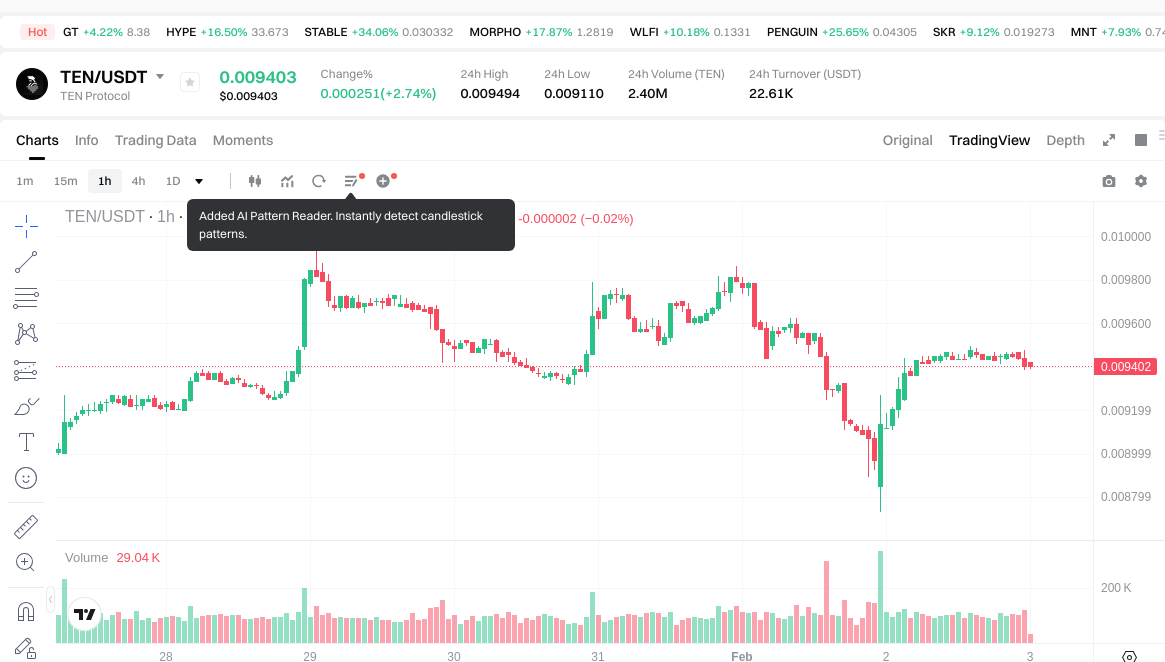
II. Core Factors Influencing Whether TEN Protocol is a Good Investment
Supply Mechanism and Scarcity (TEN investment scarcity)
- TEN Protocol has a maximum supply of 1,000,000,000 tokens with a current circulating supply of 133,900,000 tokens (13.39% of total supply)
- The controlled release of tokens may create supply-side dynamics that influence price development over time
- Limited circulation relative to total supply represents a supply mechanism that could affect long-term valuation characteristics
- Investment consideration: The relationship between circulating supply and maximum supply may be relevant for evaluating potential supply expansion effects
Institutional Investment and Mainstream Adoption (Institutional investment in TEN)
- TEN Protocol has received backing from institutional investors including Republic Capital, R3, BigBrain Ventures, Builder Capital, Cogitent Ventures, Magnus Capital, One Block Capital, DWF Labs, Master Ventures, GTS Ventures, Jets Capital, Outlier Ventures, and Legion x Nozomi
- The founding team's background includes experience at R3, where they developed Corda, a blockchain platform with over $10 billion in on-chain assets
- Institutional support from established venture capital firms and strategic advisors may contribute to network development and ecosystem growth
- The project's focus on privacy, AI, and institutional-grade encryption may position it within certain market segments that appeal to specific institutional use cases
Macroeconomic Environment's Impact on TEN Investment
- Broader cryptocurrency market trends show that established cryptocurrencies like Bitcoin and Ethereum tend to exhibit different stability characteristics compared to smaller market cap tokens
- Market conditions in 2026 reflect ongoing institutional interest in blockchain-based financial infrastructure
- Macro factors including monetary policy, interest rate environments, and risk appetite can influence capital allocation to smaller cap privacy-focused protocols
- Geopolitical and regulatory developments related to privacy and encryption technologies may affect the operating environment for privacy-focused Layer 2 solutions
Technology and Ecosystem Development (Technology & Ecosystem for TEN investment)
- TEN operates as a privacy Layer 2 solution for Ethereum, utilizing Trusted Execution Environments (TEEs) to enable encrypted applications with programmable privacy controls
- The technology allows developers to determine granular levels of data visibility, supporting applications across gaming, DeFi, AI, and institutional finance sectors
- The protocol's focus on "smart transparency" represents a technical approach to balancing privacy and openness in smart contract execution
- Ecosystem potential includes applications in sectors where programmable privacy may address specific use cases, though actual adoption levels remain subject to market development and competitive dynamics
III. TEN Future Investment Forecast and Price Outlook (Is TEN Protocol(TEN) worth investing in 2026-2031)
Short-term Investment Forecast (2026, short-term TEN investment outlook)
- Conservative forecast: $0.0055 - $0.0078
- Neutral forecast: $0.0085 - $0.0095
- Optimistic forecast: $0.010 - $0.011
Mid-term Investment Outlook (2027-2029, mid-term TEN Protocol(TEN) investment forecast)
-
Market stage expectation: TEN Protocol may enter a phase of ecosystem expansion and gradual developer adoption, with potential price appreciation as privacy-focused dApps gain traction on the platform.
-
Investment return forecast:
- 2027: $0.0096 - $0.012
- 2029: $0.0079 - $0.013
-
Key catalysts: Mainnet stability, developer ecosystem growth, strategic partnerships, and institutional adoption of privacy solutions.
Long-term Investment Outlook (Is TEN a good long-term investment?)
- Base scenario: $0.010 - $0.013 (assuming steady ecosystem development and moderate adoption of privacy Layer 2 solutions)
- Optimistic scenario: $0.014 - $0.021 (assuming accelerated developer adoption, successful deployment of privacy-focused dApps, and favorable regulatory environment)
- Risk scenario: $0.005 - $0.008 (in case of technical setbacks, competitive pressure, or adverse market conditions)
Click to view TEN long-term investment and price forecast: Price Prediction
2026-02-03 - 2031 Long-term Outlook
- Base scenario: $0.011 - $0.014 USD (corresponding to steady progress and gradual mainstream application improvement)
- Optimistic scenario: $0.015 - $0.021 USD (corresponding to large-scale adoption and favorable market environment)
- Transformative scenario: Above $0.021 USD (in case of breakthrough ecosystem progress and mainstream adoption)
- 2031-12-31 forecast high: $0.021 USD (based on optimistic development assumptions)
Disclaimer: This analysis is for informational purposes only and does not constitute investment advice. Cryptocurrency markets are highly volatile, and past performance does not guarantee future results. Investors should conduct their own research and assess their risk tolerance before making investment decisions.
| Year |
Predicted High Price |
Predicted Average Price |
Predicted Low Price |
Price Change |
| 2026 |
0.01109554 |
0.009403 |
0.00554777 |
0 |
| 2027 |
0.012299124 |
0.01024927 |
0.0096343138 |
9 |
| 2028 |
0.01273984261 |
0.011274197 |
0.01093597109 |
19 |
| 2029 |
0.01308765158745 |
0.012007019805 |
0.0079246330713 |
27 |
| 2030 |
0.015684169620281 |
0.012547335696225 |
0.011669022197489 |
33 |
| 2031 |
0.021032471460797 |
0.014115752658253 |
0.010586814493689 |
50 |
IV. TEN Investment Strategy and Risk Management (How to invest in privacy Layer 2)
Investment Methodology (TEN investment strategy)
-
Long-term holding (HODL TEN): Suitable for conservative investors
For investors seeking exposure to privacy-focused Layer 2 solutions, a long-term holding strategy may be appropriate. TEN's position as a privacy Layer 2 for Ethereum with Trusted Execution Environment (TEE) technology suggests potential alignment with the growing demand for programmable privacy in decentralized applications. The project's backing from institutional investors including Republic Capital, R3, DWF Labs, and others may indicate strategic support for long-term development. However, with a current circulating supply representing only 13.39% of the total supply, investors should consider potential dilution effects as more tokens enter circulation.
-
Active trading: Relying on technical analysis and swing operations
Active traders may consider TEN's price volatility patterns when developing trading strategies. The token has shown price movements of +73.53% over 30 days and -49.74% over one year, indicating significant volatility that may present trading opportunities. The 24-hour trading volume of approximately $22,626 suggests relatively limited liquidity, which traders should factor into execution strategies. Technical analysis should account for the token's all-time high of $0.11662 (reached on November 27, 2025) and all-time low of $0.005094 (reached on December 25, 2025).
Risk Management (Risk management for TEN investment)
-
Asset allocation ratio: Conservative / Aggressive / Professional investors
Given TEN's market capitalization of approximately $1.26 million and ranking of 2,357, allocation strategies should reflect the token's status as a smaller-cap asset:
- Conservative investors: Consider limiting TEN exposure to less than 1% of crypto portfolio
- Aggressive investors: May allocate 2-5% depending on risk tolerance and conviction
- Professional investors: Could incorporate TEN as part of a diversified Layer 2 or privacy-focused thematic allocation
-
Risk hedging solutions: Multi-asset portfolio + hedging tools
Investors may consider diversifying across multiple Layer 2 solutions and privacy-focused projects to mitigate protocol-specific risks. For those with larger positions, exploring derivatives or options (where available) could provide downside protection. Correlating TEN holdings with broader Ethereum ecosystem exposure may help balance portfolio risk, as TEN functions as an Ethereum Layer 2 solution.
-
Secure storage: Hot and cold wallets + hardware wallet recommendations
TEN operates on the ERC-20 standard (contract address: 0xea9bb54fc76bfd5dd2ff2f6da641e78c230bb683). Recommended storage approaches include:
- For long-term holdings: Hardware wallets (Ledger, Trezor) or multi-signature cold storage solutions
- For active trading: Reputable exchange platforms with strong security track records and appropriate withdrawal limits
- For intermediate needs: Software wallets with robust security features and user control of private keys
V. TEN Investment Risks and Challenges (Risks of investing in privacy Layer 2)
-
Market risk: High volatility and price manipulation concerns
TEN exhibits substantial price volatility, with the token experiencing a decline from its all-time high of $0.11662 to current levels around $0.009403, representing approximately a 91% decrease. The relatively low 24-hour trading volume of $22,626 may increase susceptibility to price swings from concentrated buying or selling activity. With only 13.39% of tokens currently circulating, future token releases could introduce additional selling pressure. The token's market dominance of 0.00033% suggests limited market depth, which may amplify price movements.
-
Regulatory risk: Policy uncertainty across different jurisdictions
Privacy-focused blockchain solutions face evolving regulatory scrutiny in various jurisdictions. TEN's emphasis on programmable privacy and encrypted applications may attract regulatory attention, particularly regarding compliance with anti-money laundering (AML) and know-your-customer (KYC) requirements. The founding team's involvement with UK government think tanks on crypto regulations may provide some regulatory awareness, but the global regulatory landscape for privacy technologies remains in flux. Investors should monitor regulatory developments that could impact privacy-focused Layer 2 solutions.
-
Technical risk: Network security vulnerabilities and upgrade failures
As a Layer 2 solution leveraging Trusted Execution Environment (TEE) technology, TEN faces technical risks associated with both the security of TEE implementations and the broader Layer 2 infrastructure. Potential vulnerabilities in TEE hardware or software could compromise the privacy guarantees that form TEN's core value proposition. Additionally, as a developing protocol, TEN may encounter challenges related to network upgrades, smart contract security, and integration with Ethereum mainnet. The project's GitHub repository information is not provided in the available materials, limiting external assessment of development activity and code audit status.
VI. Conclusion: Is privacy Layer 2 a Good Investment?
-
Investment value summary: TEN presents potential as a privacy-focused Layer 2 solution for Ethereum, supported by a founding team with experience building Corda and backing from multiple institutional investors. However, the token faces significant price volatility and currently maintains a relatively small market presence.
-
Investor recommendations:
✅ Beginners: Consider dollar-cost averaging (DCA) with modest allocations and prioritize secure wallet storage. Focus on understanding the technology and use cases before committing significant capital.
✅ Experienced investors: May explore swing trading opportunities given the volatility profile, while maintaining diversified portfolio allocation across multiple Layer 2 and privacy solutions.
✅ Institutional investors: Could evaluate TEN as part of a strategic thematic allocation to privacy infrastructure, contingent upon thorough due diligence on technology, team execution capability, and regulatory positioning.
⚠️ Disclaimer: Cryptocurrency investments carry substantial risk. This content is for informational purposes only and does not constitute investment advice. Investors should conduct independent research and consider their risk tolerance before making investment decisions.
VII. FAQ
Q1: What makes TEN Protocol different from other Layer 2 privacy solutions?
TEN Protocol distinguishes itself through its integration of Trusted Execution Environment (TEE) technology with programmable privacy controls for Ethereum smart contracts. Unlike other privacy solutions that offer all-or-nothing privacy, TEN enables developers to implement granular levels of data visibility through "smart transparency," allowing applications to determine specific aspects of transaction data that remain private versus public. This flexibility addresses use cases across gaming, DeFi, AI, and institutional finance where selective privacy is required. Additionally, the founding team's background in building Corda—a blockchain platform with over $10 billion in on-chain assets—and their involvement with UK government think tanks on crypto regulations provide technical expertise and regulatory awareness that differentiate TEN from purely technical-focused privacy projects.
Q2: How does TEN's token supply structure affect investment considerations?
The token supply structure presents both opportunities and risks. With a maximum supply of 1 billion tokens and only 133.9 million (13.39%) currently circulating, approximately 86.61% of tokens remain to be released into the market. This limited circulation creates potential scarcity effects in the short term, but investors should anticipate dilution pressure as additional tokens enter circulation through vesting schedules, team allocations, or ecosystem incentives. The substantial gap between circulating and maximum supply means that future token releases could significantly impact price dynamics, making it essential for investors to understand the token release schedule and vesting timelines when evaluating long-term holding strategies.
Q3: What are the primary risks associated with investing in TEN Protocol?
Three major risk categories affect TEN investments. First, market risk stems from extreme volatility (the token declined approximately 91% from its all-time high) and limited liquidity with only $22,626 in 24-hour trading volume, making the asset susceptible to price manipulation. Second, regulatory risk arises from the evolving compliance landscape for privacy-focused technologies, particularly concerning AML and KYC requirements across different jurisdictions. Third, technical risk involves potential vulnerabilities in TEE implementations, which form the foundation of TEN's privacy guarantees, as well as broader Layer 2 infrastructure challenges including network upgrades and smart contract security. The relatively small market capitalization of $1.26 million and market ranking of 2,357 also indicate higher risk compared to established cryptocurrency assets.
Q4: What allocation strategy is appropriate for TEN Protocol in a cryptocurrency portfolio?
Allocation strategies should reflect TEN's risk-return profile as a small-cap privacy-focused Layer 2 solution. Conservative investors should consider limiting TEN exposure to less than 1% of their cryptocurrency portfolio, treating it as a high-risk, speculative position within a broader diversified strategy. Aggressive investors with higher risk tolerance may allocate 2-5% depending on conviction in the privacy Layer 2 thesis and understanding of the technology. Professional investors could incorporate TEN as part of a thematic allocation to privacy infrastructure or Layer 2 solutions, balanced with exposure to more established protocols. All allocation decisions should account for TEN's limited liquidity, high volatility, and the fact that 86.61% of tokens remain to be released into circulation.
Q5: How should investors evaluate TEN's institutional backing?
TEN's institutional support from Republic Capital, R3, DWF Labs, BigBrain Ventures, Builder Capital, and other firms provides strategic validation but should be evaluated contextually. Institutional backing may indicate confidence in the team's execution capability and technology viability, particularly given the founders' experience building Corda with over $10 billion in on-chain assets. However, institutional investment does not guarantee success or positive price performance—the token's decline from $0.11662 to current levels around $0.009403 demonstrates that backing alone does not insulate against market volatility. Investors should assess whether institutional investors have long-term vesting commitments, their track record with similar projects, and whether their involvement includes active support for ecosystem development beyond capital provision. The quality and alignment of institutional partners matters more than quantity.
Q6: What factors should investors monitor to assess TEN Protocol's development progress?
Key indicators for evaluating TEN's progress include technical milestones such as mainnet stability, network performance metrics, and security audit results. Ecosystem growth metrics—including the number of applications building on TEN, total value locked (TVL) in privacy-focused dApps, and developer adoption rates—provide insight into real-world utility. The holder base currently stands at 7,118 addresses, and monitoring growth in this metric can indicate expanding community engagement. Strategic partnership announcements, particularly with institutional clients requiring privacy solutions, would validate the use case. Additionally, tracking token release schedules and understanding when significant portions of the remaining 86.61% of supply will circulate helps anticipate potential selling pressure. Investors should also monitor regulatory developments affecting privacy technologies and compare TEN's positioning relative to competing Layer 2 and privacy solutions.
Q7: Is TEN Protocol suitable for long-term holding or active trading strategies?
Both strategies present distinct considerations. Long-term holding may appeal to investors who believe in the multi-year thesis for programmable privacy in blockchain applications and are willing to tolerate significant volatility. The 30-day price increase of 73.53% contrasts with the one-year decline of 49.74%, illustrating substantial medium-term fluctuations. Long-term holders should focus on fundamental development progress, ecosystem adoption, and regulatory positioning rather than short-term price movements. Active trading strategies may capitalize on TEN's volatility patterns, but the limited 24-hour trading volume of $22,626 presents execution challenges and increased slippage risk. Traders should employ disciplined risk management, including stop-loss orders and position sizing relative to liquidity constraints. The technical analysis approach should incorporate TEN's all-time high ($0.11662) and all-time low ($0.005094) as reference points for support and resistance levels.
Q8: What are realistic price expectations for TEN Protocol through 2031?
Price forecasts incorporate multiple scenarios reflecting uncertainty in adoption trajectories and market conditions. Conservative short-term (2026) projections range from $0.0055 to $0.011, with neutral expectations around $0.0085-$0.0095. Mid-term forecasts (2027-2029) suggest potential ranges of $0.0096-$0.013, contingent upon ecosystem expansion and developer adoption. Long-term projections through 2031 span $0.005-$0.021, with the base scenario ($0.010-$0.013) assuming steady development, the optimistic scenario ($0.014-$0.021) requiring accelerated adoption and favorable regulatory conditions, and the risk scenario ($0.005-$0.008) reflecting potential setbacks. The 2031 forecast high of $0.021 represents a 123% increase from current levels but remains speculative given market uncertainties. These projections should be viewed as potential pathways rather than predictions, with actual outcomes dependent on execution, competition, and broader market dynamics.
* The information is not intended to be and does not constitute financial advice or any other recommendation of any sort offered or endorsed by Gate.