This comprehensive analysis examines whether Thala (THL), the governance token of the Aptos DeFi ecosystem, represents a viable investment opportunity. The article evaluates THL's historical performance, revealing a significant price decline from its March 2024 peak of $3.3333 to current levels near $0.01872, and examines its role within an integrated platform offering stablecoins, AMMs, and token launchpads. Core investment factors analyzed include supply mechanisms, institutional backing, macroeconomic impacts, and technological foundations. The article presents tiered price predictions for 2026-2031 across conservative, neutral, and optimistic scenarios, while addressing critical investment risks including market volatility, liquidity constraints, regulatory uncertainty, and technical dependencies. Tailored investment strategies and risk management approaches are provided for beginner, experienced, and institutional investors, emphasizing the need for portfolio diversification and secure asset storage. The
Introduction: Thala (THL) Investment Position and Market Outlook
THL is a notable asset in the cryptocurrency field, operating as the governance token of Thala, a DeFi Hyper App and Liquidity Engine on Aptos. Since its launch in April 2023, the project has secured $6 million in funding from leading venture capital firms. As of February 3, 2026, THL maintains a market capitalization of approximately $1.19 million, with a circulating supply of around 63.48 million tokens, and a current price hovering near $0.01872. The token serves multiple functions within the Thala ecosystem, including governance participation through veTHL locking mechanisms and launchpad access. With 42,620 holders and integration across four vertically aligned products—an overcollateralized stablecoin, AMM, dual-token LSD, and token launchpad—THL has emerged as a discussion point when investors consider "Is Thala (THL) a good investment?" This article provides a comprehensive analysis of THL's investment attributes, historical price movements, future price projections, and associated investment risks to offer reference material for market participants.
I. THL Price History Review and Current Investment Value
- 2023: Initial launch and market entry → THL debuted at $0.497951, attracting early investors in the Aptos DeFi ecosystem.
- 2024 (March): Peak market performance → THL reached a notable price level of $3.3333, reflecting strong initial market interest.
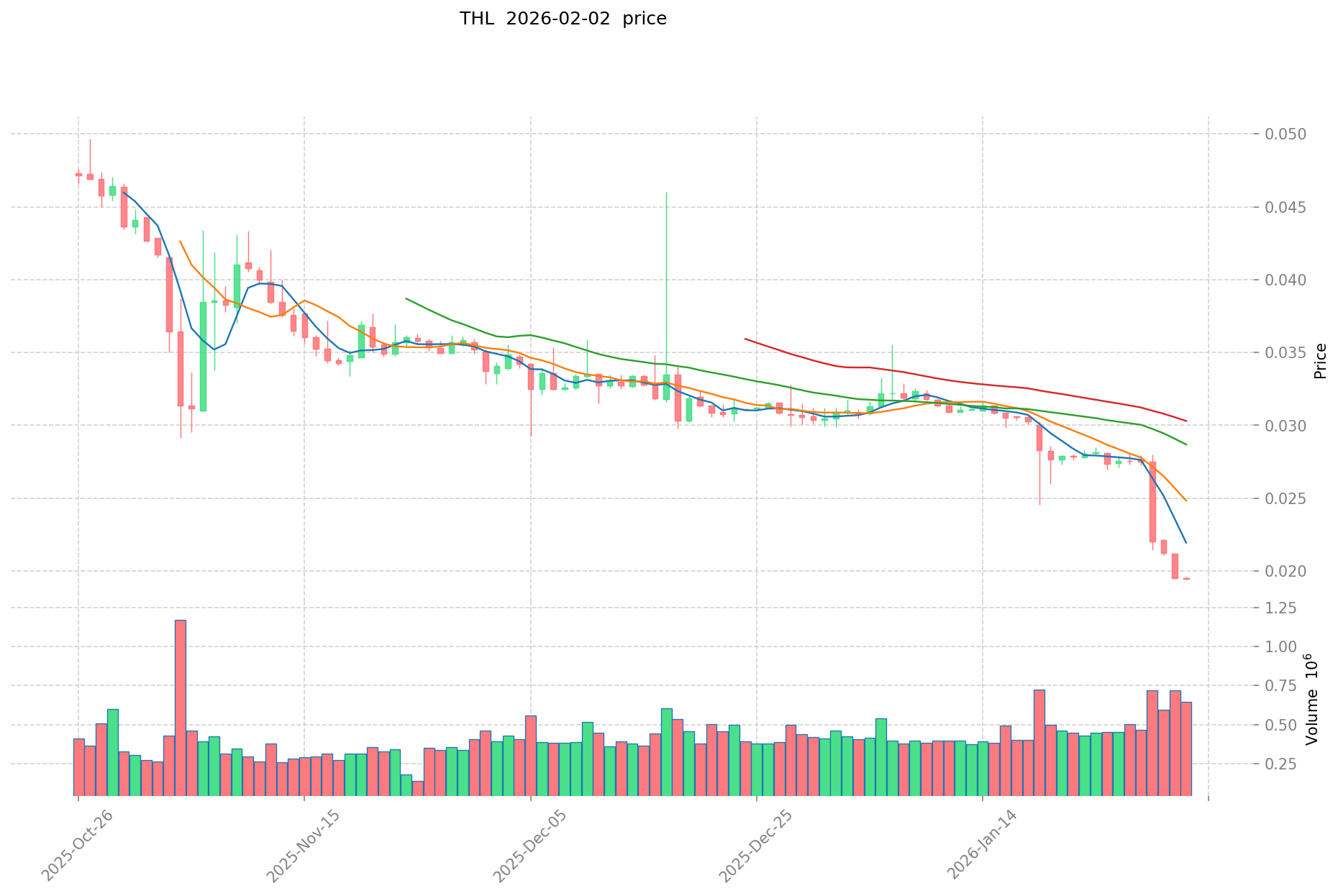
- 2025-2026: Market correction phase → Price declined from elevated levels to $0.05821 as of mid-2025, and further to $0.01872 by February 2026.
Current THL Investment Market Status (February 2026)
- THL current price: $0.01872
- Market sentiment (Fear & Greed Index): Data not available in provided materials.
- 24-hour trading volume: $14,564.37
- Institutional investor holdings: Data not available in provided materials.
Click to view real-time THL market price
II. Core Factors Affecting Whether THL is a Good Investment
Supply Mechanism and Scarcity (THL Investment Scarcity)
- Total and Maximum Supply: THL has a total supply of 100,000,000 tokens with a maximum supply cap of 100,000,000 tokens. As of February 3, 2026, the circulating supply is 63,475,463.28 THL, representing approximately 63.48% of the total supply.
- Price Volatility and Supply Impact: THL's price has experienced significant fluctuations, with a historical high of $3.3333 on March 20, 2024, and a historical low of $0.01852 on February 2, 2026. The current price stands at $0.01872, reflecting a decline of over 99% from its peak.
- Investment Significance: The relatively high circulating supply ratio and fixed maximum supply could contribute to scarcity dynamics as adoption increases, though current market conditions show substantial price depreciation from historical levels.
Institutional Investment and Mainstream Adoption (Institutional Investment in THL)
- Funding Background: Thala raised $6 million from leading venture capital firms to support the development of the Aptos DeFi ecosystem, indicating initial institutional confidence in the project.
- Holder Base: As of the latest data, THL has 42,620 holders, suggesting a growing but still relatively modest user base compared to more established crypto assets.
- Ecosystem Positioning: THL serves as the governance token for the Thala DeFi platform on Aptos, which offers integrated products including an overcollateralized stablecoin, AMM, dual-token LSD, and token launchpad. The token can be locked into veTHL for voting on protocol updates and participation in launchpad activities.
Macroeconomic Environment Impact on THL Investment
- Market Performance Context: THL has shown negative performance across multiple timeframes, with declines of 4.45% over 24 hours, 32.35% over 7 days, 39.14% over 30 days, and 91.93% over 1 year as of February 3, 2026.
- Market Capitalization: With a market cap of $1,188,260.67 and a fully diluted valuation of $1,872,000, THL represents 0.000067% of the total crypto market, indicating its position as a smaller-cap asset subject to higher volatility.
- Trading Activity: The 24-hour trading volume of $14,564.37 reflects relatively limited liquidity compared to major cryptocurrencies, which may amplify price movements during periods of market stress or uncertainty.
Technology and Ecosystem Development (Technology & Ecosystem for THL Investment)
- Platform Integration: Thala operates as a DeFi Hyper App and Liquidity Engine on the Aptos blockchain, offering four vertically integrated products that aim to create a comprehensive DeFi ecosystem.
- Governance Mechanism: THL token holders can participate in protocol governance by locking tokens into veTHL, enabling voting on protocol updates and providing utility beyond simple speculation.
- Aptos Ecosystem Role: As a key component of the Aptos DeFi landscape, THL's value proposition is tied to the growth and adoption of the Aptos blockchain infrastructure and its ability to attract users and liquidity to its integrated platform offerings.
III. THL Future Investment Prediction and Price Outlook (Is Thala(THL) worth investing in 2026-2030)
Short-term Investment Prediction (2026, short-term THL investment outlook)
- Conservative prediction: $0.0163 - $0.0187
- Neutral prediction: $0.0187 - $0.0223
- Optimistic prediction: $0.0223 - $0.0260
Mid-term Investment Outlook (2027-2028, mid-term Thala(THL) investment forecast)
-
Market stage expectation: The token may experience moderate volatility as the DeFi ecosystem on Aptos continues to develop. Market sentiment could be influenced by broader cryptocurrency trends and the adoption rate of Thala's integrated DeFi products.
-
Investment return prediction:
- 2027: $0.0130 - $0.0230
- 2028: $0.0129 - $0.0295
-
Key catalysts: Expansion of Thala's DeFi ecosystem, increased liquidity provision, governance token utility enhancement, and broader Aptos network adoption.
Long-term Investment Outlook (Is THL a good long-term investment?)
- Base scenario: $0.0194 - $0.0281 (assuming steady ecosystem development and moderate market conditions)
- Optimistic scenario: $0.0281 - $0.0351 (assuming increased DeFi adoption and favorable market environment)
- Risk scenario: $0.0129 - $0.0163 (under adverse market conditions or reduced platform activity)
View THL long-term investment and price prediction: Price Prediction
2026-02-03 - 2031 Long-term Outlook
- Base scenario: $0.0194 - $0.0281 (corresponding to steady progress and gradual mainstream application enhancement)
- Optimistic scenario: $0.0238 - $0.0351 (corresponding to large-scale adoption and favorable market environment)
- Transformative scenario: Above $0.0351 (if the ecosystem achieves breakthrough progress and mainstream popularization)
- 2031-12-31 predicted high: $0.0351 (based on optimistic development assumptions)
Disclaimer: Price predictions are based on historical data analysis and current market trends. Cryptocurrency investments carry substantial risk, and past performance does not guarantee future results. This analysis does not constitute investment advice.
| Year |
Predicted High Price |
Predicted Average Price |
Predicted Low Price |
Price Change |
| 2026 |
0.0260208 |
0.01872 |
0.0162864 |
0 |
| 2027 |
0.023041512 |
0.0223704 |
0.012974832 |
19 |
| 2028 |
0.0295177428 |
0.022705956 |
0.01294239492 |
21 |
| 2029 |
0.03002862681 |
0.0261118494 |
0.019061650062 |
39 |
| 2030 |
0.02947375001025 |
0.028070238105 |
0.01936846429245 |
49 |
| 2031 |
0.035101832750302 |
0.028771994057625 |
0.023880755067828 |
53 |
IV. THL Investment Strategy and Risk Management (How to invest in DeFi tokens)
Investment Methodology (THL investment strategy)
-
Long-term Holding (HODL THL): Suitable for conservative investors who believe in the long-term development of the Aptos DeFi ecosystem and Thala's multi-product integration model. Investors may consider accumulating THL during market downturns and holding through market cycles.
-
Active Trading: Relies on technical analysis and swing trading strategies. Given THL's historical price volatility (ranging from $0.01852 to $3.3333), traders may capitalize on short-term price movements by monitoring key support and resistance levels, trading volume patterns, and broader market sentiment.
Risk Management (Risk management for THL investment)
-
Asset Allocation Ratio:
- Conservative investors: Allocate 1-3% of total crypto portfolio to THL
- Aggressive investors: May allocate 5-10% with active position management
- Professional investors: Can consider larger allocations with hedging strategies and risk controls
-
Risk Hedging Solutions: Implement multi-asset portfolio diversification by combining THL with established cryptocurrencies and stablecoins. Consider using stop-loss orders and position sizing strategies to manage downside risk.
-
Secure Storage: Utilize cold wallets for long-term holdings and hot wallets for active trading positions. Hardware wallets from reputable manufacturers are recommended for storing significant THL holdings.
V. THL Investment Risks and Challenges (Risks of investing in DeFi tokens)
-
Market Risk: THL has demonstrated significant price volatility, with a 91.93% decline over one year and a 32.35% decrease over seven days as of February 3, 2026. The token's relatively low market capitalization of approximately $1.19 million increases susceptibility to price fluctuations and potential market manipulation.
-
Regulatory Risk: As a DeFi governance token operating within the Aptos ecosystem, THL faces uncertainty regarding evolving cryptocurrency regulations across different jurisdictions. Changes in regulatory frameworks could impact the token's utility, trading availability, and overall project operations.
-
Technical Risk: The project's reliance on the Aptos blockchain infrastructure introduces dependency risks. Potential smart contract vulnerabilities, protocol upgrade complications, or broader Aptos network issues could affect THL's functionality and value proposition.
-
Liquidity Risk: With a 24-hour trading volume of approximately $14,564 and listing on only 3 exchanges, THL exhibits limited liquidity compared to major cryptocurrencies, which may result in execution difficulties and wider bid-ask spreads during periods of market stress.
VI. Conclusion: Is DeFi tokens a Good Investment?
-
Investment Value Summary: THL presents opportunities within the Aptos DeFi ecosystem through its integrated product offerings including an overcollateralized stablecoin, AMM, dual-token LSD, and token launchpad. However, the token has experienced substantial price volatility, declining from its all-time high of $3.3333 in March 2024 to $0.01872 as of February 2026.
-
Investor Recommendations:
✅ Beginners: Consider dollar-cost averaging (DCA) approach with small position sizes and prioritize secure wallet storage. Thoroughly research the Aptos ecosystem and Thala's product suite before investing.
✅ Experienced Investors: May explore swing trading opportunities while maintaining strict risk management protocols and portfolio diversification. Monitor project developments, governance proposals, and ecosystem growth metrics.
✅ Institutional Investors: Could evaluate strategic allocation as part of a broader DeFi sector exposure, with appropriate due diligence on protocol mechanics, team background, and competitive positioning within the Aptos ecosystem.
⚠️ Disclaimer: Cryptocurrency investments carry substantial risk and may result in significant losses. This content is for informational purposes only and does not constitute investment advice. Investors should conduct independent research and consult with qualified financial advisors before making investment decisions.
VII. FAQ
Q1: What is THL and what role does it play in the Thala ecosystem?
THL is the governance token of Thala, a DeFi Hyper App and Liquidity Engine built on the Aptos blockchain. The token serves multiple functions within the ecosystem: it enables governance participation through the veTHL locking mechanism, allowing holders to vote on protocol updates; provides access to launchpad activities for new token offerings; and integrates across four core products—an overcollateralized stablecoin, automated market maker (AMM), dual-token liquid staking derivative (LSD), and token launchpad. With a total supply capped at 100 million tokens and approximately 63.48 million in circulation as of February 2026, THL represents a foundational component of the Aptos DeFi infrastructure.
Q2: How has THL's price performed historically and what is its current market position?
THL has experienced significant price volatility since its launch in April 2023. The token debuted at $0.497951 and reached its all-time high of $3.3333 in March 2024, demonstrating strong initial market interest. However, the price has declined substantially through 2025-2026, dropping to $0.05821 by mid-2025 and further to $0.01872 as of February 3, 2026—representing over 99% depreciation from its peak. Currently, THL maintains a market capitalization of approximately $1.19 million with a 24-hour trading volume of $14,564.37, positioning it as a smaller-cap asset within the cryptocurrency market with 42,620 holders.
Q3: What are the key price predictions for THL in the short-term and long-term?
Short-term projections for 2026 range from conservative estimates of $0.0163-$0.0187 to optimistic scenarios of $0.0223-$0.0260. Mid-term forecasts suggest THL could trade between $0.0130-$0.0230 in 2027 and $0.0129-$0.0295 in 2028, depending on DeFi ecosystem development and broader market conditions. Long-term outlooks through 2031 present three scenarios: a base case of $0.0194-$0.0281 assuming steady progress, an optimistic projection of $0.0281-$0.0351 with increased adoption, and a transformative scenario exceeding $0.0351 if breakthrough ecosystem developments occur. These predictions are based on historical data analysis but carry substantial uncertainty given cryptocurrency market volatility.
Q4: What investment strategies are suitable for different types of THL investors?
For conservative investors, a long-term holding (HODL) strategy with 1-3% portfolio allocation is recommended, focusing on accumulation during market downturns and belief in the Aptos DeFi ecosystem's development. Aggressive investors may allocate 5-10% with active trading strategies, capitalizing on THL's historical volatility through technical analysis and swing trading while monitoring support/resistance levels. Professional investors can consider larger allocations combined with hedging strategies and risk controls. Regardless of approach, implementing multi-asset diversification, using stop-loss orders, and securing holdings through cold wallet storage for long-term positions are essential risk management practices.
Q5: What are the primary risks associated with investing in THL?
THL investment carries multiple significant risks. Market risk is substantial, evidenced by a 91.93% price decline over one year and considerable volatility stemming from its relatively low $1.19 million market capitalization. Liquidity risk exists due to limited trading volume ($14,564 daily) and listings on only 3 exchanges, potentially causing execution difficulties during market stress. Regulatory risk involves uncertainty surrounding evolving DeFi and cryptocurrency regulations across jurisdictions. Technical risk includes dependency on Aptos blockchain infrastructure, potential smart contract vulnerabilities, and protocol upgrade complications. These factors combined make THL a high-risk investment suitable only for investors who can tolerate potential significant losses.
Q6: How does THL's supply mechanism affect its investment potential?
THL has a fixed maximum supply of 100 million tokens with approximately 63.48 million currently in circulation as of February 2026, representing about 63.5% of the total supply. This relatively high circulating supply ratio combined with the fixed cap could theoretically contribute to scarcity dynamics as adoption increases. However, the token's current market performance shows substantial depreciation from historical levels, with the price declining over 99% from its March 2024 peak. The supply mechanism's impact on investment value will largely depend on demand growth through ecosystem adoption, governance participation, and the success of Thala's integrated DeFi products rather than supply constraints alone.
Q7: What role does institutional investment play in THL's market position?
Thala secured $6 million in funding from leading venture capital firms to develop its Aptos DeFi ecosystem, indicating initial institutional confidence in the project's vision and potential. This funding background provides some validation of the platform's technology and team capabilities. However, specific data regarding current institutional holdings is not publicly available in the materials. With 42,620 holders, THL has established a growing but relatively modest user base compared to major cryptocurrencies. The token's institutional appeal may grow as the Aptos ecosystem matures and Thala's integrated products demonstrate sustainable usage and liquidity metrics, though current market capitalization and trading volumes suggest limited institutional participation at present.
Q8: What key factors should investors monitor when evaluating THL's future prospects?
Investors should track several critical indicators: First, monitor the adoption and usage metrics of Thala's four core products (stablecoin, AMM, LSD, and launchpad) as ecosystem growth directly impacts token utility. Second, observe governance participation rates through veTHL locking mechanisms, which signal community engagement. Third, watch broader Aptos blockchain development and network adoption, as THL's success is tied to the underlying infrastructure. Fourth, track liquidity metrics including trading volumes, exchange listings, and total value locked (TVL) in Thala protocols. Fifth, monitor competitive positioning within the DeFi landscape and any strategic partnerships or integrations. Finally, stay informed about regulatory developments affecting DeFi tokens and the Aptos ecosystem specifically.
* The information is not intended to be and does not constitute financial advice or any other recommendation of any sort offered or endorsed by Gate.