Is Tranche Finance (SLICE) a good investment?: A Comprehensive Analysis of Token Utility, Market Performance, and Risk Factors for 2024

Introduction: Tranche Finance (SLICE) Investment Position and Market Prospects
SLICE is a notable asset in the cryptocurrency sector, launched in 2021 as the governance token of Tranche Finance, a decentralized protocol for loan issuance and securitization. The protocol enables the creation of on-chain assets equivalent to collateralized debt obligations (CDOs) from digital assets and loans. As of February 9, 2026, SLICE maintains a market capitalization of approximately $170,988, with a circulating supply of around 17.42 million tokens out of a maximum supply of 20 million tokens. The current trading price stands at approximately $0.009816. With SLICE token holders managing the Tranche platform, vault, and ecosystem, and with liquidity provision capabilities on Uniswap through SLICE-ETH and SLICE-DAI pairs, the token has established its position within the decentralized finance landscape. This article provides a comprehensive analysis of SLICE's investment characteristics, historical price movements, future price considerations, and associated investment risks to serve as a reference for investors evaluating "Is Tranche Finance (SLICE) a good investment?"
I. SLICE Price History Review and Current Investment Value
SLICE Historical Price Performance and Investment Returns (Tranche Finance(SLICE) Investment Performance)
- 2021: SLICE reached a notable price level of $1.79 on March 1, 2021 → Investors experienced significant returns during the early phase of the token launch
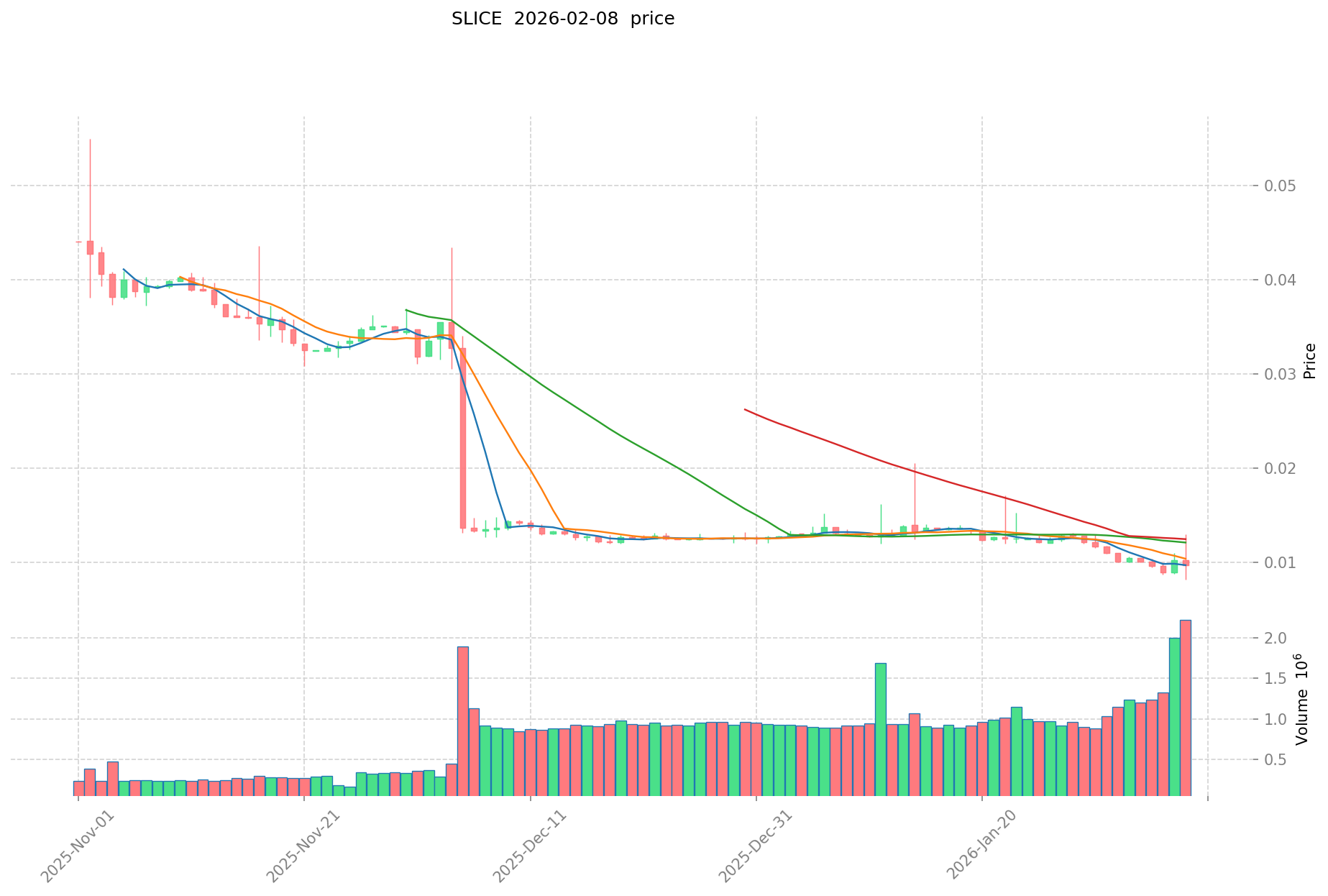
- 2026: Market correction phase → SLICE dropped to $0.00842264 on February 7, 2026, reflecting substantial downward pressure
- Multi-year trend: From early 2021 levels → Price declined to current levels around $0.009816, indicating a prolonged bear market phase for the token
Current SLICE Investment Market Status (February 2026)
- SLICE current price: $0.009816
- 24-hour trading volume: $9,401.61
- Market capitalization: $170,988.27
- Circulating supply: 17,419,343.11 SLICE (87.10% of total supply)
Click to view real-time SLICE market price
II. Core Factors Influencing Whether SLICE is a Good Investment
Supply Mechanism and Scarcity (SLICE Investment Scarcity)
- Fixed Supply Structure → Impact on Price and Investment Value
- Supply Dynamics: SLICE has a maximum supply of 20,000,000 tokens, with approximately 17,419,343 tokens currently in circulation, representing 87.10% of the total supply. The limited supply model creates a relatively constrained token availability environment.
- Investment Implication: The fixed maximum supply provides a degree of scarcity that may support long-term value retention, though this alone does not guarantee price appreciation.
Market Performance and Technical Indicators
- Price Movement Analysis: As of February 9, 2026, SLICE is trading at $0.009816, with 24-hour trading volume of $9,401.61. The token has experienced price volatility, with a 24-hour high of $0.01023 and low of $0.009208.
- Technical Outlook: Multiple technical quantitative indicators suggest a neutral forecast for 2026, with projected price around $0.009542. Some technical analysis platforms indicate a "Strong Sell" signal based on moving averages and other indicators.
- Historical Context: SLICE has demonstrated significant price fluctuations, with performance showing declines of 5.34% over 7 days, 23.97% over 30 days, and 65.19% over the past year.
Market Capitalization and Liquidity Considerations
- Market Position: SLICE maintains a relatively modest market capitalization of approximately $170,988, representing 0.0000077% of the total crypto market. The token ranks #4,136 in overall market positioning.
- Liquidity Environment: With 24-hour trading volume of $9,401.61, SLICE presents limited trading liquidity compared to major digital assets. The token is available on 1 exchange, which may constrain trading accessibility.
- Holder Distribution: The project has approximately 3,849 token holders, indicating a relatively concentrated holding pattern.
Technology and Ecosystem Development (Technology & Ecosystem for SLICE Investment)
- Protocol Functionality: Tranche operates as a decentralized protocol for loan issuance and securitization, enabling the creation of on-chain assets equivalent to collateralized debt obligations (CDOs) from digital assets and loans.
- Token Utility: SLICE token holders have governance rights over the Tranche platform, vault, and ecosystem. The token mechanism aims to align incentives among token holders, development teams, community members, and platform users including borrowers, lenders, and third parties.
- Liquidity Provision: SLICE token holders can provide liquidity for trading pairs on decentralized exchanges, specifically SLICE-ETH and SLICE-DAI pairs on Uniswap.
III. SLICE Future Investment Forecast and Price Outlook (Is Tranche Finance(SLICE) worth investing in 2026-2031)
Short-term Investment Forecast (2026, short-term SLICE investment outlook)
- Conservative estimate: $0.00766 - $0.00982
- Neutral estimate: $0.00982 - $0.01143
- Optimistic estimate: $0.01143 - $0.01306
Mid-term Investment Outlook (2027-2028, mid-term Tranche Finance(SLICE) investment forecast)
- Market phase expectation: SLICE may experience gradual price expansion during 2027-2028, with potential fluctuations reflecting broader DeFi market sentiment and adoption trends in decentralized lending protocols.
- Investment return forecast:
- 2027: $0.00595 - $0.01544
- 2028: $0.01169 - $0.01586
- Key catalysts: Protocol upgrades in decentralized loan issuance infrastructure, potential integration with major DeFi platforms, expansion of liquidity pools on Uniswap (SLICE-ETH and SLICE-DAI pairs), and broader market recovery in the DeFi sector.
Long-term Investment Outlook (Is SLICE a good long-term investment?)
- Baseline scenario: $0.00951 - $0.01611 (assuming steady protocol development and maintained liquidity provision)
- Optimistic scenario: $0.01816 - $0.02684 (assuming increased adoption of on-chain CDO-equivalent products and ecosystem expansion)
- Risk scenario: $0.00595 - $0.00864 (under conditions of limited protocol usage, reduced liquidity, or unfavorable regulatory developments affecting DeFi lending platforms)
Click to view SLICE long-term investment and price prediction: Price Prediction
2026-02-09 - 2031 Long-term Outlook
- Baseline scenario: $0.00951 - $0.01611 USD (corresponding to steady progress and gradual mainstream application growth)
- Optimistic scenario: $0.01816 - $0.02684 USD (corresponding to large-scale adoption and favorable market conditions)
- Transformative scenario: Above $0.02684 USD (if ecosystem achieves breakthrough developments and mainstream penetration)
- 2031-12-31 predicted high: $0.02684 USD (based on optimistic development assumptions)
Disclaimer: The above price forecasts are based on historical data, technical analysis, and market trend modeling. Cryptocurrency markets are highly volatile and subject to regulatory, technological, and macroeconomic uncertainties. These projections do not constitute financial advice, and actual outcomes may differ materially. Investors should conduct independent research and consider their risk tolerance before making investment decisions.
| Year | Predicted High Price | Predicted Average Price | Predicted Low Price | Price Change |
|---|---|---|---|---|
| 2026 | 0.01305528 | 0.009816 | 0.00765648 | 0 |
| 2027 | 0.015438114 | 0.01143564 | 0.0059465328 | 16 |
| 2028 | 0.01585551486 | 0.013436877 | 0.01169008299 | 36 |
| 2029 | 0.017575435116 | 0.01464619593 | 0.0086412555987 | 49 |
| 2030 | 0.02336068250835 | 0.016110815523 | 0.00950538115857 | 64 |
| 2031 | 0.026840618661318 | 0.019735749015675 | 0.018156889094421 | 101 |
IV. SLICE Investment Strategy and Risk Management (How to invest in Tranche Finance)
Investment Strategy (SLICE investment strategy)
-
Long-term Holding (HODL SLICE): Suitable for conservative investors who believe in the protocol's potential for decentralized loan issuance and securitization. Given the significant price decline of approximately 65.19% over the past year and current trading near historical lows, long-term holders should carefully evaluate the project's fundamentals and development trajectory.
-
Active Trading: Relies on technical analysis and swing trading strategies. With recent 24-hour volatility showing a 4.4% increase and a trading range between $0.009208 and $0.01023, short-term traders may identify opportunities in price fluctuations. However, the relatively low 24-hour trading volume of approximately $9,401 suggests limited liquidity, which may impact execution.
Risk Management (Risk management for SLICE investment)
-
Asset Allocation Ratio:
- Conservative investors: Consider limiting exposure to 1-3% of portfolio
- Moderate investors: May allocate 3-5% depending on risk tolerance
- Experienced investors: Could allocate 5-10% with active monitoring
-
Risk Hedging Solutions: Diversified portfolio approach combining multiple digital assets, stablecoins, and traditional hedging instruments to mitigate concentration risk.
-
Secure Storage:
- Cold wallets for long-term holdings
- Hot wallets for active trading with minimal balances
- Hardware wallet recommendations for enhanced security
V. SLICE Investment Risks and Challenges (Risks of investing in Tranche Finance)
-
Market Risk: The token has experienced substantial volatility, with a 30-day decline of 23.97% and a one-year decline of 65.19%. The market capitalization of approximately $170,988 and limited exchange availability (1 exchange) indicate relatively low liquidity, which may amplify price swings.
-
Regulatory Risk: Decentralized lending and securitization protocols may face evolving regulatory scrutiny across different jurisdictions. Policy uncertainty regarding DeFi protocols could impact the project's operational framework and token utility.
-
Technical Risk: As a decentralized protocol dealing with loan issuance and on-chain CDO equivalents, smart contract vulnerabilities, network security concerns, and potential upgrade challenges represent ongoing technical considerations. The protocol's governance model through SLICE token holders introduces additional coordination complexity.
-
Project-Specific Risk: The transition from Jibrel Network Token (JNT) to SLICE represents a significant transformation. The protocol's ability to attract borrowers, lenders, and liquidity providers on platforms like Uniswap remains critical for sustained adoption.
VI. Conclusion: Is Tranche Finance a Good Investment?
-
Investment Value Summary: SLICE presents an innovative approach to decentralized loan securitization and CDO creation on blockchain. However, the token has faced considerable price pressure, declining significantly from its historical high of $1.79 in March 2021 to current levels near $0.0098. The protocol's success depends on adoption of its lending and securitization features.
-
Investor Recommendations:
- ✅ Beginners: Consider dollar-cost averaging with small allocations and prioritize secure wallet storage. Thoroughly research the protocol's mechanics and governance structure before investing.
- ✅ Experienced Investors: May explore swing trading opportunities within established risk parameters and maintain diversified portfolio positioning.
- ✅ Institutional Investors: Evaluate the protocol's differentiation in the DeFi lending space and assess long-term strategic alignment with decentralized finance exposure.
⚠️ Disclaimer: Cryptocurrency investments carry substantial risk. This content is for informational purposes only and does not constitute investment advice. Conduct thorough due diligence and consider consulting financial professionals before making investment decisions.
VII. FAQ
Q1: What is the current market position of Tranche Finance (SLICE) and its trading accessibility?
SLICE currently ranks #4,136 in the cryptocurrency market with a modest market capitalization of approximately $170,988 as of February 9, 2026. The token is available on 1 exchange with a 24-hour trading volume of $9,401.61, indicating relatively limited liquidity compared to major digital assets. The circulating supply stands at approximately 17.42 million tokens (87.10% of the maximum supply of 20 million), with around 3,849 token holders. This concentrated holding pattern and limited exchange availability may impact trading accessibility and price volatility for investors.
Q2: How has SLICE performed historically, and what are the key price milestones?
SLICE reached its historical high of $1.79 on March 1, 2021, during the early phase of token launch, providing significant returns to early investors. However, the token has experienced substantial downward pressure, declining approximately 65.19% over the past year and dropping to $0.00842264 on February 7, 2026. As of February 9, 2026, SLICE trades at approximately $0.009816, representing a prolonged bear market phase. Recent performance shows declines of 5.34% over 7 days and 23.97% over 30 days, indicating continued price pressure.
Q3: What are the core utility and governance functions of the SLICE token?
SLICE serves as the governance token for Tranche Finance, a decentralized protocol for loan issuance and securitization. Token holders exercise governance rights over the Tranche platform, vault, and ecosystem, enabling them to influence protocol decisions and development direction. Additionally, SLICE holders can provide liquidity for trading pairs on decentralized exchanges, specifically SLICE-ETH and SLICE-DAI pairs on Uniswap. The token mechanism aims to align incentives among stakeholders including development teams, community members, borrowers, lenders, and third parties within the platform ecosystem.
Q4: What is the price forecast for SLICE in the short-term (2026) and mid-term (2027-2028)?
For 2026, technical quantitative indicators suggest a neutral forecast with projected price around $0.009542. Conservative estimates range from $0.00766 to $0.00982, while optimistic scenarios project $0.01143 to $0.01306. For the mid-term period, 2027 forecasts range from $0.00595 to $0.01544, and 2028 projections extend from $0.01169 to $0.01586. These forecasts assume gradual price expansion reflecting broader DeFi market sentiment, potential protocol upgrades in decentralized loan issuance infrastructure, and expansion of liquidity pools on Uniswap.
Q5: What are the primary risks associated with investing in SLICE?
SLICE investment carries multiple risk categories: Market Risk includes substantial volatility (30-day decline of 23.97%, one-year decline of 65.19%) and limited liquidity due to low market capitalization and single exchange availability. Regulatory Risk involves potential scrutiny of DeFi lending and securitization protocols across different jurisdictions. Technical Risk encompasses smart contract vulnerabilities, network security concerns, and governance coordination complexity. Project-Specific Risk includes the protocol's dependence on attracting borrowers, lenders, and liquidity providers, as well as the historical transition from Jibrel Network Token (JNT) to SLICE representing significant transformation challenges.
Q6: What investment strategies are recommended for different investor profiles?
Conservative investors should consider limiting SLICE exposure to 1-3% of portfolio through long-term holding (HODL) strategy, focusing on the protocol's fundamentals and development trajectory. Moderate investors may allocate 3-5% depending on risk tolerance, while experienced investors could allocate 5-10% with active monitoring. For active trading, investors should utilize technical analysis and swing trading strategies, though the relatively low 24-hour trading volume of approximately $9,401 suggests limited liquidity that may impact execution. Secure storage recommendations include cold wallets for long-term holdings, hot wallets with minimal balances for active trading, and hardware wallets for enhanced security.
Q7: What factors could drive SLICE price appreciation in the long term (2029-2031)?
Long-term price appreciation depends on several key catalysts: increased adoption of on-chain CDO-equivalent products and decentralized loan securitization services, successful protocol upgrades and integration with major DeFi platforms, expansion of liquidity provision on Uniswap and other decentralized exchanges, broader market recovery in the DeFi lending sector, and mainstream penetration of decentralized finance applications. The optimistic scenario for 2031 projects a high of $0.02684, assuming breakthrough developments in ecosystem growth, while the baseline scenario ranges from $0.00951 to $0.01611 under conditions of steady protocol development and maintained liquidity.
Q8: How does SLICE's fixed supply mechanism impact its investment value proposition?
SLICE operates with a fixed maximum supply of 20,000,000 tokens, creating a relatively constrained token availability environment. With approximately 17,419,343 tokens currently in circulation (87.10% of total supply), the limited supply model provides a degree of scarcity that may support long-term value retention. However, scarcity alone does not guarantee price appreciation, as investment value ultimately depends on protocol adoption, utility demand, market sentiment, and competitive positioning within the DeFi lending and securitization landscape. Investors should evaluate supply dynamics alongside fundamental project development and market conditions.
Share
Content
Introduction: Tranche Finance (SLICE) Investment Position and Market Prospects
I. SLICE Price History Review and Current Investment Value
II. Core Factors Influencing Whether SLICE is a Good Investment
III. SLICE Future Investment Forecast and Price Outlook (Is Tranche Finance(SLICE) worth investing in 2026-2031)
IV. SLICE Investment Strategy and Risk Management (How to invest in Tranche Finance)
V. SLICE Investment Risks and Challenges (Risks of investing in Tranche Finance)
VI. Conclusion: Is Tranche Finance a Good Investment?
VII. FAQ
How to Buy Cryptocurrency


Trending Cryptocurrencies



2025 SUI coin: price, buying guide, and Staking rewards
How to Buy Crypto: A Step-by-Step Guide with Gate.com

HNT Price in 2025: Helium Network Token Value and Market Analysis

What is SwissCheese (SWCH) and How Does It Democratize Investment?
Cardano (ADA) Price Analysis and Outlook for 2025

How to Invest in Metaverse Crypto

Is OptionRoom Token (ROOM) a good investment?: A Comprehensive Analysis of Market Performance, Risk Factors, and Future Potential

Is Puffverse (PFVS) a good investment?: A Comprehensive Analysis of Market Potential, Risk Factors, and Long-Term Viability in the Gaming and Metaverse Sector

Is LEGION (LEGION) a good investment? A Comprehensive Analysis of Market Potential, Risks, and Future Prospects

Ultimate Guide to Value Investing: Sian Hong's Stock Portfolio Strategy

What is Distributed Ledger Technology