Vtrading (VT) is an AI-driven quantitative trading platform token launched in 2024, currently trading at $0.0015071 with a market capitalization of $316,491 as of February 2026. This comprehensive analysis evaluates VT's investment potential by examining its comprehensive ecosystem, which includes strategy marketplace, automated trading capabilities, and asset management systems designed to serve diverse trader needs. The article assesses historical price trends, demonstrates VT's significant volatility with an 82.91% year-over-year decline, and provides price forecasts ranging from $0.001042 to $0.004785 through 2031 depending on market conditions. Key investment considerations include the token's supply structure with a 1 billion cap, relatively low trading volume of $21,684, and holder base of 287 addresses indicating early-stage market presence. The analysis outlines investment strategies for different investor profiles, emphasizing asset allocation ratios and risk management approaches while highlighting
Introduction: Vtrading (VT) Investment Position and Market Prospects
VT is a digital asset in the cryptocurrency field, having been launched in 2024 to serve the AI-driven quantitative trading sector. As of February 2026, VT maintains a market capitalization of approximately $316,491, with a circulating supply of 210,000,000 tokens, and a current price around $0.0015071. Positioned as an AI quantitative trading platform token, VT has gradually become a focal point for investors discussing "Is Vtrading (VT) a good investment?" The Vtrading ecosystem encompasses a strategy marketplace, automated trading capabilities, asset management systems, embedded systems, and private custom deployments, aiming to address diverse trading requirements. This article will comprehensively analyze VT's investment value, historical trends, future price predictions, and investment risks to provide reference for investors.
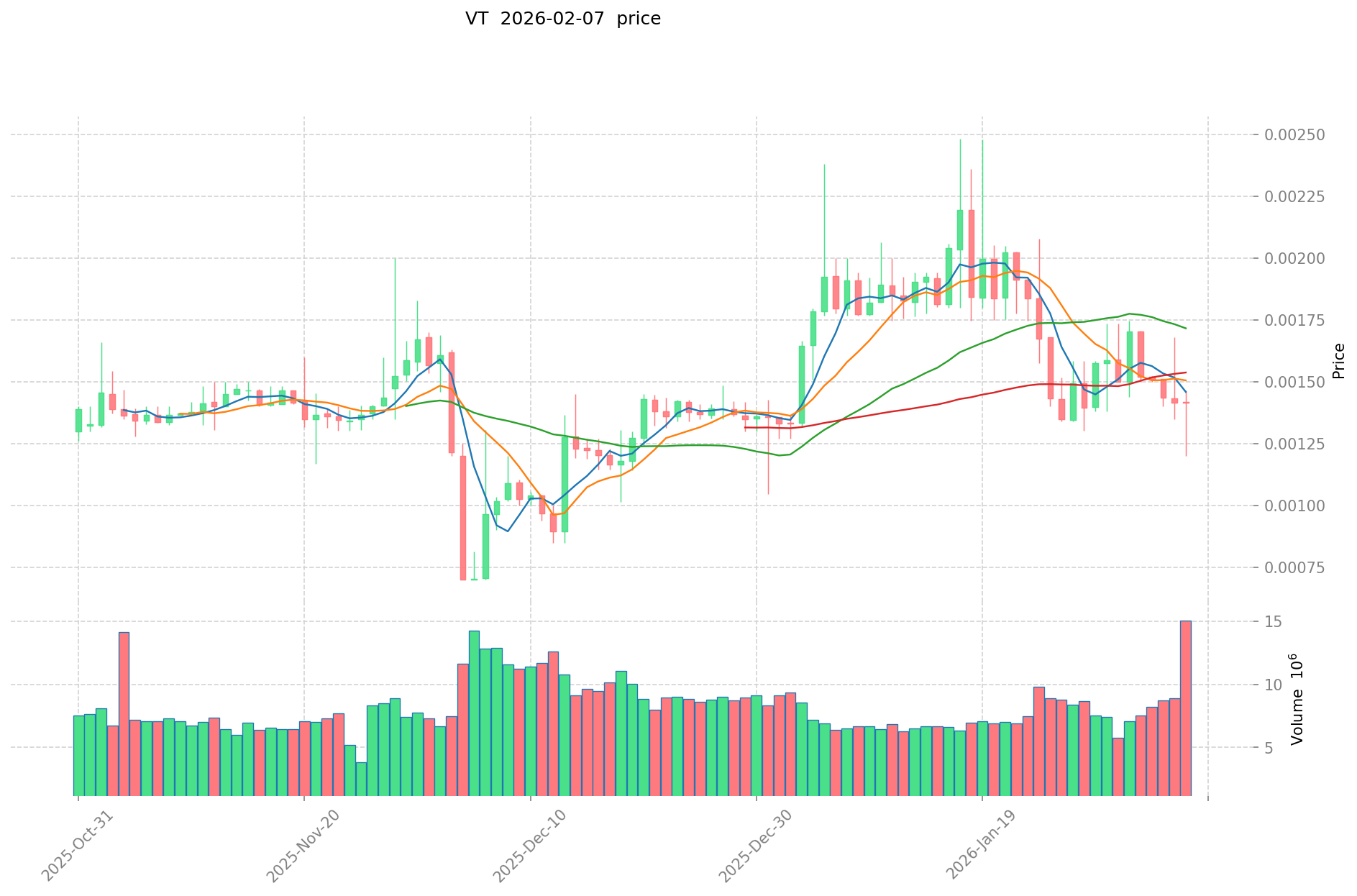
I. VT Price History Review and Current Investment Value Status
- 2024: On May 28, VT reached a price milestone → price fluctuations occurred during this period
- 2025: Market experienced notable volatility → price movement from higher levels toward lower ranges
- Current Cycle: VT has shown substantial price variation since its launch in May 2024
Current VT Investment Market Status (February 2026)
- VT current price: $0.0015071
- 24-hour trading volume: $21,684.34
- Circulating supply: 210,000,000 VT
- Market capitalization: $316,491
- Market share: 0.000060%
- Price changes: +6.67% (24H), +6.43% (1H), -5.029% (7D), -15.47% (30D)
Click to view real-time VT market price
II. Core Factors Affecting Whether VT is a Good Investment
Supply Mechanism and Scarcity (VT Investment Scarcity)
- Maximum supply capped at 1,000,000,000 tokens → influences price dynamics and investment valuation
- Circulating supply represents 21% of total supply (210,000,000 tokens) → current low circulation may affect liquidity considerations
- Historical context: VT has experienced price movement from 0.0007 to higher levels, though current pricing reflects market adjustment from initial launch price of 0.03
- Investment consideration: The token's supply structure, with a defined maximum cap, establishes a framework for potential scarcity dynamics in the long term
- 24-hour trading volume recorded at 21,684.3446827 → indicates active market participation
- Market capitalization stands at 316,491 USD → represents current market valuation scale
- Token listed on exchanges with active trading infrastructure → provides accessibility for market participants
- Holder base of 287 addresses → reflects current community participation level
- AI-driven quantitative trading platform → addresses digital asset trading strategy needs
- Comprehensive ecosystem includes strategy marketplace, automated trading capabilities, and asset management system → supports diverse trading requirements
- ERC20 standard implementation on Ethereum → utilizes established blockchain infrastructure
- Platform designed to serve traders across different experience levels → aims for broad market applicability
Market Positioning and Adoption Factors (Market Positioning for VT Investment)
- Platform focuses on AI-powered quantitative trading services → targets evolving digital asset trading landscape
- Integrated multi-functional trading platform approach → consolidates various trading functionalities
- Educational resources and documentation available → supports user engagement and knowledge development
- Market share at 0.000060% → indicates early-stage market presence within broader cryptocurrency ecosystem
III. VT Future Investment Forecast and Price Outlook (Is Vtrading(VT) worth investing in 2026-2031)
Short-term VT Investment Outlook (2026)
- Conservative forecast: $0.001042 - $0.0015103
- Neutral forecast: $0.0015103 - $0.002235
- Optimistic forecast: $0.002235 and above
Mid-term Vtrading(VT) Investment Forecast (2027-2028)
- Market stage expectation: The market is anticipated to enter a phase of structural adjustment with more balanced risk conditions. As inflation continues to ease and economic growth stabilizes, investors may focus on long-term positioning rather than short-term volatility.
- Investment return forecast:
- 2027: $0.0016855 - $0.0023035
- 2028: $0.0011276 - $0.0027146
- Key catalysts: Stabilizing economic growth, balanced inflation trends, and evolving market structure in emerging and alternative asset classes may influence price movement.
Long-term Investment Outlook (Is VT a good long-term investment?)
- Base scenario: $0.001794 - $0.004196 (assuming steady adoption and favorable market conditions through 2030)
- Optimistic scenario: $0.003119 - $0.004785 (assuming accelerated adoption and strong market leadership through 2031)
- Risk scenario: Below $0.001042 (under extreme adverse conditions or market disruptions)
Click to view VT long-term investment and price forecast: Price Prediction
2026-02-07 - 2031 Long-term Outlook
- Base scenario: $0.001042 - $0.002894 (corresponding to steady progress and gradual mainstream application growth)
- Optimistic scenario: $0.003545 - $0.004785 (corresponding to large-scale adoption and favorable market environment)
- Transformative scenario: Above $0.004785 (if ecosystem achieves breakthrough progress and mainstream popularity)
- 2031-12-31 predicted high: $0.004785 (based on optimistic development assumptions)
Disclaimer: The above forecasts are based on historical data, market analysis, and modeling assumptions. Actual prices may differ significantly due to market volatility, regulatory changes, technological developments, and other unforeseen factors. This content is for informational purposes only and should not be construed as investment advice. Investors should conduct independent research and consider their risk tolerance before making investment decisions.
| Year |
Predicted High Price |
Predicted Average Price |
Predicted Low Price |
Price Change |
| 2026 |
0.002235244 |
0.0015103 |
0.001042107 |
0 |
| 2027 |
0.00230350956 |
0.001872772 |
0.0016854948 |
24 |
| 2028 |
0.002714583014 |
0.00208814078 |
0.0011275960212 |
38 |
| 2029 |
0.00338592027477 |
0.002401361897 |
0.00156088523305 |
59 |
| 2030 |
0.004195779574533 |
0.002893641085885 |
0.001794057473248 |
92 |
| 2031 |
0.004785358945782 |
0.003544710330209 |
0.003119345090584 |
135 |
IV. Vtrading Investment Strategy and Risk Management (How to invest in Vtrading)
Investment Strategy (Vtrading investment strategy)
Long-term Holding (HODL Vtrading)
For conservative investors seeking steady exposure to AI-driven quantitative trading platforms, a long-term holding approach may be considered. This strategy involves purchasing VT tokens and maintaining positions through market cycles, focusing on the project's fundamental development rather than short-term price movements. Given Vtrading's positioning as a comprehensive AI quantitative trading ecosystem with multiple functionalities including strategy marketplace, automated trading, and asset management systems, long-term holders would benefit from the platform's growth as it attracts more traders and expands its user base.
Active Trading
Active traders may employ technical analysis and swing trading strategies when engaging with VT tokens. This approach involves analyzing price patterns, volume trends, and market momentum indicators to identify entry and exit points. With the token showing a 24-hour price change of approximately 6.67% and demonstrable volatility (24-hour high of $0.0015174 and low of $0.0012), active traders can potentially capitalize on intraday price movements. However, this strategy requires continuous market monitoring and a solid understanding of technical analysis principles.
Risk Management (Risk management for Vtrading investment)
Asset Allocation Ratio
- Conservative Investors: May consider allocating 1-3% of their crypto portfolio to VT tokens, maintaining a diversified approach across multiple established assets
- Aggressive Investors: Could allocate 5-10% of their crypto portfolio, accepting higher risk for potential returns tied to the AI quantitative trading sector
- Professional Investors: May customize allocation based on comprehensive due diligence, market conditions, and portfolio objectives, potentially ranging from 3-15% depending on conviction levels
Risk Hedging Solutions
Implementing a multi-asset portfolio strategy can help mitigate concentration risk. Investors should consider diversifying across different crypto categories, including established cryptocurrencies, DeFi tokens, and other AI-related projects. Additionally, utilizing hedging instruments such as stablecoins for liquidity management and strategic rebalancing can help manage downside exposure during market downturns.
Secure Storage
Cold and Hot Wallet Management: For VT token storage, investors should implement a tiered security approach:
- Hot Wallets: Suitable for active trading amounts, providing quick access for transactions on exchanges or trading platforms
- Cold Wallets: Recommended for long-term holdings, keeping the majority of tokens offline to minimize security risks
- Hardware Wallet Recommendations: Given that VT operates on the ERC20 standard (Ethereum blockchain), hardware wallets supporting Ethereum-based tokens such as Ledger or Trezor devices can provide enhanced security for storing VT tokens offline
Investors should verify the official contract address (0x69cade383df52ec02562869da8aa146be08c5c3c) when adding VT tokens to their wallets to avoid fraudulent tokens.
V. Vtrading Investment Risks and Challenges (Risks of investing in Vtrading)
Market Risks
High Volatility
VT tokens exhibit substantial price volatility, which is evident from the significant price fluctuations across different timeframes. The 24-hour trading range shows a variation of approximately 26.5% between the low and high prices. More notably, the token has experienced a decline of approximately 82.91% over the past year, and approximately 15.47% over the past 30 days. Such volatility can result in rapid and substantial gains or losses, making it challenging for investors to predict short-term price movements accurately.
Price Manipulation Concerns
With a relatively modest 24-hour trading volume of approximately $21,684 and a circulating market cap of around $316,491, VT tokens may be susceptible to price manipulation by large holders or coordinated trading groups. Lower liquidity assets can experience amplified price swings from relatively small trade volumes, potentially creating artificial price movements that do not reflect genuine market demand or project fundamentals.
Regulatory Risks
Policy Uncertainty Across Jurisdictions
The regulatory landscape for AI-driven quantitative trading platforms and cryptocurrency tokens remains uncertain and varies significantly across different countries. Regulatory developments could impact:
- The legal status of algorithmic trading platforms in specific jurisdictions
- Compliance requirements for AI-driven financial services
- Token classification and securities law implications
- Cross-border trading restrictions and licensing requirements
Investors should monitor regulatory developments in their respective jurisdictions and assess how changes in cryptocurrency regulations might affect Vtrading's operations and VT token utility.
Technical Risks
Network Security Vulnerabilities
As an ERC20 token operating on the Ethereum blockchain, VT inherits both the security features and potential vulnerabilities of the Ethereum network. Technical risks include:
- Smart contract vulnerabilities that could be exploited by malicious actors
- Potential bugs in the Vtrading platform's code affecting trading operations
- Cybersecurity threats targeting user accounts and platform infrastructure
- Dependency on Ethereum network performance and potential congestion issues
Upgrade and Implementation Risks
The development and implementation of new features within the Vtrading ecosystem, such as updates to the strategy marketplace, automated trading systems, or embedded systems, carry inherent technical risks. Failed upgrades, compatibility issues, or unexpected technical complications could temporarily or permanently impact platform functionality, potentially affecting token utility and investor confidence.
VI. Conclusion: Is Vtrading a Good Investment?
Investment Value Summary
Vtrading presents itself as an AI-driven quantitative trading platform with multiple integrated features designed to serve diverse trading needs. The project's comprehensive ecosystem, including strategy marketplace, automated trading capabilities, and asset management systems, positions it within the growing intersection of artificial intelligence and cryptocurrency trading. However, the token has demonstrated considerable price volatility, with significant declines over both short-term (30-day) and long-term (1-year) periods. The relatively low market capitalization and trading volume indicate that VT remains a smaller-cap asset with associated liquidity considerations.
Investor Recommendations
✅ Beginners
- Consider a dollar-cost averaging (DCA) approach to mitigate timing risk
- Prioritize secure storage solutions, utilizing hardware wallets for long-term holdings
- Allocate only funds that you can afford to lose entirely
- Conduct thorough research on the Vtrading platform and its use cases before investing
✅ Experienced Investors
- Implement swing trading strategies based on technical analysis if actively managing positions
- Maintain portfolio diversification across multiple crypto categories and risk profiles
- Monitor platform development milestones and user adoption metrics
- Set clear stop-loss levels to manage downside risk
✅ Institutional Investors
- Conduct comprehensive due diligence on the project's technology, team, and competitive positioning
- Consider strategic long-term allocation as part of a broader AI and quantitative trading sector exposure
- Assess regulatory compliance and legal frameworks applicable to your jurisdiction
- Evaluate liquidity constraints and plan entry/exit strategies accordingly
⚠️ Disclaimer
Cryptocurrency investments carry substantial risk, including the potential for complete loss of invested capital. The information presented in this article is for informational purposes only and does not constitute financial advice, investment recommendations, or an endorsement of Vtrading or VT tokens. Market conditions, regulatory environments, and project fundamentals can change rapidly. Investors should conduct their own research, consider their risk tolerance and financial situation, and consult with qualified financial advisors before making investment decisions.
VII. FAQ
Q1: Is Vtrading (VT) a good investment for beginners in 2026?
VT may be considered a high-risk investment opportunity for beginners, requiring careful consideration and proper risk management. As an AI-driven quantitative trading platform token with a current price around $0.0015071 and market capitalization of approximately $316,491, VT presents both opportunities and challenges for new investors. The token has demonstrated significant volatility, with a 24-hour price range showing approximately 26.5% variation and a year-over-year decline of roughly 82.91%. For beginners, it is advisable to allocate only 1-3% of a crypto portfolio to VT tokens, implement a dollar-cost averaging (DCA) strategy to mitigate timing risk, and prioritize secure storage solutions such as hardware wallets. New investors should thoroughly research the Vtrading platform's functionality, including its strategy marketplace, automated trading capabilities, and asset management systems, before making investment decisions. Additionally, beginners should only invest funds they can afford to lose entirely, given the high-risk nature of smaller-cap cryptocurrency assets.
Q2: What is the long-term price prediction for VT tokens through 2031?
Long-term price forecasts for VT tokens suggest a range of potential outcomes depending on market conditions and platform adoption. Under a base scenario assuming steady adoption and favorable market conditions, VT is projected to trade between $0.001794 and $0.004196 through 2030, with the 2031 forecast indicating a potential range of $0.003119 to $0.004785 under optimistic assumptions. The optimistic scenario envisions accelerated adoption and strong market leadership, potentially pushing prices toward the higher end of these ranges. Conversely, a risk scenario suggests prices could fall below $0.001042 under extreme adverse conditions or market disruptions. By 2031, the predicted high price stands at $0.004785, representing a potential price change of approximately 135% from 2026 levels, based on optimistic development assumptions. However, investors should note that these forecasts are based on historical data, market analysis, and modeling assumptions, and actual prices may differ significantly due to market volatility, regulatory changes, technological developments, and other unforeseen factors.
Q3: What are the main risks associated with investing in VT tokens?
VT token investments carry multiple categories of risk that investors should carefully evaluate. Market risks include high volatility, with the token demonstrating substantial price fluctuations such as a 26.5% intraday range and an 82.91% year-over-year decline, as well as price manipulation concerns due to relatively low trading volume ($21,684 in 24 hours) and market capitalization ($316,491). Regulatory risks encompass policy uncertainty across different jurisdictions, potential compliance requirements for AI-driven financial services, token classification implications under securities law, and possible cross-border trading restrictions. Technical risks involve network security vulnerabilities inherent in ERC20 tokens on the Ethereum blockchain, smart contract vulnerabilities that could be exploited, potential bugs in the Vtrading platform's code, cybersecurity threats targeting user accounts, and dependency on Ethereum network performance. Additionally, upgrade and implementation risks related to new feature development could temporarily or permanently impact platform functionality and token utility. Investors should implement comprehensive risk management strategies, including proper asset allocation, diversification, and secure storage practices.
Q4: How does Vtrading's AI-driven quantitative trading platform differentiate itself in the market?
Vtrading positions itself as a comprehensive AI-powered quantitative trading ecosystem with multiple integrated functionalities designed to address diverse trading requirements. The platform's core differentiators include a strategy marketplace that enables traders to access and share trading strategies, automated trading capabilities that execute trades based on predefined algorithms and AI-driven insights, an asset management system for portfolio oversight, embedded systems for seamless integration, and private custom deployment options for institutional or professional users. Operating as an ERC20 token on the Ethereum blockchain, VT serves as the native token within this ecosystem, facilitating transactions and access to platform services. The platform targets traders across different experience levels, from beginners to professional investors, aiming to democratize access to sophisticated quantitative trading tools. With a total supply capped at 1,000,000,000 tokens and a current circulating supply of 210,000,000 (21% of total supply), the token's supply structure establishes a framework for potential scarcity dynamics. However, with a current market share of 0.000060%, Vtrading represents an early-stage presence within the broader cryptocurrency ecosystem, competing in the growing intersection of artificial intelligence and digital asset trading.
Q5: What investment strategies are most suitable for VT token holders?
Two primary investment strategies can be considered for VT token holders, depending on risk tolerance and investment objectives. The long-term holding (HODL) approach is suitable for conservative investors seeking steady exposure to AI-driven quantitative trading platforms, involving the purchase and maintenance of VT tokens through market cycles while focusing on the project's fundamental development rather than short-term price movements. This strategy benefits from the platform's potential growth as it attracts more traders and expands its user base across its comprehensive ecosystem of functionalities. Alternatively, active trading strategies may be employed by investors who utilize technical analysis and swing trading to capitalize on VT's demonstrated volatility, with the token showing a 24-hour price change of approximately 6.67% and notable intraday fluctuations. This approach requires continuous market monitoring, solid technical analysis skills, and the ability to identify entry and exit points based on price patterns, volume trends, and momentum indicators. Regardless of strategy, investors should implement proper asset allocation based on their risk profile: conservative investors may allocate 1-3% of their crypto portfolio to VT, aggressive investors 5-10%, and professional investors 3-15% depending on conviction levels and comprehensive due diligence. Risk hedging through multi-asset portfolio diversification, stablecoin liquidity management, and strategic rebalancing can help manage downside exposure during market downturns.
Q6: What secure storage solutions are recommended for VT tokens?
Proper storage of VT tokens requires a tiered security approach combining both hot and cold wallet solutions based on intended use. For active trading amounts that require quick access for transactions on exchanges or trading platforms, hot wallets provide necessary liquidity and convenience. However, for long-term holdings representing the majority of token positions, cold wallet storage is strongly recommended to minimize security risks by keeping tokens offline and away from potential online threats. Given that VT operates as an ERC20 standard token on the Ethereum blockchain, hardware wallets supporting Ethereum-based tokens, such as Ledger or Trezor devices, offer enhanced security for offline VT token storage. These hardware wallet solutions provide protection against malware, phishing attacks, and unauthorized access while maintaining user control over private keys. When adding VT tokens to any wallet, investors must verify the official contract address (0x69cade383df52ec02562869da8aa146be08c5c3c) to avoid fraudulent tokens that may attempt to impersonate legitimate VT tokens. Additionally, investors should follow best practices including enabling two-factor authentication where available, maintaining secure backups of recovery phrases, avoiding storage of recovery information in digital formats, and regularly updating wallet firmware to patch potential security vulnerabilities.
Q7: How does VT's current market performance compare to its historical trends?
VT's current market performance reflects significant changes from its historical trajectory since the token launch in May 2024. The token reached a price milestone on May 28, 2024, following which the market experienced notable volatility with price movements from higher levels toward lower ranges throughout 2025. As of February 2026, VT trades at approximately $0.0015071, representing a substantial decline from its initial launch price of $0.03, indicating an approximate 95% decrease from launch levels. Recent performance metrics show mixed signals: positive short-term momentum with gains of +6.67% over 24 hours and +6.43% over 1 hour, contrasted against declines of -5.029% over 7 days, -15.47% over 30 days, and approximately -82.91% over the past year. The circulating supply stands at 210,000,000 tokens (21% of the 1,000,000,000 maximum supply), with a current market capitalization of $316,491 and a market share of 0.000060%. The 24-hour trading volume of $21,684.34 indicates active market participation, though the relatively modest volume compared to market cap suggests liquidity considerations. The holder base consists of 287 addresses, reflecting the current scale of community participation. This historical performance pattern demonstrates the high-volatility nature of smaller-cap cryptocurrency assets and underscores the importance of comprehensive risk assessment before investment decisions.
Q8: What factors could drive VT token price appreciation in the medium to long term?
Several key factors could potentially influence VT token price appreciation through the medium and long term. Platform adoption growth represents a primary catalyst, as increased user engagement with Vtrading's strategy marketplace, automated trading capabilities, and asset management systems could drive demand for VT tokens as the native utility token of the ecosystem. Technological advancement and successful implementation of platform upgrades, including enhancements to AI-driven trading algorithms, expanded embedded systems functionality, and successful private custom deployments for institutional clients, could strengthen the platform's competitive positioning. Market structure evolution in the broader cryptocurrency landscape, particularly as AI-powered trading solutions gain mainstream acceptance, may create favorable conditions for specialized platforms like Vtrading. The token's supply mechanism, with a maximum cap of 1,000,000,000 tokens and current circulating supply representing only 21% of total supply, could create scarcity dynamics if demand increases alongside controlled token release. Strategic partnerships and integrations within the digital asset trading ecosystem could expand the platform's reach and utility. Additionally, favorable regulatory clarity for AI-driven financial services and algorithmic trading platforms could reduce uncertainty and attract institutional participation. However, price appreciation is not guaranteed and depends on successful execution of the platform's roadmap, sustained user growth, favorable market conditions, and the ability to differentiate effectively in an increasingly competitive AI and quantitative trading sector.
* The information is not intended to be and does not constitute financial advice or any other recommendation of any sort offered or endorsed by Gate.