This comprehensive analysis examines whether WING is a viable investment by evaluating Wing Finance's decentralized lending platform launched in September 2020. The article covers WING's current market position with a price of $0.06885 and market cap of $376,293.89, despite experiencing a -98.05% annual decline. The analysis explores WING's dual lending mechanisms, governance utility, and token distribution structure while assessing price forecasts through 2031 across conservative, neutral, and optimistic scenarios. Key investment considerations include the token's extreme volatility, limited liquidity on 2 exchanges via Gate, and evolving regulatory risks inherent to DeFi lending platforms. The guide provides tailored investment strategies for beginners, experienced traders, and institutional investors, emphasizing rigorous risk management and portfolio diversification. WING presents potential opportunities in decentralized credit markets but demands careful evaluation of platform competitiveness and technic
Introduction: Wing (WING)'s Investment Position and Market Prospects
Wing (WING) represents a distinctive asset in the cryptocurrency sector, having been launched in September 2020 with a focus on establishing a decentralized lending market based on credit scoring and cross-chain asset interaction. As of February 2026, WING maintains a market capitalization of approximately $376,293.89, with a circulating supply of around 5,465,416 tokens and a current price positioned near $0.06885. Positioned as a governance and utility token within its decentralized finance ecosystem, WING has become a subject of analysis when investors discuss "Is Wing (WING) a good investment?" This article provides a comprehensive examination of WING's investment characteristics, historical price movements, future price considerations, and associated risks to serve as a reference for investors.
The WING token operates within a decentralized lending platform that supports two primary lending mechanisms: over-collateralized lending requiring collateral exceeding 125% of borrowed asset value, and credit score-based lending for users with OScore credentials allowing collateral at 80% or above. The token's utility encompasses governance participation in project development and network parameter adjustments, interest payment discounts on the platform, and insurance contract purchases for collateralized assets. According to the initial network design, 68.50% of WING tokens were allocated for community incentives, distributed across lending pools, borrowing pools, and margin pools to facilitate platform operations and risk management.
As of February 6, 2026, WING is listed on 2 exchanges and has 4,817 token holders, reflecting its presence within the DeFi lending sector. The token exhibits a market dominance of 0.000022%, with a market cap to fully diluted valuation ratio of 54.65%, indicating that approximately 54.65% of the maximum supply of 10,000,000 tokens is currently in circulation. Recent price trends show fluctuations of -2.31% over 1 hour, -15.55% over 24 hours, -20.75% over 7 days, -23.81% over 30 days, and -98.05% over 1 year, demonstrating considerable volatility in market performance. This analysis examines the factors influencing WING's market position and explores considerations relevant to investment evaluation.
I. WING Price History Review and Current Investment Value
- 2020: WING launched in September 2020 with its initial token distribution → Early participants experienced significant price appreciation in the initial months
- 2020: Price experienced notable volatility following launch → WING saw price movements during the DeFi market expansion period
- 2021-2025: Extended market cycles → Price adjusted from earlier levels as the DeFi lending market evolved and faced competitive pressures
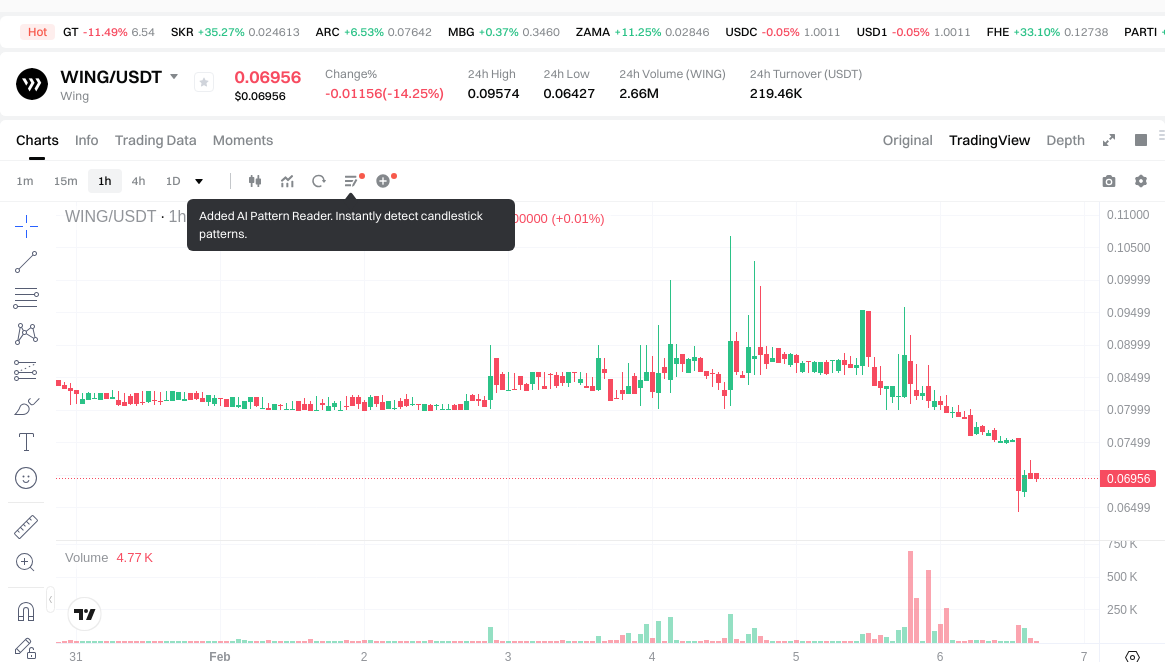
- 2026: Current trading environment → As of February 6, 2026, WING trades at $0.06885 with a 24-hour decline of 15.55%
Current WING Investment Market Status (February 2026)
- WING current price: $0.06885
- Market sentiment: Negative short-term momentum with price declining 15.55% in 24 hours and 20.75% over 7 days
- 24-hour trading volume: $219,352.39
- Market capitalization: $376,293.89 with circulating supply of 5,465,416 WING tokens
- Circulation ratio: 54.65% of maximum supply (10,000,000 WING)
- Holder distribution: 4,817 token holders across the network
Click to view real-time WING market price
II. Core Factors Influencing Whether WING is a Good Investment
Supply Mechanism and Scarcity (WING Investment Scarcity)
- Supply Structure: WING has a maximum supply of 10,000,000 tokens, with a current circulating supply of 5,465,416 tokens (approximately 54.65% of maximum supply). The total supply stands at 7,638,124.87 tokens, indicating a controlled token release mechanism that may influence scarcity dynamics over time.
- Token Distribution: According to the initial network design, 68.50% of WING tokens are allocated for community incentives, distributed across three pools: 50% to the Lending Pool (for asset lenders), 40% to the Borrowing Pool (for borrowers), and 10% to the Margin Pool (for default coverage). This distribution mechanism ties token supply to platform usage and lending activity.
- Investment Implications: The defined maximum supply cap and gradual release schedule create a framework for potential scarcity. However, with over 45% of tokens yet to enter circulation, the supply-side pressure remains a consideration for investment planning.
- Price Movement: As of February 06, 2026, WING trades at $0.06885, showing significant declines across multiple timeframes: -2.31% (1H), -15.55% (24H), -20.75% (7D), -23.81% (30D), and -98.05% (1Y). The 24-hour trading range spans $0.06427 to $0.09574.
- Market Capitalization: WING's market cap stands at $376,293.89, representing a minimal 0.000022% market share. The fully diluted market cap reaches $525,884.90, with a market cap to FDV ratio of 54.65%.
- Historical Context: WING reached its previous peak at $140.81 on September 17, 2020, and recorded its lowest point at $0.06496 on February 06, 2026, reflecting substantial volatility in its trading history.
- Governance Participation: WING token holders can vote on new project developments, network setting modifications, and community fund planning, providing governance rights within the platform ecosystem.
- Economic Benefits: Token holders receive interest payment discounts when borrowing on the platform and can utilize WING when purchasing insurance contracts for collateralized assets.
- Lending Platform Mechanics: The platform supports two lending models—over-collateralized lending (requiring 125%+ collateral) and credit score-based lending (requiring 80%+ collateral for OScore holders, with loan limits ranging from $20-$500, capped at $1,000).
Technology and Ecosystem Development (Technology & Ecosystem for WING Investment)
- Cross-Chain Functionality: Wing Finance is designed as a decentralized lending market supporting cross-chain asset interactions and protocol interoperability, deployed on the Ontology (ONG) blockchain with contract address 00c59fcd27a562d6397883eab1f2fff56e58ef80.
- Credit Scoring Innovation: The platform's OScore credit evaluation system enables under-collateralized lending for qualified users, differentiating it from traditional DeFi lending protocols that require full over-collateralization.
- Risk Management Structure: The Margin Pool mechanism, funded by platform interest and user contributions, provides a safety net for credit loan defaults, with contributors earning WING token rewards for participation.
Market Accessibility and Liquidity
- Exchange Availability: WING is listed on 2 cryptocurrency exchanges, with a 24-hour trading volume of $219,352.39, indicating relatively limited liquidity compared to major digital assets.
- Holder Distribution: The token has 4,817 holders, suggesting a modest but established user base within the DeFi lending space.
- Trading Depth: The combination of low market capitalization and limited exchange listings may present liquidity challenges for larger position entries or exits.
III. WING Future Investment Forecast and Price Outlook (Is Wing (WING) worth investing in 2026-2031)
Short-term Investment Forecast (2026, short-term WING investment outlook)
- Conservative Forecast: $0.0676 - $0.0697
- Neutral Forecast: $0.0697 - $0.0785
- Optimistic Forecast: $0.0785 - $0.0885
Mid-term Investment Outlook (2027-2029, mid-term Wing (WING) investment forecast)
-
Market Stage Expectation: WING is expected to experience gradual recovery and moderate growth during this period. The token may benefit from sustained development of its decentralized lending platform and potential expansion of cross-chain asset support. Market performance will likely depend on broader DeFi sector momentum and platform adoption metrics.
-
Investment Return Forecast:
- 2027: $0.0522 - $0.1124
- 2028: $0.0852 - $0.1426
- 2029: $0.0727 - $0.1478
-
Key Catalysts: Platform user growth, expansion of lending pool assets, implementation of credit scoring mechanisms, cross-chain integration developments, and overall DeFi market conditions.
Long-term Investment Outlook (Is WING a good long-term investment?)
- Base Scenario: $0.0748 - $0.1629 (assuming steady platform development and moderate DeFi sector growth through 2030-2031)
- Optimistic Scenario: $0.1487 - $0.1986 (assuming strong platform adoption, successful credit lending model implementation, and favorable DeFi market conditions)
- Risk Scenario: $0.0676 - $0.0727 (in case of limited platform growth, competitive pressure from established DeFi protocols, or adverse market conditions)
Click to view WING long-term investment and price forecast: Price Prediction
2026-02-06 - 2031 Long-term Outlook
- Base Scenario: $0.0697 - $0.1335 (corresponding to steady progress and gradual mainstream application improvement)
- Optimistic Scenario: $0.1191 - $0.1986 (corresponding to large-scale adoption and favorable market environment)
- Transformative Scenario: above $0.1986 (in case of breakthrough ecosystem developments and mainstream popularization)
- 2031-12-31 Forecast High: $0.1986 (based on optimistic development assumptions)
Disclaimer: Price forecasts are based on historical data analysis and market trend modeling. Cryptocurrency investments carry significant risks, and actual performance may differ materially from projections. This analysis does not constitute investment advice, and investors should conduct independent research and assess their risk tolerance before making investment decisions.
| Year |
Predicted High Price |
Predicted Average Price |
Predicted Low Price |
Price Change |
| 2026 |
0.0885317 |
0.06971 |
0.0676187 |
0 |
| 2027 |
0.112351607 |
0.07912085 |
0.052219761 |
13 |
| 2028 |
0.142646980465 |
0.0957362285 |
0.085205243365 |
37 |
| 2029 |
0.1477975895583 |
0.1191916044825 |
0.072706878734325 |
71 |
| 2030 |
0.162863408364888 |
0.1334945970204 |
0.074756974331424 |
91 |
| 2031 |
0.198559863608142 |
0.148179002692644 |
0.106688881938703 |
112 |
IV. WING Investment Strategy and Risk Management (How to invest in DeFi lending tokens)
Investment Methodology (WING investment strategy)
-
Long-term holding (HODL WING): Suitable for conservative investors
For investors who believe in the long-term development potential of decentralized lending markets, holding WING tokens may be considered as part of a diversified portfolio. This approach typically involves less frequent trading and focuses on the fundamental value proposition of the Wing Finance platform, including its credit scoring mechanism and cross-chain asset support.
-
Active trading: Relying on technical analysis and swing trading
Given WING's price volatility (with 24-hour changes of -15.55% and 7-day changes of -20.75%), active traders may seek to capitalize on short-term price movements. This strategy requires continuous market monitoring, technical analysis skills, and understanding of market sentiment indicators.
Risk Management (Risk management for WING investment)
-
Asset allocation ratio: Conservative / Aggressive / Professional investors
- Conservative investors: May consider allocating no more than 1-3% of their crypto portfolio to WING, given its relatively low market capitalization ($376,293.89) and high volatility.
- Aggressive investors: Could allocate 5-10% depending on risk tolerance and market outlook for DeFi lending protocols.
- Professional investors: May use sophisticated risk models and allocate based on correlation analysis with other DeFi assets and broader market conditions.
-
Risk hedging solutions: Multi-asset portfolio + hedging tools
Diversification across different crypto categories (Layer 1 tokens, stablecoins, other DeFi protocols) can help mitigate WING-specific risks. Some investors may also consider using derivatives or stablecoins as hedging instruments during periods of high volatility.
-
Secure storage: Hot and cold wallets + hardware wallet recommendations
Given that WING is deployed on the Ontology (ONG) chain, investors should use compatible wallets. Hardware wallets that support Ontology assets are recommended for larger holdings, while smaller amounts for active trading may be kept in reputable exchange wallets or software wallets with strong security features.
V. WING Investment Risks and Challenges (Risks of investing in DeFi lending tokens)
-
Market risks: High volatility, price manipulation
WING has experienced significant price fluctuations, with a 1-year decline of -98.05%. The token's 24-hour trading volume of $219,352.39 and relatively small market cap suggest potential liquidity constraints and susceptibility to large price swings from concentrated trades. The historical high of $140.81 (September 17, 2020) compared to the current price of $0.06885 illustrates the substantial volatility inherent in this asset.
-
Regulatory risks: Policy uncertainty across different countries
DeFi lending platforms operate in an evolving regulatory environment. Different jurisdictions have varying approaches to regulating decentralized finance, credit-based lending, and tokenized governance systems. Changes in regulatory frameworks could impact the Wing Finance platform's operations and, consequently, WING token utility and value.
-
Technical risks: Network security vulnerabilities, upgrade failures
As a cross-chain DeFi protocol, Wing Finance faces technical challenges including smart contract vulnerabilities, cross-chain bridge security, and potential bugs in its credit scoring mechanism (OScore). The platform's reliance on the Ontology network also means that any issues affecting the underlying blockchain could impact WING token functionality.
VI. Conclusion: Is DeFi lending tokens a Good Investment?
-
Investment value summary: WING presents potential opportunities in the decentralized lending space, but faces considerable challenges including significant price volatility and a substantial decline from historical highs.
-
Investor recommendations:
✅ Beginners: Dollar-cost averaging (DCA) approach with secure wallet storage is advisable for those interested in gaining exposure to DeFi lending tokens. Start with small amounts to understand the ecosystem and platform mechanics.
✅ Experienced investors: Consider swing trading strategies based on technical analysis while maintaining a diversified portfolio allocation. Monitor platform development updates and DeFi market trends.
✅ Institutional investors: May evaluate WING as part of a strategic DeFi sector allocation, conducting thorough due diligence on the platform's credit mechanism, risk management protocols, and competitive positioning.
⚠️ Disclaimer: Cryptocurrency investments carry high risks. This article is for informational purposes only and does not constitute investment advice. The substantial price decline of -98.05% over one year and current volatility metrics indicate elevated risk levels. Investors should conduct independent research and only invest amounts they can afford to lose.
VII. FAQ
Q1: What is Wing (WING) and how does it differ from traditional DeFi lending protocols?
Wing (WING) is a governance and utility token for a decentralized lending platform that launched in September 2020, distinguished by its dual lending mechanism: traditional over-collateralized lending (requiring 125%+ collateral) and an innovative credit score-based lending system using OScore credentials (allowing 80%+ collateral with loan limits of $20-$500). Unlike most DeFi protocols that require full over-collateralization, Wing Finance's credit evaluation system enables under-collateralized borrowing for qualified users, making it more accessible while maintaining risk management through its Margin Pool mechanism that provides default coverage funded by platform interest and user contributions.
Q2: How has WING's price performed historically, and what is its current market position?
WING reached its all-time high of $140.81 on September 17, 2020, but has experienced a dramatic decline of -98.05% over the past year, currently trading at $0.06885 as of February 6, 2026. The token exhibits substantial volatility with recent declines of -15.55% (24 hours), -20.75% (7 days), and -23.81% (30 days). With a market capitalization of approximately $376,293.89 and a 24-hour trading volume of $219,352.39, WING maintains a minimal market dominance of 0.000022%, indicating a relatively small presence in the broader cryptocurrency market with limited liquidity compared to major digital assets.
Q3: What utility does the WING token provide to holders?
WING token holders receive three primary benefits: (1) governance participation rights to vote on new project developments, network parameter modifications, and community fund allocation; (2) economic advantages including interest payment discounts when borrowing on the Wing Finance platform; and (3) the ability to use WING tokens when purchasing insurance contracts for collateralized assets. Additionally, participants who contribute to the Margin Pool—which provides safety coverage for credit loan defaults—earn WING token rewards, creating incentive mechanisms that align token utility with platform risk management.
Q4: What are the main investment risks associated with WING?
WING faces several significant risks: market risks include extreme volatility demonstrated by the -98.05% annual decline and relatively low liquidity with only 2 exchange listings and $219,352.39 daily trading volume, making it susceptible to price manipulation; regulatory risks stem from evolving DeFi lending regulations across different jurisdictions that could impact platform operations; technical risks involve smart contract vulnerabilities, cross-chain bridge security concerns, and potential bugs in the OScore credit mechanism. The token's small market cap of $376,293.89 and limited holder base of 4,817 users also indicate concentration risks and potential liquidity challenges for larger position entries or exits.
Q5: What is the token supply structure and distribution mechanism for WING?
WING has a maximum supply cap of 10,000,000 tokens, with approximately 5,465,416 tokens currently in circulation (54.65% of maximum supply). According to the initial network design, 68.50% of WING tokens are allocated for community incentives, distributed across three pools: 50% to the Lending Pool (rewarding asset lenders), 40% to the Borrowing Pool (incentivizing borrowers), and 10% to the Margin Pool (providing default coverage). This distribution mechanism ties token release to platform usage and lending activity, creating a gradual supply schedule that may influence scarcity dynamics over time, though over 45% of tokens remain to enter circulation.
Q6: What price forecasts exist for WING through 2031?
Price projections for WING vary significantly based on platform adoption and market conditions. For 2026, forecasts range from $0.0676 (conservative) to $0.0885 (optimistic). Mid-term projections show potential growth: 2027 ($0.0522-$0.1124), 2028 ($0.0852-$0.1426), and 2029 ($0.0727-$0.1478). Long-term outlook through 2031 presents three scenarios: base scenario ($0.0748-$0.1629 assuming steady development), optimistic scenario ($0.1487-$0.1986 with strong adoption), and risk scenario ($0.0676-$0.0727 with limited growth). The 2031 forecast high reaches $0.1986 under optimistic assumptions. These projections depend heavily on DeFi sector momentum, platform user growth, credit mechanism implementation success, and competitive positioning.
Q7: What investment strategies are suitable for different types of WING investors?
Investment approaches vary by investor profile and risk tolerance. Conservative investors may consider long-term holding (HODL) with portfolio allocation of 1-3%, focusing on Wing Finance's fundamental value proposition in decentralized lending and credit scoring innovation. Aggressive investors could allocate 5-10% while employing active trading strategies to capitalize on WING's significant volatility (24-hour changes of -15.55%). Professional investors may use sophisticated risk models and correlation analysis with other DeFi assets. All strategies should incorporate secure storage using hardware wallets compatible with Ontology blockchain for larger holdings, while maintaining appropriate risk management through diversification across different crypto categories including Layer 1 tokens, stablecoins, and other DeFi protocols.
Q8: Is Wing Finance's credit-based lending model sustainable and competitive?
Wing Finance's OScore credit evaluation system represents an innovative approach in DeFi lending, enabling under-collateralized loans ($20-$500 limits, $1,000 maximum) for qualified users with 80%+ collateral ratios—contrasting with traditional protocols requiring 125%+ over-collateralization. The sustainability depends on several factors: the effectiveness of the credit scoring mechanism in predicting defaults, the adequacy of the Margin Pool (10% token allocation) to cover bad debt, platform user growth to 4,817+ holders, and expansion of cross-chain asset support. However, the token's -98.05% annual decline suggests market skepticism about competitive positioning against established DeFi protocols, raising questions about long-term viability in an increasingly crowded lending market.
* The information is not intended to be and does not constitute financial advice or any other recommendation of any sort offered or endorsed by Gate.