


Is Wing (WING) a good investment?: A Comprehensive Analysis of Features, Market Potential, and Risk Factors
Introduction: Wing (WING)'s Investment Position and Market Outlook
WING is a notable asset in the cryptocurrency sector, having been launched in September 2020 to establish a decentralized lending market based on credit scoring and cross-chain asset interaction. As of February 2026, Wing holds a market capitalization of approximately $418,376.97, with a circulating supply of around 5,464,693.97 tokens, and the current price stands at approximately $0.07656. With its positioning as a credit-based DeFi lending platform, WING has gradually become a focal point for investors discussing "Is Wing (WING) a good investment?" This article will comprehensively analyze WING's investment value, historical trends, future price predictions, and investment risks to provide reference for investors.
I. Wing (WING) Price History Review and Current Investment Value
WING Historical Price Performance and Investment Returns (Wing(WING) investment performance)
- 2020: WING launched in September 2020 → Initial price performance showed significant volatility with early price discovery
- 2020: Price fluctuated between $0.07 and upper range during initial trading period → Market participants evaluated the DeFi lending platform's value proposition
- 2025-2026: Market cycle transition → Price declined from higher levels to $0.07656 as of February 2026
Current WING Investment Market Status (February 2026)
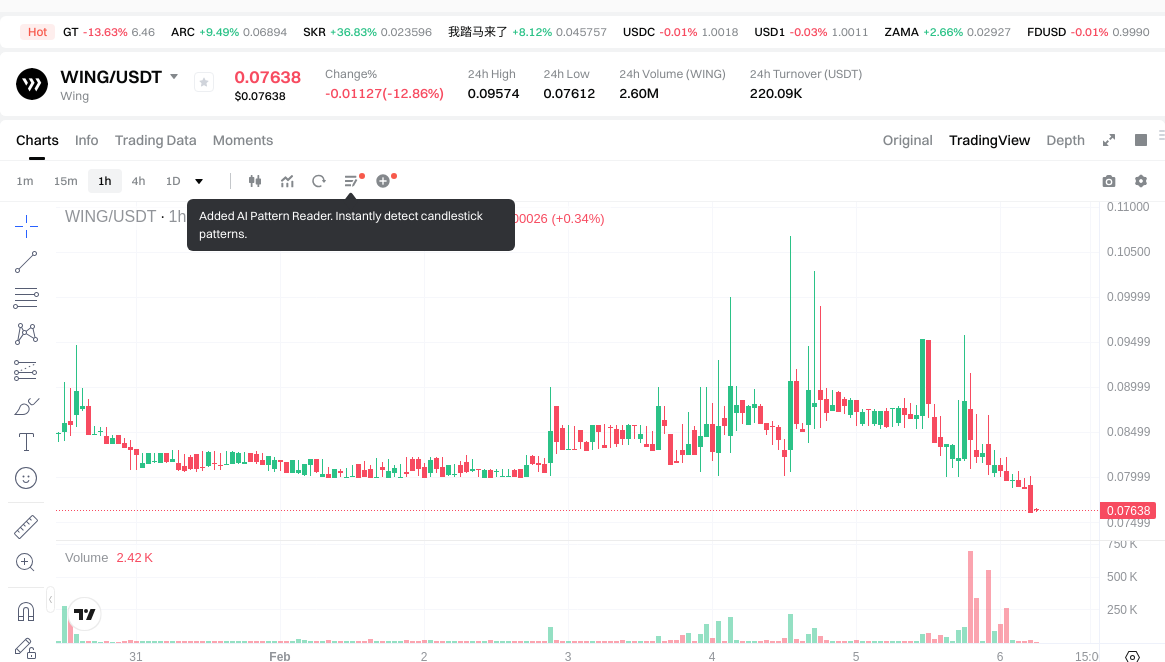
- WING current price: $0.07656
- 24-hour trading volume: $220,091.81
- Circulating supply: 5,464,693.97 WING
- Market capitalization: $418,376.97
- Circulating supply ratio: 54.65% of total supply
- Price changes: -4.07% (1H), -13.15% (24H), -10.48% (7D), -17.49% (30D)
Click to view real-time WING market price
II. Core Factors Influencing Whether WING is a Good Investment
Supply Mechanism and Scarcity (WING Investment Scarcity)
-
Token Supply Structure → Impacts Price and Investment Value
According to available data, WING has a maximum supply of 10,000,000 tokens, with a circulating supply of approximately 5,464,694 tokens (representing about 54.65% of the total supply) as of February 6, 2026. The total supply stands at 7,638,125 tokens. This controlled supply structure creates a degree of scarcity that may influence investment considerations. -
Supply Distribution and Incentive Mechanisms
Based on the initial network design, 68.50% of WING tokens were allocated for community incentives. This distribution includes: 50% allocated to the Lending Pool (rewarding users who provide collateral for lending and earn interest), 40% to the Borrowing Pool (rewarding borrowers who pay interest), and 10% to the Margin Pool (a reserve fund used to cover potential defaults on credit loans, with users able to contribute assets and receive WING token rewards). This distribution model aims to incentivize platform participation and liquidity provision. -
Investment Significance
The relatively limited circulating supply compared to the maximum supply, combined with the token's utility within the Wing Finance lending ecosystem, contributes to considerations of scarcity. However, the degree to which scarcity supports long-term investment value depends on sustained demand, platform adoption, and overall market conditions.
Institutional Investment and Mainstream Adoption (Institutional Investment in WING)
-
Market Presence and Exchange Availability
As of the referenced data, WING is listed on 2 exchanges and has approximately 1,259 token holders. The relatively modest number of holders and limited exchange availability suggest that institutional investment and mainstream adoption remain in early stages compared to more widely recognized digital assets. -
Platform Utility and Adoption
WING's investment value is closely tied to the adoption and utilization of the Wing Finance platform, which aims to establish a decentralized lending market based on credit scoring and supporting cross-chain asset interactions. Token use cases include governance (voting on project development, network settings, and community fund planning), interest payment discounts, and insurance contract purchases for collateral assets. The extent to which these utilities attract users and drive demand will influence investment considerations.
Macroeconomic Environment's Impact on WING Investment
-
Market Dynamics and Broader Trends
WING's investment attractiveness is influenced by broader macroeconomic factors affecting the cryptocurrency sector, including monetary policy shifts, interest rate changes, and overall risk appetite among investors. Changes in these conditions can alter the relative appeal of digital assets as investment vehicles. -
Sector-Specific Considerations
As a DeFi-focused token, WING's value proposition is connected to trends in decentralized finance adoption, regulatory developments affecting lending platforms, and the overall growth trajectory of the DeFi ecosystem. Market sentiment toward DeFi protocols can significantly impact investment interest in tokens like WING.
Technology and Ecosystem Development (Technology & Ecosystem for WING Investment)
-
Credit-Based Lending Model
Wing Finance supports two lending behaviors: over-collateralized lending (users can borrow by collateralizing assets worth more than 125% of the borrowed amount) and credit score-based lending (users with OScore can borrow by collateralizing assets worth more than 80% of the borrowed amount, typically allowing loans between $20-$500, with a maximum limit of $1,000). This dual-model approach aims to expand lending accessibility while managing risk. -
Cross-Chain Capabilities
The platform's design emphasizes cross-chain asset and protocol interactions, which may enhance its utility and appeal within the broader DeFi landscape. The ability to facilitate lending across different blockchain ecosystems could support long-term value if adoption grows. -
Ecosystem Integration
WING's long-term investment potential is linked to the development and expansion of the Wing Finance ecosystem, including the growth of lending and borrowing activities on the platform, integration with other DeFi protocols, and the effectiveness of its credit scoring mechanism. Sustained innovation and user engagement within these areas would be important factors for investment considerations.
Note: The analysis above is based on available data and project documentation. Investment decisions should consider multiple factors including market volatility, regulatory changes, and individual risk tolerance. Past performance and project features do not guarantee future results.
III. WING Future Investment Forecast and Price Outlook (Is Wing (WING) worth investing in 2026-2031)
Short-term Investment Forecast (2026, short-term WING investment outlook)
- Conservative forecast: $0.0588 - $0.0764
- Neutral forecast: $0.0764 - $0.0851
- Optimistic forecast: $0.0851 - $0.0939
Mid-term Investment Outlook (2027-2029, mid-term Wing (WING) investment forecast)
- Market phase expectation: As a decentralized lending platform, Wing may experience gradual ecosystem development and potential expansion in cross-chain asset support during this period.
- Investment return forecast:
- 2027: $0.0443 - $0.1022
- 2028: $0.0684 - $0.1227
- 2029: $0.0660 - $0.1601
- Key catalysts: Platform governance improvements, credit scoring mechanism optimization, expansion of lending pool incentives, and broader DeFi market growth.
Long-term Investment Outlook (Is WING a good long-term investment?)
- Baseline scenario: $0.0843 - $0.1515 (assuming steady platform development and maintained user base through 2031)
- Optimistic scenario: $0.1207 - $0.1601 (assuming successful implementation of cross-chain features and increased adoption of credit-based lending)
- Risk scenario: Below $0.0660 (in case of significant DeFi market contraction or platform security challenges)
Check WING long-term investment and price forecast: Price Prediction
2026-02-06 to 2031 Long-term Outlook
- Baseline scenario: $0.0843 - $0.1343 (corresponding to steady progress and gradual mainstream application enhancement)
- Optimistic scenario: $0.1207 - $0.1601 (corresponding to large-scale adoption and favorable market environment)
- Transformative scenario: Above $0.1601 (if the ecosystem achieves breakthrough progress and mainstream popularization)
- 2031-12-31 predicted high: $0.1515 (based on optimistic development assumptions)
Disclaimer: Price forecasts are based on historical data analysis and current market conditions. Cryptocurrency investments carry significant risks. Past performance does not guarantee future results. Investors should conduct thorough research and consider their risk tolerance before making investment decisions.
| Year | Predicted High Price | Predicted Average Price | Predicted Low Price | Price Change |
|---|---|---|---|---|
| 2026 | 0.0939474 | 0.07638 | 0.0588126 | 0 |
| 2027 | 0.10219644 | 0.0851637 | 0.044285124 | 11 |
| 2028 | 0.1227208917 | 0.09368007 | 0.0683864511 | 22 |
| 2029 | 0.160136711658 | 0.10820048085 | 0.0660022933185 | 41 |
| 2030 | 0.15161051376702 | 0.134168596254 | 0.1207517366286 | 75 |
| 2031 | 0.15146292831114 | 0.14288955501051 | 0.0843048374562 | 86 |
IV. WING Investment Strategy and Risk Management (How to invest in DeFi Lending)
Investment Methodology (WING investment strategy)
-
Long-term Holding (HODL WING): Suitable for conservative investors
Long-term holding strategies may be appropriate for investors who believe in the fundamental value proposition of decentralized lending platforms. Wing Finance's dual lending model (over-collateralized and credit-based lending) represents an innovative approach in the DeFi space. However, investors should carefully evaluate the project's development progress, user adoption metrics, and competitive positioning within the broader DeFi lending ecosystem before committing to a long-term position.
-
Active Trading: Relying on technical analysis and swing trading
Active traders may find opportunities in WING's price movements, which have shown notable volatility. The token experienced a 24-hour price change of -13.15%, with a 7-day decline of -10.48% and a 30-day decrease of -17.49% as of February 6, 2026. Trading strategies should incorporate technical indicators, volume analysis (24-hour volume: $220,091.81), and careful monitoring of support and resistance levels between the 24-hour low of $0.07612 and high of $0.09574.
Risk Management (Risk management for WING investment)
-
Asset Allocation Ratio: Conservative, aggressive, and professional investors
Conservative investors might consider limiting WING exposure to less than 1-2% of their total crypto portfolio, given the token's relatively low market capitalization of approximately $418,376 and its ranking position. Aggressive investors comfortable with higher risk may allocate 3-5%, while professional investors with deep understanding of DeFi lending protocols might consider larger positions based on thorough due diligence. The token's circulating supply represents 54.65% of the fully diluted valuation, which should be factored into allocation decisions.
-
Risk Hedging Solutions: Multi-asset portfolio and hedging tools
Diversification across multiple DeFi sectors (lending, DEXs, derivatives) can help mitigate concentration risk. Investors might consider pairing WING holdings with established lending protocols or blue-chip assets to balance portfolio volatility. Position sizing should account for WING's limited exchange availability (listed on 2 exchanges) and relatively low liquidity, which may impact execution during market stress.
-
Secure Storage: Hot and cold wallets with hardware wallet recommendations
WING tokens are deployed on the Ontology (ONG) blockchain. Investors should utilize compatible wallets that support ONG-based assets. Hardware wallets such as Ledger or Trezor (if supporting ONG) provide enhanced security for long-term holdings. For smaller amounts needed for trading, reputable exchange wallets may be appropriate, though users should be aware of counterparty risks. Always verify contract addresses (WING contract: 00c59fcd27a562d6397883eab1f2fff56e58ef80) before transactions to avoid scams.
V. WING Investment Risks and Challenges (Risks of investing in DeFi Lending)
-
Market Risk: High volatility and potential price manipulation
WING has demonstrated substantial price volatility, with the current price of $0.07656 representing a significant decline from its all-time high of $140.81 recorded on September 17, 2020. The token has experienced a 1-year decline of -97.84%, and approached its all-time low of $0.0706 on June 5, 2025. The relatively low market capitalization and limited exchange listings may contribute to increased price volatility and susceptibility to large order impacts. The small holder base of 1,259 addresses suggests limited distribution, which could amplify price movements.
-
Regulatory Risk: Policy uncertainty across different jurisdictions
DeFi lending platforms operate in an evolving regulatory landscape. Authorities worldwide continue to develop frameworks for decentralized finance, which may impact projects like Wing Finance. Credit-based lending mechanisms, such as Wing's OScore system, could attract particular regulatory scrutiny as they blur lines between traditional credit systems and decentralized protocols. Investors should monitor regulatory developments in jurisdictions where they reside and where the protocol operates.
-
Technical Risk: Network security vulnerabilities and upgrade failures
As a DeFi lending protocol, Wing Finance faces inherent smart contract risks. The platform's dual lending pools (Lending Pool, Borrowing Pool) and Margin Pool system involve complex interactions that could potentially contain vulnerabilities. While the project has documentation available, investors should assess whether independent security audits have been conducted. The credit scoring system (OScore) introduces additional technical complexity. The relatively low 24-hour trading volume and limited exchange presence may also indicate reduced protocol activity or adoption challenges.
VI. Conclusion: Is DeFi Lending a Good Investment?
-
Investment Value Summary: WING presents an innovative approach to decentralized lending with its credit-based model, though the token has experienced substantial price declines and faces significant challenges in terms of market positioning and liquidity.
-
Investor Recommendations:
✅ Beginners: Exercise extreme caution. If considering entry, implement strict dollar-cost averaging with very small position sizes and prioritize secure storage solutions compatible with ONG-based assets.
✅ Experienced Investors: May consider tactical positions based on thorough fundamental analysis of platform metrics, development activity, and competitive positioning. Utilize stop-loss strategies given high volatility patterns.
✅ Institutional Investors: Conduct comprehensive due diligence on protocol security, team background, regulatory compliance, and market fit before considering any strategic allocation.
⚠️ Disclaimer: Cryptocurrency investments carry substantial risk. WING has demonstrated extreme volatility and significant price declines. This content is for informational purposes only and does not constitute investment advice. Investors should conduct independent research and consult with financial advisors before making investment decisions.
VII. FAQ
Q1: What is Wing (WING) and how does its lending mechanism work?
Wing (WING) is a decentralized lending platform token launched in September 2020, built on the Ontology blockchain to establish a credit-based DeFi lending market with cross-chain capabilities. The platform operates through a dual lending model: over-collateralized lending (requiring collateral worth more than 125% of the borrowed amount) and credit score-based lending (using the OScore system, allowing users to borrow by collateralizing assets worth more than 80% of the borrowed amount, typically for loans between $20-$500 with a maximum of $1,000). The ecosystem includes three main pools: the Lending Pool (50% of tokens, rewarding collateral providers), Borrowing Pool (40%, rewarding borrowers paying interest), and Margin Pool (10%, serving as a reserve fund for potential defaults). WING tokens serve multiple functions including governance voting, interest payment discounts, and insurance contract purchases for collateral assets.
Q2: What is the current market status and price performance of WING?
As of February 6, 2026, WING is trading at approximately $0.07656 with a market capitalization of $418,376.97 and a 24-hour trading volume of $220,091.81. The token has experienced significant price volatility, declining from its all-time high of $140.81 (September 17, 2020) to approach its all-time low of $0.0706 (June 5, 2025), representing a 1-year decline of -97.84%. Recent performance shows continued downward momentum: -4.07% (1H), -13.15% (24H), -10.48% (7D), and -17.49% (30D). The circulating supply stands at 5,464,693.97 tokens (54.65% of the 10,000,000 maximum supply), with only 1,259 token holders and listing on 2 exchanges, indicating limited liquidity and distribution.
Q3: What are the price predictions for WING from 2026 to 2031?
Price forecasts for WING show modest growth potential under various scenarios. For 2026 (short-term), predictions range from $0.0588-$0.0764 (conservative) to $0.0851-$0.0939 (optimistic). Mid-term forecasts (2027-2029) show gradual appreciation: 2027 ($0.0443-$0.1022), 2028 ($0.0684-$0.1227), and 2029 ($0.0660-$0.1601). Long-term outlook through 2031 presents a baseline scenario of $0.0843-$0.1515, an optimistic scenario of $0.1207-$0.1601, and a transformative scenario above $0.1601. The predicted 2031 high reaches $0.1515, representing approximately 98% growth from current levels. These projections assume steady platform development, improved cross-chain functionality, and favorable DeFi market conditions. However, given WING's significant historical volatility and current market challenges, these forecasts carry substantial uncertainty and should not be considered guaranteed outcomes.
Q4: What are the main investment risks associated with WING?
WING carries multiple significant investment risks that potential investors should carefully evaluate. Market risk is substantial, evidenced by extreme volatility and a 97.84% decline over one year, with the current price near all-time lows. The low market capitalization ($418,376), limited exchange availability (2 exchanges), and small holder base (1,259 addresses) create liquidity concerns and potential for price manipulation through large orders. Regulatory risk stems from evolving DeFi regulations worldwide, with credit-based lending mechanisms like the OScore system potentially attracting increased scrutiny from authorities. Technical risk involves smart contract vulnerabilities inherent in complex DeFi protocols, particularly given Wing's multiple pool systems and credit scoring mechanisms. The relatively low 24-hour trading volume and limited mainstream adoption suggest reduced protocol activity. Additionally, the token's supply structure with only 54.65% circulation introduces potential selling pressure as more tokens enter the market.
Q5: What investment strategies are recommended for WING?
Investment strategies for WING should be tailored to risk tolerance and investment horizon. Conservative investors should consider limiting WING exposure to less than 1-2% of their total crypto portfolio, given the low market cap and high volatility, utilizing a long-term holding (HODL) approach only after thorough evaluation of platform development and competitive positioning. Aggressive investors might allocate 3-5% for tactical positions, employing strict stop-loss strategies and monitoring key technical levels between the 24-hour range of $0.07612-$0.09574. Active traders can capitalize on volatility patterns but should incorporate technical analysis and volume indicators carefully. Risk management is crucial: diversify across multiple DeFi sectors (lending, DEXs, derivatives) to mitigate concentration risk, use hardware wallets for secure storage (ensuring ONG blockchain compatibility), and verify contract addresses (00c59fcd27a562d6397883eab1f2fff56e58ef80) before transactions. Beginners should exercise extreme caution with very small position sizes and dollar-cost averaging approaches if entering at all.
Q6: How does WING's supply mechanism affect its investment value?
WING's supply mechanism presents both scarcity elements and potential concerns for investors. The token has a maximum supply of 10,000,000 tokens, with approximately 5,464,694 tokens currently circulating (54.65% of maximum), creating a moderate scarcity profile. The initial distribution allocated 68.50% to community incentives across three pools designed to drive platform engagement: Lending Pool (50%), Borrowing Pool (40%), and Margin Pool (10%). This structure aims to incentivize participation and liquidity provision on the Wing Finance platform. However, the fact that nearly half of the maximum supply has not yet entered circulation presents potential dilution concerns, as future token releases could create downward price pressure. The investment significance of this supply structure depends heavily on sustained demand generation through platform adoption, utility realization, and overall DeFi market conditions. With only 1,259 current token holders and limited exchange availability, the demand side remains constrained, which limits the positive impact of supply scarcity on price appreciation potential.
Q7: What factors determine whether WING is suitable for institutional investment?
Institutional investment suitability for WING depends on several critical factors that currently present significant challenges. Market presence indicators show limited institutional appeal: listing on only 2 exchanges, approximately 1,259 token holders, and a market capitalization of just $418,376 suggest minimal mainstream adoption compared to established digital assets. The token's extreme volatility (down 97.84% over one year) and proximity to all-time lows raise concerns about price stability and downside risk protection. Platform utility centered on credit-based DeFi lending may attract institutional interest if adoption metrics improve, but current low trading volume ($220,091.81 daily) indicates limited protocol activity. Regulatory considerations around credit scoring mechanisms (OScore) and lending operations require careful evaluation. Technical due diligence must assess smart contract security, audit history, and the complexity of multi-pool systems. Liquidity constraints pose execution challenges for larger positions. For institutions considering WING, comprehensive analysis should cover protocol security audits, team background and track record, regulatory compliance framework, competitive positioning within DeFi lending space, and clear evidence of user growth and protocol revenue generation before any strategic allocation.
Q8: What distinguishes Wing Finance's credit-based lending from traditional DeFi lending?
Wing Finance differentiates itself from traditional DeFi lending protocols through its dual-model approach that combines standard over-collateralization with credit score-based lending. Traditional DeFi lending typically requires users to deposit collateral worth significantly more than their borrowed amount (often 150-200%), making capital efficiency a limitation. Wing's innovation introduces the OScore credit scoring system, which allows qualified users to borrow with reduced collateral requirements—collateralizing assets worth more than 80% rather than 125%+—opening access to users who may have limited collateral but established credit worthiness. This credit-based model typically supports smaller loan amounts ($20-$500, maximum $1,000), targeting underserved borrowers in the DeFi space. The platform's cross-chain asset and protocol interaction capabilities further distinguish it by potentially enabling lending across different blockchain ecosystems. However, this innovative approach also introduces additional complexity and regulatory considerations, as credit scoring mechanisms blur traditional boundaries between centralized credit systems and decentralized protocols. The practical success and investment value of these features ultimately depends on user adoption rates, the effectiveness of the credit scoring algorithm, and the platform's ability to manage default risks through its Margin Pool reserve system.
Share
Content
Introduction: Wing (WING)'s Investment Position and Market Outlook
I. Wing (WING) Price History Review and Current Investment Value
II. Core Factors Influencing Whether WING is a Good Investment
III. WING Future Investment Forecast and Price Outlook (Is Wing (WING) worth investing in 2026-2031)
IV. WING Investment Strategy and Risk Management (How to invest in DeFi Lending)
V. WING Investment Risks and Challenges (Risks of investing in DeFi Lending)
VI. Conclusion: Is DeFi Lending a Good Investment?
VII. FAQ
How to Buy Cryptocurrency


Trending Cryptocurrencies



Bitcoin Fear and Greed Index: Market Sentiment Analysis for 2025

Hedera Hashgraph (HBAR): Founders, Technology, and Price Outlook to 2030

Cardano (ADA) Price Prediction 2025 & 2030 – Is ADA Set to Soar?

2025 SUI coin: price, buying guide, and Staking rewards

Cardano (ADA): A History, Tech Overview, and Price Outlook

Jasmy Coin: A Japanese Crypto Tale of Ambition, Hype, and Hope
What Does DYOR Mean in Crypto?

Everything You Need to Know About the Ethereum ERC-20 Token Standard
![[Cryptocurrency Investment Guide] Inverted Hammer Candlestick Pattern](https://gimg.staticimgs.com/learn/0ecdcb62677e87289caf34e32e85dd6e537dbe2b.png)
[Cryptocurrency Investment Guide] Inverted Hammer Candlestick Pattern

What Is a Trader: Understanding the Trading Profession Before You Start
Where can you buy Trump Coin (TRUMP)? | Supported Exchanges and How to Buy
