MF vs LTC: Understanding the Key Differences Between Mutual Funds and Long-Term Care Insurance


Introduction: MF vs LTC Investment Comparison
In the cryptocurrency market, the comparison between MF vs LTC has been a topic that investors cannot avoid. The two differ significantly in market cap ranking, application scenarios, and price performance, representing different crypto asset positioning. MF (Moonwalk Fitness): Launched in recent years, it has gained market recognition by gamifying fitness journeys and turning step goals into social competitions. LTC (Litecoin): Since its launch in 2011, it has been regarded as a peer-to-peer cryptocurrency based on the Bitcoin protocol, becoming one of the cryptocurrencies with considerable trading volume and market capitalization globally. This article will provide a comprehensive analysis of the investment value comparison between MF vs LTC, focusing on historical price trends, supply mechanisms, institutional adoption, technological ecosystems, and future predictions, attempting to answer the question that investors are most concerned about:
"Which is the better buy right now?"
I. Historical Price Comparison and Current Market Status
Moonwalk Fitness (MF) and Litecoin (LTC) Historical Price Trends
-
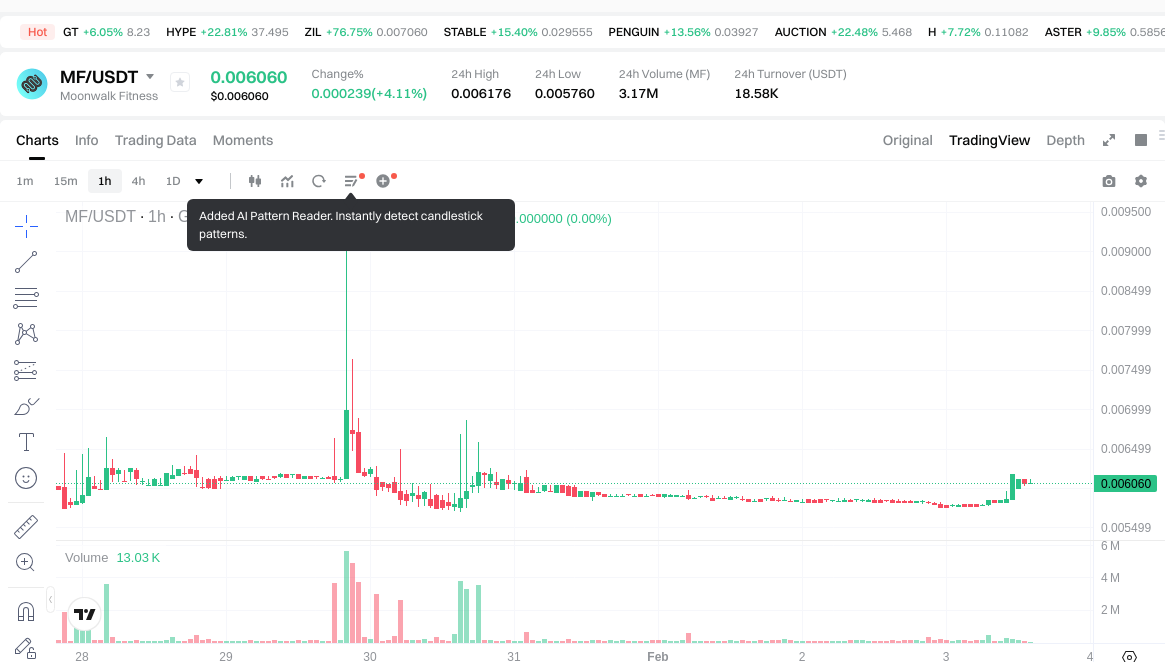
2025: Moonwalk Fitness (MF) experienced notable volatility during its early market period, reaching an all-time high of $0.10922 in October 2025. By January 2026, the token recorded its all-time low of $0.005696, reflecting a significant correction phase.
-
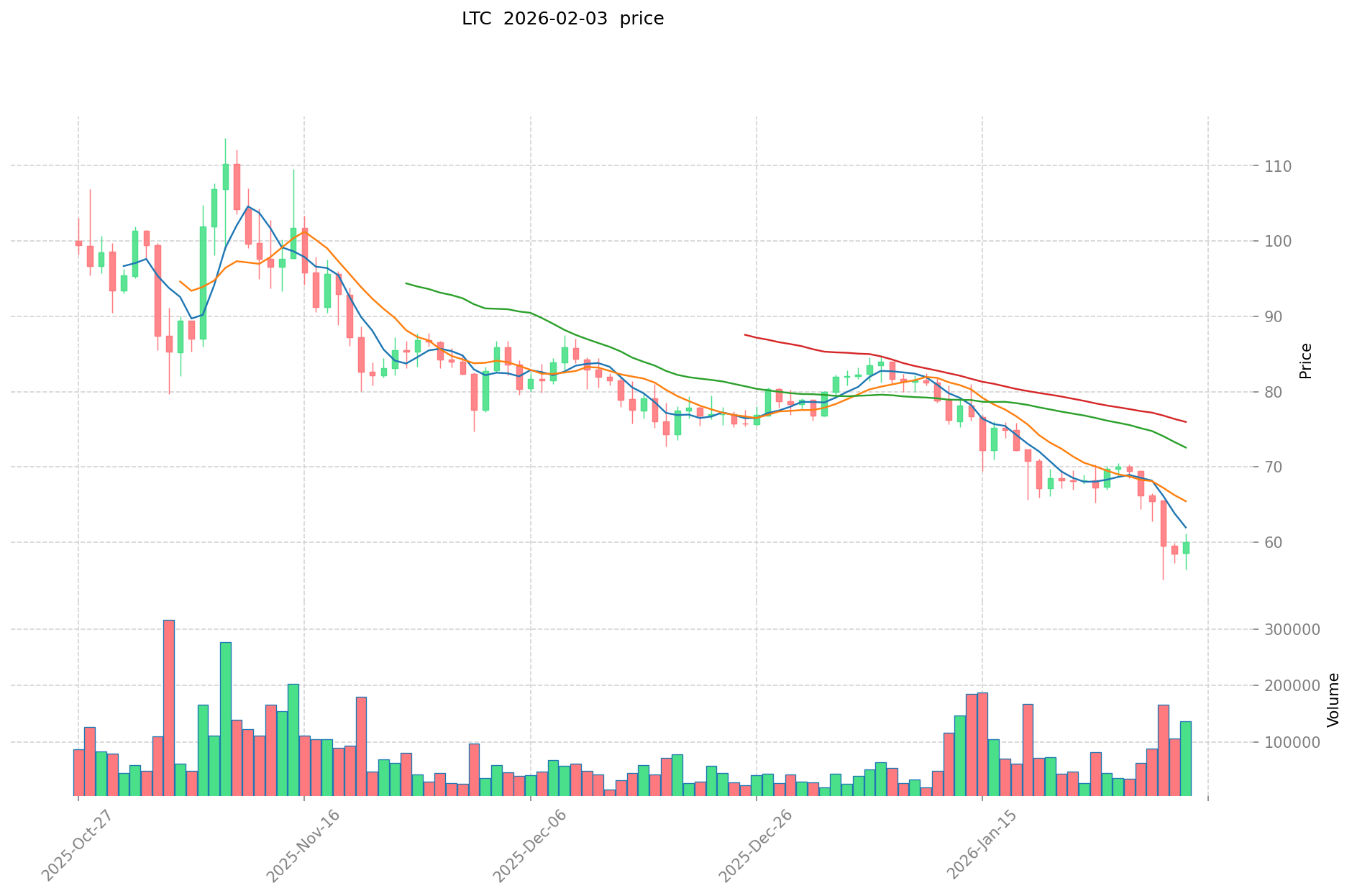
2021-2026: Litecoin (LTC) reached its all-time high of $410.26 in May 2021 during a broader cryptocurrency market rally. Subsequently, LTC underwent substantial price adjustments, with its all-time low of $1.15 recorded in January 2015. By early 2026, LTC's price stabilized around the $59-60 range.
-
Comparative Analysis: During the market correction phase between late 2025 and early 2026, MF declined from its peak of $0.10922 to approximately $0.00606, representing a substantial retracement. In contrast, LTC demonstrated relatively moderate volatility during the same period, trading within a range of $56-62, showing comparatively more stable price behavior.
Current Market Status (February 03, 2026)
- MF Current Price: $0.00606
- LTC Current Price: $59.73
- 24-hour Trading Volume: MF recorded $18,595.48 compared to LTC's $6,180,790.56
- Market Sentiment Index (Fear & Greed Index): 17 (Extreme Fear)
View real-time prices:
- Check MF current price Market Price
- Check LTC current price Market Price
II. Core Factors Influencing MF vs LTC Investment Value
Supply Mechanism Comparison (Tokenomics)
Without specific tokenomics data available in the reference materials for MF and LTC, a direct comparison of their supply mechanisms cannot be established. Generally, supply mechanisms such as fixed supply caps, deflationary models, or halving events can significantly influence long-term price cycles by affecting scarcity and market perception.
Institutional Adoption and Market Application
- Institutional Holdings: Reference materials indicate that institutional preference and portfolio management strategies can influence asset selection, though specific data on MF versus LTC institutional holdings is not provided.
- Enterprise Adoption: The materials reference enterprise digital transformation and CRM integration (such as LTC workflows in manufacturing contexts), but do not directly address cross-border payment, settlement, or investment portfolio applications specific to MF or LTC as crypto assets.
- National Policies: Regulatory attitudes toward crypto assets vary by jurisdiction, but the reference materials do not contain detailed policy comparisons specific to MF and LTC.
Technological Development and Ecosystem Building
- MF Technical Upgrades: The reference materials emphasize the importance of product-market fit (P/MF) and CRM system integration in enterprise contexts, but do not provide specific information on MF's technological roadmap or upgrades in the crypto asset domain.
- LTC Technical Development: While LTC is mentioned in enterprise workflow contexts (Lead to Cash processes), specific technical developments, protocol upgrades, or blockchain improvements for LTC as a crypto asset are not detailed in the materials.
- Ecosystem Comparison: The materials do not offer comparative analysis of DeFi, NFT, payment solutions, or smart contract deployment between MF and LTC ecosystems.
Macroeconomic Environment and Market Cycles
- Performance Under Inflation: The reference materials mention investment strategies considering core CPI trends and suggest maintaining flexibility with short-term instruments during inflationary periods, but do not specifically compare anti-inflation properties of MF versus LTC.
- Macroeconomic Monetary Policy: Interest rates and currency index fluctuations can influence crypto asset valuations, though specific impact mechanisms on MF and LTC are not documented in the provided materials.
- Geopolitical Factors: Cross-border transaction demand and international developments can affect crypto asset adoption, but specific analysis related to MF and LTC is not available in the reference sources.
III. 2026-2031 Price Forecast: MF vs LTC
Short-term Forecast (2026)
- MF: Conservative $0.0035148 - $0.00606 | Optimistic $0.00606 - $0.0083022
- LTC: Conservative $47.0366 - $59.54 | Optimistic $59.54 - $62.517
Mid-term Forecast (2028-2029)
- MF may enter a gradual growth phase, with estimated price range of $0.00601632558 - $0.0113022183924
- LTC may enter a consolidation phase, with estimated price range of $58.578205725 - $106.283284004625
- Key drivers: institutional capital flows, ETF developments, ecosystem expansion
Long-term Forecast (2031)
- MF: Baseline scenario $0.008188486967973 - $0.013207237045119 | Optimistic scenario $0.013207237045119 - $0.017037335788203
- LTC: Baseline scenario $72.378856472966915 - $99.149118456119062 | Optimistic scenario $99.149118456119062 - $133.851309915760734
Disclaimer
MF:
| Year | Predicted High Price | Predicted Average Price | Predicted Low Price | Price Change |
|---|---|---|---|---|
| 2026 | 0.0083022 | 0.00606 | 0.0035148 | 0 |
| 2027 | 0.009766296 | 0.0071811 | 0.004883148 | 18 |
| 2028 | 0.01135475532 | 0.008473698 | 0.00601632558 | 39 |
| 2029 | 0.0113022183924 | 0.00991422666 | 0.0081296658612 | 63 |
| 2030 | 0.015806251564038 | 0.0106082225262 | 0.006471015740982 | 75 |
| 2031 | 0.017037335788203 | 0.013207237045119 | 0.008188486967973 | 117 |
LTC:
| Year | Predicted High Price | Predicted Average Price | Predicted Low Price | Price Change |
|---|---|---|---|---|
| 2026 | 62.517 | 59.54 | 47.0366 | 0 |
| 2027 | 83.609045 | 61.0285 | 38.447955 | 2 |
| 2028 | 87.505714725 | 72.3187725 | 58.578205725 | 21 |
| 2029 | 106.283284004625 | 79.9122436125 | 74.318386559625 | 33 |
| 2030 | 105.200473103675625 | 93.0977638085625 | 88.442875618134375 | 55 |
| 2031 | 133.851309915760734 | 99.149118456119062 | 72.378856472966915 | 65 |
IV. Investment Strategy Comparison: MF vs LTC
Long-term vs Short-term Investment Strategies
- MF: May suit investors interested in emerging fitness-tech applications and willing to accept higher volatility in exchange for potential growth in niche gamification markets
- LTC: May suit investors seeking exposure to established peer-to-peer cryptocurrency infrastructure with relatively moderate volatility characteristics and longer operational track record
Risk Management and Asset Allocation
- Conservative Investors: MF: 10-15% vs LTC: 85-90%
- Aggressive Investors: MF: 30-40% vs LTC: 60-70%
- Hedging Instruments: Stablecoin allocation, options strategies, cross-asset portfolio diversification
V. Potential Risk Comparison
Market Risk
- MF: Demonstrated significant price volatility during early market phases, with substantial corrections from peak levels. Limited trading volume ($18,595.48 as of February 03, 2026) may present liquidity challenges during market stress periods
- LTC: Experienced historical price fluctuations across multiple market cycles since 2011. Current trading volume of $6,180,790.56 indicates relatively deeper liquidity compared to MF, though still subject to broader cryptocurrency market sentiment
Technical Risk
- MF: Specific information regarding network scalability, technical infrastructure stability, and long-term development roadmap is not available in reference materials
- LTC: As a peer-to-peer cryptocurrency based on Bitcoin protocol since 2011, technical considerations may include network capacity, mining concentration patterns, and protocol security maintenance
Regulatory Risk
- Global regulatory frameworks for crypto assets continue to evolve across jurisdictions. Both MF and LTC may face varying compliance requirements, licensing standards, and operational restrictions depending on regional policy developments. Investors should monitor regulatory announcements that may affect trading availability, taxation treatment, or institutional participation
VI. Conclusion: Which Is the Better Buy?
📌 Investment Value Summary:
- MF Characteristics: Represents exposure to fitness gamification and social competition concepts in crypto markets. Exhibited high volatility with significant retracement from October 2025 peak. Limited trading volume may present both opportunity and liquidity considerations
- LTC Characteristics: Established operational history since 2011 as peer-to-peer cryptocurrency. Demonstrated relatively moderate volatility patterns in recent periods. Higher trading volume indicates deeper market liquidity compared to MF
✅ Investment Considerations:
- Novice Investors: May consider starting with assets having longer operational track records and deeper liquidity profiles. Position sizing should reflect individual risk tolerance and understanding of cryptocurrency market dynamics
- Experienced Investors: May evaluate allocation strategies incorporating both established and emerging assets based on portfolio diversification objectives, risk-return preferences, and market cycle positioning
- Institutional Investors: May assess factors including regulatory clarity, custody solutions, liquidity depth, operational infrastructure, and alignment with investment mandates when evaluating MF versus LTC exposure
⚠️ Risk Disclosure: Cryptocurrency markets exhibit extreme volatility. This content does not constitute investment advice. Investors should conduct independent research and consult qualified financial advisors before making investment decisions.
VII. FAQ
Q1: What is the main difference between MF and LTC in terms of market positioning?
MF (Moonwalk Fitness) is an emerging cryptocurrency focused on gamifying fitness journeys and social competition, launched in recent years with limited market history. LTC (Litecoin), established in 2011, is a peer-to-peer cryptocurrency based on Bitcoin protocol with over a decade of operational track record and significantly higher trading volume ($6.18M vs $18.6K as of February 2026).
Q2: Which cryptocurrency shows greater price volatility based on recent performance?
MF demonstrates substantially higher volatility, experiencing an 86.5% decline from its October 2025 peak of $0.10922 to $0.00606 by early 2026. LTC exhibits relatively moderate price movements, trading within a narrower range of $56-62 during the same period, reflecting more stable market behavior characteristic of established cryptocurrencies.
Q3: What are the liquidity differences between MF and LTC for investors?
LTC offers significantly deeper liquidity with 24-hour trading volume of $6,180,790.56 compared to MF's $18,595.48 (as of February 03, 2026). This 330x difference in trading volume means LTC investors can generally execute larger transactions with less price impact, while MF traders may face liquidity constraints during market stress periods.
Q4: How do the short-term 2026 price forecasts compare between MF and LTC?
For 2026, MF's conservative forecast ranges $0.0035148-$0.00606 with optimistic scenario reaching $0.0083022, representing potential 37% upside from current levels. LTC's conservative range is $47.04-$59.54 with optimistic scenario at $62.52, indicating approximately 5% potential upside, suggesting MF carries higher risk-reward ratio in near-term projections.
Q5: What asset allocation strategy is recommended for conservative versus aggressive investors?
Conservative investors may consider allocating 10-15% to MF and 85-90% to LTC, prioritizing established assets with deeper liquidity. Aggressive investors might allocate 30-40% to MF and 60-70% to LTC, accepting higher volatility exposure in exchange for potential growth in emerging fitness-tech applications while maintaining majority position in proven infrastructure.
Q6: What are the primary regulatory risks affecting both MF and LTC?
Both assets face evolving global regulatory frameworks with jurisdiction-specific compliance requirements, licensing standards, and operational restrictions. Key concerns include potential trading availability limitations, varying taxation treatments across regions, and changing institutional participation rules. Investors should continuously monitor regulatory announcements that may materially impact market access and legal status.
Q7: Which cryptocurrency is more suitable for novice investors entering the crypto market?
LTC may be more appropriate for novice investors due to its longer operational history (since 2011), deeper market liquidity, relatively moderate volatility patterns, and established infrastructure. Beginners should prioritize understanding fundamental cryptocurrency concepts, implement proper position sizing reflecting personal risk tolerance, and recognize that even established assets like LTC carry substantial market risks.
Q8: What factors should institutional investors evaluate when comparing MF versus LTC?
Institutional investors should assess regulatory clarity in target jurisdictions, availability of qualified custody solutions, market liquidity depth for large-scale transactions, operational infrastructure maturity, alignment with investment mandate restrictions, and risk management framework compatibility. LTC's established track record and higher liquidity generally align better with institutional requirements compared to emerging assets like MF.
Share
Content
Introduction: MF vs LTC Investment Comparison
I. Historical Price Comparison and Current Market Status
II. Core Factors Influencing MF vs LTC Investment Value
III. 2026-2031 Price Forecast: MF vs LTC
IV. Investment Strategy Comparison: MF vs LTC
V. Potential Risk Comparison
VI. Conclusion: Which Is the Better Buy?
VII. FAQ
How to Buy Cryptocurrency


Trending Cryptocurrencies



2025 SUI coin: price, buying guide, and Staking rewards

How to Buy Crypto: A Step-by-Step Guide with Gate.com

HNT Price in 2025: Helium Network Token Value and Market Analysis

What is SwissCheese (SWCH) and How Does It Democratize Investment?

Cardano (ADA) Price Analysis and Outlook for 2025

How to Invest in Metaverse Crypto

Free Money for App Registration: Crypto Bonus Guide

What Is The Sandbox? How to Earn Money in The Sandbox?
What is AIBOT: A Comprehensive Guide to Artificial Intelligence Chatbots and Their Applications in Modern Business

What is DCB: A Comprehensive Guide to Direct Current Bus Technology and Its Applications in Modern Power Systems

What is BEER: A Comprehensive Guide to the World's Most Popular Beverage