This comprehensive analysis compares MTRG and KAVA, two distinct blockchain platforms serving different DeFi ecosystem roles. MTRG operates as a Layer 2 scaling solution on an EVM-compatible chain with governance focus, while KAVA functions as a cross-chain DeFi platform specializing in collateralized lending and stablecoins. The article examines critical investment factors including historical price performance, tokenomics, market status, institutional adoption, and technical development. MTRG currently trades at $0.03023 with $12,155.35 daily volume, while KAVA trades at $0.06415 with significantly higher $229,829.42 volume, indicating different liquidity profiles. The comparison addresses risk management strategies suitable for conservative and aggressive investors, with allocation recommendations based on portfolio diversification goals. Price forecasts, regulatory considerations, and ecosystem developments inform investment decision-making. This guide serves investors seeking to understand which token be
Introduction: Investment Comparison Between MTRG and KAVA
In the cryptocurrency market, the comparison between MTRG vs KAVA has become a topic of interest for investors. Both projects differ in market capitalization ranking, application scenarios, and price performance, representing distinct positioning within the crypto asset landscape.
MTRG (Meter): Launched in 2020, this governance token operates on a high-performance EVM-compatible public chain based on HotStuff2 consensus, utilizing a POS mechanism for network security.
KAVA: Since its launch in 2019, KAVA has positioned itself as a cross-chain DeFi platform, providing collateralized lending and stablecoin services for mainstream digital assets, supported by over 100 companies globally.
This article will analyze the investment value comparison between MTRG vs KAVA through historical price trends, supply mechanisms, ecosystem development, and future outlook, attempting to address the question that concerns investors:
"Which represents a more suitable consideration for portfolio allocation based on current market conditions?"
I. Historical Price Comparison and Current Market Status
MTRG (Coin A) and KAVA (Coin B) Historical Price Trends
- 2021: MTRG reached a notable price level of $16.47 on November 3, 2021, marking a significant point in its trading history.
- 2021: KAVA experienced its peak price of $9.12 on August 30, 2021, reflecting strong market interest during that period.
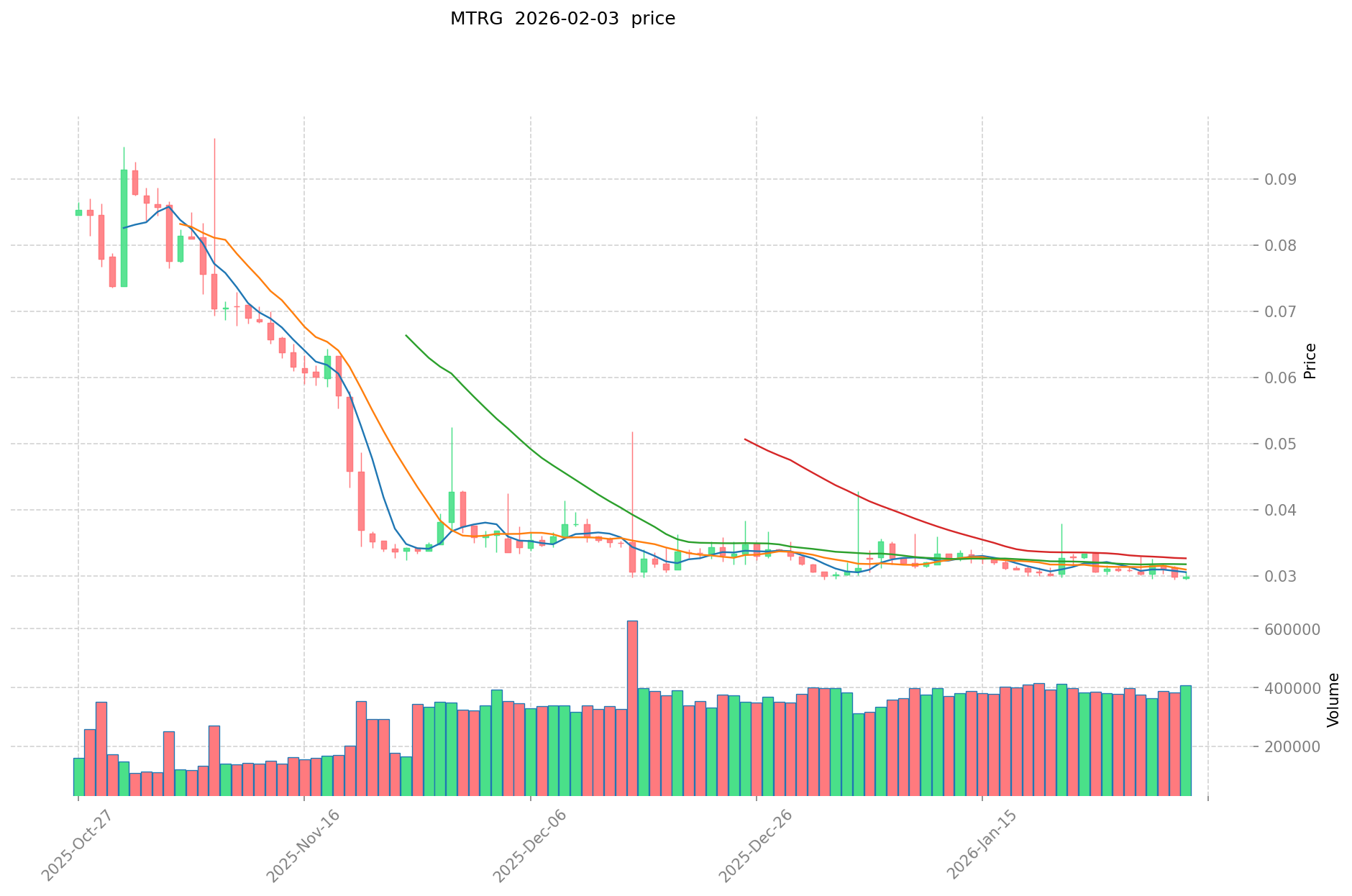
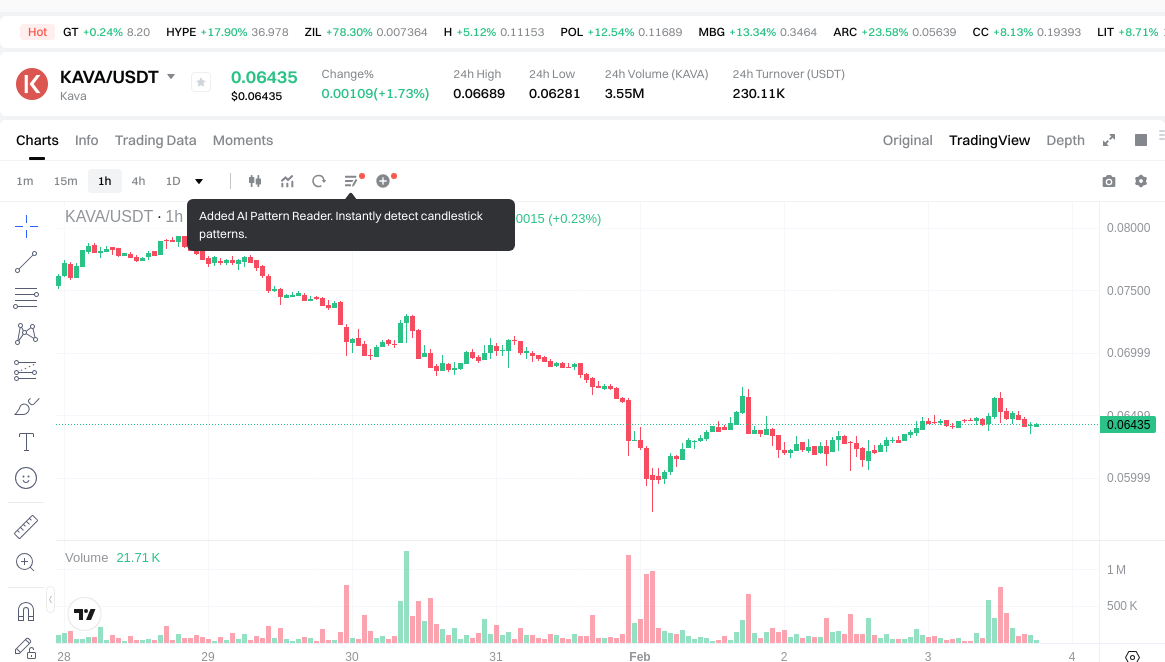
- Comparative Analysis: During the subsequent market cycle, MTRG declined from its high of $16.47 to a low of $0.029458 (recorded on January 2, 2026), while KAVA similarly decreased from $9.12 to $0.059126 (recorded on February 1, 2026), both tokens experiencing substantial downward movement.
Current Market Status (February 3, 2026)
- MTRG Current Price: $0.03023
- KAVA Current Price: $0.06415
- 24-Hour Trading Volume: MTRG $12,155.35 vs KAVA $229,829.42
- Market Sentiment Index (Fear & Greed Index): 17 (Extreme Fear)
View real-time prices:
II. Core Factors Influencing MTRG vs KAVA Investment Value
Supply Mechanism Comparison (Tokenomics)
- MTRG: The token operates within the Meter blockchain ecosystem, focusing on Layer 2 scaling solutions. Specific supply mechanism details regarding fixed supply or deflationary models require further technical documentation analysis.
- KAVA: Designed for decentralized lending platforms with token economics supporting governance and staking mechanisms within its DeFi ecosystem.
- 📌 Historical Pattern: Supply mechanisms play a role in shaping price cycles through token release schedules and staking rewards, though specific historical data for these projects remains limited in the provided materials.
Institutional Adoption and Market Application
- Institutional Holdings: Current institutional preference data between MTRG and KAVA is not extensively documented in available materials.
- Enterprise Adoption: Both projects target different sectors - MTRG focuses on blockchain scaling infrastructure while KAVA emphasizes decentralized financial services. Cross-border payment and settlement applications vary based on their respective technical architectures.
- National Policies: Regulatory attitudes toward both tokens vary across jurisdictions, with general cryptocurrency regulations applying to both projects.
Technical Development and Ecosystem Building
- MTRG Technical Development: The project concentrates on blockchain scalability solutions, addressing transaction throughput and network efficiency challenges.
- KAVA Technical Development: Focuses on expanding decentralized lending and borrowing capabilities within its multi-chain DeFi platform.
- Ecosystem Comparison: MTRG's ecosystem development centers on Layer 2 infrastructure, while KAVA has established presence in DeFi lending markets. Both projects continue developing their respective technical foundations and community support.
Macroeconomic Environment and Market Cycles
- Performance in Inflationary Environment: Both digital assets demonstrate characteristics influenced by broader cryptocurrency market trends rather than traditional inflation hedging properties.
- Macroeconomic Monetary Policy: Interest rate changes and U.S. dollar index movements affect both projects through general cryptocurrency market sentiment and liquidity conditions.
- Geopolitical Factors: Cross-border transaction demand and international developments impact both tokens through their respective use cases in blockchain infrastructure and decentralized finance.
III. 2026-2031 Price Forecast: MTRG vs KAVA
Short-term Forecast (2026)
- MTRG: Conservative $0.0157 - $0.0296 | Optimistic $0.0296 - $0.0367
- KAVA: Conservative $0.0347 - $0.0644 | Optimistic $0.0644 - $0.0753
Mid-term Forecast (2028-2029)
- MTRG may enter a gradual adjustment phase, with estimated price range of $0.0217 - $0.0413 in 2028 and $0.0314 - $0.0458 in 2029
- KAVA may enter a potential growth phase, with estimated price range of $0.0634 - $0.1163 in 2028 and $0.0652 - $0.1305 in 2029
- Key drivers: institutional capital flows, ETF developments, ecosystem expansion
Long-term Forecast (2030-2031)
- MTRG: Base scenario $0.0230 - $0.0419 (2030) | Optimistic scenario $0.0291 - $0.0486 (2031)
- KAVA: Base scenario $0.1032 - $0.1146 (2030) | Optimistic scenario $0.0807 - $0.1222 (2031)
View detailed price predictions for MTRG and KAVA
Disclaimer
MTRG:
| Year |
Predicted High Price |
Predicted Average Price |
Predicted Low Price |
Price Change |
| 2026 |
0.0366668 |
0.02957 |
0.0156721 |
-2 |
| 2027 |
0.035767872 |
0.0331184 |
0.026163536 |
9 |
| 2028 |
0.0413317632 |
0.034443136 |
0.02169917568 |
13 |
| 2029 |
0.045843814016 |
0.0378874496 |
0.031446583168 |
25 |
| 2030 |
0.05065741448768 |
0.041865631808 |
0.0230260974944 |
38 |
| 2031 |
0.048574599305232 |
0.04626152314784 |
0.029144759583139 |
53 |
KAVA:
| Year |
Predicted High Price |
Predicted Average Price |
Predicted Low Price |
Price Change |
| 2026 |
0.0752895 |
0.06435 |
0.034749 |
0 |
| 2027 |
0.0928602675 |
0.06981975 |
0.054459405 |
8 |
| 2028 |
0.1163162125125 |
0.08134000875 |
0.063445206825 |
26 |
| 2029 |
0.13045310603325 |
0.09882811063125 |
0.065226553016625 |
54 |
| 2030 |
0.122665450915507 |
0.11464060833225 |
0.103176547499025 |
78 |
| 2031 |
0.122212620512595 |
0.118653029623878 |
0.080684060144237 |
84 |
IV. Investment Strategy Comparison: MTRG vs KAVA
Long-term vs Short-term Investment Strategies
- MTRG: May appeal to investors interested in blockchain infrastructure development and Layer 2 scaling solutions, particularly those with higher risk tolerance given its lower market capitalization and trading volume.
- KAVA: May suit investors focused on the decentralized finance sector, specifically those interested in lending protocols and cross-chain DeFi applications with relatively higher liquidity compared to MTRG.
Risk Management and Asset Allocation
- Conservative Investors: Consider limited exposure with MTRG: 20-30% vs KAVA: 70-80% allocation within a diversified cryptocurrency portfolio, reflecting KAVA's relatively higher trading volume and market presence.
- Aggressive Investors: May consider MTRG: 40-50% vs KAVA: 50-60% allocation, accounting for MTRG's potential infrastructure development upside against KAVA's established DeFi positioning.
- Hedging Tools: Stablecoin reserves for volatility management, options strategies where available, and cross-asset diversification across different blockchain sectors.
V. Potential Risk Comparison
Market Risks
- MTRG: Characterized by lower trading volume ($12,155.35 daily) which may result in liquidity constraints and increased price volatility during market stress periods. The token's substantial decline from historical peaks reflects sensitivity to broader market cycles.
- KAVA: Despite higher trading volume ($229,829.42 daily), remains exposed to DeFi sector-specific risks including smart contract dependencies and cross-chain bridge vulnerabilities. Price movements show correlation with general cryptocurrency market trends.
Technical Risks
- MTRG: Infrastructure development timeline uncertainties, network adoption rates, and competitive pressures from alternative Layer 2 solutions may impact long-term value proposition.
- KAVA: Platform security considerations related to multi-chain operations, smart contract audit requirements, and potential vulnerabilities in decentralized lending mechanisms require ongoing technical oversight.
Regulatory Risks
- Both projects face evolving regulatory frameworks affecting cryptocurrency markets globally. MTRG's infrastructure focus and KAVA's DeFi lending services may encounter different regulatory considerations across jurisdictions, particularly regarding securities classifications and financial service regulations.
VI. Conclusion: Which Represents a More Suitable Consideration?
📌 Investment Value Summary:
- MTRG Characteristics: Focuses on blockchain scaling infrastructure with lower current market capitalization, presenting higher risk-reward potential for investors comfortable with emerging technology bets and lower liquidity conditions.
- KAVA Characteristics: Established presence in decentralized finance sector with relatively higher trading volume, offering exposure to cross-chain lending protocols within a more developed ecosystem framework.
✅ Investment Considerations:
- Beginning Investors: Consider starting with smaller position sizes in either asset, prioritizing understanding of underlying technology and market dynamics before significant capital allocation. KAVA's higher liquidity may provide more accessible entry and exit opportunities.
- Experienced Investors: May evaluate both projects based on portfolio diversification goals, with MTRG offering infrastructure exposure and KAVA providing DeFi sector participation. Consider position sizing relative to overall cryptocurrency allocation and risk tolerance.
- Institutional Participants: Should conduct comprehensive due diligence on technical development roadmaps, ecosystem partnerships, and regulatory compliance frameworks for both projects before considering allocation decisions.
⚠️ Risk Disclosure: Cryptocurrency markets demonstrate high volatility characteristics. This analysis does not constitute investment advice, financial guidance, or recommendations for asset purchase or sale. Market participants should conduct independent research and consult qualified financial professionals before making investment decisions.
VII. FAQ
Q1: What are the main differences between MTRG and KAVA's underlying technology?
MTRG operates on a high-performance EVM-compatible public chain based on HotStuff2 consensus mechanism, focusing on Layer 2 scaling solutions for blockchain infrastructure, while KAVA functions as a cross-chain DeFi platform providing collateralized lending and stablecoin services. The fundamental distinction lies in their core focus: MTRG addresses network scalability and transaction throughput challenges, whereas KAVA concentrates on decentralized financial services including lending protocols and multi-chain asset support. Both utilize proof-of-stake mechanisms but serve different market segments within the cryptocurrency ecosystem.
Q2: How do the trading volumes of MTRG and KAVA compare, and what does this indicate?
As of February 3, 2026, MTRG records a 24-hour trading volume of $12,155.35, while KAVA demonstrates significantly higher liquidity with $229,829.42 in daily trading volume. This substantial difference indicates KAVA maintains approximately 19 times greater market liquidity compared to MTRG, suggesting broader market participation, easier entry and exit opportunities, and potentially lower slippage during transactions. The lower trading volume for MTRG may result in increased price volatility and liquidity constraints, particularly during market stress periods, which investors should consider when evaluating position sizing and order execution strategies.
Q3: Which token experienced a greater decline from its all-time high?
Both tokens experienced substantial declines from their historical peaks during the market cycle. MTRG declined from $16.47 (November 3, 2021) to $0.029458 (January 2, 2026), representing approximately a 99.8% decrease from its high. KAVA decreased from $9.12 (August 30, 2021) to $0.059126 (February 1, 2026), marking roughly a 99.4% decline. While both tokens experienced severe downward movements reflecting broader cryptocurrency market conditions, MTRG demonstrated a marginally steeper percentage decline. These historical patterns underscore the high-volatility characteristics of both assets and the importance of risk management in cryptocurrency investments.
Q4: What factors should determine allocation between MTRG and KAVA in a diversified portfolio?
Portfolio allocation should consider several factors: risk tolerance, investment horizon, sector diversification, and liquidity requirements. Conservative investors may favor KAVA-weighted allocations (70-80% KAVA vs 20-30% MTRG) due to higher trading volume and established DeFi ecosystem presence. Aggressive investors might consider more balanced distributions (50-60% KAVA vs 40-50% MTRG) to capture potential upside from MTRG's infrastructure development. Additional considerations include exposure to different blockchain sectors (Layer 2 scaling vs DeFi lending), technical development roadmaps, ecosystem partnerships, and individual comfort with liquidity constraints. Both tokens should represent only a portion of overall cryptocurrency holdings within a properly diversified investment portfolio.
Q5: How do the price forecasts compare between MTRG and KAVA for 2030?
The 2030 price forecasts show divergent trajectories for both tokens. MTRG's base scenario estimates a range of $0.0230 - $0.0419, while KAVA projects $0.1032 - $0.1146, indicating KAVA maintains approximately 2.5-3 times higher price levels in this timeframe. However, these projections should be interpreted cautiously as they reflect potential scenarios based on current market conditions, technological developments, and ecosystem expansion assumptions. The forecasts suggest KAVA may benefit from established DeFi sector positioning, while MTRG's infrastructure focus presents different growth dynamics. Market participants should recognize that cryptocurrency price predictions carry significant uncertainty and should not form the sole basis for investment decisions.
Q6: What are the primary risks specific to each token?
MTRG faces infrastructure-specific risks including development timeline uncertainties, network adoption rates, and intense competition from alternative Layer 2 solutions. Its low trading volume ($12,155.35 daily) creates liquidity constraints and potential for increased price volatility. KAVA encounters DeFi-focused risks such as smart contract dependencies, cross-chain bridge vulnerabilities, and lending protocol security considerations inherent to decentralized financial services. Both tokens face common cryptocurrency risks including regulatory uncertainties, market cycle volatility, and the current extreme fear market sentiment (Fear & Greed Index: 17). Additionally, both projects experienced 99%+ declines from historical peaks, demonstrating exposure to severe downside risks during market corrections.
Q7: Which token is more suitable for beginning investors?
For beginning investors, KAVA may present a more accessible entry point due to its significantly higher trading volume ($229,829.42 vs $12,155.35), which facilitates easier order execution and position management. The established DeFi ecosystem and cross-chain lending focus provide clearer use-case understanding compared to Layer 2 infrastructure concepts. However, both tokens carry substantial risks given their historical volatility and current low price levels. Beginning investors should start with smaller position sizes in either asset, prioritize understanding underlying technology and market dynamics, and consider both tokens as high-risk allocations within a broader diversified portfolio. Consultation with qualified financial professionals and independent research remain essential before making investment decisions in either cryptocurrency.
Q8: How do macroeconomic factors affect MTRG and KAVA differently?
Both tokens demonstrate correlation with broader cryptocurrency market trends rather than functioning as traditional inflation hedges. However, their sector focus creates differential sensitivity to macroeconomic conditions. KAVA's DeFi lending platform may experience increased demand during periods of limited traditional financial access or capital control concerns, while facing headwinds when conventional interest rates rise and reduce DeFi yield attractiveness. MTRG's infrastructure focus may benefit from general blockchain adoption trends and technological development cycles, though remains less directly tied to specific macroeconomic variables. Interest rate changes, U.S. dollar index movements, and geopolitical factors affect both tokens primarily through cryptocurrency market liquidity conditions and overall risk appetite rather than through project-specific fundamental channels.
* The information is not intended to be and does not constitute financial advice or any other recommendation of any sort offered or endorsed by Gate.