This comprehensive analysis compares OOE and IMX, two distinct cryptocurrency assets with different market positioning. OOE functions as a DEX aggregator with smart routing optimization, while IMX serves as an Ethereum Layer 2 scaling solution for NFTs and gaming. Despite both experiencing significant price declines from historical peaks, IMX maintains stronger trading volumes and market liquidity. The article examines historical price trends, supply mechanisms, technological ecosystems, and 2026-2031 price predictions. OOE shows conservative projections around $0.00187329 by 2026, while IMX projects $0.259513. Investment strategies vary by risk tolerance: conservative investors favor IMX allocation, while aggressive investors may diversify across both assets. Key risks include market volatility, technology dependencies, and evolving regulatory frameworks affecting DeFi and NFT sectors.
Introduction: OOE vs IMX Investment Comparison
In the cryptocurrency market, the comparison between OOE and IMX continues to be a topic that investors cannot overlook. The two differ significantly in market cap ranking, application scenarios, and price performance, representing distinct positioning within the crypto asset landscape.
OOE (OpenOcean): Launched in July 2021, it has gained market recognition as a one-stop portal for decentralized and centralized exchange trading, utilizing deeply optimized smart routing algorithms to find the best prices and lowest slippage for traders.
IMX (Immutable): Emerging in November 2021, it has positioned itself as a Layer 2 scaling solution for NFTs on Ethereum, offering instant transactions, massive scalability, and zero gas fees for minting and trading.
This article will comprehensively analyze the investment value comparison between OOE and IMX through historical price trends, supply mechanisms, technological ecosystems, and future predictions, attempting to answer the question that concerns investors most:
"Which is the better buy right now?"
I. Historical Price Comparison and Current Market Status
OpenOcean (OOE) and Immutable (IMX) Historical Price Trends
- 2021: OOE reached its all-time high of $1.034 on September 3, 2021, during the broader cryptocurrency market expansion phase.
- 2021: IMX achieved its all-time high of $9.52 on November 26, 2021, driven by increased interest in NFT infrastructure solutions.
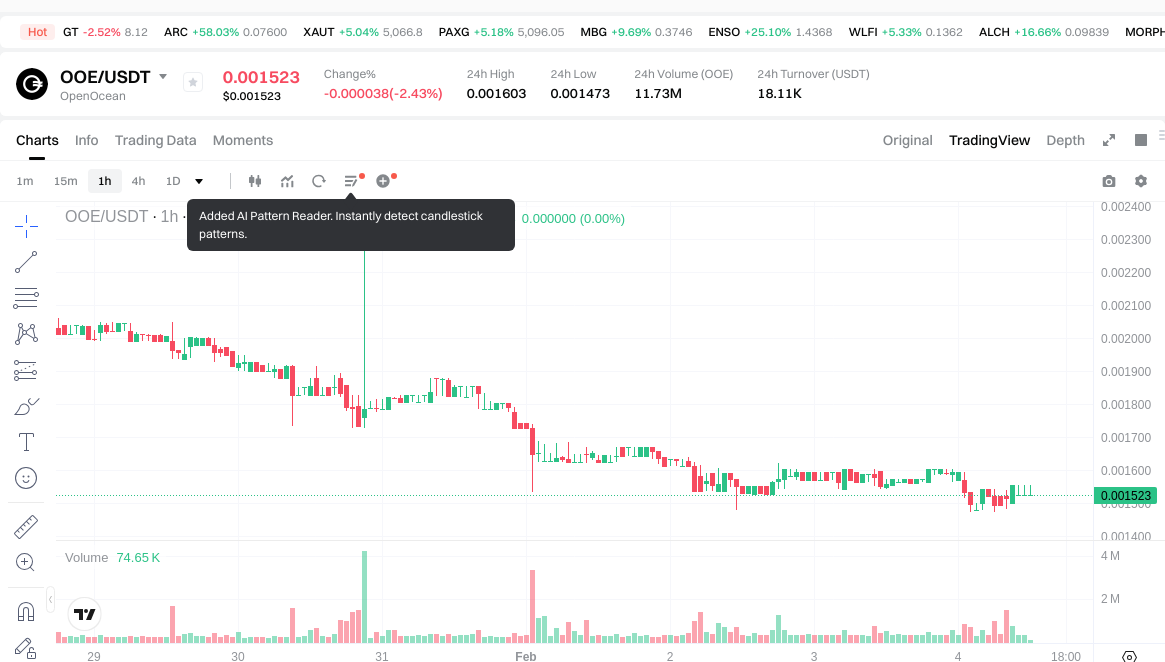
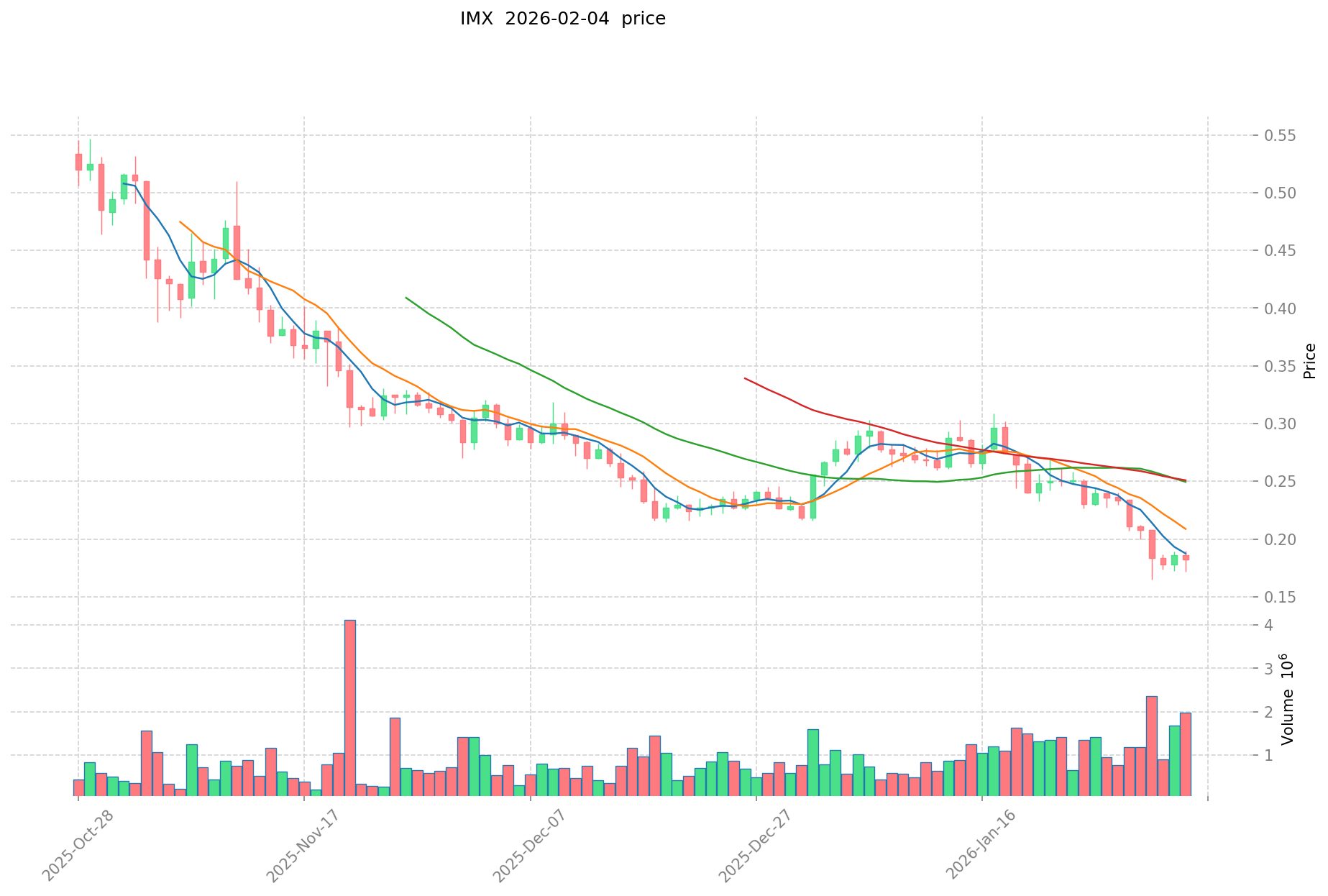
- Comparative Analysis: During the market cycle from late 2021 to early 2026, OOE experienced a significant decline from its peak of $1.034 to its all-time low of $0.00146913 recorded on February 4, 2026, representing a substantial decrease. In contrast, IMX declined from $9.52 to its all-time low of $0.172415, also recorded on February 4, 2026, showing a similar downward trajectory but maintaining a relatively higher price level in absolute terms.
Current Market Situation (February 4, 2026)
- OOE Current Price: $0.001523
- IMX Current Price: $0.1874
- 24-Hour Trading Volume: OOE recorded $18,161.80 compared to IMX's $373,554.75
- Market Sentiment Index (Fear & Greed Index): 14 (Extreme Fear)
View real-time prices:
II. Core Factors Influencing OOE vs IMX Investment Value
Supply Mechanism Comparison (Tokenomics)
Based on available information, the specific supply mechanisms for OOE and IMX require further detailed research. Market participants should examine token distribution models, inflation rates, and circulation dynamics when evaluating long-term value propositions.
📌 Historical Pattern: Supply mechanism design typically influences price cycles through scarcity effects and market liquidity conditions.
Institutional Adoption and Market Applications
- Institutional Holdings: Current data does not provide sufficient detail on institutional preferences between these assets.
- Enterprise Adoption: The enterprise-level adoption patterns for cross-border payments, settlement solutions, and portfolio integration remain an area requiring additional investigation.
- National Policies: Regulatory attitudes toward both assets vary across jurisdictions, with evolving frameworks potentially impacting market dynamics.
Technology Development and Ecosystem Building
- IMX Technology Development: IMX has demonstrated focus on technology innovation within the gaming and NFT sectors, contributing to ecosystem expansion.
- Ecosystem Comparison: Both projects show varying degrees of involvement in DeFi, NFT markets, payment solutions, and smart contract implementations. IMX has notable presence in gaming-related blockchain applications.
Macroeconomic Environment and Market Cycles
- Performance in Inflationary Environments: The anti-inflation properties of digital assets depend on multiple factors including market perception, adoption rates, and technological advancement.
- Macroeconomic Monetary Policy: Interest rate fluctuations and US dollar index movements may influence cryptocurrency valuations through capital flow dynamics.
- Geopolitical Factors: Cross-border transaction demand and international developments continue to shape the broader cryptocurrency market landscape.
III. 2026-2031 Price Prediction: OOE vs IMX
Short-term Prediction (2026)
- OOE: Conservative $0.00095949 - $0.001523 | Optimistic $0.001523 - $0.00187329
- IMX: Conservative $0.108286 - $0.1867 | Optimistic $0.1867 - $0.259513
Medium-term Prediction (2028-2029)
- OOE may enter a gradual growth phase, with expected price range of $0.001045 - $0.002410
- IMX may enter an expansion phase, with expected price range of $0.1855 - $0.3724
- Key drivers: institutional capital inflow, ETF developments, ecosystem expansion
Long-term Prediction (2031)
- OOE: Baseline scenario $0.0018802 - $0.002293 | Optimistic scenario $0.002293 - $0.003279
- IMX: Baseline scenario $0.2981 - $0.3680 | Optimistic scenario $0.3680 - $0.4416
View detailed price predictions for OOE and IMX
Disclaimer
OOE:
| Year |
Predicted High Price |
Predicted Average Price |
Predicted Low Price |
Price Change |
| 2026 |
0.00187329 |
0.001523 |
0.00095949 |
0 |
| 2027 |
0.0021736256 |
0.001698145 |
0.0010528499 |
11 |
| 2028 |
0.002148832683 |
0.0019358853 |
0.001045378062 |
27 |
| 2029 |
0.00240998360997 |
0.0020423589915 |
0.0016338871932 |
34 |
| 2030 |
0.002359741578779 |
0.002226171300735 |
0.001313441067433 |
46 |
| 2031 |
0.003278927708852 |
0.002292956439757 |
0.0018802242806 |
50 |
IMX:
| Year |
Predicted High Price |
Predicted Average Price |
Predicted Low Price |
Price Change |
| 2026 |
0.259513 |
0.1867 |
0.108286 |
0 |
| 2027 |
0.292269515 |
0.2231065 |
0.194102655 |
19 |
| 2028 |
0.347878810125 |
0.2576880075 |
0.1855353654 |
37 |
| 2029 |
0.372423592839375 |
0.3027834088125 |
0.24222672705 |
61 |
| 2030 |
0.398372130974606 |
0.337603500825937 |
0.229570380561637 |
80 |
| 2031 |
0.441585379080326 |
0.367987815900271 |
0.29807013087922 |
96 |
IV. Investment Strategy Comparison: OOE vs IMX
Long-term vs Short-term Investment Strategies
- OOE: May appeal to investors focusing on decentralized exchange aggregation and trading optimization scenarios, particularly those seeking exposure to DEX infrastructure with higher risk tolerance for emerging protocols
- IMX: May suit investors interested in NFT infrastructure and gaming ecosystem development, particularly those seeking exposure to Layer 2 scaling solutions with established market positioning
Risk Management and Asset Allocation
- Conservative Investors: OOE 20-30% vs IMX 70-80% allocation could reflect the relative market maturity and trading volume differences
- Aggressive Investors: OOE 40-50% vs IMX 50-60% allocation may accommodate higher risk appetite with emphasis on growth potential
- Hedging Instruments: Stablecoin reserves, options strategies, and cross-asset portfolio diversification remain essential risk management tools
V. Potential Risk Comparison
Market Risks
- OOE: Faces considerable volatility risk given the substantial price decline from historical peaks, limited trading volume relative to larger market cap assets, and sensitivity to broader DEX adoption trends
- IMX: Subject to volatility influenced by NFT market cycles, gaming sector adoption rates, and competition from alternative Layer 2 solutions
Technology Risks
- OOE: Scalability challenges in routing optimization, network stability considerations, and dependency on underlying DEX protocol performance
- IMX: Layer 2 infrastructure dependencies, potential security vulnerabilities in smart contract implementations, and technical challenges in maintaining zero gas fee structures
Regulatory Risks
- Global regulatory frameworks continue evolving with varying approaches to DeFi protocols and NFT platforms, potentially affecting both assets differently based on their respective use cases and jurisdictional operations
VI. Conclusion: Which Is the Better Buy?
📌 Investment Value Summary:
- OOE Advantages: Positioned in the DEX aggregation infrastructure sector with smart routing technology, offering potential exposure to decentralized trading growth, though currently experiencing significant price compression
- IMX Advantages: Established presence in NFT and gaming infrastructure with Layer 2 scaling technology, demonstrating relatively higher trading volumes and maintaining stronger price levels compared to historical performance
✅ Investment Recommendations:
- Novice Investors: Consider starting with assets demonstrating more established market presence and higher trading volumes while maintaining strict risk management protocols
- Experienced Investors: May evaluate portfolio diversification across both assets based on individual risk tolerance, sector exposure preferences, and technical understanding of underlying protocols
- Institutional Investors: Should conduct comprehensive due diligence on technology infrastructure, regulatory compliance frameworks, and long-term ecosystem development potential before allocation decisions
⚠️ Risk Disclosure: The cryptocurrency market exhibits extreme volatility characteristics. This analysis does not constitute investment advice. Market participants should conduct independent research and consult qualified financial advisors before making investment decisions.
VII. FAQ
Q1: What are the current price levels of OOE and IMX, and how do they compare to their historical peaks?
As of February 4, 2026, OOE is trading at $0.001523, while IMX is priced at $0.1874. Both tokens have experienced substantial declines from their all-time highs: OOE peaked at $1.034 on September 3, 2021, representing a decline of approximately 99.85%, while IMX reached its high of $9.52 on November 26, 2021, showing a decline of approximately 98.03%. Despite both experiencing significant corrections during the bear market cycle, IMX has maintained a relatively stronger price level in absolute terms and demonstrates considerably higher trading volume ($373,554.75 vs $18,161.80 in 24-hour volume), suggesting more robust market liquidity and investor interest.
Q2: What are the primary use cases and technological advantages of OOE versus IMX?
OOE functions as a decentralized exchange (DEX) aggregator launched in July 2021, providing a one-stop portal for both decentralized and centralized exchange trading through deeply optimized smart routing algorithms to deliver optimal prices and minimal slippage for traders. IMX, launched in November 2021, serves as a Layer 2 scaling solution specifically designed for NFTs on Ethereum, offering instant transactions, massive scalability, and zero gas fees for minting and trading. The fundamental difference lies in their market positioning: OOE focuses on trading infrastructure optimization across multiple exchanges, while IMX specializes in NFT and gaming ecosystem infrastructure with established presence in blockchain gaming applications.
Q3: What are the price predictions for OOE and IMX through 2031?
For 2026, OOE's conservative prediction ranges from $0.00095949 to $0.001523, with an optimistic scenario reaching $0.00187329, while IMX is conservatively predicted between $0.108286 and $0.1867, with optimistic projections up to $0.259513. By 2031, OOE's baseline scenario projects $0.0018802 to $0.002293, with optimistic scenarios reaching $0.003279, representing a potential 50% increase from 2026 levels. IMX's 2031 baseline scenario estimates $0.2981 to $0.3680, with optimistic projections up to $0.4416, indicating a potential 96% increase. These predictions suggest both assets may experience gradual recovery, though IMX demonstrates relatively stronger projected growth trajectories based on its established market position and higher trading volumes.
Q4: How should investors allocate between OOE and IMX based on risk tolerance?
Conservative investors seeking lower risk exposure might consider a 20-30% OOE and 70-80% IMX allocation, reflecting IMX's more established market positioning, higher trading volumes, and stronger price stability relative to OOE. Aggressive investors with higher risk tolerance pursuing growth potential could adopt a 40-50% OOE and 50-60% IMX allocation to capture potential upside from OOE's earlier-stage positioning while maintaining substantial exposure to IMX's more mature infrastructure. Both strategies should incorporate essential risk management tools including stablecoin reserves, options strategies, and cross-asset portfolio diversification. Novice investors are advised to start with assets demonstrating more established market presence and higher trading volumes while maintaining strict risk management protocols.
Q5: What are the primary risks associated with investing in OOE versus IMX?
OOE faces considerable market risks including extreme volatility given its 99.85% decline from historical peaks, significantly limited trading volume ($18,161.80 daily), high sensitivity to broader DEX adoption trends, and technology risks related to scalability challenges in routing optimization and dependency on underlying DEX protocol performance. IMX encounters market risks tied to NFT market cycles, gaming sector adoption rates, and competition from alternative Layer 2 solutions, alongside technology risks including Layer 2 infrastructure dependencies, potential smart contract security vulnerabilities, and technical challenges in maintaining zero gas fee structures. Both assets face evolving regulatory risks as global frameworks continue developing with varying approaches to DeFi protocols and NFT platforms, potentially affecting each asset differently based on their respective use cases and jurisdictional operations.
Q6: Which token is more suitable for investors interested in DeFi versus NFT ecosystems?
OOE is more suitable for investors seeking exposure to DeFi infrastructure, specifically decentralized exchange aggregation and trading optimization scenarios, as it functions as a one-stop portal utilizing smart routing algorithms across multiple trading venues. This positioning appeals to those focusing on DEX infrastructure development with higher risk tolerance for emerging protocols in the trading optimization sector. IMX is better suited for investors interested in NFT infrastructure and gaming ecosystem development, particularly those seeking exposure to Layer 2 scaling solutions with established market positioning in blockchain gaming applications. IMX's zero gas fee structure for minting and trading, combined with instant transactions and massive scalability, makes it specifically attractive for participants in the NFT and gaming sectors rather than traditional DeFi trading activities.
Q7: How does the current market sentiment affect OOE and IMX investment decisions?
The current Fear & Greed Index stands at 14, indicating "Extreme Fear" in the cryptocurrency market as of February 4, 2026. This extreme bearish sentiment typically creates both opportunities and risks: historically, extreme fear levels have sometimes preceded market bottoms and potential recovery periods, but can also signal further downside potential if negative catalysts persist. For OOE, trading near its all-time low of $0.00146913 with minimal trading volume, extreme fear conditions suggest heightened risk of continued price compression despite potential upside if market sentiment reverses. For IMX, while also at its all-time low of $0.172415, its substantially higher trading volume and more established ecosystem positioning may provide relatively better resilience during extreme fear periods. Investors should recognize that extreme fear environments require enhanced caution, strict risk management protocols, and potentially favor dollar-cost averaging strategies over large single-entry positions.
Q8: What institutional and ecosystem developments should investors monitor for OOE and IMX?
Investors should monitor several critical development areas for both tokens. For OOE, key indicators include: expansion of DEX protocol integrations, improvements in routing algorithm efficiency, trading volume growth across supported platforms, and potential institutional adoption of aggregation infrastructure. For IMX, important developments comprise: growth in gaming partnerships and NFT marketplace integrations, Layer 2 technology upgrades and security enhancements, expansion of the gaming ecosystem built on IMX infrastructure, and institutional involvement in NFT infrastructure solutions. Both assets require attention to regulatory framework evolution, particularly regarding DeFi protocols and NFT platforms across major jurisdictions. Additionally, investors should track macroeconomic factors including interest rate policies, US dollar index movements, and capital flow dynamics that influence cryptocurrency valuations, as well as sector-specific catalysts such as ETF developments and enterprise-level adoption patterns that could significantly impact long-term value propositions.
* The information is not intended to be and does not constitute financial advice or any other recommendation of any sort offered or endorsed by Gate.