RFC vs APT: Choosing the Right Approach for Your Network Security Strategy


Introduction: RFC vs APT Investment Comparison
In the cryptocurrency market, the comparison between RFC vs APT has always been a topic that investors cannot avoid. The two not only show significant differences in market cap ranking, application scenarios, and price performance, but also represent different crypto asset positioning. RFC (Retard Finder Coin): Launched in January 2025, it has gained market attention with its positioning as a community-driven meme coin on Solana, emphasizing freedom of speech and decentralized finance spirit. APT (Aptos): Since its launch in October 2022, it has been recognized as a high-performance Layer 1 blockchain, focusing on secure and scalable blockchain infrastructure through the Move programming language. This article will comprehensively analyze the investment value comparison of RFC vs APT around historical price trends, supply mechanisms, institutional adoption, technical ecosystems, and future predictions, and attempt to answer the most concerning question for investors:
"Which is the better buy right now?"
I. Price History Comparison and Current Market Landscape
RFC (Coin A) and APT (Coin B) Historical Price Trends
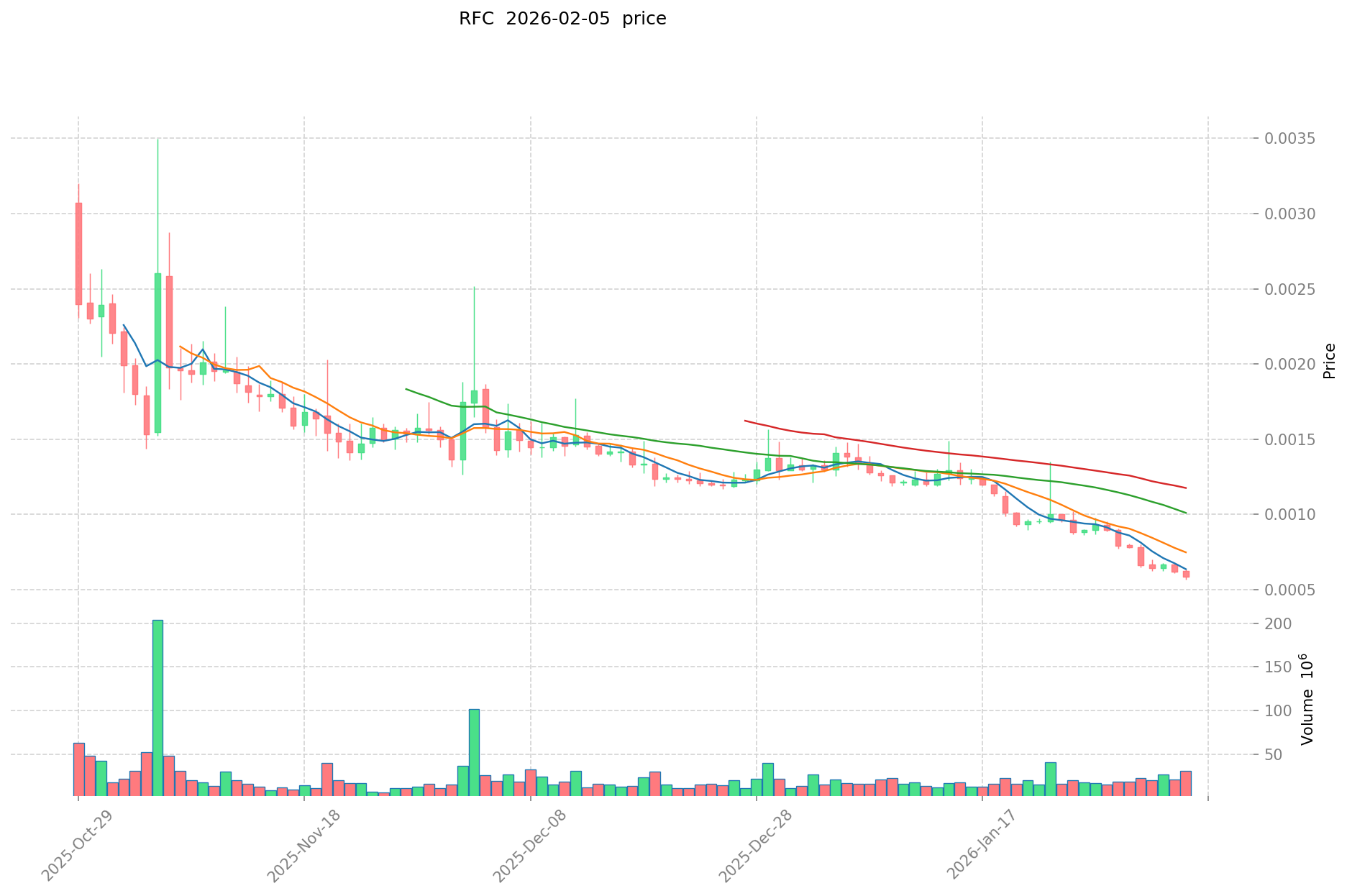
- 2025: RFC launched on Pump.fun in January 2025, experiencing notable volatility with a peak price of $0.14129 in April 2025.
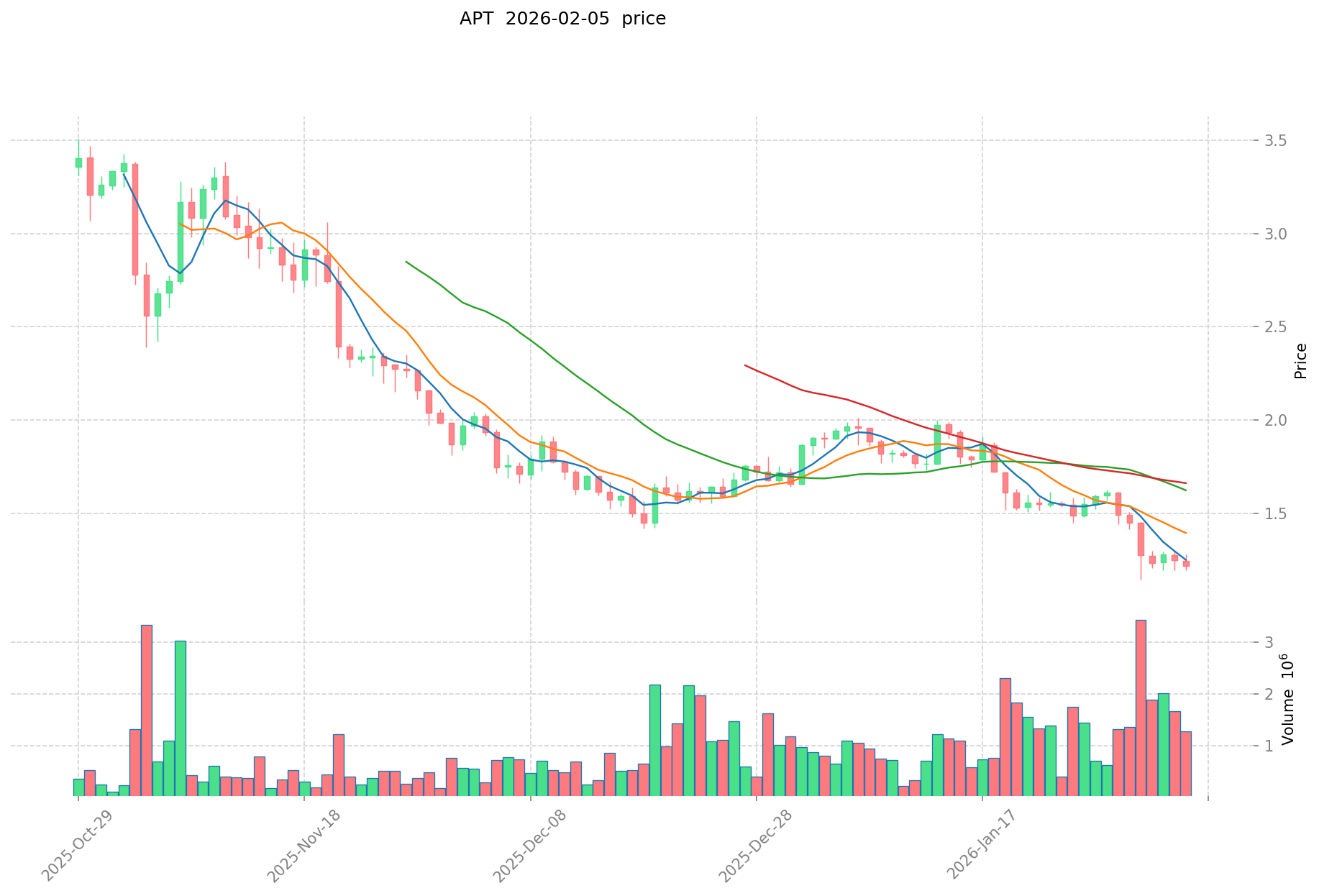
- 2022-2023: APT launched its mainnet in October 2022, reaching an all-time high of $19.92 in January 2023 during the initial market enthusiasm for Move-based blockchain technology.
- 2025-2026: RFC declined significantly from its April 2025 peak of $0.14129 to $0.0005655 by February 2026, representing substantial price compression. APT similarly experienced downward pressure, declining from previous levels to $1.2064.
- Comparative Analysis: During the recent market cycle, RFC experienced a decline from its high of $0.14129 to a low of $0.0005655, while APT declined from its historical high of $19.92 to current levels around $1.20, with both assets reflecting the broader market correction phase.
Current Market Status (2026-02-05)
- RFC Current Price: $0.0005853
- APT Current Price: $1.2064
- 24-Hour Trading Volume: RFC $18,607.25 vs APT $1,837,054.43
- Market Sentiment Index (Fear & Greed Index): 12 (Extreme Fear)
View Real-Time Prices:
- View RFC Current Price Market Price
- View APT Current Price Market Price
II. Core Factors Influencing RFC vs APT Investment Value
Supply Mechanism Comparison (Tokenomics)
- RFC: Supply mechanism information was not detailed in available materials. Network adoption and market sentiment appear to be primary value drivers according to fundamental analysis frameworks.
- APT: The Arbitrage Pricing Theory (APT) represents a financial asset pricing model rather than a cryptocurrency token, linking macroeconomic risk variables with asset pricing through multi-factor analysis.
- 📌 Historical Patterns: APT as a theoretical framework suggests that asset returns are influenced by multiple systematic factors including inflation rates, GDP growth, and industry-specific variables, rather than singular supply dynamics.
Institutional Adoption and Market Application
- Institutional Holdings: APT methodology is widely adopted by institutional investors and fund managers for portfolio construction and performance attribution, allowing decomposition of returns across different factor exposures.
- Enterprise Adoption: APT frameworks are utilized in risk management, asset allocation, and performance evaluation across financial institutions. RFC's enterprise adoption information was not substantiated in available materials.
- Regulatory Stance: APT represents an academic pricing model without direct regulatory implications. RFC's regulatory positioning across jurisdictions was not documented in reference materials.
Technological Development and Ecosystem Building
- RFC Technical Evolution: Network adoption rates and infrastructure development may influence valuation, though specific upgrade pathways were not detailed in available sources.
- APT Theoretical Development: As a pricing model, APT continues evolving through academic research, addressing factor identification challenges and estimation methodologies for factor betas and risk premiums.
- Ecosystem Comparison: APT's applicability extends across traditional finance for diversified portfolio construction and risk exposure management. RFC's presence in DeFi, NFT, payment systems, or smart contract implementations was not substantiated.
Macroeconomic Environment and Market Cycles
- Performance Under Inflation: APT framework explicitly incorporates inflation as a systematic risk factor affecting asset returns. RFC's inflation-hedging characteristics were not documented in available materials.
- Monetary Policy Impact: APT model accounts for interest rate changes and macroeconomic variables as systematic factors influencing expected returns across asset classes.
- Geopolitical Factors: APT methodology can integrate geopolitical risk factors into multi-factor pricing models. Cross-border transaction demand effects on RFC were not substantiated in reference materials.
III. 2026-2031 Price Prediction: RFC vs APT
Short-term Prediction (2026)
- RFC: Conservative $0.000380445 - $0.0005853 | Optimistic $0.0005853 - $0.000825273
- APT: Conservative $0.749022 - $1.2081 | Optimistic $1.2081 - $1.437639
Mid-term Prediction (2028-2029)
- RFC may enter a phase of gradual growth, with estimated price range of $0.000574380 - $0.001267597
- APT may enter a phase of market expansion, with estimated price range of $0.811249 - $2.505434
- Key drivers: institutional capital inflows, ETF developments, ecosystem growth
Long-term Prediction (2030-2031)
- RFC: Baseline scenario $0.000895260 - $0.001128953 | Optimistic scenario $0.001128953 - $0.001735427
- APT: Baseline scenario $1.406809 - $2.093466 | Optimistic scenario $2.093466 - $3.259109
Disclaimer
RFC:
| Year | Predicted High Price | Predicted Average Price | Predicted Low Price | Price Change |
|---|---|---|---|---|
| 2026 | 0.000825273 | 0.0005853 | 0.000380445 | 0 |
| 2027 | 0.000980348235 | 0.0007052865 | 0.000557176335 | 20 |
| 2028 | 0.001137803446125 | 0.0008428173675 | 0.0007753919781 | 43 |
| 2029 | 0.00126759732072 | 0.000990310406812 | 0.000574380035951 | 69 |
| 2030 | 0.001625693563823 | 0.001128953863766 | 0.000903163091013 | 92 |
| 2031 | 0.001735427879381 | 0.001377323713794 | 0.000895260413966 | 135 |
APT:
| Year | Predicted High Price | Predicted Average Price | Predicted Low Price | Price Change |
|---|---|---|---|---|
| 2026 | 1.437639 | 1.2081 | 0.749022 | 0 |
| 2027 | 1.627129485 | 1.3228695 | 1.124439075 | 9 |
| 2028 | 1.8879993504 | 1.4749994925 | 0.811249720875 | 22 |
| 2029 | 2.5054341379605 | 1.68149942145 | 1.3620145313745 | 39 |
| 2030 | 2.59589880683451 | 2.09346677970525 | 1.884120101734725 | 73 |
| 2031 | 3.259109082645133 | 2.34468279326988 | 1.406809675961928 | 94 |
IV. Investment Strategy Comparison: RFC vs APT
Long-term vs Short-term Investment Strategies
- RFC: May appeal to investors with higher risk tolerance seeking exposure to community-driven meme coin dynamics and potential speculative opportunities, though substantial volatility characterizes its price history.
- APT: The Arbitrage Pricing Theory framework serves institutional investors and portfolio managers focusing on systematic risk factor analysis, multi-factor asset pricing models, and diversified portfolio construction methodologies.
Risk Management and Asset Allocation
- Conservative Investors: Given RFC's historical volatility from $0.14129 to $0.0005655 and APT's theoretical framework application in traditional finance, conservative allocations would prioritize established asset classes with systematic factor exposure analysis over speculative positions.
- Aggressive Investors: Higher-risk portfolios might incorporate speculative positions in volatile assets like RFC alongside traditional holdings, while utilizing APT methodology for factor-based risk decomposition and performance attribution.
- Hedging Instruments: Risk management approaches may include stablecoin positions, options strategies for downside protection, and cross-asset diversification informed by multi-factor pricing frameworks.
V. Potential Risk Comparison
Market Risk
- RFC: Exhibits substantial price volatility with a decline from $0.14129 (April 2025) to $0.0005655 (February 2026), reflecting sensitivity to market sentiment shifts and limited trading volume of $18,607.25 in the current extreme fear market environment (Fear & Greed Index: 12).
- APT: As a theoretical pricing model rather than a tradeable asset, APT framework addresses systematic market risks through multi-factor analysis, though its application depends on accurate factor identification and estimation of factor risk premiums.
Technical Risk
- RFC: Specific information regarding network scalability, infrastructure stability, or technical upgrade pathways was not substantiated in available materials, though blockchain-based assets generally face considerations around transaction throughput and network security.
- APT: The theoretical framework encounters challenges in factor selection, estimation accuracy of factor betas, and identification of relevant macroeconomic variables that systematically influence asset returns across different market conditions.
Regulatory Risk
- RFC's regulatory positioning across different jurisdictions was not documented in reference materials, though meme coins typically face evolving regulatory scrutiny regarding investor protection and market manipulation concerns.
- APT represents an academic asset pricing model without direct regulatory implications, though its application in institutional portfolio management operates within existing financial regulatory frameworks.
VI. Conclusion: Which Is the Better Buy?
📌 Investment Value Summary:
- RFC Characteristics: Community-driven meme coin with substantial historical volatility, operating on Solana blockchain, though specific technical advantages and ecosystem development were not detailed in available materials.
- APT Characteristics: Established multi-factor asset pricing framework widely adopted in institutional finance for portfolio construction, risk management, and performance attribution, enabling systematic analysis of macroeconomic factor exposures.
✅ Investment Considerations:
- Novice Investors: Should prioritize understanding fundamental differences between speculative meme coins and theoretical pricing frameworks, recognizing that RFC represents a tradeable digital asset while APT denotes an academic model for asset pricing analysis.
- Experienced Investors: May evaluate RFC within a diversified portfolio context considering its volatility profile and limited trading volume, while applying APT methodology for systematic risk factor analysis across traditional and digital asset allocations.
- Institutional Investors: Likely to utilize APT framework for multi-factor portfolio construction and risk decomposition, with any speculative digital asset allocation representing a minor portfolio component subject to rigorous risk management protocols.
⚠️ Risk Disclosure: Cryptocurrency markets demonstrate substantial volatility. This content does not constitute investment advice. Investors should conduct independent research and consider their risk tolerance before making investment decisions.
VII. FAQ
Q1: What is the fundamental difference between RFC and APT?
RFC is a community-driven meme coin launched on Solana in January 2025, while APT (Arbitrage Pricing Theory) is an academic asset pricing framework used for multi-factor financial analysis. RFC represents a tradeable digital asset with current price of $0.0005853, whereas APT is not a cryptocurrency but rather a theoretical model employed by institutional investors for portfolio construction and risk management through systematic factor exposure analysis.
Q2: Why has RFC experienced such significant price volatility compared to APT?
RFC declined approximately 99.6% from its peak of $0.14129 in April 2025 to $0.0005655 by February 2026, reflecting the characteristic volatility of meme coins driven by community sentiment and speculative trading. APT, being a theoretical pricing model rather than a tradeable asset, does not experience price movements but serves as an analytical framework for evaluating how macroeconomic factors influence asset returns across different market conditions.
Q3: Which asset is more suitable for conservative investors?
Conservative investors should recognize that RFC carries substantial risk due to extreme volatility, limited trading volume ($18,607.25), and speculative nature characteristic of meme coins. APT methodology, conversely, provides institutional investors with systematic approaches to portfolio diversification and risk factor analysis. Conservative allocations would prioritize established asset classes with transparent factor exposures over speculative positions in highly volatile digital assets like RFC.
Q4: How do institutional investors utilize APT framework compared to investing in RFC?
Institutional investors apply APT methodology for decomposing portfolio returns across multiple systematic risk factors including inflation rates, interest rates, and GDP growth, enabling sophisticated risk management and performance attribution. RFC investment, given its meme coin characteristics and extreme volatility, would typically represent only a minor speculative allocation within institutional portfolios, subject to rigorous risk management protocols and position sizing constraints.
Q5: What are the primary risks associated with RFC investment in the current market environment?
RFC faces three critical risk categories: (1) Market risk evidenced by 99.6% decline from peak and current extreme fear sentiment (Fear & Greed Index: 12), (2) Liquidity risk reflected in limited 24-hour trading volume of $18,607.25, and (3) Regulatory uncertainty common to meme coins across different jurisdictions. These factors compound to create substantial downside exposure for investors without corresponding systematic risk premiums analyzed through traditional pricing frameworks.
Q6: Can APT framework be applied to evaluate RFC investment decisions?
APT methodology could theoretically decompose RFC returns into systematic factor exposures including overall crypto market movements, Solana ecosystem performance, and meme coin sector dynamics. However, RFC's extreme volatility, limited trading history since January 2025, and community-sentiment-driven price action make factor identification and beta estimation challenging. Traditional APT applications focus on assets with established return histories and identifiable macroeconomic sensitivities rather than speculative meme coins.
Q7: What is the outlook for RFC vs APT framework relevance through 2031?
Price predictions suggest RFC may range from $0.000380445 to $0.001735427 through 2031, though substantial uncertainty surrounds meme coin valuations dependent on community engagement and speculative cycles. APT framework relevance is expected to strengthen as institutional investors increasingly require sophisticated multi-factor models for portfolio construction across traditional and digital assets, addressing systematic risk exposures rather than speculative positioning.
Q8: Should investors prioritize RFC or utilize APT methodology for portfolio decisions?
This comparison conflates a speculative digital asset (RFC) with an analytical framework (APT). Investors should recognize that RFC represents a high-risk, high-volatility position suitable only for capital allocated to speculative opportunities with tolerance for potential total loss. APT methodology provides systematic approaches to portfolio construction, risk decomposition, and factor exposure management applicable across diversified holdings. Prudent investment strategies would employ APT framework for overall portfolio analysis while treating any RFC allocation as a minor speculative component subject to strict risk controls.
Share
Content
Introduction: RFC vs APT Investment Comparison
I. Price History Comparison and Current Market Landscape
II. Core Factors Influencing RFC vs APT Investment Value
III. 2026-2031 Price Prediction: RFC vs APT
IV. Investment Strategy Comparison: RFC vs APT
V. Potential Risk Comparison
VI. Conclusion: Which Is the Better Buy?
VII. FAQ
How to Buy Cryptocurrency


Trending Cryptocurrencies



2025 SUI coin: price, buying guide, and Staking rewards

How to Buy Crypto: A Step-by-Step Guide with Gate.com
HNT Price in 2025: Helium Network Token Value and Market Analysis

What is SwissCheese (SWCH) and How Does It Democratize Investment?

Cardano (ADA) Price Analysis and Outlook for 2025

How to Invest in Metaverse Crypto

What Is Risk to Reward Ratio and How to Use It Effectively

Comprehensive Guide to Phil Konieczny: Cryptocurrency Education, Investment Solutions, and Financial Freedom

What are NFT games?

Latest Corporate Rankings: Bitcoin & Cryptocurrency Holdings

What Is Polkadot? How Does It Work? Investment Analysis