RON vs RUNE: A Comprehensive Comparison of Two Major Blockchain Tokens

Introduction: RON vs RUNE Investment Comparison
In the cryptocurrency market, comparisons between RON and RUNE have always been a topic investors cannot ignore. The two not only show significant differences in market capitalization ranking, application scenarios, and price performance, but also represent different positioning within the crypto asset landscape. RON (Ronin Network): Since its launch in 2022, it has gained market recognition by leveraging its positioning as an Ethereum sidechain specifically developed for gaming applications, significantly reducing user costs and transaction speeds while lowering onboarding barriers through integrated payment gateways. RUNE (THORChain): Since its introduction in 2019, it has been recognized as a highly optimized multi-chain protocol utilizing pBFT consensus to achieve sub-second block finality, facilitating protocol-level cross-chain transactions and order matching while enabling token holders to receive staking rewards. This article will comprehensively analyze the investment value comparison between RON and RUNE across historical price trends, tokenomics, ecosystem development, and market positioning, while attempting to answer the question investors care about most:
"Which is the better buy right now?"
Comparative Market Analysis: Ronin Network (RON) and THORChain (RUNE)
I. Historical Price Comparison and Current Market Status
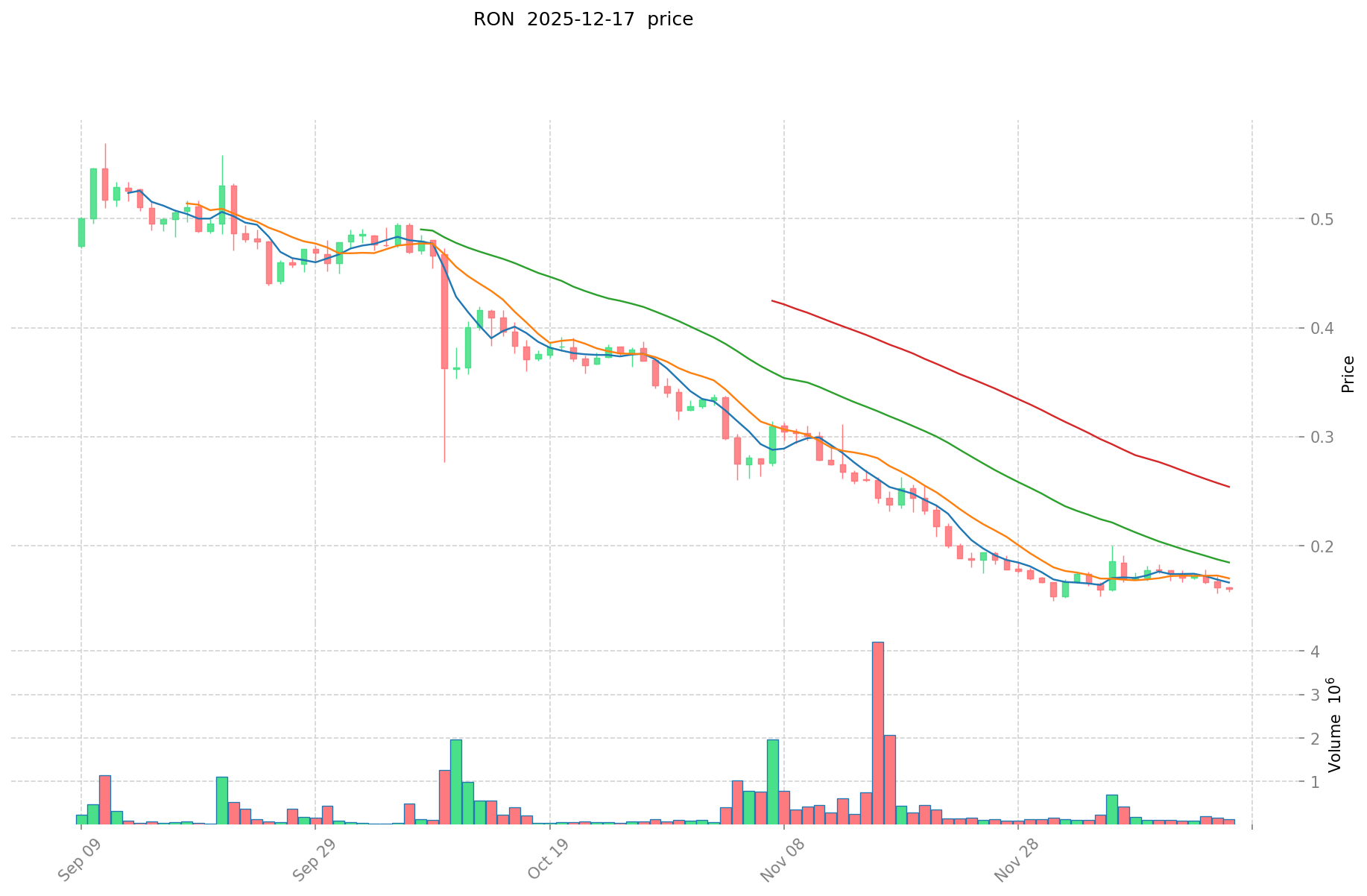
Historical Price Trajectories of RON and RUNE
RON (Ronin Network):
- All-Time High (ATH): $4.45, recorded on March 26, 2024
- All-Time Low (ATL): $0.150031, recorded on December 1, 2025
- Current Price (December 17, 2025): $0.1562
- Year-over-Year Performance: -93.15%
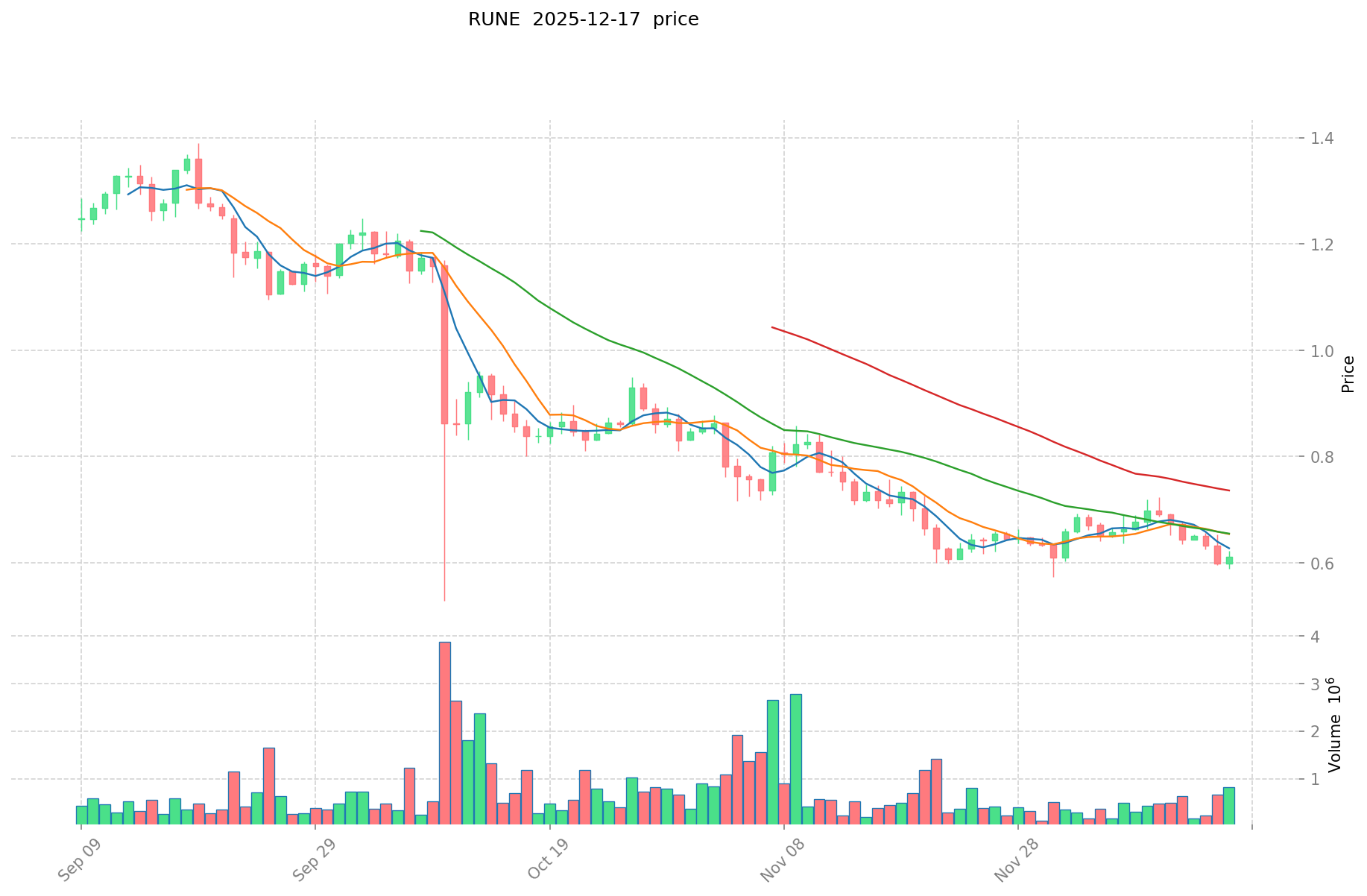
RUNE (THORChain):
- All-Time High (ATH): $20.87, recorded on May 19, 2021
- All-Time Low (ATL): $0.00851264, recorded on September 28, 2019
- Current Price (December 17, 2025): $0.6052
- Year-over-Year Performance: -91.25%
Comparative Analysis
Both assets exhibit severe downward pressure from their historical peaks. RON has deteriorated 96.50% from its ATH to current levels, while RUNE has declined 97.10% from its peak. Both tokens have experienced particularly acute declines over the past year, with RON and RUNE each losing more than 90% of their value in the 12-month period ending December 17, 2025.
In terms of cyclical positioning, RON has recently approached its all-time low, trading just marginally above the $0.150031 floor established in early December 2025. RUNE maintains relatively greater distance from its historical nadir, though both assets reflect the severe contraction characteristic of the current market environment.
Current Market Status (December 17, 2025)
RON Performance Metrics:
- Current Price: $0.1562
- 24-Hour Price Change: -2.86%
- 24-Hour Trading Volume: $18,102.87
- Market Capitalization: $156.20 million (fully diluted valuation)
- Circulating Supply: 721.09 million tokens (72.11% of total supply)
- 24-Hour Range: $0.1549 - $0.1622
- 7-Day Performance: -11.37%
- 30-Day Performance: -36.99%
RUNE Performance Metrics:
- Current Price: $0.6052
- 24-Hour Price Change: +1.23%
- 24-Hour Trading Volume: $468,570.61
- Market Capitalization: $257.26 million (fully diluted valuation)
- Circulating Supply: 351.07 million tokens (70.21% of total supply)
- 24-Hour Range: $0.5935 - $0.622
- 7-Day Performance: -13.30%
- 30-Day Performance: -18.45%
Market Sentiment Index
Crypto Fear & Greed Index: 16 (Extreme Fear)
The prevailing market sentiment indicates extreme fear, reflecting widespread investor anxiety and risk aversion across the cryptocurrency sector. This psychological state typically correlates with increased volatility and compressed valuations.
II. Project Architecture and Functional Overview
RON (Ronin Network)
Ronin Network functions as an Ethereum sidechain specifically architected by Sky Mavis for the Axie Infinity gaming ecosystem. The network redistributes computational operations from the Ethereum mainchain to a dedicated application-specific blockchain, achieving significant improvements across multiple dimensions:
- Cost Reduction: User operational expenses decreased by multiple orders of magnitude compared to mainchain execution
- Latency Improvement: Transaction response times accelerated substantially
- Onboarding Infrastructure: Integrated payment gateway functionality substantially lowered capital entry barriers
RUNE (THORChain)
THORChain represents a highly optimized multi-chain architecture utilizing practical Byzantine Fault Tolerance (pBFT) consensus mechanisms to achieve sub-second block finality. The protocol incorporates distinctive structural features:
- Token Trading Model: Tokens operate on individual chains designated as TokenChains with discrete address space architectures
- Scalability Design: Multi-component sharding enables Byzantine-resistant scaling capacity
- Protocol Functions: Native protocol infrastructure facilitates protocol-level chain transactions, order matching, with support for both limit and market order types
RUNE Token Utility: RUNE serves multiple functional roles within the THORChain ecosystem: transaction fee payment, liquidity maintenance, block reward distribution, and network security collateralization. Token holders derive dividend compensation.
III. Market Positioning and Capitalization Metrics
| Metric | RON | RUNE |
|---|---|---|
| Market Cap Rank | #316 | #222 |
| Market Capitalization | $156.20 million | $257.26 million |
| Fully Diluted Valuation | $156.20 million | $257.26 million |
| Market Cap to FDV Ratio | 100% | 100% |
| Market Dominance | 0.0049% | 0.0082% |
| Exchange Listings | 17 | 25 |
RUNE maintains superior market positioning, ranking approximately 94 positions higher than RON on aggregate market capitalization metrics. RUNE's capitalization exceeds RON's by 64.8%, while RUNE demonstrates broader exchange accessibility with 25 listings compared to RON's 17 exchange integrations.
IV. Price Movement Analysis and Short-Term Dynamics
RON Short-Term Volatility
| Timeframe | Change |
|---|---|
| 1 Hour | -0.13% |
| 24 Hours | -2.86% |
| 7 Days | -11.37% |
| 30 Days | -36.99% |
RON exhibits consistent downward pressure across all analyzed timeframes, with momentum acceleration evident at extended periods. The 30-day decline of -36.99% substantially exceeds the 7-day performance of -11.37%, indicating intensifying selling pressure over the medium term.
RUNE Short-Term Volatility
| Timeframe | Change |
|---|---|
| 1 Hour | +0.45% |
| 24 Hours | +1.23% |
| 7 Days | -13.30% |
| 30 Days | -18.45% |
RUNE exhibits divergent dynamics relative to RON. While both assets decline over 7-day and 30-day periods, RUNE achieved positive short-term appreciation on both 1-hour and 24-hour timeframes, suggesting potential consolidation or reversal attempt within the broader downtrend.
V. Supply Metrics and Token Distribution
RON Supply Structure
- Total Supply: 1,000,000,000 tokens
- Circulating Supply: 721,086,808.96 tokens (72.11%)
- Circulating Ratio: 72.11%
- Max Supply: 1,000,000,000 tokens (capped)
RUNE Supply Structure
- Total Supply: 425,079,092 tokens
- Circulating Supply: 351,065,936 tokens (70.21%)
- Circulating Ratio: 70.21%
- Max Supply: 500,000,000 tokens
RON operates under a fixed 1 billion token cap, while RUNE's maximum supply extends to 500 million tokens with current circulation representing approximately two-thirds of the ultimate cap. Both tokens maintain comparable circulating ratios, indicating relatively mature distribution phases relative to their respective maximum supply schedules.
VI. Market Infrastructure and Accessibility
| Parameter | RON | RUNE |
|---|---|---|
| Primary Website | roninchain.com | thorchain.org, thorchain.com |
| Block Explorer | explorer.roninchain.com | viewblock.io |
| Trading Pairs | 17 exchanges | 25 exchanges |
| Developer Resources | GitHub | GitHub available |
| Community Channels | Limited social presence | Twitter, Reddit, Facebook presence |
RUNE demonstrates substantially broader ecosystem development and community engagement infrastructure, with established presence across multiple social platforms and whitepaper documentation. RON's infrastructure remains more narrowly focused on primary network operations.
Investment Value Analysis: RON vs RUNE
I. Executive Summary
RON and RUNE represent two distinct value capture mechanisms within their respective blockchain ecosystems. RON derives value from the Ronin Network ecosystem development and market demand, while RUNE's value is influenced by THORChain network technical progress and market sentiment. This report analyzes the core factors affecting both tokens' investment value based on available market research.
II. Core Factors Influencing RON vs RUNE Investment Value
Token Utility and Core Functions
RON - Ronin Network Native Asset:
- Primary function tied to ecosystem participation and network security within the Ronin Network
- Value proposition depends on ecosystem development trajectory and adoption rates
RUNE - THORChain Native Asset:
- Four core use cases: collateral, security, governance, and base trading pair
- Serves as the fundamental asset for cross-chain liquidity provision on THORChain protocol
- Directly captures value through protocol usage and transaction flows
Revenue Capture Mechanisms
The valuation foundation for both tokens depends critically on whether protocol revenues are effectively captured by token holders:
-
Revenue-to-Token Conversion: The primary valuation consideration is whether protocol revenues are captured through mechanisms such as:
- Token buybacks
- Token burning or deflation
- Dividend distributions
- Protocol development fund allocation
-
Critical Gap: If revenues flow entirely outside the protocol without token holder participation, intrinsic value creation is limited
Ecosystem Development and Adoption
RON:
- Value linked directly to Ronin Network ecosystem growth
- Key factors: DApp development, user adoption, transaction volume
RUNE:
- Value dependent on THORChain network expansion and technical innovation
- Cross-chain liquidity demand directly impacts token utility and demand
Market Sentiment and Adoption Narratives
The following factors influence price movements for RUNE/USD and RON/USD:
- Market Sentiment: Investor confidence and emotional factors create direct impact on price trajectories
- Technology Breakthroughs: Positive developments regarding widespread adoption or major technical innovations generate bullish market conditions
- Technical Progress: Network upgrades and protocol improvements drive medium-to-long-term value perception
Token Valuation Methodology
Assessment framework for both tokens should include:
- Historical price performance analysis
- Market supply and demand dynamics
- Ecosystem development trajectories
- Macroeconomic factor correlation
III. Comparative Investment Considerations
RON and RUNE investors should evaluate tokens based on ecosystem maturity, revenue capture mechanisms, technical development velocity, and market adoption rates rather than speculative price movements alone.
IV. Important Disclaimer
This analysis is based on available market information as of December 17, 2025. This report does not constitute investment advice, financial recommendation, or encouragement to buy or sell either asset. Cryptocurrency investments carry substantial risk. Investors should conduct independent research and consult financial professionals before making investment decisions.
III. 2025-2030 Price Forecast: RON vs RUNE
Short-term Forecast (2025)
- RON: Conservative $0.1169-$0.1559 | Optimistic $0.2151
- RUNE: Conservative $0.3455-$0.6062 | Optimistic $0.6304
Mid-term Forecast (2027-2028)
- RON may enter a consolidation phase with potential breakout, estimated price range $0.1012-$0.2501
- RUNE may experience sustained growth momentum, estimated price range $0.5050-$1.0942
- Key drivers: institutional capital inflow, ETF adoption, ecosystem development expansion
Long-term Forecast (2030)
- RON: Base scenario $0.1796-$0.2764 | Optimistic scenario $0.3648
- RUNE: Base scenario $0.7972-$1.1228 | Optimistic scenario $1.5383
Disclaimer: This analysis is based on historical data and predictive models. Cryptocurrency markets are highly volatile and unpredictable. Past performance does not guarantee future results. This information should not be considered investment advice. Investors should conduct their own research and consult with financial professionals before making investment decisions. All forecasts carry significant uncertainty and risk.
RON:
| 年份 | 预测最高价 | 预测平均价格 | 预测最低价 | 涨跌幅 |
|---|---|---|---|---|
| 2025 | 0.215142 | 0.1559 | 0.116925 | 0 |
| 2026 | 0.21149394 | 0.185521 | 0.13914075 | 18 |
| 2027 | 0.2501194122 | 0.19850747 | 0.1012388097 | 27 |
| 2028 | 0.275905532553 | 0.2243134411 | 0.186180156113 | 43 |
| 2029 | 0.302632479060065 | 0.2501094868265 | 0.21009196893426 | 60 |
| 2030 | 0.364809697485132 | 0.276370982943282 | 0.179641138913133 | 76 |
RUNE:
| 年份 | 预测最高价 | 预测平均价格 | 预测最低价 | 涨跌幅 |
|---|---|---|---|---|
| 2025 | 0.630448 | 0.6062 | 0.345534 | 0 |
| 2026 | 0.87802008 | 0.618324 | 0.38336088 | 2 |
| 2027 | 0.93521505 | 0.74817204 | 0.7032817176 | 23 |
| 2028 | 1.0942016085 | 0.841693545 | 0.505016127 | 39 |
| 2029 | 1.27769080131 | 0.96794757675 | 0.677563303725 | 59 |
| 2030 | 1.5382622889711 | 1.12281918903 | 0.7972016242113 | 85 |
Comprehensive Investment Analysis: RON vs RUNE
I. Investment Strategy Comparison: RON vs RUNE
Long-Term vs Short-Term Investment Strategies
RON (Ronin Network):
- Short-Term Strategy: Suitable for traders monitoring ecosystem developments and technical breakout patterns. Current proximity to all-time lows presents elevated volatility risk but potential recovery scenarios.
- Long-Term Strategy: Appropriate for investors with conviction in gaming ecosystem expansion and Ronin Network adoption. Long-term forecasts project potential appreciation to $0.1796-$0.3648 by 2030, requiring sustained ecosystem development execution.
RUNE (THORChain):
- Short-Term Strategy: Suitable for technical traders capitalizing on recent 24-hour positive momentum (+1.23%) and potential consolidation patterns. RUNE demonstrates relative stability compared to RON's steeper declines.
- Long-Term Strategy: Appropriate for investors seeking cross-chain infrastructure exposure. Long-term forecasts project more substantial appreciation potential, with base scenarios reaching $0.7972-$1.1228 by 2030 and optimistic scenarios extending to $1.5383.
Risk Management and Asset Allocation
Conservative Investor Profile:
- RON: 20% allocation | RUNE: 30% allocation | Stablecoins: 50%
- Rationale: Reduced exposure to both assets given extreme fear market sentiment and severe year-over-year declines exceeding 90%
Aggressive Investor Profile:
- RON: 30% allocation | RUNE: 35% allocation | Additional speculative positions: 35%
- Rationale: Enhanced positioning in RUNE reflecting superior market capitalization ranking, broader exchange accessibility, and relatively favorable short-term momentum
Hedging Instruments:
- Stablecoin allocation for capital preservation during extreme volatility periods
- Option strategies for downside protection
- Cross-asset diversification incorporating non-correlated cryptocurrency categories
- Dollar-cost averaging to mitigate timing risk across multi-year accumulation periods
II. Comparative Risk Analysis
Market Risk Factors
RON (Ronin Network) - Market Risks:
- Extreme price volatility: Trading 96.50% below all-time high, with only marginal distance from December 2025 all-time low of $0.150031
- Concentrated user base risk: Heavy dependency on Axie Infinity ecosystem adoption and gaming market cycles
- Lower trading volume ($18,102.87 daily) creates liquidity risk and wider bid-ask spreads during market stress periods
- Severe 30-day performance decline of -36.99% indicates accelerating downward momentum
RUNE (THORChain) - Market Risks:
- Cross-chain complexity risk: Protocol functionality depends on multiple blockchain network stability and interoperability
- Moderate trading volume ($468,570.61 daily) substantially exceeds RON but remains relatively constrained compared to major cryptocurrencies
- Dependency on multi-chain infrastructure adoption rates
- Competitive positioning within decentralized exchange and cross-chain bridge market segments
Technical Risk Factors
RON (Ronin Network):
- Ethereum sidechain architecture dependency: Network security and functionality contingent upon Ethereum mainchain stability and bridge integrity
- Limited technical innovation visibility: Specialized gaming-focused positioning creates narrower ecosystem expansion possibilities
- Scalability proven through gaming use cases but unproven for broader DeFi applications
RUNE (THORChain):
- pBFT consensus mechanism implementation: Byzantine fault tolerance algorithms require continuous validation and monitoring
- Multi-chain coordination complexity: Sub-second block finality mechanisms across heterogeneous blockchain environments introduce technical complexity and potential failure vectors
- Smart contract risk: Cross-chain liquidity infrastructure incorporates execution risk across distributed consensus layers
Regulatory Risk Factors
Global Regulatory Considerations:
- Gaming-focused tokenomics (RON) potentially face increased scrutiny in jurisdictions restricting gaming-related financial instruments
- Cross-chain bridge protocols (RUNE) subject to evolving regulatory frameworks addressing cryptocurrency interoperability and financial infrastructure
- Both assets maintain exposure to macro-level cryptocurrency regulation, including potential central bank digital currency competition and stablecoin restrictions
- Jurisdiction-specific restrictions on cryptocurrency trading may impact market accessibility and pricing mechanisms
III. Market Positioning and Accessibility Metrics
RUNE Advantages:
- Superior market capitalization: $257.26 million vs RON's $156.20 million (+64.8% differential)
- Higher market dominance: 0.0082% vs RON's 0.0049%
- Expanded exchange accessibility: 25 listings vs RON's 17 integrations
- Established community infrastructure: Multiple social media channels and developer engagement platforms
- Diversified use case portfolio: Collateral, security, governance, and trading pair functionality
RON Advantages:
- Proven gaming ecosystem integration: Established Axie Infinity user base provides tangible application adoption
- Integrated payment gateway infrastructure: Reduced onboarding barriers for gaming users
- Ethereum sidechain optimization: Specialized architecture delivers measurable latency and cost improvements
IV. Conclusion: Which Is the Better Buy?
📌 Investment Value Summary:
RON Strengths:
- Specialized gaming ecosystem positioning with established user base
- Significantly lower circulating supply concentration relative to market cap
- Focused technical architecture optimized for specific use case requirements
- Recent convergence toward all-time lows may signal capitulation and potential reversal candidates
RUNE Strengths:
- Multi-chain protocol infrastructure capturing broader decentralized finance market segment
- Superior market capitalization ranking and exchange accessibility
- Positive short-term price momentum (24-hour +1.23%) suggesting consolidation within downtrend
- Four distinct token utility functions provide diversified value capture mechanisms
- Long-term price forecasts project substantially larger appreciation potential (base case: +85% by 2030 vs RON's +76%)
✅ Investment Recommendations:
For Novice Investors:
- Initial Approach: Allocate 20% portfolio exposure maximum to either asset given extreme market sentiment (Fear & Greed Index: 16)
- Recommended Allocation: 60% stablecoins for opportunity capital, 20% RUNE (superior liquidity and market positioning), 20% diversified cryptocurrency basket
- Strategy: Dollar-cost averaging over 12-24 month periods to mitigate timing risk in extreme fear environment
For Experienced Investors:
- RUNE as Primary Position: Superior ecosystem maturity, broader functionality matrix, and more favorable long-term forecasts justify higher allocation
- RON as Contrarian Play: Consider tactical positions at extreme oversold levels with strict risk management protocols
- Hedging Strategy: Implement stop-loss orders at -30% below entry points given elevated volatility
- Rebalancing Protocol: Quarterly portfolio rebalancing to maintain target allocation ratios
For Institutional Investors:
- RUNE Positioning: Cross-chain infrastructure positioning aligns with institutional infrastructure expansion narratives
- Research Requirements: Conduct proprietary due diligence on protocol revenue capture mechanisms and token holder distribution policies
- Liquidity Consideration: Current trading volumes may constrain large position accumulation without material market impact; recommend phased entry protocols
- Macro Correlation Analysis: Establish comparative volatility analysis relative to Bitcoin, Ethereum, and broader asset classes
⚠️ Risk Disclaimer:
Cryptocurrency markets exhibit extreme volatility and unpredictability. Both RON and RUNE have declined over 90% in year-over-year performance and currently trade near historical lows. This analysis does not constitute investment advice, financial recommendation, or encouragement to buy or sell either asset. Past performance does not guarantee future results. All price forecasts carry substantial uncertainty and significant risk. Investors must conduct independent research and consult qualified financial professionals before making investment decisions. Cryptocurrency investments carry substantial risk of total capital loss. None
Frequently Asked Questions: RON vs RUNE Investment Comparison
I. What are the key differences between RON and RUNE in terms of project architecture?
RON functions as an Ethereum sidechain specifically designed by Sky Mavis for gaming applications, particularly the Axie Infinity ecosystem. It reduces transaction costs, improves latency, and lowers onboarding barriers through integrated payment gateways. RUNE operates as a multi-chain protocol utilizing practical Byzantine Fault Tolerance (pBFT) consensus mechanisms to achieve sub-second block finality, facilitating protocol-level cross-chain transactions and order matching while enabling token holders to receive staking rewards.
II. How have RON and RUNE performed relative to their all-time highs?
RON has declined 96.50% from its all-time high of $4.45 (March 26, 2024) to its current price of $0.1562 (December 17, 2025). RUNE has declined 97.10% from its all-time high of $20.87 (May 19, 2021) to its current price of $0.6052 (December 17, 2025). Both assets have experienced severe downward pressure over the past year, with losses exceeding 90% in year-over-year performance.
III. Which asset demonstrates superior market positioning and accessibility?
RUNE maintains significantly stronger market positioning, ranking #222 by market capitalization compared to RON's #316 ranking. RUNE's market capitalization of $257.26 million exceeds RON's $156.20 million by 64.8%. Additionally, RUNE demonstrates broader exchange accessibility with 25 listings compared to RON's 17 integrations, and maintains established community infrastructure across multiple social media platforms.
IV. What are the primary use cases and utility functions for each token?
RON derives value primarily from ecosystem participation and network security within the Ronin Network gaming ecosystem. RUNE possesses four distinct core functions: collateral provision, network security, governance participation, and base trading pair functionality on THORChain. RUNE's multiple utility functions provide more diversified value capture mechanisms compared to RON's narrower gaming-focused positioning.
V. What do the price forecasts indicate for 2030 investment potential?
Long-term price forecasts project RON reaching a base scenario range of $0.1796-$0.2764 by 2030 (representing approximately 76% appreciation from current levels), with optimistic scenarios extending to $0.3648. RUNE projects a base scenario range of $0.7972-$1.1228 by 2030 (representing approximately 85% appreciation), with optimistic scenarios reaching $1.5383. RUNE demonstrates substantially larger appreciation potential in most scenarios analyzed.
VI. What are the primary risk factors investors should consider for each asset?
RON faces concentrated user base risk dependent on Axie Infinity ecosystem adoption, extremely low trading volume ($18,102.87 daily) creating liquidity concerns, and Ethereum sidechain architecture dependency. RUNE encounters cross-chain complexity risks, multi-chain coordination technical challenges, and competitive positioning pressures within the decentralized exchange market. Both assets carry regulatory uncertainty regarding cryptocurrency oversight and potential jurisdictional restrictions.
VII. Which asset represents a better investment for different investor profiles?
Conservative investors should allocate 20% to RON and 30% to RUNE with 50% stablecoins given extreme market sentiment. Aggressive investors may allocate 30% to RON and 35% to RUNE with additional speculative positions. Experienced investors should prioritize RUNE due to superior ecosystem maturity, broader functionality, and more favorable long-term forecasts, while considering RON as tactical contrarian positions at oversold levels. Institutional investors should focus on RUNE's cross-chain infrastructure positioning with phased entry protocols addressing current liquidity constraints.
VIII. What investment strategy best mitigates risk in the current market environment?
Dollar-cost averaging over 12-24 month periods effectively mitigates timing risk given the extreme fear sentiment (Fear & Greed Index: 16). Conservative investors should maintain substantial stablecoin allocations (50%+) for opportunistic capital deployment. Implement stop-loss orders at -30% below entry points to manage volatility exposure. Conduct quarterly portfolio rebalancing to maintain target allocation ratios. Consider hedging instruments including option strategies and cross-asset diversification incorporating non-correlated cryptocurrency categories. Avoid aggressive leverage or concentrated positions given both assets trading near historical lows with uncertain recovery trajectories.
Share
How to Buy Cryptocurrency


Trending Cryptocurrencies



XZXX: A Comprehensive Guide to the BRC-20 Meme Token in 2025

Bitcoin Fear and Greed Index: Market Sentiment Analysis for 2025

Top Crypto ETFs to Watch in 2025: Navigating the Digital Asset Boom

5 ways to get Bitcoin for free in 2025: Newbie Guide

Bitcoin Market Cap in 2025: Analysis and Trends for Investors

2025 Bitcoin Price Prediction: Trump's Tariffs' Impact on BTC

What Is a Ponzi Scheme? How Ponzi Scams Work and How to Identify Them
DRK: Understanding the Controversial Cryptocurrency and Its Market Impact

Infrared Finance LSD: How IR Token Works in DeFi Yield Farming and Liquid Staking
How to Invest in Tokenized US Stocks on Solana With Ondo Finance ETFs

Theoriq (THQ): AI-Driven DeFi Infrastructure for Web3