This comprehensive analysis compares RWAINC and ETH across performance metrics, technology development, and investment potential in the digital asset market. RWAINC, launched in November 2024 as a Real-World Asset ecosystem token, currently trades at $0.002605 with $22,794.02 daily volume, while ETH, operating since July 2014 as established blockchain infrastructure, trades at $2,190.86 with $534,819,644.56 daily volume. The article examines historical price trends, tokenomics mechanisms, institutional adoption patterns, and technical ecosystems, revealing ETH's mature infrastructure advantages including 17 billion USD in RWA-related TVL and Layer 2 scalability improvements through EIP-4844 implementation. Investment forecasts through 2031 project ETH at $3,214.97-$5,219.10 (90% growth) and RWAINC at $0.003929-$0.004774 (62% growth), with allocation recommendations varying by investor risk profiles. The analysis provides strategic guidance for conservative, aggressive, and institutional investors while addres
Introduction: Investment Comparison Between RWAINC and ETH
In the cryptocurrency market, the comparison between RWAINC vs ETH remains a significant topic that investors cannot overlook. Both assets demonstrate notable differences in market cap ranking, application scenarios, and price performance, representing distinct positioning within the crypto asset landscape.
RWAINC (RWAINC): Launched in November 2024, this project positions itself as a comprehensive Real-World Asset (RWA) ecosystem, aiming to bridge traditional finance and blockchain through its utility token that powers various ecosystem components.
ETH (ETH): Since its launch in July 2014, Ethereum has been recognized as a decentralized blockchain platform supporting smart contracts and decentralized applications (DApps), ranking as one of the cryptocurrencies with substantial global trading volume and market capitalization.
This article will provide a comprehensive analysis of RWAINC vs ETH investment value comparison, examining aspects including historical price trends, supply mechanisms, institutional adoption, technical ecosystems, and future projections, while attempting to address the question most pressing to investors:
"Which is the better buy right now?"
I. Historical Price Comparison and Current Market Status
RWAINC (Coin A) and ETH (Coin B) Historical Price Trends
- 2024: RWAINC reached a notable price level of $0.14542 in December 2024, marking a significant milestone since its launch in November 2024.
- 2025: ETH experienced substantial price movements, reaching $4,946.05 in August 2025, representing a significant peak in its market cycle.
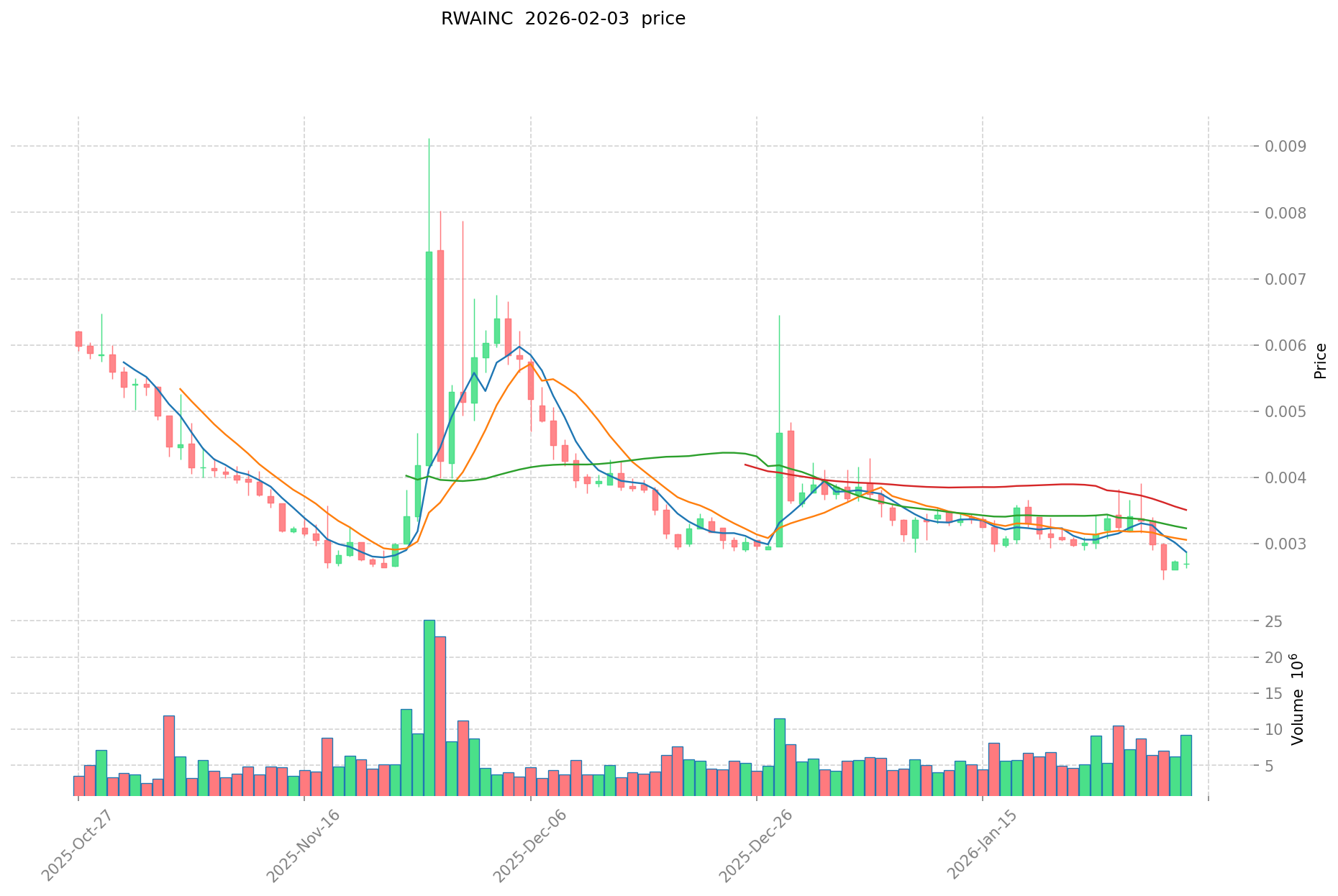
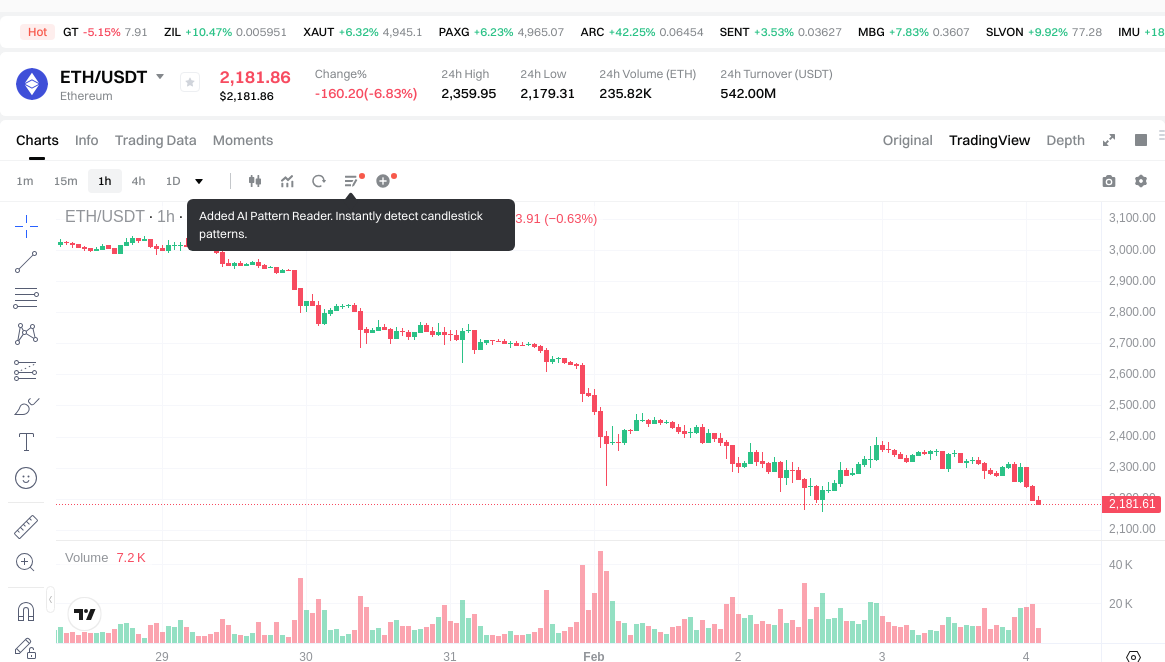
- Comparative Analysis: During the recent market cycle, RWAINC declined from its peak of $0.14542 to $0.002456, reflecting a substantial correction, while ETH also experienced volatility, declining from its August 2025 peak of $4,946.05 to current levels around $2,190.86.
Current Market Status (2026-02-04)
- RWAINC Current Price: $0.002605
- ETH Current Price: $2,190.86
- 24-Hour Trading Volume: RWAINC $22,794.02 vs ETH $534,819,644.56
- Market Sentiment Index (Fear & Greed Index): 17 (Extreme Fear)
View real-time prices:
- View RWAINC current price Market Price
- View ETH current price Market Price
II. Core Factors Influencing RWAINC vs ETH Investment Value
Supply Mechanism Comparison (Tokenomics)
-
RWAINC: The supply mechanism is closely tied to AI and blockchain technology development. Price trend analysis requires consideration of historical patterns from 2025 to 2030, with supply dynamics influenced by technological advancement cycles and ecosystem expansion phases.
-
ETH: Ethereum's supply mechanism has evolved with the transition to proof-of-stake, implementing a dynamic issuance model. The EIP-4844 upgrade introduced blob space and a separate fee market, where blob fees contribute to ETH burning, potentially creating deflationary pressure during periods of high Layer 2 activity.
-
📌 Historical Pattern: Supply mechanisms have demonstrated influence on price cycles through mechanisms such as token burning during network usage peaks and issuance adjustments tied to network security requirements.
Institutional Adoption and Market Applications
-
Institutional Holdings: ETH has gained attention from institutional investors, with Peter Thiel's Founders Fund making investments in Ethereum-related assets. The network's positioning as a platform for real-world asset (RWA) tokenization has attracted interest from traditional finance players.
-
Enterprise Adoption: ETH serves as a deployment platform for RWA applications, with use cases spanning tokenized treasury bonds, private credit, and commodity-backed products. The network hosts platforms facilitating cross-border settlement through stablecoins and institutional-grade financial instruments. RWAINC's enterprise adoption patterns appear connected to AI-driven blockchain applications, though specific deployment cases require further validation.
-
Regulatory Landscape: Different jurisdictions have taken varied approaches to digital asset oversight. The regulatory framework surrounding RWA tokenization represents a key factor, with clarity in major financial markets potentially enabling transition from pilot projects to scaled implementations.
Technology Development and Ecosystem Building
-
RWAINC Technology Advancement: Development trajectory appears linked to progress in AI integration with blockchain infrastructure, though specific technical milestones and their market implications remain subject to ecosystem maturation.
-
ETH Technology Development: The implementation of EIP-4844 (Proto-Danksharding) enhanced scalability by introducing blob transactions, optimizing Layer 2 data storage. This upgrade created a separate blob gas market, allowing L2 solutions to publish data without competing with Layer 1 transaction fees. Technical improvements in rollup efficiency and data compression are expected to encourage increased blob space utilization.
-
Ecosystem Comparison: ETH maintains advantages in ecosystem maturity across developer count, DeFi protocol total value locked (TVL), and institutional recognition. The network serves as infrastructure for RWA platforms, decentralized lending protocols, and tokenization services. Daily blob publication exceeded 20,000 units since late 2024, indicating growing Layer 2 activity. The RWA sector on Ethereum reached approximately 17 billion USD in TVL, with tokenized treasuries and commodities attracting institutional capital.
Macroeconomic Environment and Market Cycles
-
Performance in Inflationary Conditions: The elevated interest rate environment has influenced demand for on-chain yield-bearing assets. Tokenized treasuries and private credit products have gained traction as sources of stable returns, with RWA growth driven by balance sheet needs rather than speculative narratives.
-
Macroeconomic Monetary Policy: Interest rate levels and duration expectations affect the attractiveness of yield-generating tokenized assets. Higher rates for extended periods have enhanced appeal of on-chain fixed-income equivalents, while policy adjustments by central banks influence capital flows into digital asset markets.
-
Geopolitical Factors: Cross-border settlement demand, particularly through stablecoins, represents a driver for blockchain-based financial infrastructure. Global economic conditions, including recovery patterns and supply chain dynamics, influence the development trajectory of tokenized real-world assets. Regulatory clarity in major markets serves as a factor affecting institutional participation levels.
III. 2026-2031 Price Forecast: RWAINC vs ETH
Short-term Forecast (2026)
- RWAINC: Conservative $0.00164115 - $0.002605 | Optimistic $0.002605 - $0.0031781
- ETH: Conservative $1,269.475 - $2,188.75 | Optimistic $2,188.75 - $2,823.4875
Mid-term Forecast (2028-2029)
- RWAINC may enter a consolidation phase with estimated price range of $0.0027990204 - $0.0043426801506, showing gradual growth momentum
- ETH may enter an expansion phase with estimated price range of $2,435.195589375 - $4,531.313311875, demonstrating stronger volatility
- Key drivers: institutional capital inflows, ETF development, and ecosystem expansion
Long-term Forecast (2031)
- RWAINC: Baseline scenario $0.003929369310956 - $0.004225128291351 | Optimistic scenario $0.004225128291351 - $0.004774394969226
- ETH: Baseline scenario $3,214.9667947753125 - $4,175.28155165625 | Optimistic scenario $4,175.28155165625 - $5,219.1019395703125
View detailed price predictions for RWAINC and ETH
Disclaimer
Price predictions are based on historical data analysis and market trend modeling. Cryptocurrency markets are highly volatile and subject to various risk factors including regulatory changes, technological developments, and macroeconomic conditions. These forecasts should not be considered as investment advice. Investors should conduct independent research and assess their risk tolerance before making any investment decisions.
RWAINC:
| Year |
Predicted High Price |
Predicted Average Price |
Predicted Low Price |
Price Change |
| 2026 |
0.0031781 |
0.002605 |
0.00164115 |
0 |
| 2027 |
0.004106001 |
0.00289155 |
0.001966254 |
11 |
| 2028 |
0.00398860407 |
0.0034987755 |
0.0027990204 |
34 |
| 2029 |
0.0043426801506 |
0.003743689785 |
0.0035190683979 |
43 |
| 2030 |
0.004407071614902 |
0.0040431849678 |
0.002587638379392 |
55 |
| 2031 |
0.004774394969226 |
0.004225128291351 |
0.003929369310956 |
62 |
ETH:
| Year |
Predicted High Price |
Predicted Average Price |
Predicted Low Price |
Price Change |
| 2026 |
2823.4875 |
2188.75 |
1269.475 |
0 |
| 2027 |
3658.933375 |
2506.11875 |
2080.0785625 |
14 |
| 2028 |
3390.77866875 |
3082.5260625 |
2435.195589375 |
40 |
| 2029 |
4531.313311875 |
3236.652365625 |
1909.62489571875 |
47 |
| 2030 |
4466.5802645625 |
3883.98283875 |
3417.9048981 |
77 |
| 2031 |
5219.1019395703125 |
4175.28155165625 |
3214.9667947753125 |
90 |
IV. Investment Strategy Comparison: RWAINC vs ETH
Long-term vs Short-term Investment Strategies
-
RWAINC: Suitable for investors focused on emerging RWA ecosystem potential and AI-blockchain convergence themes. The asset exhibits characteristics aligned with speculative positioning in nascent technology sectors, requiring higher risk tolerance and longer time horizons to capture potential ecosystem maturation benefits.
-
ETH: Suitable for investors seeking exposure to established blockchain infrastructure with institutional recognition. The asset serves multiple investor profiles, from those prioritizing DeFi ecosystem participation to institutional players accessing tokenized real-world assets through a mature network.
Risk Management and Asset Allocation
-
Conservative Investors: RWAINC 5-10% vs ETH 90-95%. Conservative positioning emphasizes allocation toward the established network with institutional adoption patterns, limiting exposure to early-stage ecosystem tokens.
-
Aggressive Investors: RWAINC 20-30% vs ETH 70-80%. Aggressive positioning maintains core exposure to Ethereum's infrastructure while allocating capital toward higher-risk, higher-potential-return emerging ecosystem plays.
-
Hedging Instruments: Stablecoin reserves for rebalancing opportunities, options strategies for downside protection on concentrated positions, cross-asset correlation analysis for portfolio construction across multiple blockchain networks.
V. Potential Risk Comparison
Market Risk
-
RWAINC: Exhibits elevated volatility characteristic of low-liquidity assets, with 24-hour trading volume of $22,794.02 indicating limited market depth. Price movements may experience significant slippage during position adjustments. The asset remains subject to broader crypto market sentiment cycles, with correlation to major assets potentially intensifying during risk-off periods.
-
ETH: Demonstrates substantial price volatility despite established market position, with recent movements from $4,946.05 to current levels around $2,190.86 illustrating correction magnitude. Market cycles influence valuation through network activity patterns, institutional capital flows, and macroeconomic factors affecting risk asset appetite. The current Fear & Greed Index reading of 17 (Extreme Fear) reflects challenging sentiment conditions.
Technical Risk
-
RWAINC: Ecosystem maturity remains in early stages, with technical infrastructure requiring validation through sustained network activity and developer adoption. Integration of AI components with blockchain architecture presents implementation complexity. Limited historical operational data constrains assessment of network stability under various load conditions.
-
ETH: Scalability improvements through Layer 2 solutions and blob space implementation represent ongoing technical evolution. Network upgrades carry execution risk, though Ethereum's track record demonstrates capability for major transitions. Dependency on Layer 2 infrastructure for throughput creates additional complexity layers. Security considerations include smart contract vulnerabilities across the extensive DeFi ecosystem built on the network.
Regulatory Risk
-
Global regulatory approaches to digital assets vary significantly across jurisdictions. Classification frameworks for tokens, securities laws application, and taxation policies affect both assets differently based on their positioning and use cases.
-
ETH faces regulatory attention related to staking mechanisms, DeFi protocol oversight, and RWA tokenization frameworks. Regulatory clarity in major markets serves as a factor enabling institutional participation expansion.
-
RWAINC's regulatory exposure relates to RWA sector developments and evolving frameworks for AI-integrated blockchain applications. Early-stage projects may face uncertainty as regulatory standards for emerging token categories develop.
-
Cross-border regulatory coordination and policy changes represent ongoing factors affecting market access, institutional adoption pathways, and compliance requirements for both assets.
VI. Conclusion: Which Is the Better Buy?
📌 Investment Value Summary:
-
RWAINC Advantages: Positioning in emerging RWA ecosystem narrative with potential for significant appreciation if adoption materializes. Early entry point in nascent AI-blockchain integration sector. Lower absolute price point may appeal to specific investor preferences, though market capitalization and liquidity metrics require consideration.
-
ETH Advantages: Established network infrastructure with institutional recognition and substantial ecosystem development. Technical improvements through scaling solutions and demonstrated capability for major network transitions. Serves as deployment platform for RWA tokenization with approximately 17 billion USD in related TVL. Higher liquidity profile with 24-hour trading volume of $534,819,644.56 enables position management.
✅ Investment Recommendations:
-
Novice Investors: Consider initiating exposure through ETH given its established infrastructure, higher liquidity, and extensive educational resources. Allocate smaller portions to exploratory positions in emerging ecosystems after developing understanding of market dynamics and risk management principles.
-
Experienced Investors: Evaluate portfolio construction incorporating both established infrastructure plays and measured exposure to emerging ecosystem narratives. Risk-adjusted positioning should account for liquidity requirements, correlation patterns, and personal risk tolerance parameters. Consider dollar-cost averaging approaches during periods of elevated market volatility.
-
Institutional Investors: Focus on ETH for core blockchain infrastructure exposure with consideration of regulatory clarity, custody solutions, and risk management frameworks. Evaluate emerging ecosystem tokens through venture capital allocation models with appropriate due diligence on technical architecture, team capabilities, and market opportunity validation.
⚠️ Risk Disclosure: Cryptocurrency markets demonstrate extreme volatility characteristics. Historical price patterns do not guarantee future performance. This analysis does not constitute investment advice. Investors should conduct independent research, assess personal risk tolerance, and consult qualified financial professionals before making investment decisions. Capital loss risk exists, and investors should only allocate capital they can afford to lose.
VII. FAQ
Q1: What is the primary difference between RWAINC and ETH in terms of market positioning?
ETH serves as an established blockchain infrastructure platform with extensive institutional adoption, while RWAINC represents an emerging Real-World Asset ecosystem token launched in November 2024. Ethereum has operated since July 2014 as a decentralized platform supporting smart contracts and DApps, accumulating substantial trading volume ($534,819,644.56 in 24 hours) and hosting approximately 17 billion USD in RWA-related TVL. RWAINC positions itself within the nascent AI-blockchain convergence sector with significantly lower liquidity ($22,794.02 in 24-hour volume), targeting investors willing to accept higher risk for potential early-stage ecosystem appreciation.
Q2: How do the supply mechanisms of RWAINC and ETH differ?
ETH employs a dynamic proof-of-stake issuance model with deflationary mechanisms through EIP-4844's blob fee burning, while RWAINC's supply is tied to AI and blockchain technology development cycles. Ethereum's transition to proof-of-stake created a sophisticated supply model where network usage peaks can generate deflationary pressure through fee burning, particularly as Layer 2 activity increases blob space utilization (exceeding 20,000 daily units since late 2024). RWAINC's tokenomics remain influenced by ecosystem expansion phases and technological advancement cycles, though specific mechanisms require further validation given its recent launch.
Q3: What are the realistic price expectations for both assets through 2031?
For 2026, ETH shows a conservative range of $1,269.475 - $2,188.75 and optimistic range of $2,188.75 - $2,823.4875, while RWAINC ranges from $0.00164115 - $0.002605 conservatively and $0.002605 - $0.0031781 optimistically. By 2031, baseline scenarios project ETH at $3,214.97 - $4,175.28 (optimistic: $4,175.28 - $5,219.10), representing 90% growth from current levels, while RWAINC projects $0.00392937 - $0.00422513 (optimistic: $0.00422513 - $0.00477439), representing 62% growth. These forecasts incorporate institutional capital inflows, ETF development, ecosystem expansion, and macroeconomic factors, though cryptocurrency volatility creates substantial uncertainty around all projections.
Q4: Which asset carries greater risk for investors?
RWAINC exhibits elevated risk due to limited liquidity, early-stage ecosystem status, and unproven technical architecture validation. With 24-hour trading volume of only $22,794.02 compared to ETH's $534,819,644.56, RWAINC positions present significant slippage risk and market depth constraints. The asset's recent launch in November 2024 provides minimal operational history for assessing network stability, while its AI-blockchain integration architecture adds implementation complexity. ETH demonstrates substantial volatility despite established positioning, with recent corrections from $4,946.05 to approximately $2,190.86, but benefits from institutional recognition, extensive developer ecosystem, and proven capability for major network transitions.
Q5: What portfolio allocation strategy is appropriate for different investor profiles?
Conservative investors should allocate 5-10% to RWAINC and 90-95% to ETH, prioritizing the established network with institutional adoption patterns while maintaining limited exposure to emerging ecosystem narratives. Aggressive investors might consider 20-30% RWAINC and 70-80% ETH, balancing core infrastructure exposure with higher-risk, higher-potential-return positioning. Institutional investors should focus primarily on ETH for blockchain infrastructure exposure while evaluating emerging tokens through venture capital allocation models with appropriate due diligence frameworks. All allocations should account for individual risk tolerance, liquidity requirements, and correlation patterns, with stablecoin reserves maintained for rebalancing opportunities during volatile periods.
Q6: How does the current macroeconomic environment affect both assets?
The elevated interest rate environment influences both assets through distinct mechanisms, with current market sentiment at Extreme Fear (index: 17) reflecting challenging conditions. For ETH, higher rates have enhanced appeal of on-chain yield-bearing assets, driving growth in tokenized treasuries and private credit products that constitute significant portions of the 17 billion USD RWA TVL on Ethereum. Cross-border settlement demand through stablecoins supports blockchain infrastructure adoption regardless of rate conditions. RWAINC's macroeconomic sensitivity remains less defined given its recent launch, though RWA sector positioning creates exposure to institutional capital flows seeking alternatives to traditional fixed-income products. Regulatory clarity development in major markets represents a critical factor affecting institutional participation pathways for both assets.
Q7: What are the key technical developments influencing ETH's investment value?
The implementation of EIP-4844 (Proto-Danksharding) represents a significant technical milestone, introducing blob transactions that optimize Layer 2 data storage without competing with Layer 1 transaction fees. This upgrade created a separate blob gas market, with daily blob publication exceeding 20,000 units since late 2024, demonstrating growing Layer 2 activity that enhances network scalability. The blob fee burning mechanism contributes to potential deflationary pressure during high usage periods, affecting supply dynamics. Ethereum's proven capability for executing major network transitions, including the shift to proof-of-stake, provides confidence in ongoing technical evolution. These improvements position ETH as infrastructure for institutional-grade applications, including RWA tokenization platforms that have attracted traditional finance participants seeking blockchain-based settlement and custody solutions.
Q8: Should investors wait for better entry points given current market conditions?
Current market conditions (Extreme Fear index: 17) historically correlate with attractive long-term entry opportunities, though timing market bottoms remains challenging. ETH's decline from $4,946.05 to current levels around $2,190.86 represents substantial correction magnitude that may appeal to value-oriented positioning, while RWAINC's drop from $0.14542 to $0.002456 reflects even more dramatic retracement. Dollar-cost averaging strategies help mitigate timing risk by accumulating positions across multiple price points during volatile periods. Investors should evaluate personal liquidity needs, risk tolerance parameters, and investment time horizons rather than attempting precise market timing. Conservative approaches prioritize capital preservation through measured position building, while experienced investors might view extreme fear readings as accumulation opportunities, though both strategies require acceptance of continued volatility risk and potential for further price declines before recovery materializes.
* The information is not intended to be and does not constitute financial advice or any other recommendation of any sort offered or endorsed by Gate.