This comprehensive analysis compares SFI and RUNE, two distinct DeFi tokens offering different investment opportunities in 2024. SFI, launched in 2025 as an AI-centric EVM-compatible L2 blockchain with RWA tokenization, represents emerging AI infrastructure, while RUNE, operational since 2019, specializes in cross-chain liquidity provision through THORChain. The article examines historical price performance—SFI declined 94% from its peak while RUNE dropped 97%—alongside current market conditions showing SFI at $0.007643 and RUNE at $0.4691. Critical factors compared include tokenomics structures, institutional adoption potential, technical ecosystems, and macro-economic influences. Price forecasts through 2031 project varying growth trajectories, with investment allocation recommendations tailored to conservative and aggressive investor profiles. The analysis addresses market, technical, and regulatory risks inherent to both tokens, helping investors determine optimal positioning based on their risk tolerance
Introduction: Investment Comparison Between SFI and RUNE
In the cryptocurrency market, the comparison between SFI vs RUNE continues to be a topic that investors cannot avoid. The two not only show distinct differences in market cap ranking, application scenarios, and price performance, but also represent different positioning within the crypto asset landscape.
SFI (Singularity Finance): Launched in 2025, it has gained market recognition through its positioning as the first AI-centric EVM-compatible L2 blockchain, bringing the AI economy on-chain with a fully compliant RWA tokenization framework.
RUNE (THORChain): Since its launch in 2019, it has been recognized for its highly optimized multi-chain architecture using pBFT consensus, facilitating cross-chain transactions and order matching at the protocol level.
This article will comprehensively analyze the investment value comparison of SFI vs RUNE around historical price trends, supply mechanisms, technical ecosystems, and future forecasts, attempting to answer the question that investors care about most:
"Which is the better buy right now?"
I. Historical Price Comparison and Current Market Status
Historical Price Trends of SFI (Coin A) and RUNE (Coin B)
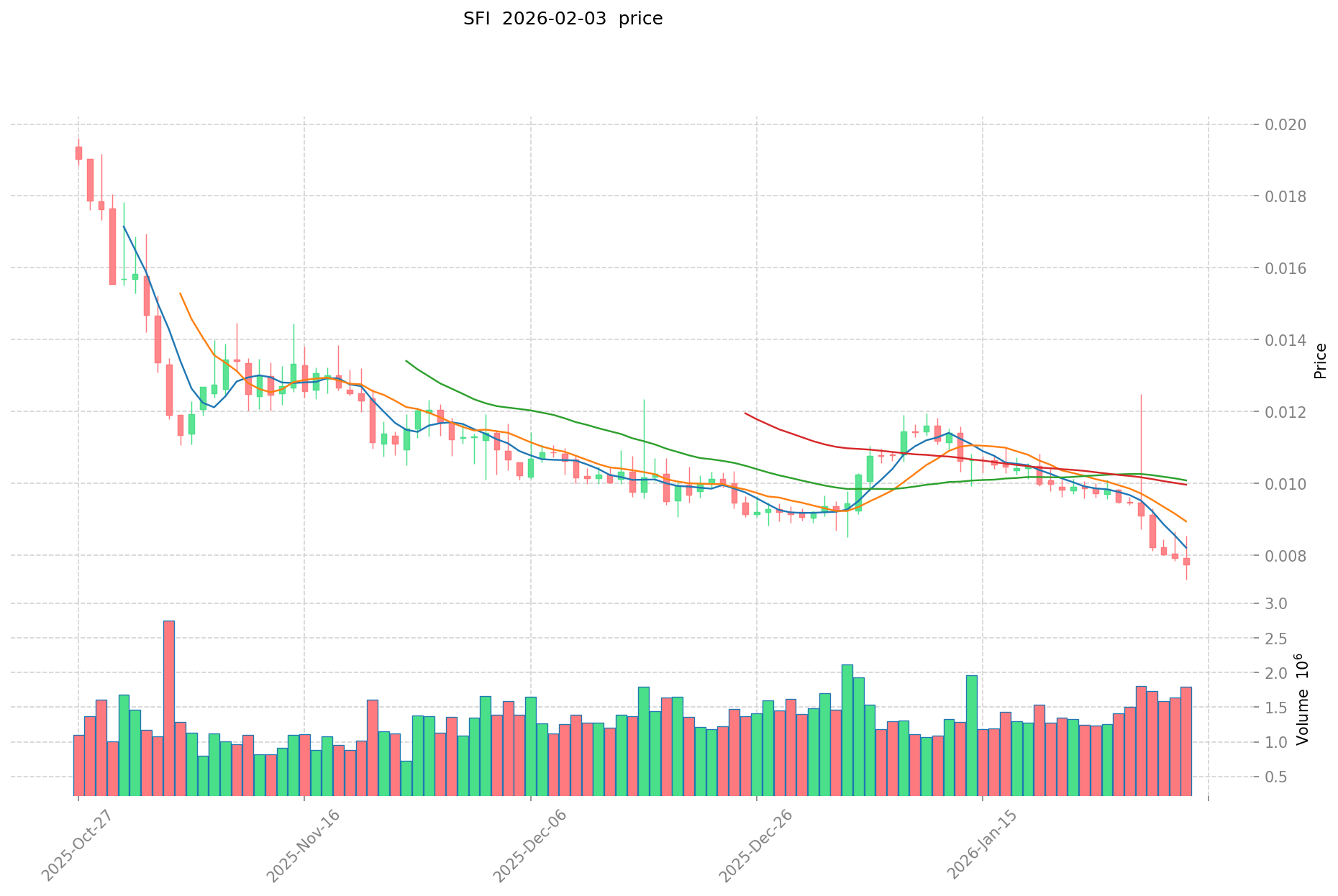
- 2025: SFI experienced notable volatility during its initial launch phase. The token reached an all-time high of $0.135 on February 19, 2025, shortly after its market debut on February 07, 2025.
- 2021: RUNE showed significant growth momentum, reaching its all-time high of $20.87 on May 19, 2021, driven by increased adoption of THORChain's cross-chain liquidity solutions.
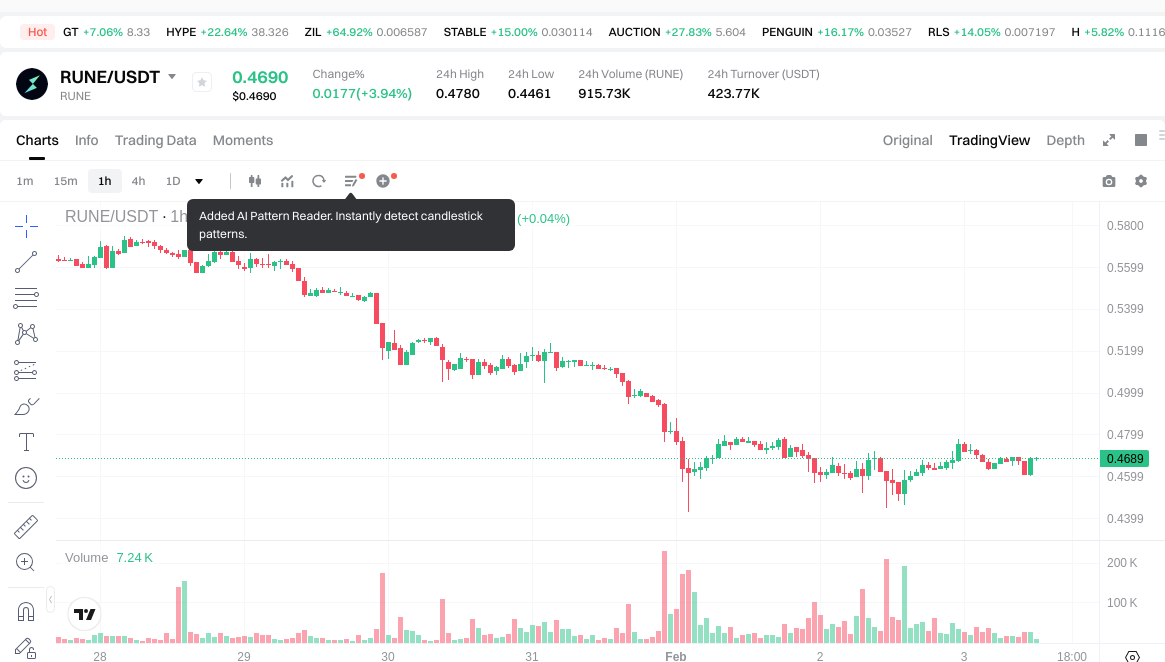
- Comparative Analysis: During recent market cycles, SFI declined from its peak of $0.135 to an all-time low of $0.007324 on February 02, 2026, representing a decline of over 94%. In contrast, RUNE has fallen from its 2021 high of $20.87 to $0.4691 as of February 03, 2026, marking a decline of approximately 97% from its peak.
Current Market Situation (2026-02-03)
- SFI Current Price: $0.007643
- RUNE Current Price: $0.4691
- 24-Hour Trading Volume: SFI at $13,456.67 vs RUNE at $424,804.06
- Market Sentiment Index (Fear & Greed Index): 17 (Extreme Fear)
View Real-Time Prices:
- Check SFI Current Price Market Price
- Check RUNE Current Price Market Price
II. Core Factors Influencing SFI vs RUNE Investment Value
Tokenomics Comparison
- RUNE: The token supply mechanism is designed with a 3:1 ratio model, where the total RUNE quantity represents three times the value of locked non-RUNE assets. This ratio reflects the minimum intrinsic value required for protocol operations.
- SFI: The token's value mechanism is primarily tied to its role within reward structures in the DeFi ecosystem.
- 📌 Historical Pattern: Supply mechanisms play a significant role in shaping price cycles, with protocol-required token quantities influencing minimum value thresholds.
Institutional Adoption and Market Applications
- Institutional Holdings: Data on institutional preference between the two tokens is limited in current market analysis.
- Enterprise Adoption: Both tokens serve distinct functions within their respective ecosystems, with RUNE facilitating cross-chain transaction services between liquidity pools, while SFI operates within DeFi reward mechanisms.
- Regulatory Environment: Policy approaches toward these tokens vary across jurisdictions, though specific regulatory stances remain evolving.
Technical Development and Ecosystem Building
- RUNE Technical Framework: The token functions as a core component in ThorChain's cross-chain service infrastructure, where users require RUNE to access liquidity pool services.
- SFI Technical Position: The token's technical development centers on its integration within DeFi reward and incentive mechanisms.
- Ecosystem Comparison: Both tokens occupy distinct positions within decentralized finance infrastructure, with RUNE focusing on cross-chain liquidity provision and SFI concentrating on reward distribution systems.
Macroeconomic Factors and Market Cycles
- Inflation Environment Performance: The anti-inflation characteristics of both tokens depend largely on their utility demand and ecosystem adoption rates.
- Macroeconomic Monetary Policy: Interest rate fluctuations and currency index movements may influence both tokens' performance through broader crypto market dynamics.
- Geopolitical Considerations: Cross-border transaction demand and international developments may affect adoption patterns, particularly for cross-chain infrastructure tokens like RUNE.
III. 2026-2031 Price Forecast: SFI vs RUNE
Short-term Forecast (2026)
- SFI: Conservative $0.00725 - $0.00756 | Optimistic $0.00756 - $0.00808
- RUNE: Conservative $0.342 - $0.468 | Optimistic $0.468 - $0.487
Mid-term Forecast (2028-2029)
- SFI may enter a consolidation phase with estimated price range of $0.00462 - $0.01194 in 2028, potentially extending to $0.00936 - $0.01149 by 2029
- RUNE may enter a growth phase with estimated price range of $0.466 - $0.663 in 2028, potentially reaching $0.357 - $0.713 by 2029
- Key drivers: institutional capital inflows, ETF developments, ecosystem expansion
Long-term Forecast (2030-2031)
- SFI: Baseline scenario $0.00639 - $0.01083 (2030) | Optimistic scenario $0.00831 - $0.01905 (2031)
- RUNE: Baseline scenario $0.519 - $0.649 (2030) | Optimistic scenario $0.705 - $1.077 (2031)
View detailed price predictions for SFI and RUNE
Disclaimer
SFI:
| Year |
Predicted High Price |
Predicted Average Price |
Predicted Low Price |
Price Change |
| 2026 |
0.00808492 |
0.007556 |
0.00725376 |
-1 |
| 2027 |
0.008993529 |
0.00782046 |
0.0046140714 |
2 |
| 2028 |
0.01193793219 |
0.0084069945 |
0.004623846975 |
9 |
| 2029 |
0.01149488357985 |
0.010172463345 |
0.0093586662774 |
33 |
| 2030 |
0.014733795908898 |
0.010833673462425 |
0.00639186734283 |
41 |
| 2031 |
0.019047764681635 |
0.012783734685661 |
0.008309427545679 |
67 |
RUNE:
| Year |
Predicted High Price |
Predicted Average Price |
Predicted Low Price |
Price Change |
| 2026 |
0.486824 |
0.4681 |
0.341713 |
0 |
| 2027 |
0.53475744 |
0.477462 |
0.3580965 |
1 |
| 2028 |
0.6630037332 |
0.50610972 |
0.4656209424 |
7 |
| 2029 |
0.713159206452 |
0.5845567266 |
0.356579603226 |
24 |
| 2030 |
0.93435547179744 |
0.648857966526 |
0.5190863732208 |
38 |
| 2031 |
1.076585138059939 |
0.79160671916172 |
0.70452998005393 |
68 |
IV. Investment Strategy Comparison: SFI vs RUNE
Long-term vs Short-term Investment Strategies
- SFI: May be suitable for investors with higher risk tolerance seeking exposure to emerging DeFi reward mechanisms and AI-focused blockchain infrastructure. The token's recent launch in 2025 positions it in an early development phase with significant volatility characteristics.
- RUNE: May appeal to investors interested in established cross-chain liquidity infrastructure with a longer operational history since 2019. The token's role in facilitating multi-chain transactions provides exposure to the broader cross-chain DeFi ecosystem.
Risk Management and Asset Allocation
- Conservative Investors: A more balanced approach might consider limited exposure to either asset given current market conditions, with potential allocation ranges of SFI: 5-10% vs RUNE: 10-20% within a diversified crypto portfolio
- Aggressive Investors: Those with higher risk appetite might consider allocation ranges of SFI: 15-25% vs RUNE: 20-30%, while maintaining awareness of elevated volatility
- Hedging Tools: Stablecoin reserves, options strategies, and cross-asset diversification approaches may help manage exposure volatility
V. Potential Risk Comparison
Market Risks
- SFI: The token faces substantial market risk given its recent 94% decline from peak levels, limited trading volume of $13,456.67, and early-stage market presence. Price discovery mechanisms remain in development.
- RUNE: While experiencing a 97% decline from 2021 highs, the token maintains higher liquidity with $424,804.06 in 24-hour trading volume. Market risks include sensitivity to broader DeFi adoption trends and cross-chain transaction demand.
Technical Risks
- SFI: As a recently launched L2 blockchain solution, the project faces technical risks related to network stability during scaling phases, smart contract security considerations, and ecosystem development maturity.
- RUNE: Technical considerations include the complexity of cross-chain infrastructure operations, potential vulnerabilities in multi-chain bridge mechanisms, and dependencies on connected blockchain networks' performance.
Regulatory Risks
- Both tokens operate in evolving regulatory environments where policy developments may impact operations differently. Cross-chain protocols like RUNE may face specific regulatory considerations regarding cross-border transaction facilitation, while AI-focused infrastructure projects like SFI may encounter regulations related to emerging technology frameworks.
VI. Conclusion: Which Is the Better Buy?
📌 Investment Value Summary:
- SFI Characteristics: Early-stage exposure to AI-focused blockchain infrastructure, significant price volatility with potential for recovery from recent lows, limited current liquidity
- RUNE Characteristics: Established presence in cross-chain liquidity infrastructure since 2019, higher trading volume indicating better liquidity conditions, proven operational track record in multi-chain environments
✅ Investment Considerations:
- Beginner Investors: Given the current Extreme Fear market sentiment (index: 17) and substantial volatility in both assets, newer participants may benefit from education and gradual exposure approaches rather than immediate significant allocations
- Experienced Investors: Those with established risk management frameworks might evaluate both tokens based on their distinct ecosystem positions—RUNE's cross-chain infrastructure role versus SFI's AI-DeFi positioning—within diversified portfolio strategies
- Institutional Participants: May assess both tokens through frameworks evaluating liquidity profiles, ecosystem maturity levels, technical infrastructure sustainability, and alignment with broader portfolio mandates
⚠️ Risk Disclosure: Cryptocurrency markets exhibit extreme volatility. This analysis does not constitute investment advice. Both assets have experienced significant declines from peak valuations, and past performance does not indicate future results. Investors should conduct independent research and consider their risk tolerance before making allocation decisions.
VII. FAQ
Q1: What is the main difference between SFI and RUNE in terms of their core functionality?
SFI focuses on AI-centric DeFi infrastructure, while RUNE specializes in cross-chain liquidity provision. SFI, launched in 2025, operates as an AI-focused EVM-compatible L2 blockchain with RWA tokenization capabilities, positioning itself within the emerging AI economy sector. In contrast, RUNE, operational since 2019, serves as the core utility token for THORChain's cross-chain transaction infrastructure, facilitating liquidity pool access and multi-chain asset swaps through its pBFT consensus mechanism.
Q2: Which token shows better liquidity conditions as of February 2026?
RUNE demonstrates significantly better liquidity with a 24-hour trading volume of $424,804.06 compared to SFI's $13,456.67. This 31x difference in trading volume indicates that RUNE maintains more active market participation and potentially easier entry/exit conditions for investors. Higher liquidity generally translates to reduced slippage during transactions and more efficient price discovery mechanisms.
Q3: How have both tokens performed relative to their all-time highs?
Both tokens have experienced substantial declines from peak valuations: SFI has fallen approximately 94% from its February 2025 high of $0.135 to its current level around $0.007643, while RUNE has declined roughly 97% from its May 2021 peak of $20.87 to approximately $0.4691. Despite similar percentage declines, RUNE's longer operational history provides more historical data for pattern analysis, whereas SFI's recent launch offers limited historical context for long-term trend evaluation.
Q4: What are the projected price ranges for both tokens by 2031?
According to forecast models, SFI's optimistic scenario projects a range of $0.00831 - $0.01905 by 2031, representing potential appreciation of 67% from baseline projections. RUNE's optimistic 2031 forecast suggests a range of $0.705 - $1.077, indicating potential growth of 68% above conservative estimates. However, these projections carry substantial uncertainty given cryptocurrency market volatility and should not be interpreted as guaranteed outcomes.
Q5: Which token presents higher technical risk factors?
SFI carries elevated technical risks due to its early-stage development phase, including potential challenges in network scaling, smart contract security testing with limited operational history, and ecosystem maturity development. RUNE's technical risks center on the complexity of maintaining cross-chain bridge infrastructure, potential vulnerabilities in multi-chain coordination mechanisms, and dependencies on the performance and security of connected blockchain networks. Both present distinct technical risk profiles requiring different evaluation frameworks.
Q6: How does the tokenomics structure differ between SFI and RUNE?
RUNE employs a distinctive 3:1 ratio mechanism where total RUNE supply represents three times the value of locked non-RUNE assets, creating a protocol-defined minimum value threshold tied to ecosystem usage. This design creates direct correlation between liquidity pool growth and token demand. SFI's tokenomics centers on reward distribution mechanisms within DeFi ecosystems, though specific details regarding supply dynamics and value accrual mechanisms require further documentation for comprehensive comparison.
Q7: What allocation percentages might different investor profiles consider?
Conservative investors might consider limited exposure ranges of 5-10% for SFI and 10-20% for RUNE within diversified crypto portfolios, given current market volatility and the Extreme Fear sentiment index of 17. Aggressive investors with higher risk tolerance might explore allocation ranges of 15-25% for SFI and 20-30% for RUNE, while implementing robust risk management protocols including stablecoin reserves and hedging strategies to mitigate downside exposure.
Q8: What regulatory considerations should investors monitor for both tokens?
Both tokens operate within evolving regulatory frameworks requiring ongoing monitoring. RUNE may face specific regulatory scrutiny regarding cross-chain transaction facilitation and potential cross-border payment regulations as authorities develop policies for decentralized liquidity protocols. SFI's AI-focused infrastructure positioning may encounter emerging regulatory frameworks addressing artificial intelligence integration in financial systems and RWA tokenization compliance requirements. Regulatory developments in major jurisdictions could significantly impact both tokens' operational parameters and market accessibility.
* The information is not intended to be and does not constitute financial advice or any other recommendation of any sort offered or endorsed by Gate.