SGC vs XLM: A Comprehensive Comparison of Two Leading Blockchain Payment Solutions


Introduction: Investment Comparison Between SGC and XLM
In the cryptocurrency market, the comparison between SGC vs XLM continues to be a topic of significant interest among investors. The two assets exhibit notable differences in market capitalization ranking, application scenarios, and price performance, representing distinct positioning within the crypto asset landscape.
SGC (KAI Battle of Three Kingdoms): Launched in 2025, this blockchain-integrated strategy game combines SEGA's classic Sangokushi Taisen IP with blockchain technology. SGC functions as both a governance and utility token, enabling players to earn rewards through PvP gameplay and utilize them within the game's marketplace ecosystem.
XLM (Stellar): Since its launch in 2014, Stellar has established itself as a decentralized payment network facilitating low-cost cross-border transactions. The platform enables rapid transfer of digital assets between banks, payment institutions, and individuals, attracting numerous projects to issue new assets on its network.
This article provides a comprehensive analysis of SGC vs XLM across multiple dimensions including historical price trajectories, supply mechanisms, institutional adoption patterns, technical ecosystems, and future projections. We aim to address the core question that concerns investors most:
"Which represents a more compelling investment opportunity at present?"
By examining market data as of February 04, 2026, we will evaluate both assets' investment characteristics to assist readers in forming informed perspectives on these distinctly positioned cryptocurrencies.
I. Historical Price Comparison and Current Market Status
Historical Price Trends of SGC (Coin A) and XLM (Coin B)
- 2025: SGC launched in June 2025 with Token Generation Event (TGE) and distribution through Binance Wallet Sale. The token experienced initial volatility following its market debut.
- 2018: XLM reached its all-time high of $0.875563 on January 3, 2018, driven by broader cryptocurrency market momentum during that period.
- 2025: XLM continued to serve as infrastructure for cross-border payments and tokenization of real-world assets. In July 2025, Visa added support for Stellar in its stablecoin infrastructure.
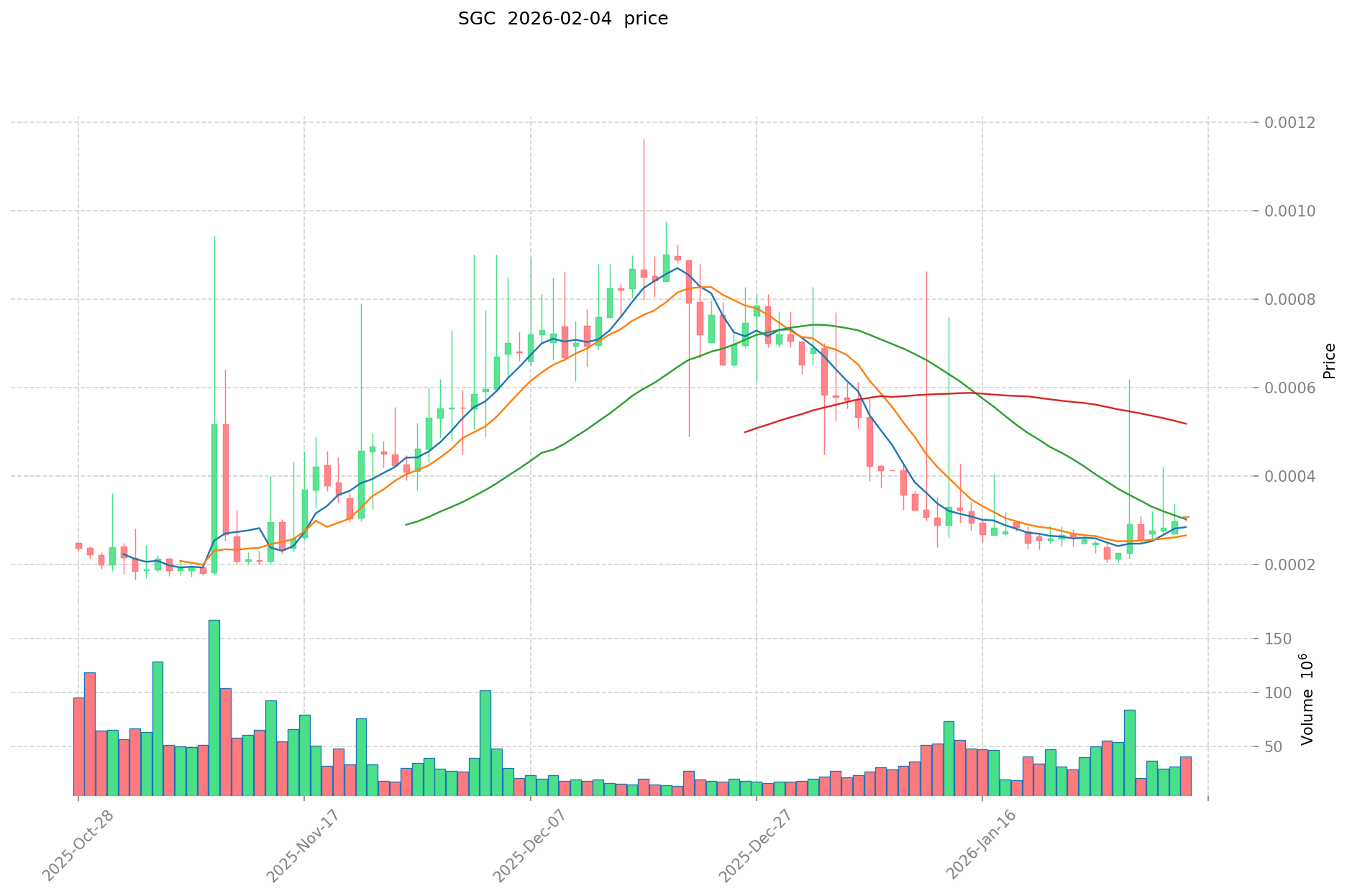
- Comparative Analysis: During the recent market cycle, SGC moved from its all-time high of $0.0062 on June 13, 2025, to a low of $0.000166 on November 2, 2025, representing significant price volatility for a newly launched token. Meanwhile, XLM traded in a more established range, with its current price at $0.17175, which remains substantially below its 2018 peak.
Current Market Status (February 4, 2026)
- SGC Current Price: $0.000322
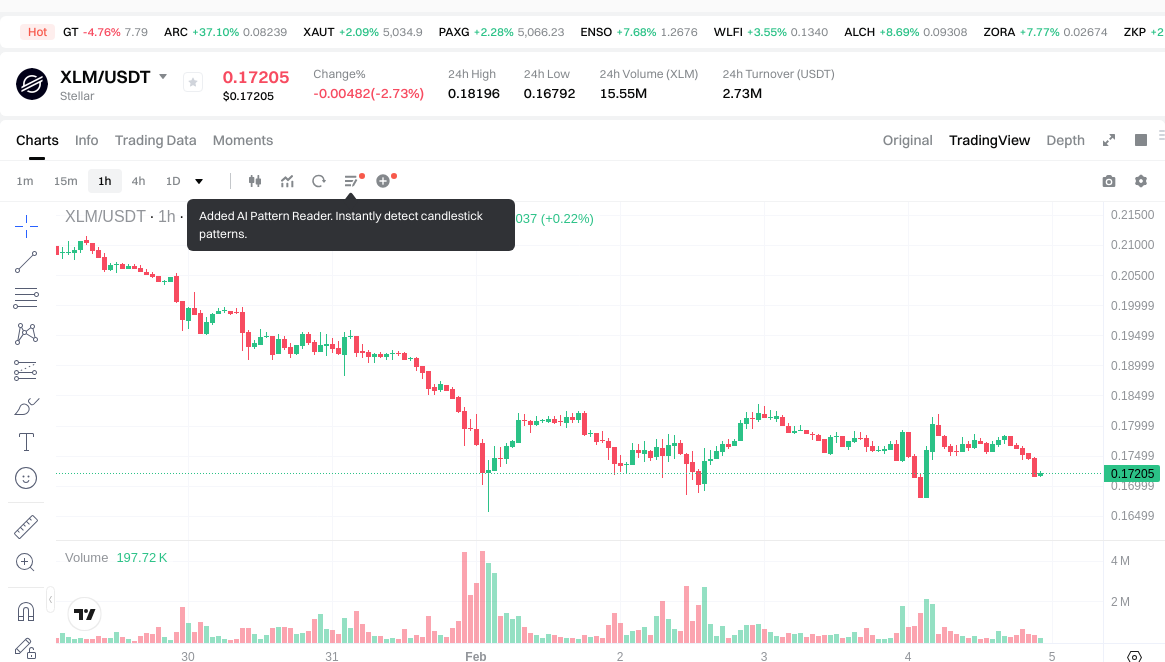
- XLM Current Price: $0.17175
- 24-Hour Trading Volume: SGC $12,476.39 vs XLM $2,702,023.26
- Market Sentiment Index (Fear & Greed Index): 14 (Extreme Fear)
View Real-Time Prices:
- Check SGC Current Price Market Price
- Check XLM Current Price Market Price
II. Core Factors Influencing SGC vs XLM Investment Value
Supply Mechanism Comparison (Tokenomics)
- SGC: As of February 4, 2026, SGC trading at $0.0004278 USD with a market capitalization of $724,509.51, reflecting relatively modest market presence and liquidity parameters.
- XLM: Market demand, scarcity characteristics, and ecosystem utility play significant roles in determining value proposition within their respective operational frameworks.
- 📌 Historical Pattern: Supply mechanisms may contribute to cyclical price movements, though specific tokenomics details require further verification from official protocol documentation.
Institutional Adoption and Market Applications
- Institutional Holdings: Comparative institutional preference patterns between SGC and XLM require analysis of on-chain data and publicly disclosed allocation strategies.
- Enterprise Adoption: Both assets demonstrate varying degrees of integration in cross-border payment systems, settlement infrastructure, and portfolio diversification strategies, subject to institutional requirements and regulatory frameworks.
- National Policies: Regulatory attitudes toward digital assets differ across jurisdictions, influencing adoption trajectories and operational parameters for both tokens.
Technical Development and Ecosystem Construction
- SGC Technical Developments: Recent performance indicators show a 24-hour price decline of 20.51% with trading volume of $115,074.71, suggesting active market participation despite volatility.
- XLM Technical Progress: Ecosystem utility and integration capabilities remain fundamental to value assessment, with community engagement serving as a key metric for development momentum.
- Ecosystem Comparison: DeFi integration, payment infrastructure, and smart contract implementation status vary between the two assets, influenced by their respective protocol architectures and development roadmaps.
Macroeconomic Environment and Market Cycles
- Performance in Inflationary Contexts: Asset characteristics in relation to inflation hedging properties depend on multiple factors including market perception, liquidity dynamics, and adoption rates.
- Macroeconomic Monetary Policy: Interest rate adjustments, dollar index movements, and broader monetary conditions may influence price discovery mechanisms for both digital assets.
- Geopolitical Factors: Cross-border transaction requirements and international developments can affect demand patterns, particularly for assets with payment or settlement functionalities.
III. 2026-2031 Price Prediction: SGC vs XLM
Short-term Forecast (2026)
- SGC: Conservative $0.000189 - $0.000310 | Optimistic $0.000310 - $0.000328
- XLM: Conservative $0.122 - $0.172 | Optimistic $0.172 - $0.182
Mid-term Forecast (2028-2029)
- SGC may enter a gradual accumulation phase, with estimated price range of $0.000232 - $0.000469
- XLM may enter an expansion phase, with estimated price range of $0.142 - $0.330
- Key drivers: institutional capital inflows, ETF developments, ecosystem growth
Long-term Forecast (2030-2031)
- SGC: Baseline scenario $0.000250 - $0.000472 | Optimistic scenario $0.000472 - $0.000567
- XLM: Baseline scenario $0.203 - $0.323 | Optimistic scenario $0.323 - $0.356
Disclaimer
SGC:
| Year | Predicted High Price | Predicted Average Price | Predicted Low Price | Price Change |
|---|---|---|---|---|
| 2026 | 0.000328282 | 0.0003097 | 0.000188917 | -3 |
| 2027 | 0.00034451028 | 0.000318991 | 0.00027752217 | 0 |
| 2028 | 0.0004246408192 | 0.00033175064 | 0.000232225448 | 3 |
| 2029 | 0.000468962704704 | 0.0003781957296 | 0.000325248327456 | 17 |
| 2030 | 0.000521002437096 | 0.000423579217152 | 0.000249911738119 | 31 |
| 2031 | 0.000566748992549 | 0.000472290827124 | 0.00038255556997 | 46 |
XLM:
| Year | Predicted High Price | Predicted Average Price | Predicted Low Price | Price Change |
|---|---|---|---|---|
| 2026 | 0.182373 | 0.17205 | 0.1221555 | 0 |
| 2027 | 0.232147065 | 0.1772115 | 0.154174005 | 2 |
| 2028 | 0.2947381668 | 0.2046792825 | 0.15146266905 | 18 |
| 2029 | 0.329615516538 | 0.24970872465 | 0.1423339730505 | 44 |
| 2030 | 0.35628440833062 | 0.289662120594 | 0.27807563577024 | 68 |
| 2031 | 0.345581392974671 | 0.32297326446231 | 0.203473156611255 | 87 |
IV. Investment Strategy Comparison: SGC vs XLM
Long-term vs Short-term Investment Strategies
-
SGC: May appeal to investors with higher risk tolerance seeking opportunities in emerging blockchain gaming ecosystems. The token's integration with SEGA's Sangokushi Taisen IP and gameplay-driven utility presents potential for growth as the gaming platform develops, though recent price volatility (20.51% decline in 24 hours) suggests significant near-term uncertainty.
-
XLM: May suit investors interested in established payment infrastructure and cross-border transaction frameworks. With institutional integrations such as Visa's stablecoin infrastructure support added in July 2025, XLM offers exposure to payment network development, though current pricing remains substantially below historical peaks from 2018.
Risk Management and Asset Allocation
-
Conservative Investors: A more cautious allocation approach might consider minimal exposure to SGC (5-10%) given limited market capitalization ($724,509.51) and trading volume ($115,074.71 in 24 hours), with greater allocation to XLM (15-25%) due to its longer operational history and broader institutional recognition.
-
Aggressive Investors: Those with higher risk appetite might consider increased SGC allocation (20-30%) to capture potential upside from gaming ecosystem expansion, balanced with XLM positioning (30-40%) for infrastructure-based growth opportunities.
-
Hedging Instruments: Portfolio diversification strategies may include stablecoin positions for liquidity management, options contracts where available, and cross-asset combinations to manage correlation risks.
V. Potential Risk Comparison
Market Risk
-
SGC: The token demonstrates substantial price volatility, declining from an all-time high of $0.0062 on June 13, 2025, to $0.000166 on November 2, 2025. Limited trading volume ($12,476.39 in 24 hours as of February 4, 2026) may result in liquidity constraints and wider bid-ask spreads during market stress.
-
XLM: While more established, XLM's current price of $0.17175 represents a significant discount to its 2018 peak of $0.875563. Market sentiment indicators showing 14 (Extreme Fear) suggest broader market uncertainty that may affect price discovery mechanisms.
Technical Risk
-
SGC: As a recently launched gaming token (June 2025), the project's technical infrastructure requires continued development and testing. Platform stability, scalability to accommodate user growth, and smart contract security remain areas requiring ongoing assessment.
-
XLM: The Stellar network's decentralized architecture presents different technical considerations, including validator distribution patterns and network consensus mechanisms. Integration complexity with various financial institutions may introduce operational dependencies.
Regulatory Risk
- Global regulatory frameworks continue to evolve regarding digital assets, with varying approaches across jurisdictions. Gaming tokens like SGC may face scrutiny related to in-game economy mechanics and token utility classification. Payment-focused networks like XLM may encounter regulatory requirements related to money transmission, cross-border payments, and financial infrastructure compliance. Regulatory developments in major markets could significantly affect operational parameters and adoption trajectories for both assets.
VI. Conclusion: Which Is the Better Buy?
📌 Investment Value Summary:
-
SGC Characteristics: Early-stage gaming ecosystem token with integration of established SEGA IP, offering exposure to blockchain gaming sector development. Current market positioning reflects nascent project stage with corresponding volatility and limited liquidity.
-
XLM Characteristics: Established payment network infrastructure with institutional partnerships including Visa integration. Longer operational history provides greater price discovery data, though current valuation remains well below previous cycle peaks.
✅ Investment Considerations:
-
New Investors: May benefit from focusing on assets with longer operational histories and greater liquidity depth to better understand market dynamics. Consideration of both fundamental analysis and risk tolerance assessment remains important before allocation decisions.
-
Experienced Investors: Could evaluate both assets within broader portfolio context, considering correlation with existing holdings, liquidity requirements, and alignment with investment thesis regarding gaming ecosystems versus payment infrastructure.
-
Institutional Investors: May assess regulatory clarity, custody solutions, liquidity parameters, and integration capabilities within existing infrastructure frameworks when evaluating either asset class.
⚠️ Risk Disclosure: Cryptocurrency markets exhibit high volatility characteristics. This analysis does not constitute investment advice. Market participants should conduct independent research, assess personal risk tolerance, and consider consultation with qualified financial advisors before making allocation decisions.
VII. FAQ
Q1: What is the fundamental difference between SGC and XLM's primary use cases?
SGC functions as a blockchain gaming token integrated with SEGA's Sangokushi Taisen IP, serving both governance and utility purposes within a play-to-earn ecosystem. Players earn SGC rewards through PvP gameplay and utilize tokens in the game's marketplace. In contrast, XLM operates as infrastructure for cross-border payments and asset tokenization, facilitating low-cost transactions between financial institutions, payment processors, and individuals since 2014. This represents a distinction between entertainment-focused gaming utility versus financial infrastructure functionality.
Q2: How do the liquidity profiles of SGC and XLM compare for practical trading purposes?
XLM demonstrates significantly higher liquidity with 24-hour trading volume of $2,702,023.26 compared to SGC's $12,476.39 as of February 4, 2026. This approximately 217x volume difference means XLM offers substantially tighter bid-ask spreads, faster order execution, and reduced slippage risk during position entry or exit. SGC's limited liquidity may result in price impact during larger transactions and potential difficulty executing trades during periods of market stress, making it more suitable for smaller position sizes or investors comfortable with lower liquidity environments.
Q3: What accounts for SGC's extreme price volatility compared to XLM?
SGC declined 20.51% in 24 hours and experienced an 86% drawdown from its June 2025 all-time high of $0.0062 to November 2025 low of $0.000166. This volatility stems from its recent launch (June 2025), limited market capitalization of $724,509.51, nascent ecosystem development stage, and lower trading volume creating susceptibility to larger price swings. XLM, operational since 2014 with established institutional partnerships including Visa integration, exhibits more stable price action despite remaining below its 2018 peak, benefiting from deeper liquidity pools and broader market recognition.
Q4: How do institutional adoption patterns differ between these two assets?
XLM has secured tangible institutional integration, notably Visa's addition of Stellar to its stablecoin infrastructure in July 2025, demonstrating enterprise-level validation for cross-border payment applications. The network facilitates transactions between banks and payment institutions, indicating established financial sector adoption. SGC, as a gaming token launched in 2025, operates primarily within the blockchain gaming sector without comparable traditional financial institution partnerships. Its adoption trajectory depends on gaming ecosystem expansion and player base growth rather than financial infrastructure integration.
Q5: What should investors consider regarding regulatory risks for SGC versus XLM?
XLM faces regulatory scrutiny related to payment network operations, money transmission requirements, and cross-border financial compliance across multiple jurisdictions where it facilitates transactions. Gaming tokens like SGC may encounter different regulatory considerations around in-game economy mechanics, token utility classification, and potential securities law implications depending on governance rights and reward distribution mechanisms. Both assets operate in evolving regulatory landscapes, but the specific compliance frameworks differ substantially—payment infrastructure regulations for XLM versus gaming and digital asset entertainment regulations for SGC.
Q6: How do the price prediction ranges reflect different risk-reward profiles?
SGC's 2031 predicted range of $0.000250-$0.000567 represents potential 67x-127x returns from current levels, reflecting high-risk, high-reward characteristics typical of early-stage gaming projects with limited operational history. XLM's 2031 predicted range of $0.203-$0.356 suggests more modest 1.2x-2.1x potential returns, consistent with a mature payment infrastructure asset. SGC's wider prediction variance (127% spread) versus XLM's narrower range (75% spread) quantifies the uncertainty difference between an emerging gaming ecosystem and established payment network.
Q7: Which asset better suits portfolio diversification objectives?
For portfolio diversification, SGC and XLM offer exposure to distinctly different sectors—blockchain gaming entertainment versus payment infrastructure—providing low correlation benefits. XLM's institutional partnerships and payment network focus may correlate more closely with traditional financial sector performance, while SGC's gaming ecosystem dependency correlates with blockchain gaming adoption trends and player engagement metrics. Investors seeking gaming sector exposure might allocate to SGC, while those preferring payment infrastructure development would favor XLM, with both serving different diversification roles within a broader digital asset portfolio strategy.
Q8: What market conditions would favor SGC versus XLM performance?
SGC would likely outperform during periods of increased blockchain gaming adoption, successful gameplay feature launches, growing player base metrics, and positive sentiment toward entertainment-focused crypto applications. Rising interest in play-to-earn models and gaming NFT ecosystems would support SGC valuation. XLM would benefit from expanding institutional payment network adoption, increased cross-border transaction volumes, stablecoin infrastructure development, and regulatory clarity favoring decentralized payment systems. Macroeconomic conditions driving demand for efficient remittance solutions and financial inclusion initiatives would support XLM's value proposition over gaming-focused alternatives.
Share
Content
Introduction: Investment Comparison Between SGC and XLM
I. Historical Price Comparison and Current Market Status
II. Core Factors Influencing SGC vs XLM Investment Value
III. 2026-2031 Price Prediction: SGC vs XLM
IV. Investment Strategy Comparison: SGC vs XLM
V. Potential Risk Comparison
VI. Conclusion: Which Is the Better Buy?
VII. FAQ
How to Buy Cryptocurrency


Trending Cryptocurrencies



2025 Vertus daily combo code: Web3 gamers rewards guide

Today's Vertus Daily Combo Code: Boost Your Web3 Gaming Rewards (April 29, 2025)

GALA Coin (GALA) – Web3 Gaming Token Overview, Price Prediction & Trading on Gate.com

What is Gaming Crypto?How Gaming Crypto Works?

Detailed analysis of the top ten encryption game coins to be launched in 2025
Top 6 Best Gaming Currencies

Promising Cryptocurrencies: Leading AI Tokens for Investment

Top Cold Wallets for Cryptocurrency: Rankings

What Is a Cryptocurrency Airdrop? Where to Find Opportunities and How to Profit in the Current Landscape
Comprehensive Guide to Phil Konieczny's Cryptocurrency Investment Strategy and Philosophy

What is Raydium: A Complete Overview of the DEX on Solana Blockchain