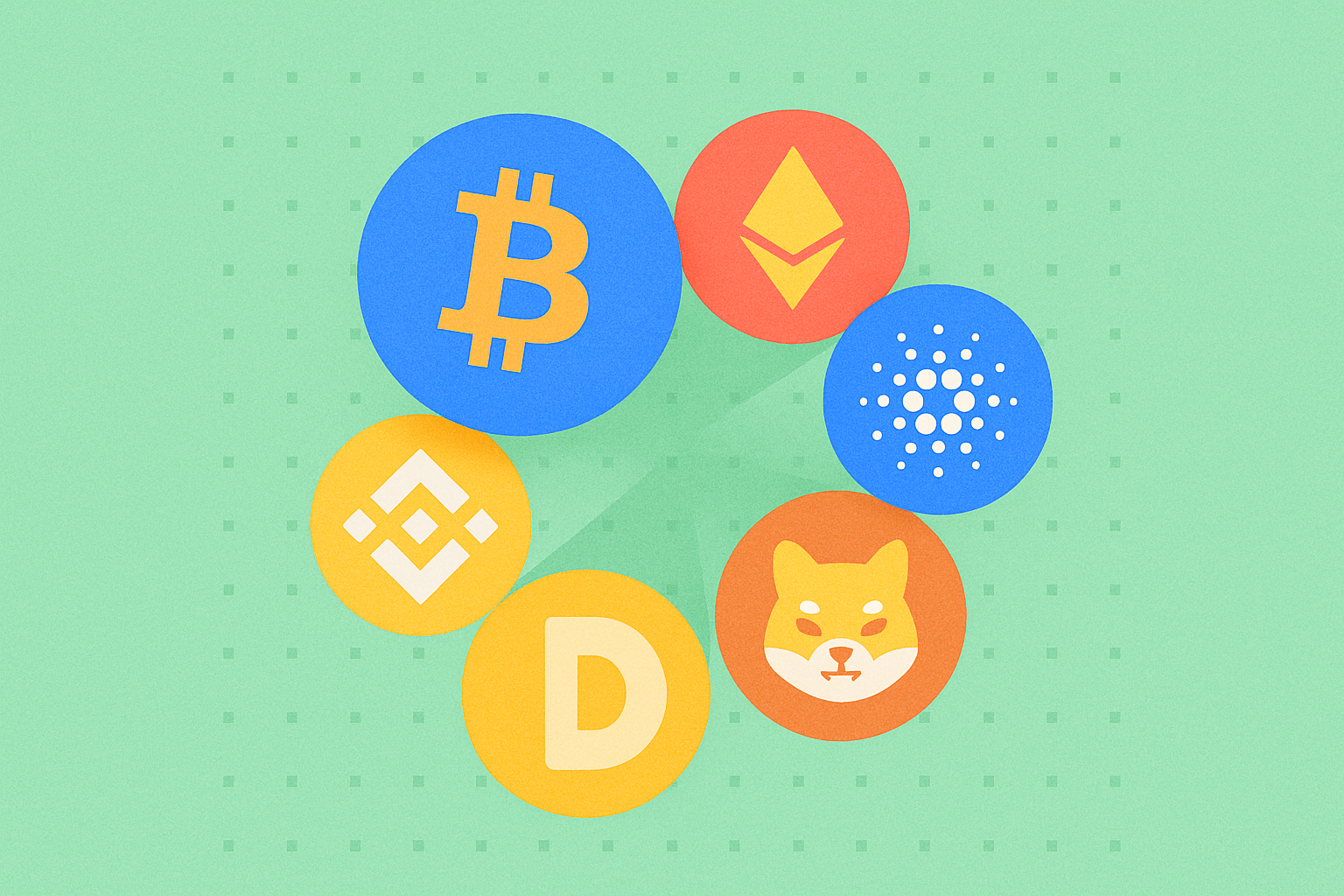
A comprehensive analysis of the top 6 recommended cryptocurrencies for 2024. This guide covers the growth drivers and investment strategies for BTC, ETH, BNB, ADA, DOGE, and SHIB, specifically designed for beginner and intermediate investors. It also outlines low-risk investment strategies on Gate and highlights essential criteria for choosing cryptocurrencies with long-term growth potential.
Summary of Growth for Six Major Tokens (Initial Price, All-Time High, Multiples)
Over the past decade, the crypto asset market has posted extraordinary growth, with many tokens surging hundreds or thousands of times from their initial prices. Bitcoin, in particular, has delivered astronomical returns—at least a millionfold to its all-time high, or tens of millions of times by some estimates. Which tokens besides Bitcoin have seen gains of more than 1,000x?
The table below selects six major tokens that each grew more than 1,000x in price between 2009 and early 2025. It summarizes their launch year (public release), initial price (ICO or initial trading price), all-time high (historical peak through early 2025), and the approximate multiple from launch to peak.
Initial price reflects either the ICO price or the starting market price; all-time highs are as of early 2025. Multiples are estimated by dividing the all-time high by the initial price.
| Token (Ticker) |
Launch Year |
Initial Price |
All-Time High (Date) |
Multiple (vs. Initial Price) |
| Bitcoin (BTC) |
2009 |
$0.0008 (2010 est.) |
$109,350 (Jan 20, 2025) |
Approx. 136,687,500x |
| Ethereum (ETH) |
2015 |
$0.31 (2014 ICO) |
$4,878 (Nov 2021) |
Approx. 15,736x |
| Binance Coin (BNB) |
2017 |
$0.15 (2017 ICO) |
$690 (May 2021) |
Approx. 4,600x |
| Cardano (ADA) |
2017 |
$0.0024 (2015–17 ICO) |
$3.10 (Sep 2021) |
Approx. 1,291x |
| Dogecoin (DOGE) |
2013 |
$0.0004 (Dec 2013 launch) |
$0.74 (May 2021) |
Approx. 1,850x |
| Shiba Inu (SHIB) |
2020 |
$0.00000000051 (Aug 2020 launch) |
$0.0000885 (Oct 2021) |
Approx. 173,529x |
Each of these tokens has achieved exceptional performance in the crypto market, driven by distinct backgrounds and growth factors. The sections below provide detailed analysis of price trends and growth drivers for each token.
Bitcoin (BTC)
Launched in January 2009 by Satoshi Nakamoto, Bitcoin is the world’s first crypto asset. It serves as the cornerstone of the crypto market and is widely known as “digital gold.” Bitcoin’s supply is strictly capped at 21 million, and its scarcity and decentralized security have made it a leading store of value for long-term investors.
As the first project to put blockchain technology into practical use, Bitcoin operates as a decentralized network with no central authority. This design limits government and financial institution intervention, establishing Bitcoin’s role as an inflation hedge.
Price Trends (Initial Price, All-Time High) and Multiples
At launch, Bitcoin had virtually no value, and in 2009, there were no exchanges or market pricing. The first exchange rate to the US dollar was set in October 2009, when 5,050 BTC were sold for about $5—or roughly $0.0009 per BTC. In July 2010, Bitcoin trading began on an exchange, with prices initially ranging from about $0.0008 to $0.08.
By late 2010, the price had climbed to around $0.5, surpassed $1 for the first time in 2011, and then skyrocketed to about $29.6 in June, with high volatility. Bitcoin’s price continued to follow four-year cycles, breaking $1,000 in late 2013 and hitting roughly $19,000 in December 2017. Most recently, Bitcoin posted an all-time high of $109,350 on January 20, 2025.
From its initial trading range ($0.0008–$0.08), Bitcoin’s rise to its all-time high represents at least a 1,000,000x return, and possibly tens of millions of times. This extraordinary growth reflects both the crypto market’s expansion and Bitcoin’s unique value proposition.
Main Drivers of Bitcoin’s Growth
Several key factors drove Bitcoin’s 1,000x-plus growth. Below are the primary growth drivers in detail.
Market Maturity and Reserve Asset Status
As the first crypto asset, Bitcoin has long been the market’s anchor. It is the first choice for institutions and corporations and has consistently accounted for more than half of the crypto market’s total value. This reserve status means new investors typically start with Bitcoin, supporting continued demand.
Supply Limits and Scarcity via Halving
Bitcoin’s issuance halves every four years, which occurred in 2012, 2016, and 2020, curbing inflation. Following the third halving in 2020, monetary easing boosted Bitcoin’s status as an inflation hedge. This supply mechanism underpins long-term price appreciation.
Macroeconomic Shifts and Safe-Haven Appeal
Post-pandemic stimulus and monetary easing accelerated capital flows into Bitcoin. In early 2021, Bitcoin drew attention as a risk asset alongside stocks and real estate, surging from $29,000 at the end of 2020 to over $64,000 within months. This move solidified Bitcoin’s standing as a legitimate investment class.
Institutional and Corporate Involvement
From 2020, major companies began accumulating BTC. In 2021, an electric vehicle manufacturer announced a $1.5 billion BTC purchase. Leading payment firms and US banks launched crypto services, and traditional financial institutions entered the space. Institutional adoption enhanced Bitcoin’s legitimacy, price stability, and growth.
Nation-State Adoption as Legal Tender
In 2021, a Central American country adopted Bitcoin as legal tender, distributing wallets nationwide—a landmark move. This signaled a shift from speculation to practical payment use, significantly boosting Bitcoin’s value.
Recognition as Digital Gold
Bitcoin’s “digital gold” status became globally established, with market capitalization briefly exceeding $1 trillion in 2021. The capped supply and decentralization make it attractive for long-term investors, who increasingly view Bitcoin as a store of value.
Government Strategic Reserve Considerations
In early 2025, the US government suggested adding BTC to its foreign reserves to maintain dollar dominance and counter foreign digital asset policies. After the news, Bitcoin set a new all-time high, reinforcing the link between policy and price. This development highlighted Bitcoin’s growing recognition as a strategic national asset.
Ethereum (ETH)
Launched in July 2015, Ethereum is a blockchain platform second in size only to Bitcoin. If Bitcoin is “digital gold,” Ethereum is the “protocol for the decentralized internet,” serving as the backbone for smart contracts and DApps (decentralized apps).
Ethereum’s flexible design puts it at the center of DeFi and NFT trends, supporting countless projects and tokens. It is more than a crypto asset—it is a platform for decentralized application development.
Price Trends (Initial Price, All-Time High) and Multiples
Ethereum’s 2014 ICO sold ETH at about $0.31 each, raising roughly $18 million—one of the most successful fundraisers in crypto history.
At mainnet launch in July 2015, ETH traded for just a few dollars. Demand exploded during the 2017 ICO boom, and ETH hit a then-record $1,400 in January 2018. The price crashed to the $80s by the end of that year, marking the “crypto winter.”
Interest returned from 2020, with DeFi and NFT growth driving prices up. On November 10, 2021, ETH set its all-time high at $4,878.26. This represents over a 15,000x gain from the ICO price, establishing Ethereum as one of crypto’s most successful projects.
Main Drivers of Ethereum’s Growth
Ethereum’s explosive growth was powered by both technological innovation and market demand. Below are its primary growth drivers.
Smart Contract and DApp Innovation
Ethereum’s core feature is enabling anyone to create tokens or applications via smart contracts. Since 2016, countless projects have launched on Ethereum, fueling the ICO boom. This innovation dramatically broadened blockchain’s applications and created new economic networks.
The Rise of DeFi (Decentralized Finance)
From 2020, Ethereum-based DeFi platforms—like decentralized exchanges and lending protocols—saw rapid growth. Yield farming drove ETH to be locked in contracts, supporting price increases. Ethereum became the core infrastructure for DeFi, offering new alternatives to traditional finance.
NFT Boom and Soaring Demand
In early 2021, NFT marketplaces expanded rapidly, and ETH was used to trade digital art and collectibles, attracting new users. Rising gas fees reflected surging network usage and drove up ETH’s price. The NFT boom cemented Ethereum’s utility in the market.
Technical Advances: Ethereum 2.0 Migration
The London Upgrade in August 2021 introduced EIP-1559, burning a portion of transaction fees. The Merge in September 2022 transitioned Ethereum from Proof of Work (PoW) to Proof of Stake (PoS), dramatically improving energy efficiency and investor confidence. These upgrades enhanced Ethereum’s sustainability and reduced environmental concerns.
Institutional Adoption and Ecosystem Expansion
Ethereum has established itself as the second most important investment after Bitcoin. In 2017, the Enterprise Ethereum Alliance (EEA) formed, including major IT and financial firms. Since 2020, exchanges have launched ETH futures, and custody services have expanded for institutions. Institutional adoption has strengthened Ethereum’s legitimacy and its foundation for long-term growth.
Binance Coin (BNB)
Binance Coin is the native token of one of the world’s largest crypto exchanges. Launched with the exchange in July 2017 via ICO, it started as an ERC-20 token before migrating to its own BNB Chain. Today, BNB is a utility token used for trading fee discounts, gas payments, and more throughout the ecosystem.
BNB has evolved from an exchange token to the foundation of its own blockchain ecosystem, supporting DeFi and NFT projects. This versatility has significantly increased BNB’s value.
Price Trends (Initial Price, All-Time High) and Multiples
BNB was offered at $0.15 in the ICO, with about 100 million tokens sold. Initially trading at a few dollars, BNB soared in early 2021, hitting an all-time high of $690.93 on May 10, 2021—a 4,605x gain from the ICO price.
In 2024, the expanding ecosystem and regulatory tailwinds helped BNB reach a new peak of $705 on November 15, 2024—about 7,016x from the ICO price. Recently, BNB has traded in the $500–$700 range as the market stabilizes.
Main Drivers of BNB’s Growth
BNB’s exceptional growth was fueled by the explosive growth of its parent exchange and the development of a unique ecosystem. Key growth drivers include:
Exchange Growth and User Expansion
Since 2018, the leading exchange has dominated global trading volumes. Users receive fee discounts with BNB, supporting steady demand. Since 2019, scandals at rival exchanges have accelerated capital inflows. The exchange’s growth directly boosts BNB’s value.
Fee Discounts and Expanding Use Cases
BNB is used for trading fee discounts, IEOs, staking, lending, and more. Especially for Launchpad IEOs, holding BNB is required, driving demand and price. As the user base grows, BNB’s utility continues to expand.
Success of BNB Chain
The exchange launched its own chain in 2019, with BNB as the native token. In 2020, an Ethereum-compatible smart chain went live, attracting developers with low gas fees for DeFi and gaming. Today, BNB Chain is the second-largest smart contract platform after Ethereum.
Regular Token Burns and Deflationary Model
BNB’s total supply is set to decrease to 100 million. The exchange conducts quarterly buybacks and burns, reducing circulation. This deflationary model benefits long-term holders and supports BNB’s price over time.
Brand Power and Community Strength
The founder’s leadership and user-focused marketing have built global support. Frequent airdrops and IEOs have fostered long-term holders, and the exchange’s reliability (including hack compensation) has increased trust in BNB.
Cardano (ADA)
Cardano is a third-generation blockchain platform launched in 2017. The ADA token supports smart contracts and DApps. Cardano’s development, led by Ethereum co-founder Charles Hoskinson, is based on academic peer review and formal verification.
Cardano uses the Ouroboros Proof of Stake consensus algorithm and has advanced through phased upgrades (Byron, Shelley, Goguen, etc.). This academic approach is a key driver of Cardano’s security and reliability.
Price Trends (Initial Price, All-Time High) and Multiples
In January 2017, Cardano’s ICO, focused on Japan and Korea, sold ADA at about $0.0024. After the mainnet launch in October 2017, the altcoin boom quickly pushed the price near $1.
Although Cardano stagnated during the 2018 crypto winter, it rebounded in 2020–2021. Staking (Shelley) and smart contracts (Alonzo) sparked renewed interest, and ADA reached a record $3.1 on September 2, 2021—a more than 1,300x gain from ICO.
Main Drivers of Cardano’s Growth
Cardano’s 1,000x-plus rise was driven by technical innovation and growing real-world use. Key growth drivers include:
Upgrade Milestones as Catalysts
The Shelley upgrade in 2020 enabled staking and decentralization; Alonzo in 2021 added smart contracts. These milestones fueled price increases. In 2023, the Hydra upgrade improved scalability, enabling thousands of transactions per second and accelerating DeFi and NFT adoption.
Academic Development and Reliability
Cardano’s peer-reviewed, theory-based design has earned long-term trust for its safety and stability. The community is highly committed, with many long-term holders, supporting the project’s value over time.
“Ethereum Killer” Positioning
With lower energy use, low fees, and strong security, Cardano was viewed as an alternative to Ethereum, especially during high gas fee periods in 2021. The Hydra upgrade’s fast processing has further solidified this status. Cardano has strong recognition in Japan, where domestic listings have also helped its growth.
Real-World Use Cases
Partnerships with African governments have introduced digital IDs and academic management for over 5 million students, expanding to over 10 million as adoption grows. Other projects include agricultural traceability and notary services, supporting prospects for nationwide implementation.
Staking as a Long-Term Holding Incentive
ADA holders earn annual staking rewards. About 75% of circulating ADA is locked in staking, limiting market liquidity and promoting price stability.
Dogecoin (DOGE)
Dogecoin was created in 2013 as a meme-based crypto asset, launched by engineers Billy Markus and Jackson Palmer and inspired by the Shiba Inu “Kabosu” meme. At launch, Dogecoin had no clear purpose or technical innovation and began as an “infinitely issued joke currency.”
Despite this, its approachable logo and playful culture won over the community. By 2021, Dogecoin had evolved from a meme into a top-five token by market cap.
Price Trends (Initial Price, All-Time High) and Multiples
DOGE launched in December 2013 at about $0.0004. Reddit buzz drove prices up over 300% in days. In 2015, DOGE hit its all-time low at $0.000086, but it rebounded in the 2017–2018 altcoin boom.
In 2021, celebrity endorsements and retail investor enthusiasm drove DOGE to a record $0.74 on May 8—a roughly 1,850x return (+185,000%).
Further movement through 2025 saw DOGE spike again on expectations of electric vehicle adoption, reaching $1.23 on December 15, 2024—a new all-time high and about 3,075x from launch. The price has since stabilized in the $0.80–$1.00 range.
Main Drivers of Dogecoin’s Growth
Dogecoin’s explosive rise was driven by meme culture and celebrity influence. Key growth drivers include:
Meme Culture and Community Strength
The Shiba Inu logo and light tone made DOGE beginner-friendly, and it became a tipping and donation currency on Reddit. The “No highs, no lows, only Doge” ethos and strong meme presence on social media fostered a highly unified community, supporting the price.
Celebrity and Influencer Support
A high-profile tech entrepreneur—self-described as the “Dogefather”—helped drive up the price, especially with the 2024 electric vehicle adoption. Rappers and business figures also backed DOGE, and viral social media fueled the 2021 bubble and 2024’s new all-time high. Investment fund ETF filings added fuel to the hype.
Retail Investor Momentum
The 2021 retail investor movement drew buyers to DOGE, rallying behind “To the Moon.” The campaign briefly pushed DOGE into the top five by market cap. ETF optimism continues to support retail demand and top-ten status.
Platform Accessibility
Major trading apps and exchanges improved access, especially for younger users, causing surges in trading. ETF filings and expanded DOGE trading have encouraged institutional participation.
Hype as a Unique Brand Asset
Despite limited utility or technical progress, DOGE’s “fun” appeal persists. In 2023, a prominent entrepreneur changed a social media logo to a Shiba Inu, drawing renewed attention. The December 2024 trial of DOGE payments by an EV maker and ETF approvals kept DOGE in the spotlight. Viral slogans like “Dogecoin for Mars currency” sustain the speculative boom.
Shiba Inu (SHIB)
Shiba Inu, launched in August 2020 by the anonymous “Ryoshi,” is a meme-based crypto asset inspired by Dogecoin and branded as the “Dogecoin Killer.” It is an Ethereum-based ERC-20 token with an extremely low price and massive supply, allowing users to accumulate enormous amounts easily.
SHIB became a global phenomenon during the 2021 meme coin boom, creating many overnight millionaires.
Price Trends (Initial Price, All-Time High) and Multiples
SHIB began trading on DEXs in 2020 with an initial price of $0.00000000051. Initially obscure, it gained attention after major exchange listings in May 2021, peaking at $0.00008845 in October 2021—a gain of over 500,000x.
After a correction, SHIB is now trading in the $0.00001–$0.00003 range—still exponentially higher than its starting price.
Main Drivers of SHIB’s Growth
SHIB’s rise was driven by meme appeal and speculative excitement. Key growth drivers include:
Meme Appeal and “Dogecoin Killer” Branding
SHIB’s use of the Shiba Inu breed and “next Dogecoin” positioning fueled social media hype and FOMO, driving explosive rallies in 2021.
Passionate Community and Viral Hype
The SHIB Army amplified attention through social media, celebrity tweets, and a major SHIB burn by the Ethereum founder. High-profile involvement triggered price volatility and token burns supported prices.
Rapid Listings on Major Exchanges
In 2021, a wave of exchange listings boosted liquidity and transformed SHIB’s image from microcap to mainstream. With over 100 exchanges now supporting SHIB, liquidity continues to expand.
Low Price and Speculative Appeal
The ability to buy millions of SHIB for just a few dollars fueled the “what if it hits $1…” narrative, and stories of outsized returns spread on social media, accelerating FOMO. The low entry price and huge supply sustain speculative interest.
Ongoing Project Development and Utility Expansion
In 2021, SHIB launched its own DEX; since 2022, it has announced layer-2 development and metaverse initiatives. Expanded utility and a burn mechanism aim to support the price.
Summary: Future Outlook
Reviewing the six major tokens (BTC, ETH, BNB, ADA, DOGE, SHIB) that grew over 1,000x between 2009 and early 2025, it’s clear that innovation, macroeconomic trends, and social media influence drove growth.
Bitcoin solidified its role as “digital gold,” Ethereum became the foundation for smart contracts and DeFi, Binance Coin’s value soared with its exchange ecosystem, Cardano established trust through academic rigor, and Dogecoin and Shiba Inu achieved explosive growth through meme culture and community support.
Each token has a unique story, illustrating the diversity and potential of the crypto market. While similar phenomena may occur, past success does not guarantee future returns. The crypto market remains volatile, and regulatory and technical uncertainties persist.
Investors should remain level-headed and long-term focused, making decisions according to their risk tolerance. The market will continue to innovate, and new technologies and use cases could unlock further growth potential.
FAQ
What are the key characteristics of tokens that have grown over 1,000x?
Tokens with 1,000x growth typically launch with low liquidity, generate strong buzz, and rapidly expand as the market grows. Meme coins are notable examples, showing sharp value spikes driven by events and social interest.
What do successful 1,000x crypto projects have in common?
They feature innovative technology, unique ideas, strong community support, high demand, and sustained investor interest. These factors underpin their outsized growth.
What are the risks and considerations when investing in high-growth tokens?
High-growth tokens can drop sharply when momentum slows. They are sensitive to market swings and can be impacted by technical or regulatory changes. Careful research and diversification are essential.
How can you evaluate the high-growth potential of early-stage crypto projects?
Look for strong community backing, innovative technology, clear use cases, transparent regulatory compliance, and partnerships with established financial institutions. Evaluate the team’s track record, development progress, and trading activity as well.
What separates 1,000x gainers from failed crypto projects?
Successful tokens focus on utility and scalability, building lasting network effects. Failures depend only on speculation and lack clear use cases. Regulatory compliance and transparent development teams are critical for long-term growth.
What are the most important metrics for evaluating crypto growth rates?
Key metrics include market capitalization, trading volume, and active address count. These reflect network activity and growth. Transaction count, hash rate, and development progress are also important for gauging real growth potential.
* The information is not intended to be and does not constitute financial advice or any other recommendation of any sort offered or endorsed by Gate.