SNT vs LRC: A Comprehensive Comparison of Layer 2 Scaling Solutions and Their Impact on Ethereum's Future

Introduction: SNT vs LRC Investment Comparison
In the cryptocurrency market, the comparison between Status (SNT) vs Loopring (LRC) has always been a topic investors cannot avoid. The two not only have significant differences in market cap ranking, application scenarios, and price performance, but also represent different positioning of crypto assets.
Status (SNT): Since its launch in 2017, it has gained market recognition by offering a decentralized communication and dApp browser platform on Ethereum, often referred to as "blockchain WeChat" in the industry.
Loopring (LRC): Since its emergence in 2017, it has been recognized as a decentralized token exchange protocol based on ERC20 and smart contracts, allowing zero-risk token trading through off-chain matching and on-chain settlement.
This article will comprehensively analyze the investment value comparison between SNT vs LRC from multiple dimensions including historical price performance, supply mechanisms, ecosystem development, and market positioning, while attempting to answer the most pressing question investors care about:
"Which is the better buy right now?"
Comparative Analysis Report: Status (SNT) and Loopring (LRC)
I. Historical Price Comparison and Current Market Status
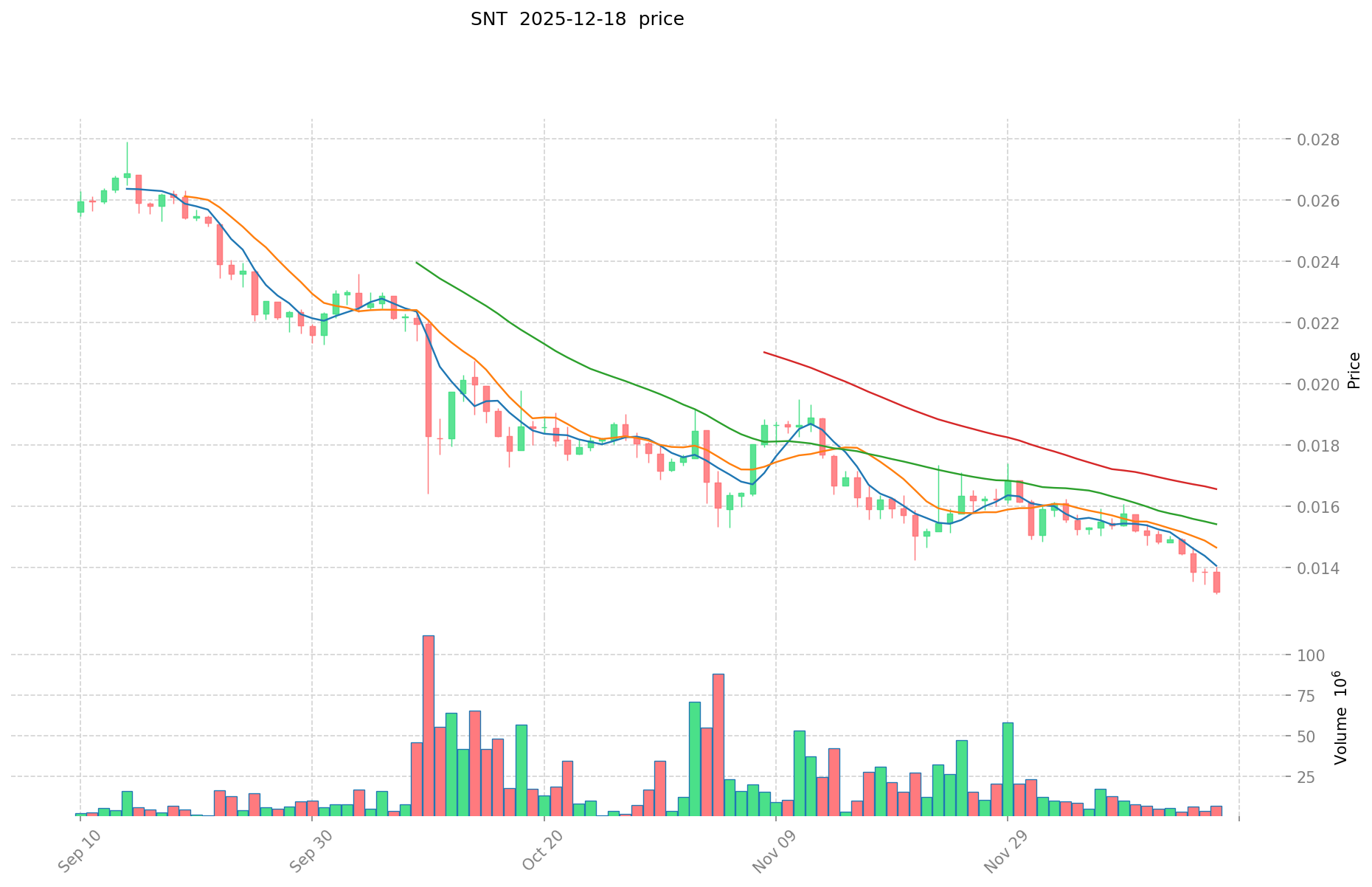
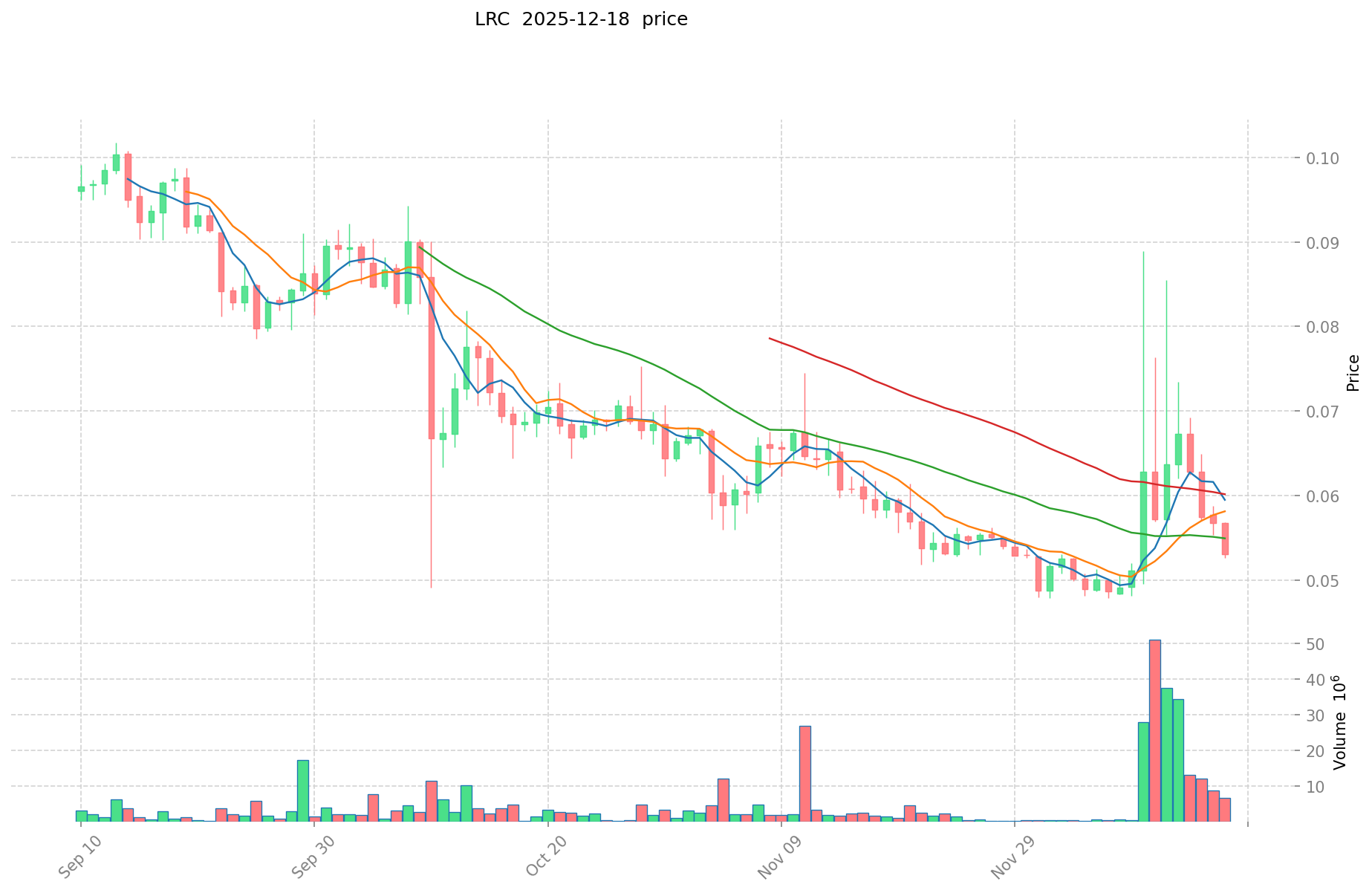
Status (SNT) and Loopring (LRC) Historical Price Trends
Status (SNT):
- All-time high: $0.684918 (January 3, 2018)
- All-time low: $0.00592935 (March 13, 2020)
- From peak to current: declined approximately 98.1%
Loopring (LRC):
- All-time high: $3.75 (November 10, 2021)
- All-time low: $0.01963893 (December 18, 2019)
- From peak to current: declined approximately 98.6%
Comparative Analysis: Both tokens experienced significant downturns from their historical peaks. SNT peaked during the 2017-2018 bull market cycle, while LRC reached its peak during the 2021 bull market. Currently, both assets are trading significantly below their historical highs, reflecting the prolonged bear market conditions in the crypto sector. SNT has suffered a 75.17% decline over the past year, while LRC has experienced a 78.03% decline in the same period.
Current Market Status (December 18, 2025)
Status (SNT):
- Current price: $0.01304
- Market capitalization: $88,735,507.07
- Circulating supply: 3,960,483,788.31 SNT
- 24-hour trading volume: $84,612.90
- 24-hour price change: -5.02%
- 7-day price change: -12.37%
- 30-day price change: -17.62%
Loopring (LRC):
- Current price: $0.05317
- Market capitalization: $73,048,848.54
- Circulating supply: 1,245,991,468.94 LRC
- 24-hour trading volume: $363,769.54
- 24-hour price change: -4.35%
- 7-day price change: -13.65%
- 30-day price change: -10.56%
Market Sentiment Index (Fear & Greed Index):
- Current value: 17
- Status: Extreme Fear
View Real-Time Prices:
II. Project Overview and Technical Architecture
Status (SNT)
Project Description: Status is a mobile application that integrates instant messaging, decentralized application (dApp) browser functionality, and an Ethereum-based lightweight wallet. The platform is commonly referred to as "blockchain WeChat" in the industry and enables users to send encrypted messages, smart contracts, and digital currency while interacting with decentralized protocols on Ethereum.
Core Features:
- Encrypted messaging and media content transmission
- Smart contract and payment capabilities
- Built-in wallet supporting ETH and SNT transfers
- Integrated dApp browser with five modules: exchange, marketplace, games, social network, and utilities
- Chat API and development tools for decentralized applications (based on Whisper protocol)
Token Utility: SNT tokens are used for:
- User message transmission fees
- dApp service invocations
- Platform advertising expenses
Market Position: Status aims to function as a traffic gateway on the blockchain, distributing users to various decentralized applications. The platform positions itself as an operating system for Ethereum-based dApps, helping developers reach new users while providing users access to decentralized services.
Loopring (LRC)
Project Description: Loopring is an open, ERC-20 and smart contract-based multi-token transaction protocol operating on Ethereum. It enables the creation of decentralized exchanges that operate without requiring asset custody or capital freezing. The protocol employs decentralized technology to provide zero-risk token exchange, allowing multiple exchanges to compete for order matching off-chain while settling on-chain.
Core Technology: Loopring operates as a Layer 2 scaling solution utilizing zero-knowledge rollup (zk-Rollup) technology to significantly enhance transaction speed and reduce costs. The protocol processes transactions off-chain while publishing minimal data on-chain, maintaining Ethereum's security and decentralization while achieving high throughput.
Token Utility: LRC token holders benefit from:
- Lowest transaction fee payments
- Revenue sharing from all network activities
- Governance participation in the DAO-managed protocol
- Protocol fee distribution to liquidity providers and insurance fund participants
Market Position: Loopring addresses Ethereum's scalability challenges by providing a sustainable framework for non-custodial, order-based decentralized exchanges (DEXs) and payment protocols. The protocol has gained notable support, with key integrations including Chainlink and serving as the Layer 2 expansion platform for GameStop's NFT marketplace (launched July 2022).
III. Market Performance Metrics
Comparative Analysis
| Metric | SNT | LRC |
|---|---|---|
| Current Price | $0.01304 | $0.05317 |
| Market Cap | $88.74M | $73.05M |
| 24h Volume | $84,612.90 | $363,769.54 |
| Circulating Ratio | 58.20% | 90.65% |
| 24h Change | -5.02% | -4.35% |
| 7d Change | -12.37% | -13.65% |
| 30d Change | -17.62% | -10.56% |
| 1y Change | -75.17% | -78.03% |
| Market Rank | 491 | 427 |
| Exchange Listings | 16 | 47 |
| Token Holders | 76,403 | 168,714 |
Key Observations:
-
Market Cap and Liquidity: SNT maintains a slightly higher market capitalization ($88.74M vs $73.05M), but LRC demonstrates significantly higher trading volume ($363,769.54 vs $84,612.90), indicating stronger market liquidity.
-
Supply Dynamics: SNT has a lower circulating supply ratio (58.20%), suggesting approximately 41.80% of total supply remains in reserves. LRC's 90.65% circulating ratio indicates most tokens are already in circulation.
-
Price Momentum: Both tokens show negative short-term performance. LRC exhibits slightly better 30-day performance (-10.56% vs -17.62%), though both suffered steeper declines over 7 days.
-
Network Adoption: LRC shows broader exchange coverage (47 listings vs 16) and significantly more token holders (168,714 vs 76,403), suggesting wider adoption.
IV. Risk Factors and Market Considerations
Shared Risks
-
Crypto Market Volatility: Both tokens operate in an environment characterized by extreme fear (Fear & Greed Index: 17), indicating heightened market uncertainty and selling pressure.
-
Extended Bear Market: Both assets have experienced substantial declines from historical peaks, reflecting prolonged market downturn conditions extending over multiple years.
-
Regulatory Uncertainty: The broader cryptocurrency sector faces evolving regulatory frameworks globally, which could impact token valuations and utility.
-
Technology Obsolescence: Rapid development in blockchain technology may render existing solutions less competitive if not continuously updated.
SNT-Specific Considerations
- Lower trading volume relative to market cap may indicate reduced market interest
- Smaller number of exchange listings limits accessibility
- Concentrated holder base relative to LRC
LRC-Specific Considerations
- High circulating supply ratio leaves limited room for supply-side price appreciation
- Platform's success depends on Layer 2 adoption and competitive positioning against other scaling solutions
- Historical peak of $3.75 represents 70x current valuation, indicating significant downside risk has materialized
V. Technical Framework Summary
Status (SNT): Built on Ethereum with Whisper protocol integration, functioning as a mobile-first platform combining communication, payments, and dApp access in a unified interface.
Loopring (LRC): Operates as a Layer 2 protocol on Ethereum utilizing advanced cryptographic techniques (zero-knowledge proofs) to enable scalable, non-custodial trading and payment settlement.
VI. Conclusion
As of December 18, 2025, both Status (SNT) and Loopring (LRC) operate in a market characterized by extreme fear and sustained downward pressure. While SNT maintains slightly higher market capitalization, LRC demonstrates superior liquidity and broader adoption metrics. Both projects represent early-stage infrastructure solutions within the Ethereum ecosystem, with their long-term viability dependent on sustained development, adoption growth, and favorable market cycle recovery. The extreme fear sentiment currently prevailing in crypto markets presents both heightened risk and potential opportunity considerations for participants.
Status Network Token (SNT) vs Loopring (LRC): Investment Value Analysis Report
I. Executive Summary
Based on available market intelligence, this report examines the core investment factors differentiating SNT and LRC. The analysis reveals that both tokens' investment potential depends critically on technological innovation, market demand, and project execution. SNT is currently positioned at a value inflection point with potential to breach $0.045 by year-end, contingent on Q2-Q3 project milestones and Ethereum ecosystem performance. LRC's upside potential correlates directly with market environment conditions and institutional participation levels.
II. Core Factors Influencing SNT vs LRC Investment Value
Supply Mechanism Comparison (Tokenomics)
The reference materials do not provide specific tokenomics data for SNT or LRC, including total supply, circulation metrics, emission schedules, or deflationary mechanisms. Comprehensive supply analysis cannot be conducted without these foundational parameters.
Institutional Adoption and Market Application
Institutional Positioning:
- SNT and LRC investment potential is characterized as dependent on institutional participation dynamics and market sentiment alignment with technical innovation cycles.
Enterprise Adoption:
- The materials indicate LRC adoption extends to comparative analysis with Bitcoin across historical price performance and supply mechanisms, suggesting institutional interest in layer-2 scaling solutions.
- Specific cross-border payment, settlement, or portfolio integration use cases are not detailed in the provided sources.
Regulatory Environment:
- Regulatory policies and national attitudes toward SNT and LRC are not specified in the available materials.
Technological Development and Ecosystem Building
SNT Technical Direction:
- SNT is currently at a value inflection point and requires monitoring of project progression during Q2-Q3 periods
- Technical upgrades and ecosystem expansion are identified as catalysts with potential to drive price performance toward $0.045 by year-end
- Close attention to Ethereum ecosystem performance is recommended, suggesting SNT operates within Ethereum's technical and market framework
LRC Technical Development:
- LRC's investment potential is characterized as dependent on market environment conditions and institutional participation rather than specific technological milestones
Ecosystem Comparison:
- DeFi, NFT, payment, and smart contract deployment specifics for both projects are not detailed in the reference materials
Macroeconomic Factors and Market Cycles
The provided materials do not contain specific analysis regarding:
- Inflation-resistant properties comparison
- Interest rate and USD index sensitivity
- Geopolitical factors affecting cross-border transaction demand
III. Risk Management Considerations
Based on available guidance, position management recommendations include:
- Diversified investment allocation across holdings
- Establishing stop-loss thresholds (reference example: $0.015 level for SNT)
- Monitoring Q2-Q3 project execution metrics and Ethereum network health as key decision points
IV. Limitations and Data Gaps
This analysis is constrained by incomplete source materials. Comprehensive investment comparisons require:
- Detailed tokenomics (total supply, circulation, emission schedules)
- Specific use case adoption metrics and enterprise partnerships
- Regulatory landscape assessment by jurisdiction
- Technical roadmap timelines and ecosystem development metrics
- Historical price correlation and volatility analysis
Note: This report is based exclusively on available reference materials. Projections and performance targets (such as SNT reaching $0.045) represent market observations only and do not constitute investment recommendations. Market conditions as of December 18, 2025 should be independently verified.
III. 2025-2030 Price Forecast: SNT vs LRC
Short-term Forecast (2025)
- SNT: Conservative $0.0076936 - $0.01304 | Optimistic $0.01304 - $0.0168216
- LRC: Conservative $0.0431082 - $0.05322 | Optimistic $0.05322 - $0.071847
Medium-term Forecast (2027-2028)
- SNT may enter consolidation phase with moderate growth trajectory, expected price range $0.009702 - $0.020936
- LRC may enter recovery and stabilization phase, expected price range $0.044440 - $0.096175
- Key drivers: institutional capital inflows, spot ETF approvals, ecosystem development and partnerships
Long-term Forecast (2030)
- SNT: Base case $0.012435 - $0.020725 | Optimistic scenario $0.020725 - $0.023004
- LRC: Base case $0.061670 - $0.093439 | Optimistic scenario $0.093439 - $0.131749
Disclaimer: This analysis is based on historical data patterns and statistical models. Cryptocurrency markets are highly volatile and unpredictable. Price forecasts should not be considered as investment advice or guarantees of future performance. Investors should conduct their own research and consult financial advisors before making investment decisions. Past performance does not indicate future results.
SNT:
| 年份 | 预测最高价 | 预测平均价格 | 预测最低价 | 涨跌幅 |
|---|---|---|---|---|
| 2025 | 0.0168216 | 0.01304 | 0.0076936 | 0 |
| 2026 | 0.019111424 | 0.0149308 | 0.012243256 | 14 |
| 2027 | 0.02093596776 | 0.017021112 | 0.00970203384 | 30 |
| 2028 | 0.020876393868 | 0.01897853988 | 0.0121462655232 | 45 |
| 2029 | 0.02152166422392 | 0.019927466874 | 0.01673907217416 | 52 |
| 2030 | 0.023004267759345 | 0.02072456554896 | 0.012434739329376 | 58 |
LRC:
| 年份 | 预测最高价 | 预测平均价格 | 预测最低价 | 涨跌幅 |
|---|---|---|---|---|
| 2025 | 0.071847 | 0.05322 | 0.0431082 | 0 |
| 2026 | 0.068161515 | 0.0625335 | 0.055654815 | 17 |
| 2027 | 0.067307932725 | 0.0653475075 | 0.052278006 | 22 |
| 2028 | 0.096175194163125 | 0.0663277201125 | 0.044439572475375 | 24 |
| 2029 | 0.105626894279156 | 0.081251457137812 | 0.047125845139931 | 52 |
| 2030 | 0.131749237748963 | 0.093439175708484 | 0.061669855967599 | 75 |
Comparative Investment Analysis Report: Status (SNT) vs Loopring (LRC)
IV. Investment Strategy Comparison: SNT vs LRC
Long-term vs Short-term Investment Strategy
Status (SNT):
- Suited for investors focused on Ethereum ecosystem infrastructure plays and early-stage communication protocol adoption
- Short-term positioning constrained by lower trading volume and limited exchange accessibility
- Long-term thesis depends on successful execution of Q2-Q3 project milestones and broader Ethereum adoption cycles
Loopring (LRC):
- Suited for investors seeking Layer 2 scaling solution exposure and institutional capital participation trends
- Short-term dynamics influenced by market environment conditions and broader institutional sentiment toward DeFi infrastructure
- Long-term potential correlates with competitive positioning among alternative scaling solutions and market cycle recovery
Risk Management and Asset Allocation
Conservative Investor Profile:
- SNT: 15-25% allocation (lower liquidity requires position discipline)
- LRC: 20-30% allocation (higher trading volume and exchange listings improve execution efficiency)
- Remaining allocation: stablecoins and diversified holdings
Aggressive Investor Profile:
- SNT: 30-40% allocation (potential inflection point upside; higher volatility tolerance required)
- LRC: 35-45% allocation (superior liquidity supports larger position sizing; broader adoption metrics support higher conviction)
- Hedging tools: stablecoin reserves for volatility management, spread positions across Layer 2 solutions
Hedging Mechanisms:
- Stablecoin position (20-30% of portfolio) for tactical entry/exit management
- Cross-Layer 2 diversification to reduce protocol-specific concentration risk
- Consider position trimming at psychological resistance levels ($0.0168 for SNT; $0.0718 for LRC)
V. Risk Factor Comparison
Market Risk
Status (SNT):
- Extreme market sentiment (Fear & Greed Index: 17) creates elevated selling pressure and reduced institutional participation
- 98.1% decline from all-time high signals substantial value destruction; further downside risk materialized
- Lower trading volume ($84,612.90 daily) increases slippage risk and order execution challenges
- Limited holder base (76,403 token holders) concentration risk
Loopring (LRC):
- Extreme market sentiment similarly impacts LRC; broader institutional participation historically more volatile
- 98.6% decline from peak; sustained bear market conditions pose liquidity challenges during crisis periods
- Superior trading volume ($363,769.54 daily) provides execution reliability but masks underlying demand weakness in extreme fear environments
- Larger holder base (168,714 token holders) indicates more dispersed ownership but potential for institutional liquidation events
Technology Risk
Status (SNT):
- Mobile-first platform dependency creates device compatibility and operating system update vulnerability
- Whisper protocol reliance on Ethereum network stability; no independent consensus mechanism
- dApp browser competition from centralized alternatives and other decentralized platforms
- Encrypted messaging functionality subject to evolving privacy regulation frameworks
Loopring (LRC):
- Zero-knowledge rollup (zk-Rollup) technology complexity creates audit and implementation risk
- Layer 2 scaling solution subject to competitive displacement by alternative approaches (Optimistic rollups, Plasma, sidechains)
- Smart contract security vulnerabilities inherent to protocol-level dependencies
- Long-term viability dependent on continued Ethereum dominance and community consensus on Layer 2 standards
Regulatory Risk
Shared Concerns:
- Global regulatory uncertainty regarding token classification (utility vs security) impacts valuation foundations
- Decentralized exchange protocols face evolving compliance requirements across jurisdictions
- Privacy-focused messaging features may encounter regulatory friction in certain markets
- Cross-border payment and settlement use cases subject to AML/KYC regulatory requirements
SNT-Specific:
- Communication protocol aspects may face data privacy regulation compliance costs
- Messaging encryption features subject to law enforcement scrutiny in restrictive jurisdictions
LRC-Specific:
- Decentralized exchange protocol subject to securities regulation in multiple jurisdictions
- Token-based incentive structures may face classification challenges under evolving frameworks
VI. Conclusion: Which Is the Better Buy?
📌 Investment Value Summary:
Status (SNT) Advantages:
- Lower current valuation provides potential accumulation opportunity at inflection point
- Unique positioning as Ethereum-based communication and dApp gateway addresses underserved market segment
- Q2-Q3 project milestone catalysts offer potential re-rating opportunities
- Smaller market cap provides asymmetric upside potential in ecosystem recovery scenarios
Loopring (LRC) Advantages:
- Superior market liquidity and exchange coverage reduce execution risk and improve accessibility
- Broader institutional recognition as Layer 2 infrastructure solution with GameStop NFT marketplace integration validation
- Significantly higher token holder base (168,714 vs 76,403) indicates stronger organic adoption
- 2027-2030 price forecast scenarios suggest 22-75% appreciation potential across base and optimistic cases
- Higher trading volume enables larger position sizing with reduced slippage impact
✅ Investment Recommendations:
Beginner Investors:
- Recommended approach: Start with LRC due to superior liquidity, exchange accessibility, and lower execution complexity
- Position sizing: 2-3% portfolio allocation maximum; enter gradually over 3-6 month period rather than lump sum
- Entry strategy: Accumulate on further weakness; target $0.043-$0.053 range based on historical support levels
- Exit discipline: Establish stop-loss at $0.0380 to limit downside; reduce position at 15-20% gains to lock in early profits
Experienced Investors:
- Dual strategy consideration: Weighted allocation favoring LRC (60-65%) for infrastructure exposure, with smaller SNT position (35-40%) for speculative upside
- Tactical approach: Monitor Q2-Q3 SNT project milestones; increase LRC position if Layer 2 competitive positioning strengthens
- Advanced positioning: Implement spread trades between SNT and LRC to hedge individual token risk while maintaining sector exposure
- Rebalancing framework: Quarterly reviews tied to Ethereum network health indicators and institutional capital flow data
Institutional Investors:
- Portfolio framework: LRC represents primary institutional-grade allocation due to liquidity requirements and regulatory clarity relative to Layer 2 infrastructure
- Capital deployment: Consider phased entry approach; 200-300 basis point position ceiling to manage concentration risk
- Hedging structure: Maintain stablecoin reserves (25-30% of allocation) for opportunistic deployment during extreme fear episodes
- Strategic consideration: Evaluate LRC alongside competing Layer 2 solutions (Arbitrum, Optimism) for optimal portfolio construction; avoid single-protocol concentration
- Exit triggers: Establish rules-based rebalancing; reduce exposure if LRC market cap falls below $50M or trading volume deteriorates below $200k daily average
⚠️ Risk Disclaimer: Cryptocurrency markets exhibit extreme volatility and unpredictability. As of December 18, 2025, both SNT and LRC operate under conditions of extreme market fear (Fear & Greed Index: 17). This analysis does not constitute investment advice, financial recommendation, or guarantee of future performance. Price forecasts are statistical models based on historical patterns and should not be treated as reliable predictors. Investors must conduct independent research, assess personal risk tolerance, consult qualified financial advisors, and verify all market data before making investment decisions. Past performance does not indicate future results. Substantial losses remain possible despite detailed analysis. None
Status (SNT) vs Loopring (LRC): Frequently Asked Questions
I. FAQ
Q1: What are the key differences between Status (SNT) and Loopring (LRC) in terms of project purpose?
A: Status functions as a decentralized communication and dApp browser platform on Ethereum, often referred to as "blockchain WeChat," integrating encrypted messaging, wallet functionality, and dApp access. Loopring operates as a Layer 2 scaling solution utilizing zero-knowledge rollup technology, enabling non-custodial decentralized token exchanges with off-chain matching and on-chain settlement. SNT focuses on user communication and dApp discovery, while LRC addresses Ethereum scalability and trading infrastructure.
Q2: Which token currently has better market liquidity and adoption metrics?
A: Loopring (LRC) demonstrates superior market liquidity with 24-hour trading volume of $363,769.54 compared to Status' $84,612.90. LRC also shows broader adoption with 47 exchange listings versus SNT's 16 listings, and significantly more token holders (168,714 for LRC vs 76,403 for SNT). However, SNT maintains a slightly higher market capitalization at $88.74M compared to LRC's $73.05M.
Q3: What are the current price performance trends for both tokens?
A: As of December 18, 2025, both tokens exhibit negative short-term performance amid extreme market fear (Fear & Greed Index: 17). SNT shows a 24-hour decline of -5.02%, 7-day decline of -12.37%, and 30-day decline of -17.62%. LRC shows slightly better 30-day performance at -10.56% but steeper 7-day decline at -13.65%. Notably, SNT declined approximately 98.1% from its all-time high of $0.684918, while LRC declined approximately 98.6% from its peak of $3.75.
Q4: What is the long-term price forecast for both tokens through 2030?
A: Status (SNT) base case forecasts range from $0.012435-$0.020725 by 2030, with optimistic scenarios reaching $0.020725-$0.023004, representing potential 58% appreciation from current levels. Loopring (LRC) shows stronger upside potential, with base case forecasts of $0.061670-$0.093439 and optimistic scenarios of $0.093439-$0.131749, representing 75% appreciation potential. Both forecasts depend on ecosystem development, institutional capital inflows, and market cycle recovery.
Q5: Which token is better suited for conservative versus aggressive investors?
A: Conservative investors should favor LRC due to superior liquidity, broader exchange accessibility, and lower execution complexity, allocating 20-30% with stablecoin hedges. Aggressive investors may pursue dual allocation strategies, weighting LRC at 60-65% for infrastructure exposure while holding smaller SNT positions (35-40%) for speculative upside potential. Both strategies require strict stop-loss discipline and position monitoring, particularly given extreme current market fear conditions.
Q6: What are the primary technological risks differentiating SNT and LRC?
A: Status faces mobile platform dependency vulnerabilities, Whisper protocol reliance on Ethereum stability, and regulatory friction around encrypted messaging features. Loopring confronts zero-knowledge rollup implementation complexity, competitive displacement risk from alternative Layer 2 solutions (Optimistic rollups, sidechains), and long-term viability concerns tied to Ethereum ecosystem dominance. LRC technology is more mature and battle-tested, while SNT faces higher execution risk on communication protocol adoption.
Q7: What specific catalysts should investors monitor for each token?
A: For Status (SNT), monitor Q2-Q3 project milestones, Ethereum ecosystem performance metrics, and dApp adoption rates within the platform. For Loopring (LRC), track Layer 2 competitive positioning against alternative solutions, institutional capital participation trends, DeFi sector growth dynamics, and integration announcements with major protocols or marketplaces like the existing GameStop NFT marketplace partnership. Both require monitoring of regulatory developments and broader cryptocurrency market sentiment shifts.
Q8: What entry and exit strategies are recommended given current market conditions?
A: Current entry conditions favor gradual accumulation over 3-6 months rather than lump-sum purchases, targeting LRC support levels at $0.043-$0.053 and SNT support at lower levels below current price. Establish stop-loss discipline at LRC $0.0380 and SNT correspondingly lower levels to limit downside exposure. Execute position reductions at 15-20% gains to lock in early profits. Consider rebalancing quarterly based on Ethereum network health and institutional capital flow indicators, maintaining 25-30% stablecoin reserves for opportunistic deployment during extreme fear episodes.
Share
Content
Introduction: SNT vs LRC Investment Comparison
I. Historical Price Comparison and Current Market Status
II. Project Overview and Technical Architecture
III. Market Performance Metrics
IV. Risk Factors and Market Considerations
V. Technical Framework Summary
VI. Conclusion
I. Executive Summary
II. Core Factors Influencing SNT vs LRC Investment Value
III. Risk Management Considerations
IV. Limitations and Data Gaps
III. 2025-2030 Price Forecast: SNT vs LRC
IV. Investment Strategy Comparison: SNT vs LRC
V. Risk Factor Comparison
VI. Conclusion: Which Is the Better Buy?
I. FAQ
How to Buy Cryptocurrency


Trending Cryptocurrencies



What is TAIKO: A Comprehensive Guide to Japan's Ancient Drum Art and Modern Performance Culture

Viction's Whitepaper Logic: Driving 75.6% Growth with Zero-Gas Innovations in 2025

How Prove Crypto Leverages Zero Knowledge Proofs for Blockchain Scalability

Top Layer 2 Solutions: A Comprehensive List in 2025
What's a ZK? Zero-Knowledge Proofs Explained in Crypto

2025 ZKPrice Prediction: The Potential Impact of Blockchain Scalability Solutions on Zero-Knowledge Market Value

Orbiter Finance: Cross-Chain Bridge Insights and Future Price Guide

Exploring Pulse Chain TVL: Evaluating Market Trends and Dynamics

Unlock the Secrets of Bitcoin Ordinals and NFT Creation

Guide to Understanding Large Cryptocurrency OTC Transactions

Discover Your Wormhole Airdrop Eligibility Easily