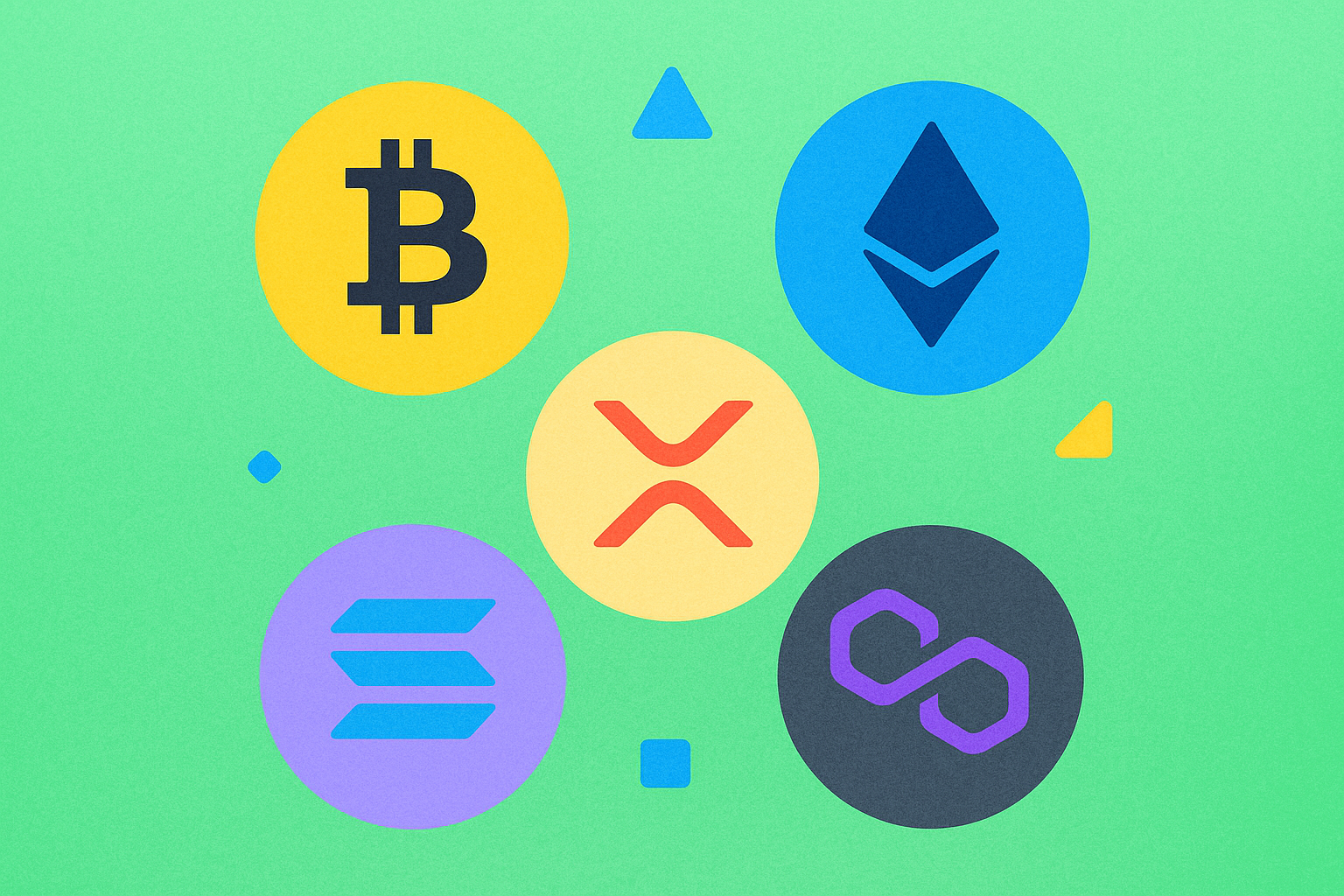
Top Cryptocurrencies for Investment in 2025: Bitcoin, Ethereum, Solana, XRP, and Other Leading Altcoins with Growth Potential. Expert insights on choosing cryptocurrencies, Layer 2 solutions, and DeFi projects. Find out which cryptocurrencies to buy in 2025 on Gate and how to select investment opportunities in the crypto sector.
Top Cryptocurrencies to Watch in 2025: Expert Selections
With the rapid advancement of the cryptocurrency market and the steady emergence of new projects, choosing investment assets has become increasingly challenging. Leading industry experts have shared their predictions for the most promising digital assets in 2025, drawing on technical analysis, market trends, and project fundamentals.
Rafik Mamin, CEO of Minestream, identifies Ethereum, XRP, Solana, and Bitcoin as the top contenders for maximum returns in 2025, with Bitcoin set to remain the dominant asset in the crypto space. He expects Bitcoin to maintain its "digital gold" status and continue attracting institutional investors.
"I believe Bitcoin is well positioned to reach $150,000, and under favorable conditions—such as strong market momentum and regulatory progress—could even surpass $180,000," he told us.
Mamin also sees Ethereum, as the foundation for decentralized applications, retaining its leadership in the smart contract ecosystem. Upcoming protocol upgrades aim to boost scalability and reduce transaction fees. He forecasts Ethereum could climb to $5,700 in 2025, and, with exceptionally strong momentum, reach $5,800.
On XRP’s 2025 outlook, Mamin points to the likelihood of Ripple resolving its dispute with US regulators. A positive court ruling could spark significant price growth for the token and broaden its adoption in global payments.
"If Ripple prevails, it will serve as a powerful catalyst, potentially driving XRP’s price to the $4–5 range. XRP has massive potential in cross-border payments, and regulatory clarity is the key factor here," Mamin asserts.
For Solana, Mamin anticipates growth fueled by performance improvements, expanding infrastructure, and a rising number of blockchain applications. Its high-speed transactions and low fees continue to attract developers, making it a strong competitor to Ethereum.
"I expect SOL’s price to fluctuate between $200–$550, with the possibility of reaching $700 in the most favorable scenario," he commented on his optimistic outlook for Solana.
Alexey Bykov, Head of Client Data Management at Strifor, partially agrees with Mamin’s picks and offers an expanded list of six cryptocurrencies across different categories for investment in 2025. He explains his selections in detail, focusing on each asset’s technical features and market potential.
1. Ethereum. Ethereum remains a frontrunner thanks to upcoming upgrades designed to boost scalability, lower transaction costs, and improve energy efficiency. The shift to Proof-of-Stake has already delivered positive results. Smart contracts and decentralized applications continue to drive network growth. ETH’s robust innovation and strong developer community make it an appealing long-term investment.
2. Optimism. This Layer 2 solution (Layer 2) for Ethereum leverages Optimistic Rollups to ease mainnet congestion and reduce fees. Leading projects like Uniswap and Synthetix are already using Optimism, highlighting its reliability and growth prospects. The technology enables off-chain transaction processing while ensuring high security.
3. StarkNet. Another Layer 2 platform for Ethereum, StarkNet uses zk-rollups to enhance transaction speed and security. The technology allows cryptographic transaction verification without exposing transaction details. With STRK trading near historical lows, it presents attractive long-term growth potential for investors.
4. Polygon. Polygon successfully tackles Ethereum’s scalability challenges, enabling fast and affordable transactions via its sidechain network. Its thriving ecosystem draws decentralized app developers and institutional investors. Upcoming protocol updates could further solidify Polygon’s market position and expand its platform capabilities.
5. Bitcoin. Despite the rise of alternative coins, Bitcoin remains the benchmark "digital gold" of the crypto market. Its integration into traditional finance through ETFs and institutional products reinforces its reputation as a reliable long-term investment. The capped supply of 21 million coins underpins a deflationary model that supports price appreciation.
6. Solana. Solana’s network stands out for its lightning-fast transaction speeds (up to 65,000 per second) and minimal fees. The growing popularity of decentralized apps and NFTs on Solana drives steady demand for SOL. The expanding DeFi ecosystem further strengthens Solana’s position among leading platforms.
Financial expert and investor Ilya Makar also joined the discussion on 2025’s top cryptocurrencies. When asked which coin might surge first, he pointed to Bitcoin, citing increased institutional interest and scalability potential enabled by Layer 2 solutions like Lightning Network.
Among altcoins, Makar highlights Ethereum, whose team is continuously enhancing technical features and rolling out new upgrades, as well as Cardano, notable for its scientific development approach.
"By 2025, Cardano could become a leading platform for smart contracts and decentralized applications, especially given the team’s emphasis on sustainability and social impact," Makar explained.
Makar also singles out Polkadot, Chainlink, Solana, Avalanche, Polygon, Cosmos, and Near Protocol as original altcoins worth investors’ attention. He believes these promising projects could deliver substantial gains in 2025, thanks to strong technical fundamentals, active ecosystem growth, and rising demand for their solutions across blockchain sectors.
Serial FinTech and DeFi entrepreneur, developer, and analyst Alexander Vais recommends investors consider Layer 2 coins and several established projects with proven technology. His top picks include TON (The Open Network), Solana, and Sui—platforms that are demonstrating high performance and dynamic ecosystem growth.
Pavel Butenko, crypto trading expert at Crypto Academy SoulTeam, suggests focusing on Ethereum for investment, believing its current price is below its real value and fundamentals, presenting a favorable buy opportunity. He also highlights Arbitrum and Optimism tokens within the Ethereum ecosystem as promising scaling solutions.
Butenko adds that RWA (Real World Assets)—the tokenization of real-world assets—is a compelling area for investment. Notable tokens in this segment include Lido Finance, which specializes in liquid staking, and Synthetix, which provides access to synthetic assets. In the DePIN segment (Decentralized Physical Infrastructure Networks), he recommends IOTA, a project focused on the Internet of Things and decentralized infrastructure.
Conclusion: Which Cryptocurrency Should You Invest in for 2025?
For 2025, experts identify several categories of cryptocurrencies with strong growth prospects based on technological strengths, market demand, and fundamental indicators. Bitcoin remains the top choice as a core portfolio asset, with forecasts of potential growth to $150,000 and even $180,000 if market conditions and institutional adoption remain favorable. Its "digital gold" status is reinforced by limited supply and growing acceptance among traditional financial institutions.
Ethereum continues to lead thanks to upgrades aimed at greater scalability and lower transaction costs. The platform’s dominance in decentralized apps and smart contracts ensures ongoing demand for ETH. XRP also stands out, especially if Ripple secures a favorable outcome in its US regulatory case, which could open new opportunities for the token in cross-border payments.
Solana’s high throughput (up to 65,000 transactions per second) and low fees sustain its competitiveness. Experts believe SOL could reach $700 if the ecosystem continues to expand and more projects launch on the platform. The growth of DeFi and NFT segments on Solana keeps attracting developers and users alike.
Beyond market leaders, other recommended cryptocurrencies span various categories. Alexey Bykov points to Polygon, Optimism, StarkNet, and Cardano as attractive long-term investments, emphasizing their technological advantages—such as Layer 2 scalability and low transaction fees. These projects are rapidly building their ecosystems and attracting institutional partners.
Ilya Makar highlights Polkadot, Chainlink, Avalanche, and Cosmos, citing their solid technical foundations and rising demand for their solutions across blockchain industry sectors. These coins may realize significant growth, driven by ongoing ecosystem development, adoption of innovative technologies, and expanded partnership networks. Experts especially favor projects offering unique technology and well-defined use cases.
Additionally, experts recommend that investors watch TON, Sui, Arbitrum, and Optimism—projects delivering solutions for blockchain scaling and efficiency. RWA sector tokens like Lido Finance and Synthetix, along with DePIN projects such as IOTA, are also attracting increasing attention. When constructing a portfolio, experts advise diversifying across asset categories and remaining mindful of the risks posed by cryptocurrency market volatility.
FAQ
Which cryptocurrencies are the most promising for investment in 2025?
Ethereum, Solana, Cardano, Ripple, Dogecoin, Shiba Inu, and Polkadot offer the highest growth potential in 2025, thanks to their technological edge and rising market demand.
What are the investment prospects for Bitcoin and Ethereum in 2025?
In 2025, Ethereum outpaced Bitcoin, driven by institutional demand, whale accumulation, and regulatory support. ETH rose 60% in July, while BTC increased by 10%. Capital inflows into ETFs and cyclical market rotation fueled Ethereum’s upward momentum.
What risks do new cryptocurrency projects face, and how can you avoid them?
New projects are exposed to fraud, hacking, and regulatory risks. Avoid suspicious airdrops, research the team and technology, and use secure wallets. Never invest more than you can afford to lose.
What are the key trends shaping the cryptocurrency market in 2025?
In 2025, the crypto market is expected to become more stable and regulated. Anticipate innovation, blockchain advancements, and greater institutional interest. The market will show sustainable growth and broader cryptoasset adoption.
How do you identify cryptocurrency projects with investment potential?
Evaluate project technology, developer activity, and real-world use cases. Diversify your portfolio, review whitepapers and team credentials, and track trading volumes and market cap. Invest in projects with long-term growth prospects and a clear roadmap.
How should small investors allocate funds to cryptocurrencies in 2025?
Choose established assets (BTC, ETH), apply dollar-cost averaging (DCA), invest only discretionary funds, diversify across coins and segments, set stop-losses, and avoid excessive leverage.
Are Layer 2 solutions and new tech coins viable investment opportunities in 2025?
Yes, Layer 2 solutions and decentralized finance (DeFi) applications present significant investment opportunities. DeFi derivatives trading volume is rising, outpacing centralized exchanges. These sectors are projected to expand further in 2025–2026.
How do policy changes in 2025 affect crypto investments?
Policy changes in 2025 triggered notable market volatility. Federal Reserve decisions led Bitcoin to swing 15% in Q4, with prices between $40,000–$45,000. Inflation announcements intensified downward pressure, pushing prices to $35,000–$40,000. These shifts created strategic investment opportunities amid volatility.
* The information is not intended to be and does not constitute financial advice or any other recommendation of any sort offered or endorsed by Gate.