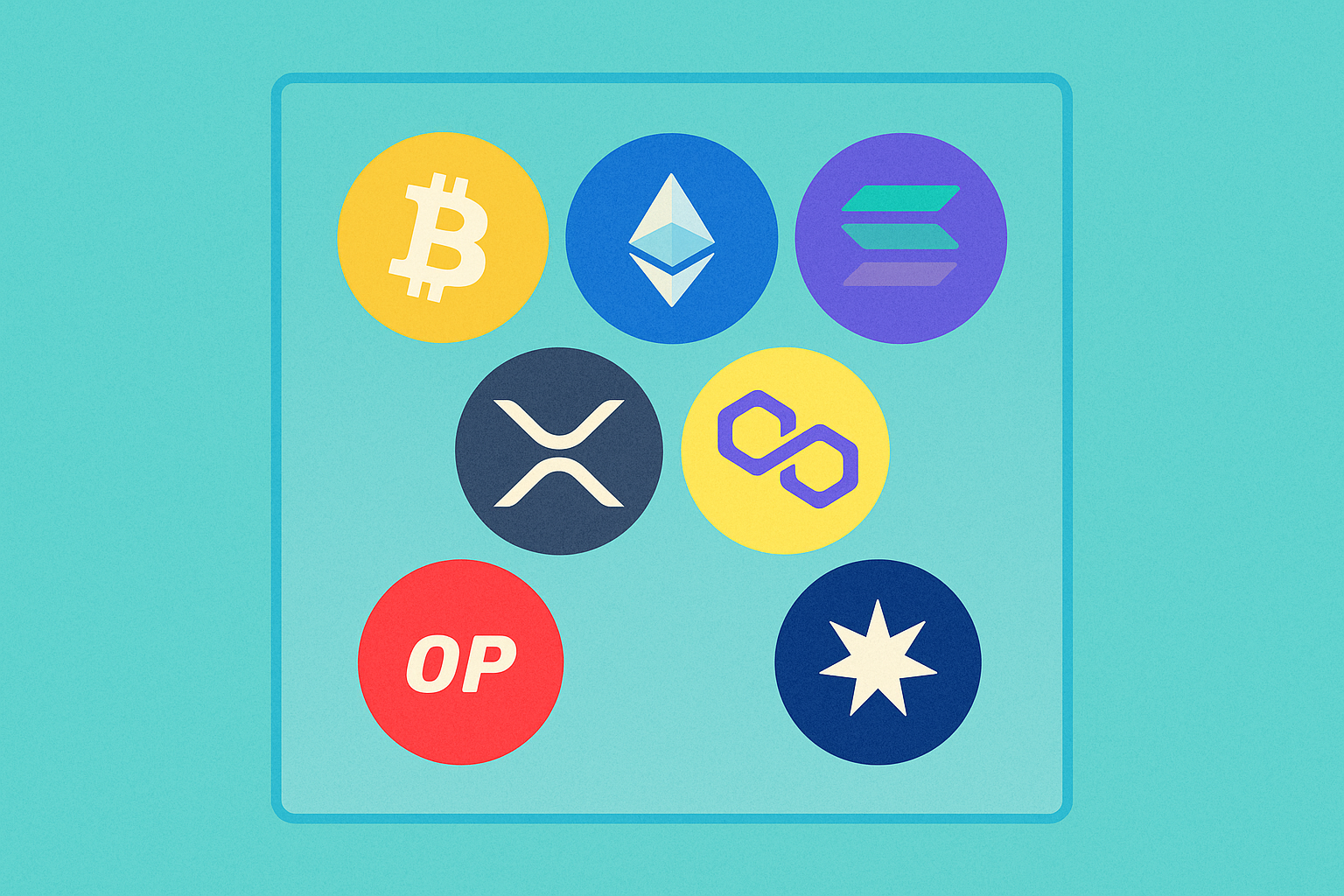
Explore the leading cryptocurrencies with strong investment potential for 2024, as identified by industry experts. This comprehensive analysis covers Bitcoin, Ethereum, XRP, Solana, and Layer-2 solutions. Find tailored recommendations for both traders and newcomers on Gate.
Most Promising Cryptocurrencies: Expert Picks
The cryptocurrency market continues to evolve rapidly, offering investors a broad array of profit opportunities. The BeInCrypto editorial team reached out to leading industry experts to determine which digital assets warrant special focus in the current market cycle.
Rafik Mamin, CEO of Minestream, identifies Ethereum, XRP, Solana, and Bitcoin as the top candidates for maximum returns in the near term, with Bitcoin retaining its status as the flagship asset of the crypto market. According to Mamin, these projects have the strongest fundamentals and technical potential for significant growth.
“I believe Bitcoin has every chance to reach $150,000, and under favorable conditions—sustained market momentum and regulatory progress—it could exceed $180,000,” he shared.
Bitcoin continues to cement its position as digital gold and the primary instrument for institutional investors. Growing adoption of BTC by traditional financial institutions, the launch of exchange-traded funds, and an improving regulatory landscape are creating favorable conditions for the long-term appreciation of the first cryptocurrency.
Mamin believes Ethereum will maintain its leadership in the blockchain ecosystem as the foundation for decentralized applications (dApps). In the near term, he sees the potential for Ethereum to rise to $5,700, and under extremely positive market dynamics, up to $5,800. Ethereum’s ongoing infrastructure development—including solutions for scalability and lower transaction costs—continues to make the platform more attractive to both developers and users.
Mamin attributes the investment prospects of Ripple’s XRP in this cycle to the potential resolution of its dispute with US regulators. This remains a key catalyst for token price growth.
“If Ripple prevails, it will serve as a powerful catalyst, potentially pushing XRP to the $4–5 range. XRP has tremendous potential in cross-border payments, and regulatory clarity is the decisive factor,” Mamin asserts.
Ripple is actively expanding partnerships with financial institutions worldwide, offering efficient solutions for international money transfers. Its technology enables transactions that are significantly faster and cheaper than those of traditional banking systems, making XRP an appealing asset for long-term investors.
Mamin expects Solana to grow driven by higher performance, infrastructure development, and a rising number of blockchain applications. The platform has established itself as one of the industry’s fastest and most scalable solutions.
“I expect SOL’s price to range from $200–550, with the possibility of reaching $700 under ideal conditions,” he explained, outlining his positive outlook for Solana.
Solana attracts developers with its high network throughput and low transaction fees. Its ecosystem is rapidly expanding, spanning DeFi, NFTs, and decentralized applications. Solana’s technological advantages make it a serious challenger to Ethereum for smart contract market leadership.
Alexey Bykov, Head of Client Data Management at Strifor, partially agreed with Mamin’s coin selection. Bykov presented an expanded investment shortlist for the current cycle, consisting of six cryptocurrencies. He also explained his choices in detail, focusing on each project’s technological strengths and market potential.
Top 6 Promising Cryptocurrencies by Alexey Bykov:
1. Ethereum. Ethereum maintains its leading position thanks to upcoming upgrades that will enhance scalability, reduce transaction costs, and improve energy efficiency. Smart contracts and decentralized applications remain the main growth drivers for the network. High innovation and a strong developer community make ETH a compelling long-term investment. The shift to a Proof-of-Stake consensus mechanism has significantly reduced energy usage and created new staking opportunities.
2. Optimism. This Layer-2 solution for Ethereum, leveraging Optimistic Rollups, helps offload the mainnet and lower transaction fees. Popular projects such as Uniswap and Synthetix already use the platform, demonstrating its reliability and growth potential. Layer-2 technology is now critical for Ethereum’s scalability, with Optimism leading in this segment.
3. StarkNet. Another Layer-2 platform on Ethereum, StarkNet uses zk-rollups to boost transaction speed and security. STRK’s token price is near all-time lows, making it attractive to long-term investors from a growth perspective. Zero-knowledge proof technology delivers high privacy and scalability, especially important for enterprise applications.
4. Polygon. Polygon effectively addresses Ethereum’s scalability issues by offering fast, low-cost transactions. Its ecosystem is expanding quickly, drawing developers and investors globally. Future upgrades could further solidify Polygon’s market position. Polygon has become the go-to platform for many major companies deploying blockchain solutions.
5. Bitcoin. Despite steady growth among other altcoins, Bitcoin remains the digital gold of the crypto market. It is integrated into traditional finance and serves as a reliable long-term asset. BTC continues to display resilience to volatility and remains the primary hedge in crypto portfolios.
6. Solana. Solana’s network stands out for its high transaction speed and low fees. The popularity of decentralized applications and NFTs on Solana continues to climb, supporting consistent demand for the token. The platform is actively competing with Ethereum in the smart contract space, offering a faster and more accessible alternative.
Next, financial expert and investor Ilya Makar shared his views on promising cryptocurrencies in the current cycle. When asked which cryptocurrency is likely to grow first, Makar pointed to Bitcoin, attributing its growth prospects to rising institutional interest and the network’s scalability via Layer-2 solutions like Lightning Network.
Among altcoins, Makar highlighted Ethereum—whose team continues to advance the technology—and Cardano, a project with a strong academic approach to blockchain development.
“In the near future, Cardano could become a leading platform for smart contracts and decentralized applications, especially given the team’s focus on sustainability and social impact,” he explained.
Cardano stands out with its research-driven development and peer-reviewed protocol design. The platform is expanding its DeFi and NFT ecosystems, attracting projects committed to sustainability and social responsibility.
Makar also pointed to Polkadot, Chainlink, Solana, Avalanche, Polygon, Cosmos, and Near Protocol as original altcoins worthy of investor attention. He believes these promising cryptocurrencies could see considerable growth in this cycle, citing strong technical foundations and rising demand for these platforms’ solutions.
Each of these projects addresses specific challenges in blockchain: Polkadot ensures cross-chain interoperability, Chainlink delivers decentralized oracles for smart contracts, Avalanche provides a high-performance platform for custom blockchains, and Cosmos is building an ecosystem of interconnected blockchains.
Alexander Vais, a serial FinTech and DeFi entrepreneur, developer, and analyst, believes investors should focus on Layer-2 coins and several foundational projects with robust technology. His top picks are TON, Solana, and Sui—projects that showcase innovative approaches to scaling and blockchain development.
TON (The Open Network) stands out for its integration with a popular messenger and potential for mass adoption. Sui represents a new generation of blockchain platforms with unique architecture built for high performance and developer-friendliness.
Pavel Butenko, a crypto trading expert at Crypto Academy SoulTeam, recommended Ethereum as a buy, noting the current price does not reflect the platform’s true value considering its fundamentals and technical progress. He also highlighted Arbitrum and Optimism tokens from the Ethereum ecosystem as promising investments in the Layer-2 segment.
Butenko also named RWA (Real World Assets)—the tokenization of real-world assets—as another promising direction. Among these tokens, he pointed to Lido Finance and Synthetix, which provide innovative solutions for staking and synthetic asset creation. In the DePIN segment (Decentralized Physical Infrastructure Networks), he suggested focusing on IOTA, which specializes in the Internet of Things and decentralized infrastructure.
The RWA sector is gaining momentum by bringing traditional financial instruments onto blockchain, delivering transparency, liquidity, and accessibility. DePIN projects are unlocking new ways to monetize physical infrastructure through decentralized networks.
Summary: Which Cryptocurrencies to Invest in During the Current Cycle
For investments in the current market cycle, experts highlight several cryptocurrencies with strong growth potential, driven by robust fundamentals and technical advantages. Bitcoin remains the leading candidate, with forecasts projecting possible growth to $150,000—and even $180,000 under favorable market conditions and regulatory improvements. Its digital gold status and growing institutional adoption make BTC a core holding for any crypto portfolio.
Ethereum continues to gain popularity through ongoing upgrades aimed at scalability and lower transaction costs. The rise of Layer-2 solutions like Optimism and Arbitrum further cements Ethereum’s leadership for smart contracts and decentralized apps. Experts widely agree that ETH remains undervalued with significant upside potential.
XRP also appears promising, especially if Ripple prevails in its legal dispute with US regulators. A favorable outcome could be a powerful catalyst for the token’s price and unlock new opportunities in cross-border payments. Ripple’s technical strengths and expanding partner network lay a solid foundation for long-term growth.
Solana maintains its dominance among high-performance blockchains thanks to its fast transactions and low fees. Experts see SOL’s price potentially climbing to $700 if market conditions are favorable. The expanding DeFi, NFT, and decentralized app ecosystem on Solana continues to support robust token demand.
In addition to market leaders, other promising cryptocurrencies are also recommended. Bykov mentions Polygon, Optimism, StarkNet, and Cardano as attractive long-term assets, emphasizing their technical strengths such as scalability solutions and low fees. These projects address critical industry challenges and hold strong growth potential.
Makar highlights Polkadot, Chainlink, Avalanche, and Cosmos for their technical robustness and growing demand for their solutions. These coins could deliver substantial gains as their ecosystems develop and new technologies are adopted. Each project occupies a unique niche and offers targeted solutions in blockchain.
Our experts also suggest investors consider TON, Sui, Arbitrum, Optimism, as well as Lido Finance, Synthetix, and IOTA. These projects represent cutting-edge developments in Layer-2 solutions, real-world asset tokenization (RWA), and decentralized physical infrastructure (DePIN).
When building an investment portfolio, it’s vital to diversify risk and strike a balance between established projects (Bitcoin, Ethereum) and high-potential altcoins. Experts recommend conducting independent analysis and factoring in your own risk tolerance when making investment decisions.
FAQ
Which cryptocurrencies are considered the most promising in the current market cycle?
In the current cycle, Bitcoin, Ethereum, and Solana are the most promising. Binance Coin and Avalanche also stand out for their growing trading volumes and ecosystem development.
What factors should you consider when choosing a cryptocurrency for investment?
Focus on project fundamentals, technological innovation, market capitalization, trading volume, and community activity. Assess the development team and real-world use case prospects.
What risks are associated with investing in cryptocurrencies, and how can they be minimized?
The main risks are price volatility, regulatory changes, and security threats. To minimize risk: invest only a portion of your capital, diversify your portfolio, use cold storage, choose reputable projects, and avoid panic during market swings.
What’s the difference between investing in major cryptocurrencies (Bitcoin, Ethereum) and altcoins?
Bitcoin and Ethereum are market leaders with high liquidity and stability. Altcoins offer higher growth potential but also greater volatility. Major cryptocurrencies are less risky, while altcoins may suit more aggressive investors.
What is the optimal portfolio allocation strategy for investing in cryptocurrencies?
Use a fixed-share strategy: set a percentage allocation for each asset and rebalance regularly. Diversify among major coins, altcoins, and stablecoins. Avoid concentrating on a single asset.
What technological and fundamental indicators signal a promising crypto project?
Promising projects feature innovative blockchain technology, active code development, growing trading volume and user numbers, and strong market capitalization with sustainable demand.
* The information is not intended to be and does not constitute financial advice or any other recommendation of any sort offered or endorsed by Gate.