THL vs BAT: The Battle for Market Dominance in China's Tech Industry


Introduction: THL and BAT Investment Comparison
In the cryptocurrency market, the comparison between THL vs BAT continues to be a topic investors cannot avoid. The two differ markedly in market cap ranking, application scenarios, and price performance, and represent distinct crypto asset positioning. THL (THL): Launched in 2023, it has gained market recognition through its positioning as a DeFi Hyper App and Liquidity Engine on Aptos. BAT (BAT): Since its launch in 2017, it has been recognized for its positioning as a digital advertising solution, becoming one of the tokens with substantial user adoption in the digital advertising ecosystem. This article will comprehensively analyze the investment value comparison between THL vs BAT around historical price trends, supply mechanisms, institutional adoption, technical ecosystems, and future forecasts, attempting to answer the question investors care about most:
"Which is the better buy right now?"
I. Historical Price Comparison and Current Market Status
Price Trends of THL (Coin A) and BAT (Coin B)
- March 2024: THL reached a price level of $3.3333, marking a notable valuation period in its early trading history.
- November 2021: BAT experienced significant price movement, reaching $1.9 during a period of heightened activity in the digital advertising token sector.
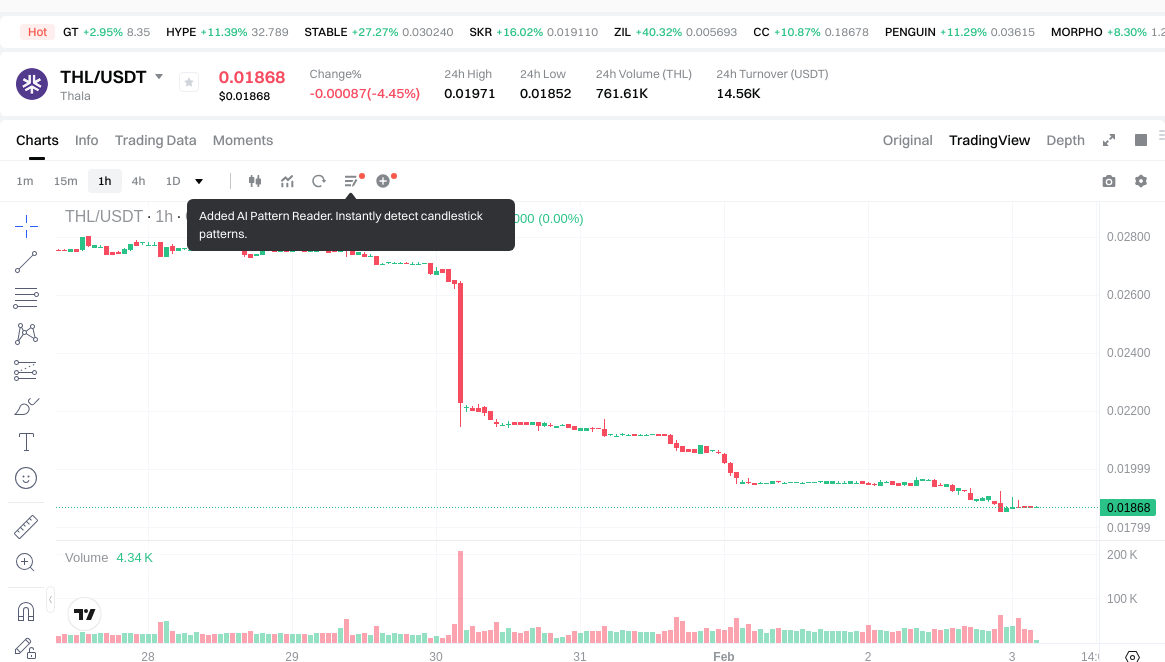
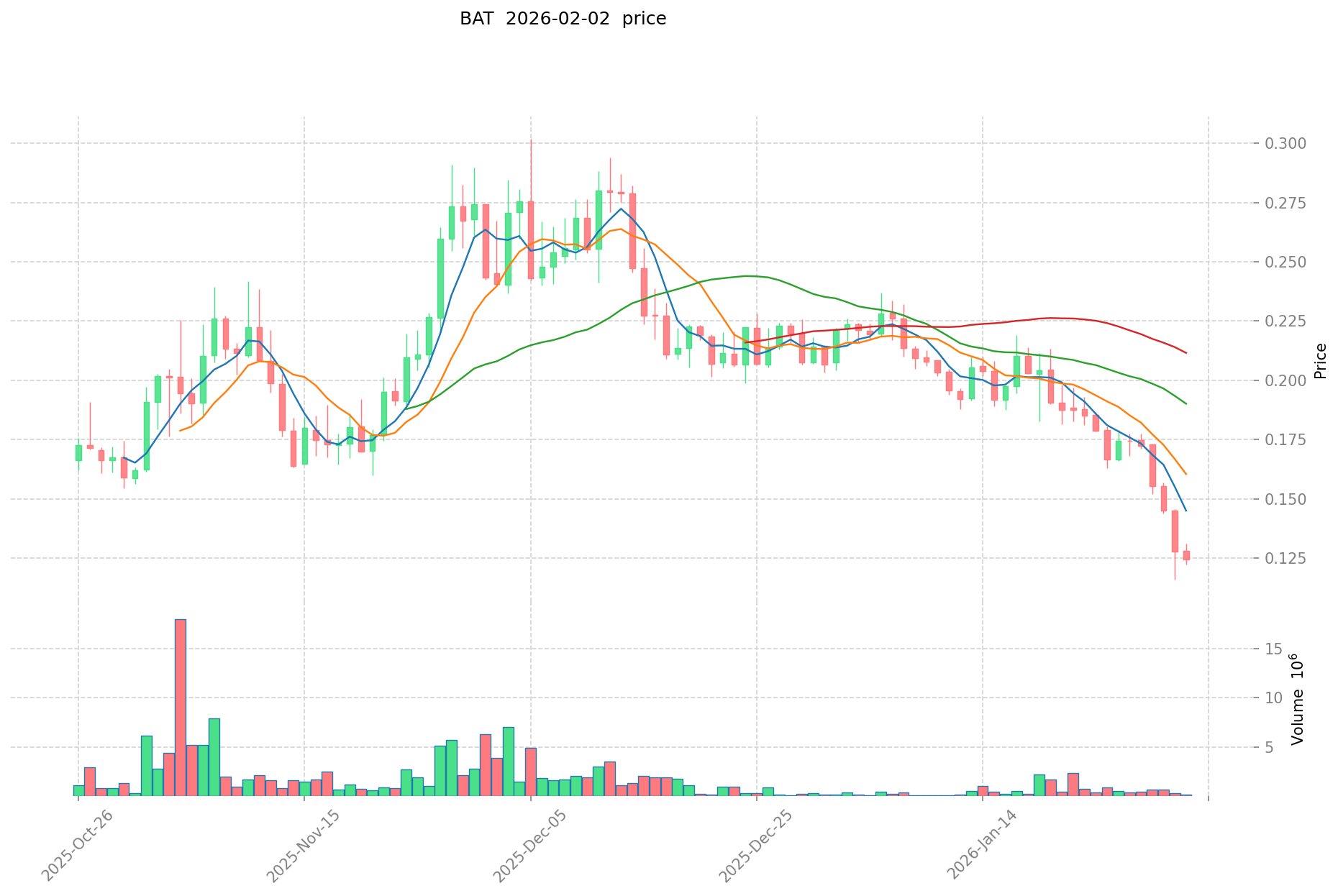
- Comparative Analysis: During the recent market cycle, THL declined from $3.3333 to $0.01852, while BAT decreased from $1.9 to $0.072394, reflecting similar downward pressure across both assets.
Current Market Status (February 3, 2026)
- THL Current Price: $0.01868
- BAT Current Price: $0.1228
- 24-Hour Trading Volume: THL $14,567.38 vs BAT $24,891.09
- Market Sentiment Index (Fear & Greed Index): 14 (Extreme Fear)
View Real-Time Prices:
- Check THL Current Price Market Price
- Check BAT Current Price Market Price
II. Core Factors Influencing THL vs BAT Investment Value
Supply Mechanism Comparison (Tokenomics)
- THL: The reference materials do not provide specific information regarding THL's supply mechanism, token distribution model, or economic design structure.
- BAT: The reference materials do not contain details about BAT's tokenomics, including whether it employs a fixed supply, deflationary model, or other monetary policy mechanisms.
- 📌 Historical Pattern: Supply mechanisms typically play a role in shaping price cycles through controlled issuance rates, burn mechanisms, or halving events, though specific historical data for these tokens is not available in the provided materials.
Institutional Adoption and Market Applications
- Institutional Holdings: The reference materials mention THL A13 Limited and Tencent Mobility Limited as institutional entities, though their direct connection to cryptocurrency investment preferences between THL and BAT tokens is not established in the available documentation.
- Enterprise Adoption: The materials do not provide comparative analysis of THL or BAT adoption in cross-border payments, settlement systems, or institutional investment portfolios.
- National Policies: Regulatory attitudes toward these specific tokens across different jurisdictions are not addressed in the reference materials.
Technology Development and Ecosystem Building
- THL Technology Development: The reference materials reference THL in contexts related to smartphone technology and brand building rather than blockchain or cryptocurrency technical specifications.
- BAT Technology Development: While BAT (as an acronym representing major Chinese internet companies) appears in materials discussing market resources and influence, specific cryptocurrency technology upgrades or blockchain development roadmaps are not documented.
- Ecosystem Comparison: The materials do not provide information comparing DeFi integration, NFT platforms, payment infrastructure, or smart contract deployment between THL and BAT ecosystems.
Macroeconomic Environment and Market Cycles
- Performance in Inflationary Environments: The reference materials do not contain comparative data on how THL or BAT perform as inflation hedges or store-of-value assets during periods of currency devaluation.
- Macroeconomic Monetary Policy: The relationship between interest rate movements, US Dollar Index fluctuations, and the performance of these two assets is not addressed in the available documentation.
- Geopolitical Factors: While cross-border transaction demand and international developments may influence cryptocurrency markets broadly, specific impacts on THL and BAT are not detailed in the reference materials.
III. 2026-2031 Price Forecast: THL vs BAT
Short-term Forecast (2026)
- THL: Conservative $0.0135 - $0.0187 | Optimistic $0.0187 - $0.0271
- BAT: Conservative $0.112 - $0.123 | Optimistic $0.123 - $0.158
Mid-term Forecast (2028-2029)
- THL may enter a gradual appreciation phase, with projected prices ranging from $0.0138 to $0.0319 in 2028, potentially reaching $0.0228 - $0.0306 by 2029
- BAT may enter a growth acceleration phase, with projected prices ranging from $0.0919 to $0.196 in 2028, potentially reaching $0.129 - $0.233 by 2029
- Key drivers: institutional capital flows, ETF developments, ecosystem expansion
Long-term Forecast (2030-2031)
- THL: Baseline scenario $0.0225 - $0.0292 (2030) | Optimistic scenario $0.0225 - $0.0456 (2031)
- BAT: Baseline scenario $0.194 - $0.209 (2030) | Optimistic scenario $0.192 - $0.368 (2031)
Disclaimer
THL:
| Year | Predicted High Price | Predicted Average Price | Predicted Low Price | Price Change |
|---|---|---|---|---|
| 2026 | 0.027086 | 0.01868 | 0.0134496 | 0 |
| 2027 | 0.02471364 | 0.022883 | 0.01281448 | 22 |
| 2028 | 0.0318897488 | 0.02379832 | 0.0138030256 | 27 |
| 2029 | 0.03062843784 | 0.0278440344 | 0.022832108208 | 49 |
| 2030 | 0.0368376575112 | 0.02923623612 | 0.027774424314 | 56 |
| 2031 | 0.045590986605528 | 0.0330369468156 | 0.022465123834608 | 76 |
BAT:
| Year | Predicted High Price | Predicted Average Price | Predicted Low Price | Price Change |
|---|---|---|---|---|
| 2026 | 0.157568 | 0.1231 | 0.112021 | 0 |
| 2027 | 0.20629098 | 0.140334 | 0.11086386 | 14 |
| 2028 | 0.1958431137 | 0.17331249 | 0.0918556197 | 41 |
| 2029 | 0.232568030331 | 0.18457780185 | 0.129204461295 | 50 |
| 2030 | 0.302430728331225 | 0.2085729160905 | 0.193972811964165 | 69 |
| 2031 | 0.367922623983642 | 0.255501822210862 | 0.191626366658146 | 108 |
IV. Investment Strategy Comparison: THL vs BAT
Long-term vs Short-term Investment Strategies
- THL: May suit investors focused on emerging DeFi ecosystem opportunities and early-stage positioning within the Aptos network, though substantial price volatility and limited institutional adoption data suggest elevated risk profiles
- BAT: May appeal to investors seeking exposure to digital advertising blockchain integration with longer operational history since 2017, though price performance has shown significant drawdowns similar to broader market trends
Risk Management and Asset Allocation
- Conservative Investors: THL 15-20% vs BAT 25-30%, with remainder allocated to established assets and stablecoins to manage volatility exposure
- Aggressive Investors: THL 30-40% vs BAT 35-45%, accepting higher volatility in exchange for potential appreciation scenarios reflected in optimistic forecasts
- Hedging Tools: stablecoin reserves for rebalancing opportunities, options strategies where available, cross-asset diversification across multiple cryptocurrency sectors
V. Potential Risk Comparison
Market Risks
- THL: Significant price decline from $3.3333 to $0.01868 demonstrates high volatility exposure; limited trading volume of $14,567.38 may indicate liquidity constraints during market stress; extreme fear sentiment (Fear & Greed Index: 14) suggests ongoing downward pressure
- BAT: Substantial decline from $1.9 to $0.1228 reflects prolonged bear market conditions; trading volume of $24,891.09 indicates moderate liquidity; extended operational period since 2017 exposes asset to multiple market cycles and regime changes
Technical Risks
- THL: As a newer protocol launched in 2023, network maturity and stress-testing under extreme conditions remain areas requiring observation; specific technical specifications regarding scalability and stability are not detailed in available materials
- BAT: Longer operational history may indicate battle-tested infrastructure; however, specific technical architecture details, security audit results, and network performance metrics are not provided in reference materials
Regulatory Risks
- Both THL and BAT operate in evolving regulatory environments where classification standards, taxation frameworks, and compliance requirements vary significantly across jurisdictions; digital advertising tokens and DeFi protocols may face distinct regulatory scrutiny depending on regional policy developments; absence of specific regulatory stance information in materials suggests investors should monitor jurisdiction-specific announcements
VI. Conclusion: Which Is the Better Buy?
📌 Investment Value Summary:
- THL Advantages: positioning within Aptos DeFi ecosystem may offer exposure to emerging protocol development; lower absolute price point creates mathematical room for percentage gains in optimistic scenarios; 2031 optimistic forecast suggests potential appreciation to $0.0456
- BAT Advantages: longer operational track record since 2017 provides historical performance data across multiple market cycles; higher current price of $0.1228 and trading volume of $24,891.09 may indicate relatively stronger liquidity; 2031 optimistic forecast projects potential appreciation to $0.368
✅ Investment Recommendations:
- Beginner Investors: Consider starting with smaller position sizes in both assets while maintaining substantial stablecoin reserves; prioritize understanding fundamental differences between DeFi protocols and digital advertising tokens before committing significant capital
- Experienced Investors: May implement diversified allocation across both assets with regular rebalancing based on performance metrics; consider implementing stop-loss mechanisms given historical volatility patterns; monitor ecosystem developments and adoption metrics as indicators for position adjustments
- Institutional Investors: Conduct comprehensive due diligence on technical infrastructure, regulatory compliance frameworks, and liquidity depth before deployment; consider phased entry strategies to minimize market impact; evaluate both assets within broader portfolio context considering correlation patterns with established cryptocurrency benchmarks
⚠️ Risk Warning: Cryptocurrency markets exhibit extreme volatility. This content does not constitute investment advice. Both THL and BAT have demonstrated substantial price declines from historical peaks. The Fear & Greed Index reading of 14 indicates extreme fear sentiment. Price forecasts represent potential scenarios rather than guaranteed outcomes. Investors should conduct independent research and consider risk tolerance before making investment decisions.
VII. FAQ
Q1: Which cryptocurrency has shown better price stability between THL and BAT historically?
BAT has demonstrated relatively better price stability compared to THL. While both assets experienced significant declines from their respective peaks, BAT's longer operational history since 2017 and higher current trading volume of $24,891.09 suggest more established market liquidity. THL, launched in 2023, declined from $3.3333 to $0.01868, representing a more severe drawdown percentage compared to BAT's decline from $1.9 to $0.1228. Additionally, BAT's higher absolute price point and longer track record across multiple market cycles indicate more mature price discovery mechanisms.
Q2: What are the primary use cases that differentiate THL from BAT?
THL and BAT serve fundamentally different market segments. THL positions itself as a DeFi Hyper App and Liquidity Engine within the Aptos blockchain ecosystem, focusing on decentralized finance applications such as liquidity provision, yield optimization, and protocol-level financial infrastructure. In contrast, BAT operates within the digital advertising sector, serving as a token solution for blockchain-based advertising ecosystems with substantial user adoption since its 2017 launch. This fundamental difference in application scenarios means investors are essentially choosing between exposure to emerging DeFi protocols versus established digital advertising blockchain integration.
Q3: How do the 2031 price forecasts compare between THL and BAT?
According to the optimistic scenario projections for 2031, BAT shows significantly higher absolute price potential with a predicted high of $0.368 compared to THL's $0.0456. However, percentage appreciation potential requires context: THL's forecast represents approximately 144% increase from its current price of $0.01868, while BAT's projection indicates roughly 200% increase from $0.1228. Both forecasts assume favorable market conditions including institutional capital flows, ecosystem expansion, and broader cryptocurrency market recovery. Investors should note these are scenario-based projections rather than guaranteed outcomes, and actual performance will depend on numerous factors including adoption rates, regulatory developments, and macroeconomic conditions.
Q4: What position sizing should conservative investors consider for THL and BAT?
Conservative investors are recommended to allocate 15-20% to THL and 25-30% to BAT within their cryptocurrency portfolios, with the remainder distributed across established assets and stablecoins. This allocation strategy reflects BAT's longer operational history and relatively higher liquidity profile compared to THL's emerging status within the Aptos ecosystem. The larger stablecoin reserve provides flexibility for rebalancing opportunities during market volatility and serves as a risk management buffer given the extreme fear sentiment (Fear & Greed Index: 14) currently prevailing in cryptocurrency markets. Conservative investors should also implement stop-loss mechanisms and regular portfolio reviews given both assets' historical volatility patterns.
Q5: What are the main liquidity differences between THL and BAT?
BAT demonstrates superior liquidity metrics compared to THL based on current trading data. BAT's 24-hour trading volume of $24,891.09 exceeds THL's $14,567.38 by approximately 71%, indicating deeper market participation and potentially tighter bid-ask spreads. This liquidity differential becomes particularly significant during market stress periods when investors may need to execute large orders or exit positions rapidly. BAT's higher trading volume combined with its longer operational history since 2017 suggests more established market-making infrastructure and broader exchange availability. However, both assets show relatively modest absolute trading volumes compared to major cryptocurrencies, indicating investors should carefully consider position sizing relative to daily volume to minimize market impact.
Q6: How do regulatory risks differ between THL and BAT?
Both THL and BAT face distinct regulatory considerations based on their different operational frameworks. THL, as a DeFi protocol on the Aptos blockchain, may encounter scrutiny related to decentralized finance regulations, including potential classification as securities depending on jurisdictional interpretations of governance tokens and yield-generating mechanisms. BAT, operating within the digital advertising sector, faces regulatory considerations specific to advertising standards, user privacy requirements, and token utility classifications across different markets. The evolving global regulatory landscape for cryptocurrencies means both assets carry jurisdiction-specific compliance uncertainties. Investors should monitor regulatory developments in their respective regions and consider how different policy approaches toward DeFi protocols versus utility tokens might impact long-term viability and adoption trajectories.
Q7: What ecosystem developments should investors monitor for THL and BAT?
For THL, critical ecosystem indicators include Aptos blockchain adoption rates, total value locked (TVL) in THL protocols, partnership announcements with other DeFi applications, technical upgrades addressing scalability and security, and institutional integration within the Aptos ecosystem. For BAT, key developments include expansion of digital advertising partnerships, browser integration updates, user growth metrics within the Brave ecosystem, enterprise adoption announcements, and technological improvements to the advertising token infrastructure. Both assets would benefit from increased institutional recognition, exchange listings, regulatory clarity in major markets, and successful navigation of market cycles. Investors should establish monitoring frameworks tracking these ecosystem metrics as leading indicators for potential price movements and long-term value appreciation.
Q8: Given current market conditions with extreme fear sentiment, what entry strategy is advisable?
With the Fear & Greed Index at 14 (Extreme Fear), implementing a phased entry strategy rather than lump-sum investment appears prudent for both THL and BAT. This approach involves dividing intended investment capital into multiple tranches deployed at predetermined intervals or price levels, reducing exposure to potential further downside while maintaining participation in any market recovery. Specifically, investors might consider deploying 25-30% of allocated capital immediately, reserving subsequent tranches for deployment if prices decline an additional 15-20% or upon confirmation of trend reversal signals. This dollar-cost averaging methodology helps mitigate timing risk during periods of extreme sentiment. Additionally, maintaining substantial stablecoin reserves (40-50% of cryptocurrency allocation) provides flexibility to capitalize on potential capitulation events while protecting capital during ongoing market uncertainty.
Share
Content
Introduction: THL and BAT Investment Comparison
I. Historical Price Comparison and Current Market Status
II. Core Factors Influencing THL vs BAT Investment Value
III. 2026-2031 Price Forecast: THL vs BAT
IV. Investment Strategy Comparison: THL vs BAT
V. Potential Risk Comparison
VI. Conclusion: Which Is the Better Buy?
VII. FAQ
How to Buy Cryptocurrency


Trending Cryptocurrencies



What will be the market capitalization of USDC in 2025? Analysis of the stablecoin market landscape.

How is DeFi different from Bitcoin?

What is DeFi: Understanding Decentralized Finance in 2025

USDC stablecoin 2025 Latest Analysis: Principles, Advantages, and Web3 Eco-Applications

Development of Decentralized Finance Ecosystem in 2025: Integration of Decentralized Finance Applications with Web3
2025 USDT USD Complete Guide: A Must-Read for Newbie Investors

Top 7 Overseas Exchanges for Korean Investors

Top Presale Solutions for Cryptocurrency Investors

How to Choose and Set Up the Best Cryptocurrency Wallet in Recent Years

How to Create an NFT Token for Free and Sell It on NFT Marketplaces: Complete Guide
How to Exchange USDT for Japanese Yen | Complete Guide to Payment Services Act Compliance