TKO vs IMX: A Comprehensive Comparison of Two Leading Blockchain Platforms


Introduction: TKO vs IMX Investment Comparison
In the cryptocurrency market, comparisons between TKO and IMX have always been a topic investors cannot ignore. The two assets exhibit significant differences not only in market capitalization rankings, application scenarios, and price performance, but also represent distinct positioning within the crypto asset landscape. TKO (Tokocrypto): Since its launch in 2018, it has gained market recognition by serving as Indonesia's fastest-growing digital asset exchange, providing users access to the digital currency market, investment opportunities in the Indonesian market, and participation in decentralized product offerings through its NFT marketplace and DeFi utilities. IMX (Immutable): Established as an ERC-20 utility token, it powers Immutable X, a Layer 2 scaling solution for NFTs on Ethereum, characterized by instant transactions, large-scale scalability, and zero gas fees for minting and trading without compromising user or asset security. This article will comprehensively analyze the investment value comparison between TKO and IMX across historical price trends, supply mechanisms, market adoption, and technological ecosystems, while attempting to address the question most investors care about:
"Which is the better buy right now?"
Comparative Market Analysis Report: Tokocrypto (TKO) and Immutable X (IMX)
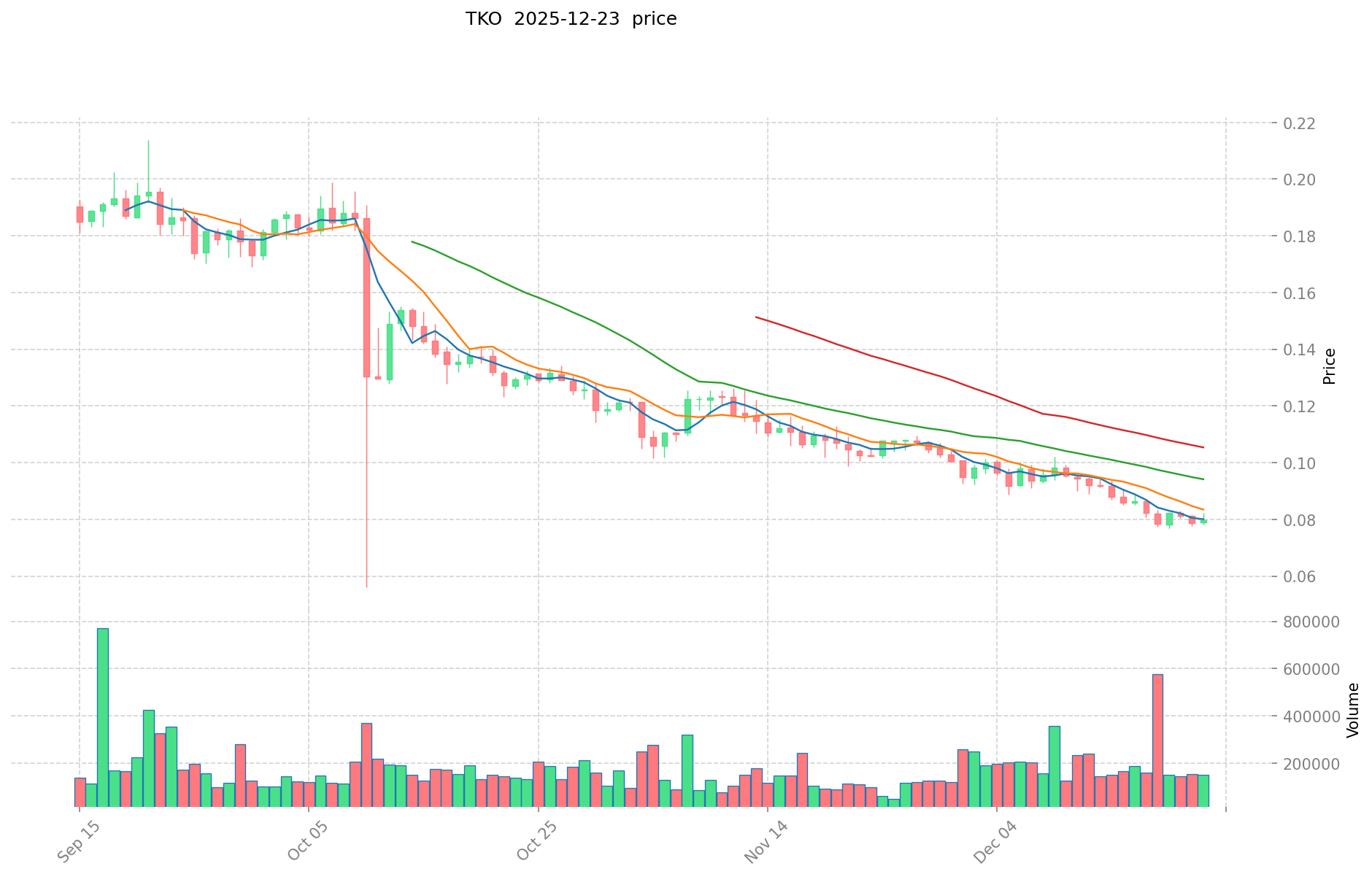
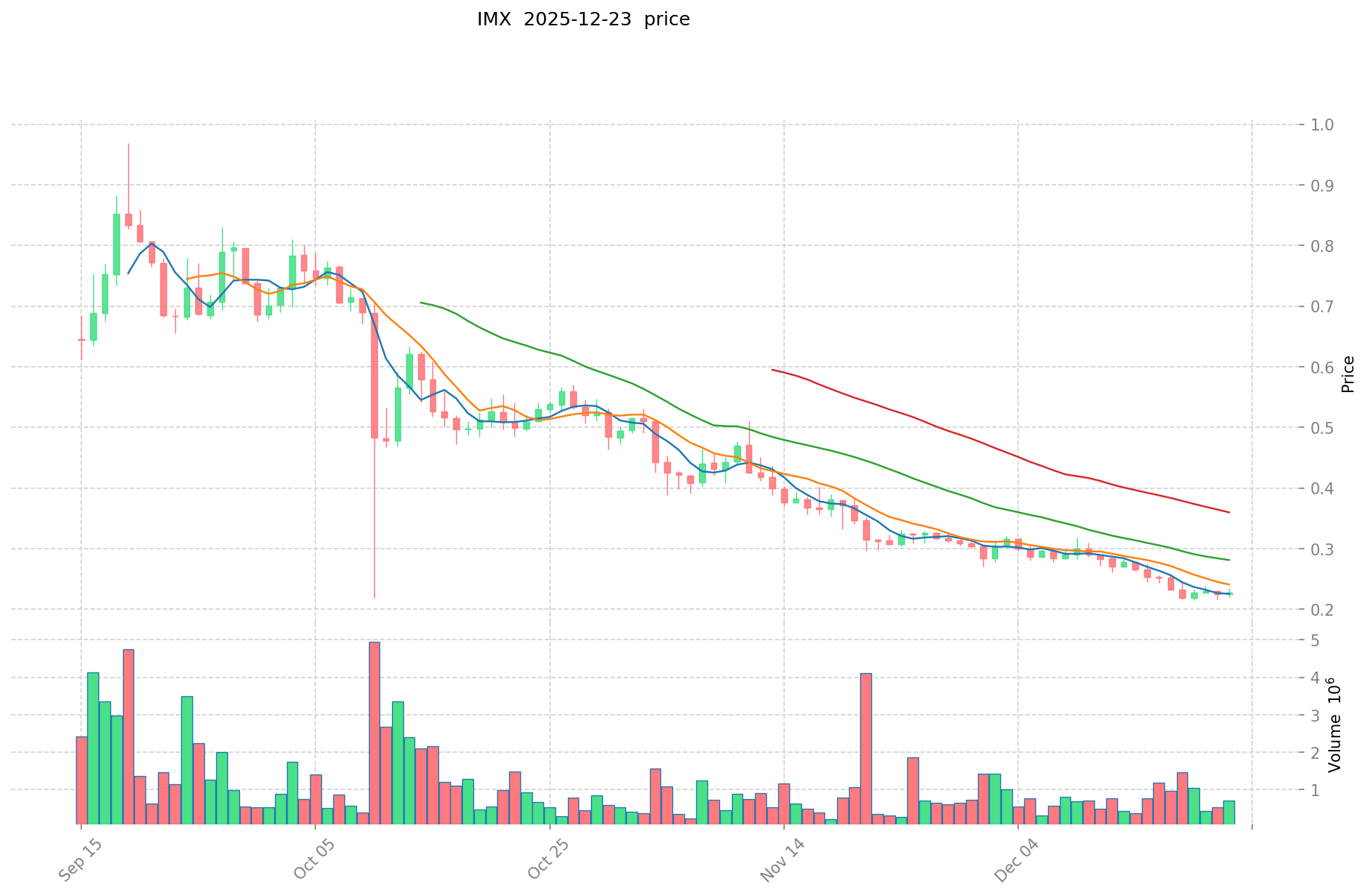
I. Historical Price Comparison and Current Market Status
Price Performance of TKO and IMX
Historical Context:
-
TKO reached an all-time high (ATH) of $4.91 on May 3, 2021, following its launch and initial market enthusiasm. Since then, the token has experienced a prolonged bear market, declining significantly over subsequent years.
-
IMX achieved an ATH of $9.52 on November 26, 2021, during the NFT market peak. Similar to TKO, IMX has experienced substantial price depreciation throughout the crypto market downturn.
Comparative Analysis:
Both tokens exhibit severe long-term downtrends characteristic of the broader crypto market correction cycle. TKO has declined 81.73% over the past year, while IMX has fallen 82.83% annually. From their respective all-time highs:
- TKO: From $4.91 to current $0.07944 represents a 98.38% decline
- IMX: From $9.52 to current $0.2256 represents a 97.63% decline
Current Market Status (December 23, 2025)
Price Data:
| Metric | TKO | IMX |
|---|---|---|
| Current Price | $0.07944 | $0.2256 |
| 24-Hour Change | -1.25% | +0.49% |
| 7-Day Change | -6.94% | -9.66% |
| 30-Day Change | -22.63% | -29.18% |
| 1-Year Change | -81.73% | -82.83% |
Trading Volume & Market Metrics:
| Metric | TKO | IMX |
|---|---|---|
| 24h Trading Volume | $12,120.94 | $150,790.25 |
| Market Capitalization | $5.96M | $186.42M |
| Fully Diluted Valuation | $39.72M | $451.2M |
| Market Dominance | 0.0012% | 0.014% |
| Number of Holders | 58,853 | 97,810 |
| Exchanges Listed | 15 | 53 |
Market Sentiment:
The Fear & Greed Index stands at 24, indicating "Extreme Fear" in the market as of December 23, 2025. This sentiment reflects broader cryptocurrency market anxiety and uncertainty.
Current price data:
II. Project Overview and Utility
Tokocrypto (TKO) - Regional Exchange Focus
Project Background:
Tokocrypto was established in 2018 as Indonesia's fastest-growing digital asset exchange by transaction volume and user registration. The platform serves as a gateway to cryptocurrency markets for Indonesian users and emerging market participants.
Token Specifications:
| Parameter | Value |
|---|---|
| Total Supply | 500,000,000 TKO |
| Circulating Supply | 75,000,000 TKO |
| Circulation Ratio | 15.0% |
| Contract Address | 0x9f589e3eabe42ebc94a44727b3f3531c0c877809 |
| Blockchain | BSC (Binance Smart Chain) |
Core Utilities:
I. Platform Benefits
- Transaction fee discounts for TKO holders
- Airdrop allocation rights
- Merchandise redemption opportunities
- User adoption incentive programs
II. CeFi Integration
- Participation in deposit and savings programs (TKO Deposit, TKO Savings, TKO Cashback)
- Yield generation through platform programs
III. Cross-Platform DeFi Expansion
- Planned integration with third-party DeFi protocols
- Mining pool participation
- Lending protocol support
IV. NFT Marketplace
- Core payment mechanism for TKO NFT Arcade (Indonesia's first native NFT marketplace)
- Creator and user transaction facilitation
- Support for digital collectibles and creative assets
Immutable X (IMX) - Layer 2 NFT Scaling
Project Background:
Immutable X operates as a Layer 2 (L2) scaling solution for Ethereum, specifically optimized for NFT transactions. Launched in April 2021 by founders James Ferguson, Robbie Ferguson, and Alex Connolly, the protocol addresses Ethereum's scalability challenges for NFT trading.
Token Specifications:
| Parameter | Value |
|---|---|
| Total Supply | 2,000,000,000 IMX |
| Circulating Supply | 826,317,107.12 IMX |
| Circulation Ratio | 41.32% |
| Contract Address | 0xf57e7e7c23978c3caec3c3548e3d615c346e79ff |
| Blockchain | Ethereum (ETH) |
Core Utilities:
I. Network Incentives
- Rewards for trading activities
- Compensation for liquidity provision
- Developer incentives for application building
II. Governance & staking
- Protocol governance participation
- Network staking mechanisms
III. Transaction Features
- Near-instantaneous transaction settlement
- Zero gas fees for minting and trading
- Full security inheritance from Ethereum
IV. Technical Architecture
- Zero-knowledge proof (ZK-proof) implementation via StarkWare STARK prover
- Rollup technology for scalability
- NFT-optimized transaction processing
III. Technical Architecture Comparison
Tokocrypto (TKO)
Infrastructure:
- ERC-20 based token on Binance Smart Chain
- Centralized exchange model with DeFi integration plans
- Focus on Indonesian market penetration and regional expansion
Scalability Approach:
- Operates on existing BSC infrastructure
- Leverages Binance Smart Chain's validation and throughput capacity
Immutable X (IMX)
Infrastructure:
- Ethereum Layer 2 scaling solution using zero-knowledge proofs
- StarkWare STARK prover implementation
- Rollup-based transaction batching
Scalability Features:
- Eliminates gas costs for NFT operations
- Achieves transaction finality in near real-time
- Maintains security through Ethereum settlement
- Supports cross-chain asset compatibility
IV. Market Position and Competitive Analysis
Market Capitalization Metrics
| Metric | TKO | IMX | Ratio |
|---|---|---|---|
| Market Cap (USD) | $5.96M | $186.42M | IMX: 31.2x larger |
| FDV (USD) | $39.72M | $451.2M | IMX: 11.4x larger |
| Market Dominance | 0.0012% | 0.014% | IMX: 11.7x higher |
Key Observations:
IMX commands significantly greater market capitalization and market share despite both tokens experiencing similar percentage declines. IMX's larger FDV suggests stronger long-term valuation framework and greater ecosystem development ambitions.
Liquidity and Trading Activity
- IMX exhibits superior liquidity with $150,790.25 in 24-hour volume across 53 exchanges
- TKO shows limited liquidity with $12,120.94 in daily volume across 15 exchanges
- IMX trading volume is approximately 12.4x larger than TKO
Ecosystem Maturation
| Parameter | TKO | IMX |
|---|---|---|
| Exchange Listings | 15 | 53 |
| Token Holders | 58,853 | 97,810 |
| Ecosystem Focus | Regional CeFi + NFT | Global Layer 2 NFT |
| Use Case | Exchange + DeFi | Scaling Solution |
V. Risk Assessment and Market Dynamics
Downside Pressure Factors
Both Tokens:
- Sustained long-term price depreciation (>81% annually)
- Extreme fear sentiment in broader market (Fear & Greed Index: 24)
- Historical price declines from 2021 peaks of approximately 98%
TKO Specific:
- Limited geographic market (Indonesia focus)
- Concentrated liquidity on fewer exchanges
- Smaller active holder base
IMX Specific:
- Dependency on Ethereum Layer 2 adoption rates
- NFT market cyclicality and sentiment dependency
- Competitive Layer 2 landscape (Arbitrum, Optimism, Polygon alternatives)
Positive Indicators
IMX:
- Significantly broader market presence (53 exchanges)
- Larger holder community
- Established Layer 2 infrastructure with proven technical implementation
- Monthly trading volume of $150,790+ indicates sustained market interest
TKO:
- Regional monopoly position in Indonesian market
- Diversified use cases (exchange, CeFi, DeFi, NFT)
- Growing Indonesian cryptocurrency adoption potential
VI. Supply and Tokenomics
Token Distribution
| Metric | TKO | IMX |
|---|---|---|
| Total Supply | 500M | 2B |
| Circulating Supply | 75M (15%) | 826.32M (41.32%) |
| Unlocked Percentage | 15% | 41.32% |
| Future Dilution Risk | Moderate (85% locked) | Lower (58.68% locked) |
Emission Schedule Analysis
TKO: With only 15% of total supply currently circulating, significant future dilution potential exists. Token release schedule will substantially impact price dynamics.
IMX: More advanced in circulation ratio (41.32%), indicating less future dilution risk relative to TKO.
VII. Conclusion
Comparative Summary
Both Tokocrypto (TKO) and Immutable X (IMX) represent distinct positioning within cryptocurrency markets:
- TKO: Regional exchange token with concentrated market focus and moderate liquidity
- IMX: Global Layer 2 scaling solution with broader ecosystem adoption and superior liquidity
Market Performance Context
Both tokens reflect the broader cryptocurrency market downturn from 2021-2025 peaks, with >81% annual declines. Current extreme fear sentiment (index: 24) suggests market capitulation in broader crypto markets.
Differentiation Factors
IMX maintains competitive advantages through:
- 31.2x larger market capitalization
- Superior exchange listing diversity
- Proven Layer 2 technical implementation
- Higher trading liquidity
TKO maintains potential through:
- Regional market monopoly position
- Diversified utility framework
- Lower circulating supply (15% vs 41.32%)
- Emerging market growth opportunities
Disclaimer: This report is intended for informational purposes only and does not constitute investment advice. Cryptocurrency markets are highly volatile and speculative. Past performance does not guarantee future results. Readers should conduct independent research and consult with financial advisors before making investment decisions.
Data Source: Information current as of December 23, 2025. Real-time price data available at Gate.
Investment Value Analysis: TKO vs IMX
I. Executive Summary
Based on the available reference materials, this report examines the investment value factors for TKO and IMX tokens. The analysis reveals that investment value is primarily determined by market demand, technological innovation, and project team execution capability. TKO's acquisition has enhanced market confidence, while IMX maintains a stable market capitalization.
II. Core Factors Affecting TKO vs IMX Investment Value
Market Capitalization and Token Unlock Dynamics
- IMX: Market capitalization of $672.51 million USD, with token unlock amount of $10.54 million USD (representing 1.57% of market capitalization).
- TKO: Acquisition completion improved market credibility and institutional confidence.
Institutional Investment and Backer Confidence
The reference materials indicate that both projects have attracted institutional-grade investors:
- Investment backers include: Coinbase Ventures, Dragonfly, HashKey Capital, and Fabric Ventures
- Institutional participation suggests perceived long-term viability and market adoption potential
Key Investment Value Drivers
Market Demand: Both tokens' investment value depends fundamentally on real-world adoption and utilization within their respective ecosystems.
Project Execution: Investor focus centers on project development progress and market response metrics, indicating that execution capability significantly influences token valuation.
Acquisition & Trust Enhancement: TKO's acquisition status represents a positive signal for risk assessment, as it reflects validation from established market participants.
Market Stability: IMX's stable market capitalization suggests consistent investor confidence and demand.
III. Risk Considerations
Token Unlock Risk: IMX faces periodic token unlock events, which historically can influence short-term price dynamics through potential supply pressure.
Market Dependency: Both tokens' valuations remain highly dependent on broader cryptocurrency market sentiment and macroeconomic conditions, given the early-stage nature of their respective ecosystems.
IV. Conclusion
The investment value of TKO and IMX is primarily driven by technological development, ecosystem adoption, team execution capability, and market demand dynamics. While institutional backing provides confidence, investors should monitor project progress, token unlock schedules, and broader market conditions when evaluating these assets.
Disclaimer: This analysis is based on limited reference materials and does not constitute investment advice. Investors should conduct comprehensive due diligence and consult with qualified financial advisors before making investment decisions.
III. 2025-2030 Price Forecasts: TKO vs IMX
Short-term Forecast (2025)
- TKO: Conservative $0.0611-$0.0794 | Optimistic $0.0865
- IMX: Conservative $0.2144-$0.2257 | Optimistic $0.2392
Medium-term Forecast (2027-2028)
- TKO may enter a growth consolidation phase, with predicted price range of $0.0513-$0.1272, demonstrating a projected gain of 13-28%
- IMX may enter a steady appreciation phase, with predicted price range of $0.1694-$0.3729, demonstrating a projected gain of 27-41%
- Key drivers: Institutional capital inflows, ETF adoption, ecosystem development and partnership expansion
Long-term Forecast (2029-2030)
- TKO: Base case $0.0630-$0.1637 | Optimistic scenario $0.1070-$0.1530
- IMX: Base case $0.3319-$0.4046 | Optimistic scenario $0.1988-$0.4164
Disclaimer
This analysis is based on historical data and mathematical modeling. Price predictions for cryptocurrency assets involve substantial uncertainty and volatility. Actual market performance may differ significantly from forecasts due to regulatory changes, market sentiment shifts, technological developments, and macroeconomic factors. This content is intended for informational purposes only and should not be construed as investment advice. Always conduct thorough due diligence and consult with qualified financial professionals before making investment decisions.
TKO:
| 年份 | 预测最高价 | 预测平均价格 | 预测最低价 | 涨跌幅 |
|---|---|---|---|---|
| 2025 | 0.0865896 | 0.07944 | 0.0611688 | 0 |
| 2026 | 0.097127316 | 0.0830148 | 0.058940508 | 4 |
| 2027 | 0.11348953308 | 0.090071058 | 0.05134050306 | 13 |
| 2028 | 0.127225369425 | 0.10178029554 | 0.0977090837184 | 28 |
| 2029 | 0.163739050449975 | 0.1145028324825 | 0.062976557865375 | 44 |
| 2030 | 0.153033035612861 | 0.139120941466237 | 0.107123124929002 | 75 |
IMX:
| 年份 | 预测最高价 | 预测平均价格 | 预测最低价 | 涨跌幅 |
|---|---|---|---|---|
| 2025 | 0.239242 | 0.2257 | 0.214415 | 0 |
| 2026 | 0.34173237 | 0.232471 | 0.16505441 | 3 |
| 2027 | 0.3502640557 | 0.287101685 | 0.16938999415 | 27 |
| 2028 | 0.3728589583095 | 0.31868287035 | 0.178462407396 | 41 |
| 2029 | 0.404551969765807 | 0.34577091432975 | 0.33194007775656 | 53 |
| 2030 | 0.416429200673034 | 0.375161442047778 | 0.198835564285322 | 66 |
Comparative Investment Analysis Report: TKO vs IMX
IV. Investment Strategy Comparison: TKO vs IMX
Long-term vs Short-term Investment Strategies
TKO: Suitable for investors seeking exposure to emerging market cryptocurrency adoption and regional fintech expansion. The token's concentration in the Indonesian market and diversified utility framework (exchange, CeFi, DeFi, NFT) appeal to investors betting on Southeast Asian market penetration and institutional adoption within regional markets.
IMX: Suitable for investors targeting global Layer 2 infrastructure plays and NFT ecosystem growth. The token's positioning within Ethereum's scaling solution ecosystem appeals to investors seeking exposure to broader blockchain infrastructure development and decentralized application scalability.
Risk Management and Asset Allocation
Conservative Investors:
- TKO: 20% | IMX: 30% | Stablecoins/Alternative Assets: 50%
- Rationale: Conservative allocation prioritizes capital preservation given the sustained >81% annual declines for both tokens. IMX receives higher allocation due to superior liquidity and broader market presence.
Aggressive Investors:
- TKO: 25% | IMX: 40% | Other High-Growth Crypto Assets: 35%
- Rationale: Aggressive allocation acknowledges higher risk tolerance while maintaining IMX overweight due to stronger market fundamentals and institutional backing.
Hedging Mechanisms:
- Stablecoin reserves (USDT/USDC) for volatility dampening
- Diversified Layer 2 exposure (complementary positions in competing L2 solutions like Arbitrum or Optimism)
- Dollar-cost averaging strategy to mitigate timing risk
- Options strategies for downside protection during extreme fear periods (current Fear & Greed Index: 24)
V. Comparative Risk Assessment
Market Risk
TKO: Geographic concentration risk in Indonesian market exposes the token to regional regulatory changes and localized market sentiment. Limited exchange listings (15 vs IMX's 53) restrict liquidity during market stress events. Smaller holder base (58,853 vs 97,810) increases vulnerability to concentrated selling pressure.
IMX: Dependency on NFT market cyclicality creates valuation sensitivity to speculative asset cycles. Competitive Layer 2 landscape (Arbitrum, Optimism, Polygon) presents market share erosion risk. Ethereum's technical upgrades and fee structure changes directly impact IMX's value proposition.
Technical Risk
TKO:
- Scalability limitations dependent on Binance Smart Chain infrastructure stability
- DeFi integration plans remain aspirational; execution risk for third-party protocol partnerships
- Centralized exchange model creates operational risk concentration
IMX:
- Zero-knowledge proof implementation complexity introduces potential security audit findings
- Dependency on StarkWare STARK prover technology creates technical concentration risk
- Cross-chain compatibility mechanisms require ongoing validation and security review
Regulatory Risk
Global Impact: Both tokens face regulatory uncertainty regarding cryptocurrency classification (security vs. utility), trading restrictions in major jurisdictions, and potential adverse tax treatment changes.
TKO-Specific: Indonesian regulatory environment for cryptocurrency exchanges and DeFi protocols remains evolving. Regional restrictions could impact platform adoption and token utility.
IMX-Specific: Ethereum Layer 2 solutions face regulatory scrutiny regarding settlement finality, custody frameworks, and bridge security standards. Classification changes could affect protocol viability and token demand.
VI. Conclusion: Which Is the Better Buy?
📌 Investment Value Summary
TKO Advantages:
- Regional monopoly positioning within Indonesian digital asset ecosystem
- Diversified utility framework reducing single-use-case dependency
- Lower circulating supply (15%) provides moderate inflation protection relative to IMX
- Emerging market growth potential aligned with Southeast Asian cryptocurrency adoption trends
- Acquisition validation signals institutional confidence
IMX Advantages:
- 31.2x larger market capitalization providing greater ecosystem development capacity
- Superior liquidity (12.4x higher 24-hour trading volume) enables easier position entry/exit
- 53 exchange listings versus TKO's 15 provide broader market accessibility
- Proven Layer 2 technical implementation addresses Ethereum scalability challenges
- Larger holder base (97,810 vs 58,853) indicates broader ecosystem adoption
- More advanced circulation ratio (41.32% vs 15%) reduces future dilution severity
✅ Investment Recommendations
Beginner Investors:
- Prioritize IMX for capital preservation and liquidity advantages
- IMX's superior market depth and broader exchange listings reduce execution risk
- Conservative allocation (30% IMX, 20% TKO, 50% stablecoins) recommended
- Implement dollar-cost averaging to mitigate entry timing risk in current extreme fear environment (Fear & Greed Index: 24)
Experienced Investors:
- Consider TKO for asymmetric upside potential tied to Indonesian market adoption and token unlock dynamics
- Deploy tactical positions favoring IMX's Layer 2 infrastructure narrative during market recovery phases
- Monitor token unlock schedules: TKO's 85% locked supply and IMX's 58.68% locked supply create distinct dilution timelines
- Utilize comparative valuation analysis (FDV ratios, supply metrics) for rebalancing triggers
Institutional Investors:
- IMX presents superior infrastructure for significant position deployment given liquidity depth and exchange diversity
- Evaluate TKO for emerging market thesis exposure within Asia-Pacific cryptocurrency adoption framework
- Monitor ecosystem development metrics: partnership expansion, protocol upgrades, and adoption rate growth
- Establish systematic rebalancing protocols addressing token unlock events and regulatory developments
- Consider IMX's Layer 2 positioning within broader Ethereum infrastructure allocation strategies
Market Timing Context
Both tokens remain in extreme fear sentiment environment (December 23, 2025 Fear & Greed Index: 24), historically representing capitulation phases that occasionally precede recovery cycles. Price forecasts indicate potential 13-28% gains for TKO and 27-41% gains for IMX through 2027-2028 medium-term periods, though substantial downside risks persist.
⚠️ Risk Disclaimer: Cryptocurrency markets exhibit extreme volatility and speculative characteristics. Both TKO and IMX have experienced >81% annual declines and >97% declines from 2021 all-time highs. Historical performance provides no guarantee of future results. This analysis is intended for informational purposes only and does not constitute investment advice. Investors should conduct independent due diligence, assess personal risk tolerance, and consult qualified financial advisors before making investment decisions. Regulatory changes, macroeconomic conditions, and market sentiment shifts can substantially impact asset valuations and investment outcomes.
Data Source: Information current as of December 23, 2025. Analysis based on publicly available market data from Gate and referenced research materials. None
FAQ: TKO vs IMX Investment Comparison
I. Market Performance and Price Dynamics
Q1: What are the current price levels and performance trends for TKO and IMX?
A: As of December 23, 2025, TKO trades at $0.07944 with a 24-hour change of -1.25%, while IMX trades at $0.2256 with a 24-hour change of +0.49%. Both tokens have experienced severe long-term declines: TKO has fallen 81.73% over the past year (98.38% from its $4.91 all-time high), and IMX has fallen 82.83% annually (97.63% from its $9.52 all-time high). The current market sentiment remains in "Extreme Fear" territory with a Fear & Greed Index of 24, reflecting broader cryptocurrency market anxiety.
Q2: How do market capitalization and liquidity differ between TKO and IMX?
A: IMX maintains significantly larger market metrics: market capitalization of $186.42M (versus TKO's $5.96M—a 31.2x difference) and fully diluted valuation of $451.2M (versus TKO's $39.72M—an 11.4x difference). Trading volume disparity is equally stark: IMX generates $150,790.25 in 24-hour volume across 53 exchange listings, while TKO produces only $12,120.94 across 15 listings. IMX's 12.4x superior trading volume indicates substantially better liquidity for position entry and exit, reducing execution risk for investors.
II. Project Fundamentals and Technology
Q3: What are the core technological differences between TKO and IMX?
A: TKO operates as an ERC-20 token on Binance Smart Chain serving as a regional digital asset exchange with integrated CeFi and DeFi utilities. IMX functions as an Ethereum Layer 2 scaling solution using zero-knowledge proof technology (StarkWare STARK prover) to enable instant NFT transactions with zero gas fees while maintaining Ethereum's security. IMX's rollup-based architecture represents more advanced technological infrastructure compared to TKO's centralized exchange model with planned DeFi expansion.
Q4: How does token supply and circulation affect future investment potential?
A: TKO has total supply of 500M with only 75M circulating (15% circulation ratio), indicating 85% of tokens remain locked—creating significant future dilution risk when supply unlocks occur. IMX maintains total supply of 2B with 826.32M circulating (41.32% circulation ratio), indicating 58.68% remains locked but represents a less severe dilution scenario. TKO's lower circulation ratio theoretically provides inflation protection advantage, but the substantial unlock volume presents valuation pressure risk during release periods.
III. Market Position and Investment Considerations
Q5: Which token offers better regional market positioning versus global exposure?
A: TKO specializes in regional concentration, serving as Indonesia's fastest-growing digital asset exchange with dedicated marketplace integration and Southeast Asian user base expansion. This positioning appeals to investors betting on emerging market cryptocurrency adoption and regional fintech growth. IMX provides global Layer 2 infrastructure exposure applicable across Ethereum's entire ecosystem, appealing to investors seeking broader blockchain scalability solutions. Investment choice depends on whether exposure preference is regional (Indonesia) versus global (blockchain infrastructure).
Q6: What does the holder distribution tell us about ecosystem adoption?
A: IMX maintains a larger active holder community with 97,810 token holders compared to TKO's 58,853, suggesting broader ecosystem participation and adoption metrics. IMX's wider holder base indicates stronger distributed network effects and reduced concentration risk from large holders. However, TKO's smaller holder base in a concentrated regional market may indicate stronger engagement intensity within Indonesian cryptocurrency community specifically.
IV. Risk Assessment and Future Outlook
Q7: What are the primary risks distinguishing investment in these two tokens?
A: TKO-specific risks include geographic concentration in Indonesian market (regulatory exposure), limited exchange listing diversity (liquidity risk during market stress), and centralized operational model. IMX-specific risks involve NFT market cyclicality dependency, competitive Layer 2 landscape pressure (Arbitrum, Optimism, Polygon alternatives), and zero-knowledge proof implementation complexity. Both tokens face macro risks from extreme current market fear sentiment (index: 24), regulatory uncertainty, and long-term price depreciation patterns exceeding 81% annually.
Q8: What do price forecasts suggest for 2025-2030 investment horizons?
A: Short-term forecasts (2025) project TKO range of $0.0611-$0.0865 and IMX range of $0.2144-$0.2392. Medium-term forecasts (2027-2028) indicate TKO potential gains of 13-28% and IMX potential gains of 27-41% as key drivers including institutional capital inflows, ETF adoption, and ecosystem development potentially materialize. Long-term forecasts (2029-2030) suggest TKO base case $0.0630-$0.1637 and IMX base case $0.3319-$0.4046. However, substantial uncertainty and downside risks persist given current market conditions and historical volatility patterns.
Disclaimer: This FAQ is intended for informational purposes only and does not constitute investment advice. Cryptocurrency investments involve substantial risk including potential total capital loss. Past performance does not guarantee future results. Readers should conduct independent research and consult qualified financial advisors before making investment decisions.
Share
Content
Introduction: TKO vs IMX Investment Comparison
I. Historical Price Comparison and Current Market Status
II. Project Overview and Utility
III. Technical Architecture Comparison
IV. Market Position and Competitive Analysis
V. Risk Assessment and Market Dynamics
VI. Supply and Tokenomics
VII. Conclusion
I. Executive Summary
II. Core Factors Affecting TKO vs IMX Investment Value
III. Risk Considerations
IV. Conclusion
Short-term Forecast (2025)
Medium-term Forecast (2027-2028)
Long-term Forecast (2029-2030)
Disclaimer
IV. Investment Strategy Comparison: TKO vs IMX
V. Comparative Risk Assessment
VI. Conclusion: Which Is the Better Buy?
I. Market Performance and Price Dynamics
II. Project Fundamentals and Technology
III. Market Position and Investment Considerations
IV. Risk Assessment and Future Outlook
How to Buy Cryptocurrency


Trending Cryptocurrencies



NOM vs IMX: Understanding the Key Differences Between Two Leading Layer 2 Solutions

2025 LUMIA Price Prediction: Future Value Analysis and Market Trends for Investors

What is CFX: Understanding the Fundamentals and Applications of Computational Fluid Dynamics eXchange
What is APT: Understanding Advanced Persistent Threats and Their Impact on Cybersecurity

2025 BLUR Price Prediction: Analyzing Market Trends and Future Potential for the NFT Marketplace Token

2025 SPrice Prediction: Analyzing Future Market Trends and Investment Opportunities
Is TrustSwap (SWAP) a good investment?: A Comprehensive Analysis of Risk, Performance, and Market Potential for 2024

Is Sleepless AI (AI) a good investment?: A Comprehensive Analysis of Growth Potential, Risk Factors, and Market Outlook

Is Stella (ALPHA) a good investment?: A Comprehensive Analysis of Performance, Risk Factors, and Future Potential in the Cryptocurrency Market
AIV vs XTZ: A Comprehensive Comparison of Two Emerging Blockchain Platforms
AFC vs KAVA: A Comprehensive Comparison of Two Popular Herbal Remedies and Their Health Benefits