Top Decentralized Exchanges — Top 6 DEX
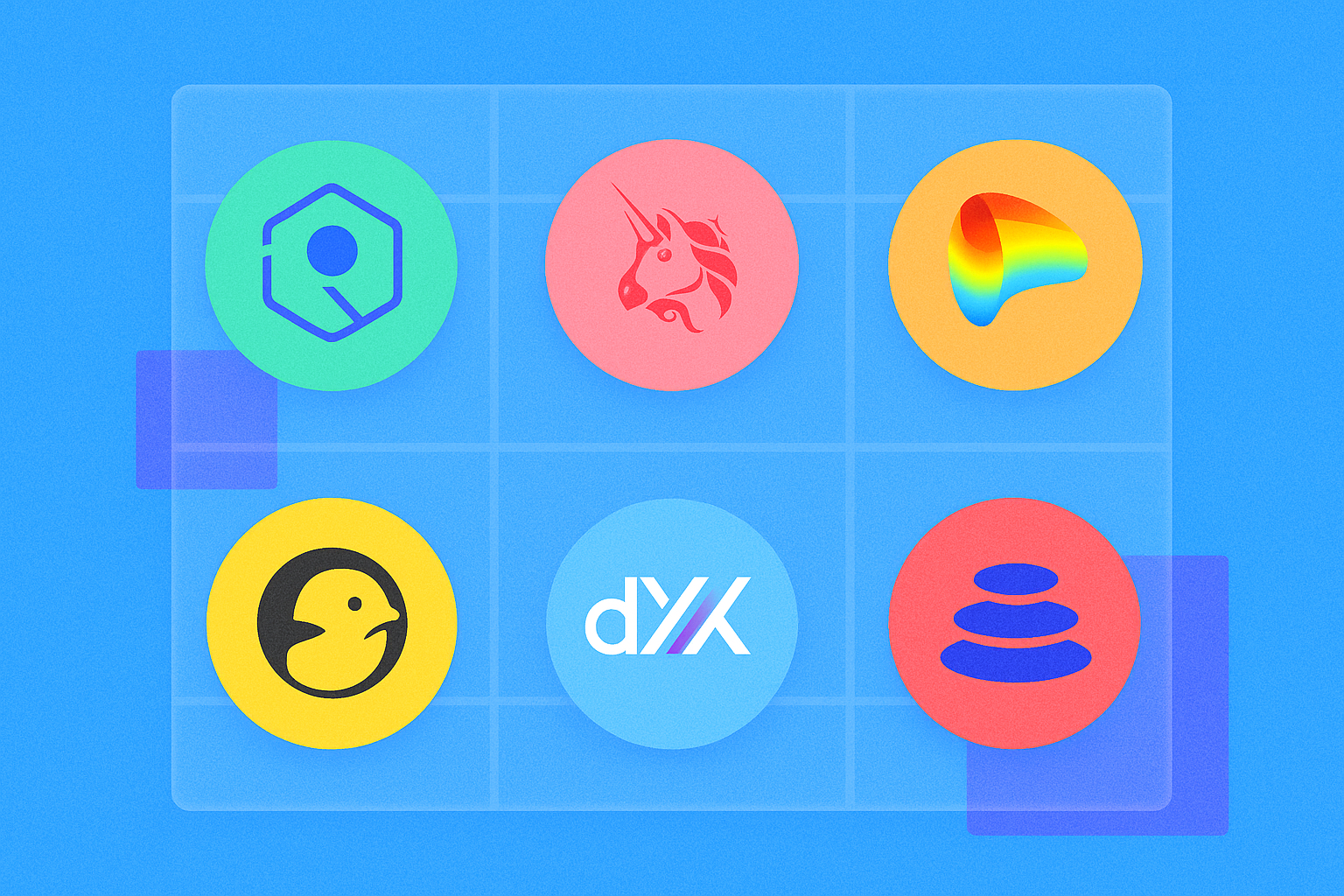
Decentralized Exchanges: An Overview
Expanding access to financial services for everyone is the driving force behind the crypto industry. A pivotal innovation in this effort is the rise of decentralized exchanges (DEXs), which let anyone trade digital assets directly—no intermediaries, no centralized authority. All you need to participate is a reliable internet connection and a crypto wallet.
DEXs represent the next generation of trading platforms, empowering users to maintain full control over their assets, with every transaction executed through smart contracts. This design delivers transparency, robust security, and freedom from traditional financial institutions. This guide reviews the leading decentralized crypto exchanges, each with its own strengths and specialized features.
1. Leading Platform Aggregator
Comprehensive aggregator with advanced security and broad capabilities
Founded: 2021
Trading Pairs: 100,000+ tokens across 100+ blockchains
24h Trading Volume: Over $500 million
Platform: Multifunctional aggregator with sophisticated protection
This DEX stands out as one of the most powerful aggregators in the market. By pooling liquidity from numerous decentralized exchanges, it gives users optimal crypto exchange rates. The platform’s system integrates dozens of blockchains, allowing traders to identify the best deals with minimal slippage.
User safety is paramount. The platform employs cutting-edge tools to detect counterfeit tokens, defend against rug pulls, and prevent MEV (Maximal Extractable Value) exploits. Every user’s funds remain in their own wallet, eliminating the risks of centralized asset storage.
This aggregator supports cross-chain transactions, enabling seamless token swaps between blockchains without using bridges. That streamlines trading and reduces fees. An intelligent routing engine automatically determines the most efficient path for every trade, maximizing effectiveness.
Pros:
- Aggregates prices from multiple DEXs for best rates
- High liquidity by pooling across platforms
- Cross-chain support without third-party bridges
- Full security—assets always stay with the user
- Flashbot technology to guard against MEV and front-running
- Intuitive interface with advanced analytics
Cons:
- Complexity may challenge beginners due to extensive features and settings
- Requires knowledge of multiple blockchains for optimal use
2. Raydium
Streamlined and powerful decentralized exchange built on Solana
Founded: 2022
Trading Pairs: All Solana-based tokens
24h Trading Volume: $1,809,450,364
Security: AMM model integrated with Serum order book
Raydium is a leading DEX running on Solana’s ultra-fast blockchain. It leverages an advanced automated market maker (AMM), delivering efficient, low-latency trading. Its standout feature is integration with the Serum central order book, combining benefits of AMM and classic exchange mechanics.
Thanks to Solana’s infrastructure, Raydium processes thousands of transactions per second at ultra-low cost, making it perfect for active traders. The platform supports a full range of DeFi features—yield farming, staking, and initial DEX offerings (IDOs) via AcceleRaytor.
Raydium Highlights:
Serum Integration: Raydium’s architecture leverages Serum’s central order book, dramatically enhancing liquidity and reducing slippage. Traders tap into both Raydium pools and the entire Serum ecosystem.
Lightning-Fast Transactions: Solana enables near-instant confirmations—under one second. This is critical for volatile assets where timing matters.
RAY Token: Raydium’s native token is used for staking, governance, liquidity rewards, and unlocking premium features.
DeFi Suite: Raydium offers a comprehensive DeFi ecosystem: token swaps, liquidity pool management, yield farming for maximum returns, and early access to new projects through the AcceleRaytor IDO platform.
Pros:
- Ultra-fast transactions via Solana
- Extremely low fees—often fractions of a cent
- Flexible liquidity pools with concentrated liquidity options
- Serum integration for deep liquidity
- Trader-friendly interface with advanced tools
Cons:
- Limited to Solana ecosystem—smaller token selection
- No margin trading or derivatives
- Reliant on Solana’s network stability
3. Uniswap
The original DEX with an intuitive user experience
Founded: 2018
Trading Pairs: ERC-20 tokens
24h Trading Volume: $276,906,311
Platform: AMM built on Ethereum and Layer 2
Uniswap is the trailblazing decentralized exchange that set the standard for DeFi. Created by Hayden Adams in 2018, it’s now one of the most influential DEXs globally. Running on Ethereum, Uniswap uses smart contracts to automate ERC-20 token swaps, eliminating centralized intermediaries.
Uniswap’s breakthrough is its automated market maker (AMM) approach, removing the need for traditional order books. Prices are set by mathematical formulas based on liquidity pool ratios, ensuring always-on liquidity and intuitive trading.
Uniswap Highlights:
AMM Model: Uniswap’s automated market maker lets users swap tokens directly from their wallet without an order book. Pricing uses the constant product formula (x * y = k) for fair, algorithmic rates.
Liquidity Pools: Anyone can provide liquidity by depositing token pairs and earning fees proportional to their share. This creates a fully decentralized market-making system.
UNI Token: The UNI governance token empowers holders to vote on protocol changes, upgrades, and treasury allocations—enabling genuine decentralized governance.
Multi-Network Support: Uniswap runs on Ethereum mainnet and several Layer 2s and sidechains (Polygon, Optimism, Arbitrum, Base), so users can choose networks for optimal speed and cost.
User Experience and Security: Uniswap offers a simple, intuitive interface—no registration or KYC required. Users stay in control, and all transactions use audited smart contracts.
Pros:
- Simplified, beginner-friendly UX
- High liquidity from many pools
- Broad ERC-20 token support
- Active community and continual upgrades
- Multi-network access for fee optimization
Cons:
- Ethereum mainnet can be costly during congestion
- Limited advanced trading features
- Not ideal for professional traders seeking complex tools
4. Curve Finance
Specialist DEX for stablecoins and low-volatility assets
Founded: 2020
Trading Pairs: Major stablecoins (DAI, USDC, USDT, etc.)
24h Trading Volume: $570,820,034
Platform: Optimized AMM for stablecoins
Curve Finance is a focused DEX for rapid, efficient swapping of stablecoins and low-volatility assets. Built on Ethereum and multiple EVM-compatible networks, Curve’s architecture is purpose-built for trading assets with similar values.
Curve’s main advantage is its custom pricing model that minimizes slippage in stablecoin trades. While typical AMMs (like Uniswap) use constant product formulas, Curve’s modified curve keeps prices extremely close to 1:1 parity for stablecoins.
Curve Finance Highlights:
AMM Model: Curve’s advanced market maker formula is optimized for assets with similar prices, delivering minimal slippage and optimal efficiency for stablecoin swaps.
Liquidity Pools: The platform provides diverse pools for stablecoin combinations. Liquidity providers earn fees and can access bonus reward programs. Many pools are linked to lending protocols for extra yield.
CRV Token: The governance token CRV is central to Curve’s ecosystem. Holders can lock CRV for veCRV, gaining voting rights, boosted rewards, and a share of platform fees. Community votes decide CRV emission allocation.
Multi-Network Support: Curve operates on Ethereum, Polygon, Arbitrum, Optimism, Avalanche, and more, so users can choose networks based on transaction size and gas cost.
Lending Innovation: Curve introduced its own stablecoin, crvUSD, featuring soft liquidation—enabling crypto-collateralized loans with reduced risk of total liquidation.
Pros:
- Minimum slippage for stablecoin swaps via optimized pricing
- Deep liquidity in stablecoin pools
- Extra earning potential through staking and boost mechanisms
- Integrated with many DeFi protocols for composite yield
- Low fees thanks to efficient structure
Cons:
- Limited support for volatile tokens
- Governance and rewards can be complex for new users
- Requires CRV staking for maximum returns
5. Orca
Innovative, accessible decentralized exchange for all users
Founded: 2021
Trading Pairs: 200+ markets on Solana
24h Trading Volume: $1,809,450,364
Security: AMM with concentrated liquidity and a beginner-friendly interface
Orca is a creative DEX on Solana’s high-speed blockchain. Launched in 2021, it’s recognized for a unique user-centric approach and technical innovation. Orca brands itself as the most beginner-friendly DEX, making it perfect for those new to DeFi.
Orca’s key differentiator is balancing simplicity with advanced technical features. It offers an intuitive interface with playful design (including an orca mascot), without sacrificing trading efficiency or functionality.
Orca Highlights:
Concentrated Liquidity AMM: Orca’s Whirlpools let liquidity providers focus capital within narrow price ranges, dramatically improving capital efficiency and reducing slippage. Providers can earn higher fees with less capital.
User Interface: Designed for DeFi newcomers, Orca’s interface is the most intuitive among DEXs. Helpful tools like a fair price indicator guide users toward favorable trades, with clear visual prompts and explanations for easy onboarding.
ORCA Token: Launched in 2021, ORCA is used for governance and rewarding liquidity providers. Holders participate in platform development votes and receive a transparent share of fees.
Security and Decentralization: Orca is non-custodial and does not require KYC, ensuring privacy and user control. All smart contracts have passed multiple independent security audits.
Speed and Low Fees: Built on Solana, Orca processes transactions in under one second, with fees just fractions of a cent—accessible for traders of any size.
Pros:
- Fast, low-cost trades via Solana
- Most beginner-friendly DEX interface
- Concentrated liquidity boosts efficiency
- Comprehensive documentation and tutorials
- Active, supportive community
Cons:
- Limited to Solana
- Fewer tokens than Ethereum-based DEXs
- Dependent on Solana’s network reliability
6. dYdX
Advanced platform for professional derivatives trading
Founded: 2017
Trading Pairs: 240+ markets
24h Trading Volume: $100,595,793
Security: Multi-tiered security system, own blockchain
dYdX is an advanced DEX specializing in derivatives like perpetual futures. Founded by Antonio Juliano in 2017, it’s a premier venue for professional DeFi traders.
dYdX’s primary edge is its focus on sophisticated trading tools and margin trading. It offers functionality rivaling centralized exchanges, while preserving decentralization—users retain control, with transparent, verifiable transactions.
dYdX Highlights:
Blockchain and Scalability: Originally built on Ethereum, dYdX now runs on its own Layer 1 blockchain using Cosmos SDK and CometBFT consensus. This architecture enables high scalability—thousands of transactions per second, minimal latency, and full transparency. Its proprietary blockchain delivers speed and efficiency on par with leading centralized platforms.
Trading Tools: dYdX offers margin and perpetual futures trading with leverage up to 100×. Traders can access 180+ pairs, including BTC, ETH, SOL, and popular altcoins. Advanced order types include stop-loss, take-profit, and conditional orders.
Fee Structure: Tiered fees based on volume: 0.05% for makers and 0.20% for takers. High-volume traders earn significant discounts, and staking pools offer extra rewards and reduced fees.
Security and Asset Control: dYdX preserves core decentralization—users retain full control via smart contracts. No need to trust the platform or third parties; all operations use audited, secure contracts.
DYDX Token: The DYDX governance token drives the ecosystem. Holders can vote on protocol changes, earn bonuses and fee discounts, participate in staking for passive income, and receive rewards for active engagement.
Getting Started: Connect a compatible wallet (MetaMask, Coinbase Wallet, Trust Wallet, Ledger, etc.)—no registration or KYC required. Setup takes minutes.
Pros:
- Institutional-grade security and transparency
- High-leverage trading and advanced tools
- Users keep full control of their assets
- Deep liquidity via proprietary blockchain
- Professional interface with charts and analytics
- Low latency, fast execution
Cons:
- Performance and fees may fluctuate with network status
- No fiat currency support
- Complex for beginners
- High risk when using leverage
Decentralized Exchange Comparison Table
| Exchange | Founded | Trading Pairs | Main Pros | Main Cons |
|---|---|---|---|---|
| Leading Platform Aggregator | 2021 | 100,000+ tokens | Best pricing, cross-chain trades, security | Complex for beginners |
| Raydium | 2022 | Solana tokens | High speed, low fees | Limited to Solana |
| Uniswap | 2018 | ERC-20 tokens | Simple UX, high liquidity | High mainnet fees |
| Curve | 2020 | Stablecoins | Minimal slippage | Stablecoins only |
| Orca | 2021 | Solana tokens | Ease of use, fast trading | Limited to Solana |
| dYdX | 2017 | 240+ | Security, pro tools | Complex for beginners |
Summary: Choosing a Decentralized Exchange
Your ideal DEX depends on your goals, experience, and trading style. Each platform offers distinct advantages:
For top liquidity and security: The leading aggregator delivers best prices, advanced security, and cross-chain trading.
For Solana ecosystem users: Raydium and Orca offer speed, low fees, and user-friendly interfaces. Orca is perfect for newcomers; Raydium suits advanced traders.
For stablecoin trading: Curve Finance is specialized for stablecoin and low-volatility swaps, providing minimum slippage and efficiency.
For Ethereum users: Uniswap sets the standard, offering simplicity, deep liquidity, and broad token selection.
For derivatives: dYdX features professional margin and futures trading with high leverage.
If you value best pricing, cross-chain options, and security, the leading aggregator is your best bet. For low-fee, active trading, consider Solana-based platforms.
Decentralized Exchanges Explained
Decentralized exchanges (DEXs) are blockchain-powered online platforms for trading cryptocurrencies. Users transact directly with each other, bypassing centralized intermediaries and financial institutions.
What sets DEXs apart from traditional stock exchanges and centralized crypto platforms is their decentralized control structure. On a DEX, users and the community make key decisions—not a central corporation. Decentralization is achieved through automated processes governed by smart contracts—self-executing software recorded on the blockchain.
Smart contracts execute trades instantly, with no need for trusted third parties. When a user initiates a swap, the contract checks funds, calculates rates, and completes the transaction if all conditions are met—uneditable and irreversible by any party.
Unlike centralized exchanges, DEXs enable true anonymity and privacy. No account registration, personal data, or KYC required—just connect your non-custodial wallet to start.
DEX users control their funds at all times. Assets stay in personal wallets, not on exchange accounts, eliminating risks of hacks or platform freezes. This guarantees financial freedom and independence.
Types of Decentralized Exchanges
DEXs vary by functionality, architecture, and pricing mechanism. The main types:
1. Automated Market Makers (AMM): The most common DEX type. AMMs use mathematical algorithms to set prices in real time, replacing traditional order books with liquidity pools—token reserves provided by users. Pricing is determined by formulas such as x * y = k, reflecting the ratio of tokens in the pool.
Uniswap pioneered AMMs, Curve Finance optimized for stablecoins, and other platforms have followed. AMMs democratized liquidity provision in DeFi.
2. On-chain Order Book DEXs: These platforms record all orders on the blockchain, forming prices based on live buyer/seller activity—similar to traditional exchanges. Data is fully transparent and immutable, while assets remain off-chain in users’ wallets for security.
This model suits professional traders seeking familiar interfaces and advanced order types, but on-chain order recording can be costly on high-fee networks.
3. Off-chain Order Book DEXs: A hybrid approach that maintains order books off-chain for speed and cost efficiency, while final settlements occur on-chain via smart contracts. This balances performance and decentralization, enabling high throughput with secure asset transfers.
DEX Aggregators: Aggregators combine liquidity from multiple DEXs, boosting trading efficiency and offering broader market access. They automatically locate the best prices and optimal trade routes, splitting orders across platforms to minimize slippage and costs. Aggregators are essential for advanced traders seeking maximum efficiency.
FAQ
What is a decentralized exchange (DEX), and how is it different from a centralized exchange?
A DEX is a platform for direct peer-to-peer trading without a central operator. Centralized exchanges are managed by a single company. DEXs offer greater privacy and security; centralized exchanges provide superior liquidity and convenience.
What are the best DEX platforms, and what are their main advantages?
Top DEXs feature deep liquidity, low fees, and a wide variety of trading pairs. Each platform has unique strengths—advanced routing algorithms, DeFi integration, and robust security. Choose based on your trading preferences and portfolio size.
How do you trade on a DEX? What are the exact steps?
Connect your wallet to the DEX, click “Swap,” select a trading pair, enter your amount, and confirm the transaction in your wallet.
What fees will I pay when trading on a DEX?
DEX trading involves two main fees: gas for network transactions, and protocol fees set by the platform. Actual costs depend on network congestion and the chosen trading pair.
What risks and security issues should I consider when trading on DEXs compared to CEXs?
DEX risks include smart contract vulnerabilities, user-managed private keys (raising theft risk), lack of regulation (more fraud projects), higher slippage, and liquidity shortages due to volume volatility.
How do supported blockchains and trading pairs differ among DEX platforms?
DEXs support different blockchains—some focus on Ethereum, others on multiple networks. Trading pairs also vary based on platform liquidity.
How do liquidity pools work on DEXs?
Liquidity pools are smart contracts holding locked tokens to facilitate trades. LPs (liquidity providers) earn a portion of trading fees. AMM algorithms (e.g., x*y=k) balance prices, enabling swaps without traditional market makers.
How do I evaluate and choose the best DEX platform?
Review fees, transaction speed, and security. Check platform reputation and user feedback. Confirm smart contract audits for fund safety. Compare trading volume and liquidity for your preferred asset pairs.
Share
Content
How to Buy Cryptocurrency


Trending Cryptocurrencies



How to Withdraw Money from Crypto Exchanges in 2025: A Beginner's Guide
Hedera Hashgraph (HBAR): Founders, Technology, and Price Outlook to 2030

Jasmy Coin: A Japanese Crypto Tale of Ambition, Hype, and Hope

IOTA (MIOTA) – From Tangle Origins to 2025 Price Outlook

Bitcoin Price in 2025: Analysis and Market Trends
How to Trade Bitcoin in 2025: A Beginner's Guide

Cloud Mining: Leading Platforms in Recent Years
6 Cryptocurrencies With Total Growth Exceeding 1,000x
Cryptocurrency Arbitrage: How to Profit from Crypto Trading
Top 13 Low-Cost Cryptocurrencies to Consider for Investment
What is INSP: A Comprehensive Guide to Understanding Investment in Sustainability and Performance