TRVL vs XRP: Which Cryptocurrency Investment Offers Better Long-Term Value in 2024?

Introduction: TRVL vs XRP Investment Comparison
In the cryptocurrency market, the comparison between TRVL vs XRP continues to be a topic of discussion among investors. The two assets exhibit notable differences in market capitalization ranking, application scenarios, and price performance, representing distinct positioning within the crypto asset landscape.
TRVL: As the utility token of Dtravel, it has been developed to address challenges in the travel industry including trust, reputation, distribution, connectivity, and direct bookings through its ecosystem products.
XRP: Launched in 2011, it has been recognized for its payment infrastructure built on the XRP Ledger, designed for fast (approximately 3 seconds per transaction), cost-effective ($0.0002 per transaction), and scalable (1,500+ tps) transactions.
This article will provide a comprehensive analysis of TRVL vs XRP investment value comparison, covering historical price trends, supply mechanisms, institutional adoption, technological ecosystems, and future outlook, attempting to address investors' key question:
"Which is the better buy right now?"
I. Historical Price Comparison and Current Market Status
TRVL (Coin A) and XRP (Coin B) Historical Price Trends
- 2021: TRVL reached its all-time high of $1.56 on November 28, 2021, during the broader cryptocurrency market rally.
- 2025: XRP experienced significant price movement, reaching $3.65 on July 18, 2025, marking a notable milestone since 2018.
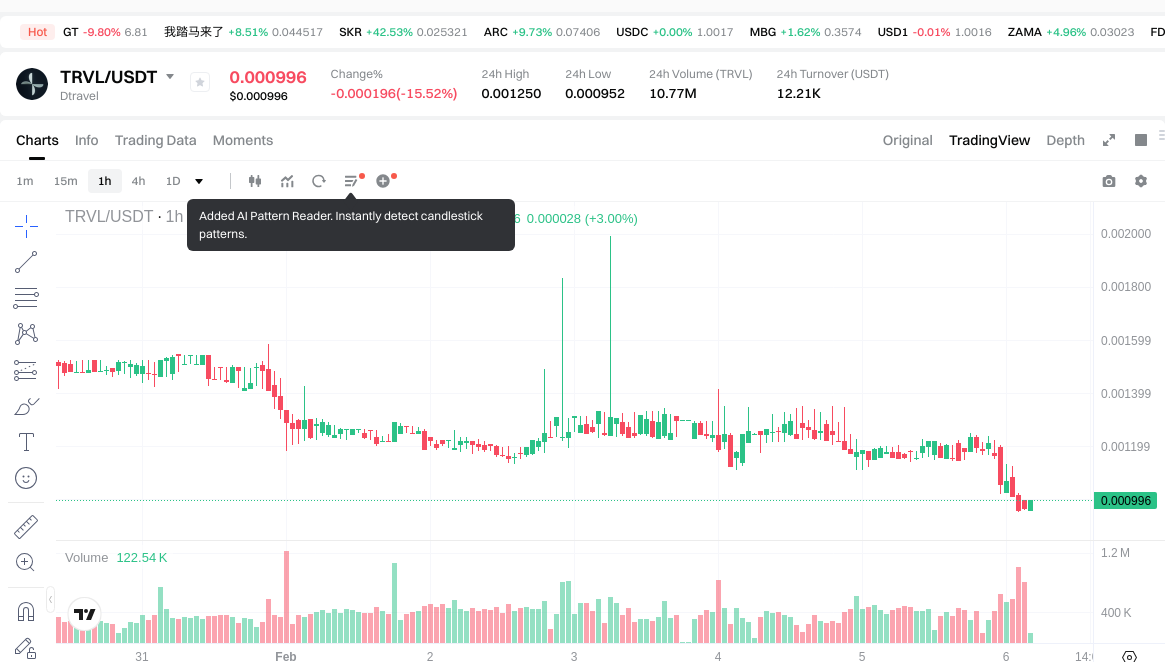
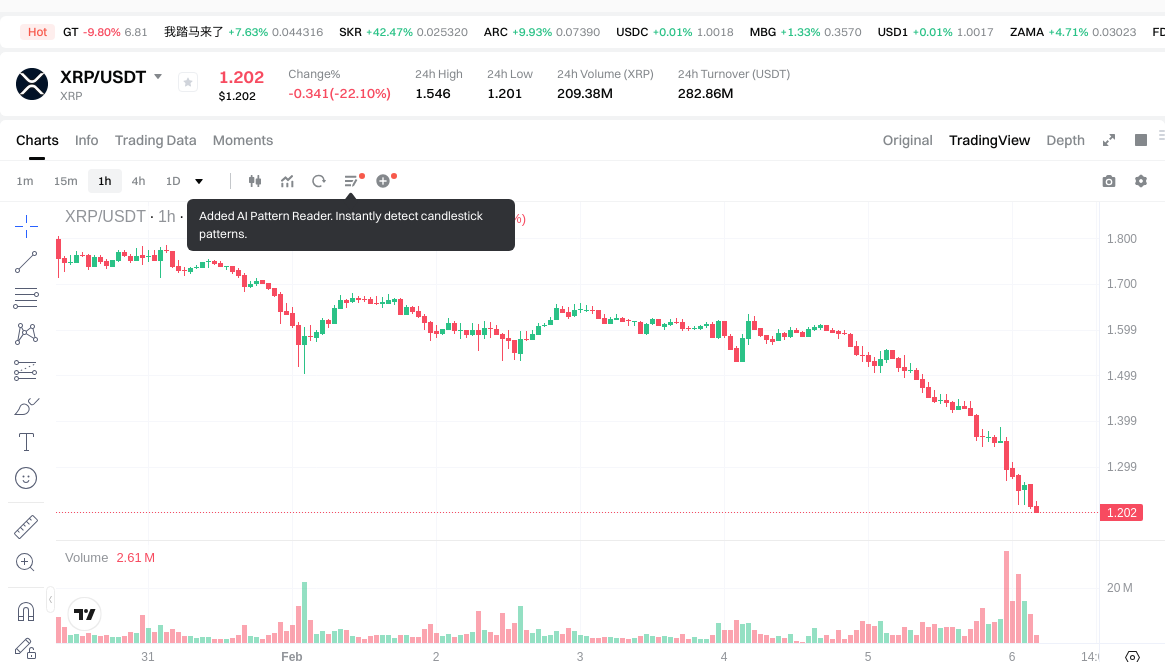
- Comparative Analysis: During the market cycle from late 2021 to early 2026, TRVL declined from its peak of $1.56 to $0.000968, representing a substantial correction. In contrast, XRP, while also experiencing volatility, maintained relatively stronger positioning, declining from $3.65 to $1.216 over a shorter timeframe.
Current Market Status (February 6, 2026)
- TRVL Current Price: $0.000968
- XRP Current Price: $1.216
- 24-Hour Trading Volume: TRVL $12,170.57 vs XRP $281,726,723.24
- Market Sentiment Index (Fear & Greed Index): 12 (Extreme Fear)
View real-time prices:
- Check TRVL current price Market Price
- Check XRP current price Market Price
II. Core Factors Influencing TRVL vs XRP Investment Value
Supply Mechanism Comparison (Tokenomics)
- TRVL: The available materials do not provide specific information about TRVL's supply mechanism or tokenomics model.
- XRP: The available materials do not provide detailed information about XRP's supply mechanism, halving events, or tokenomics structure.
- 📌 Historical Pattern: Supply mechanisms can influence price cycles, though specific historical patterns for these assets are not detailed in the provided materials.
Institutional Adoption and Market Application
- Institutional Holdings: The provided materials do not contain comparative data on institutional preference between TRVL and XRP.
- Enterprise Adoption: While materials mention XRP in context of broader crypto adoption discussions, specific enterprise use cases in cross-border payments, settlement, or institutional portfolios are not detailed for either asset.
- National Policies: Regulatory attitudes toward these specific assets across different jurisdictions are not covered in the available materials.
Technical Development and Ecosystem Building
- TRVL Technical Upgrades: The provided materials do not contain information about TRVL's technical roadmap or upgrades.
- XRP Technical Development: Specific technical developments or upgrade plans for XRP are not detailed in the available materials.
- Ecosystem Comparison: The materials do not provide comparative analysis of DeFi, NFT, payment applications, or smart contract implementations for either asset.
Macroeconomic and Market Cycles
- Performance in Inflationary Environments: The materials mention that TRVL's exchange rate is influenced by macroeconomic trends and policy regulations, while XRP's value depends on market confidence and technical applications. However, specific anti-inflation properties are not compared.
- Macroeconomic Monetary Policy: The materials reference broader market factors including interest rates and financial system confidence, but do not provide specific analysis of how these affect TRVL versus XRP.
- Geopolitical Factors: While cross-border transaction demand is implied in discussions of crypto assets, specific geopolitical impacts on these two assets are not detailed in the provided materials.
III. 2026-2031 Price Forecast: TRVL vs XRP
Short-term Forecast (2026)
- TRVL: Conservative $0.0008964 - $0.000996 | Optimistic $0.000996 - $0.00111552
- XRP: Conservative $1.04487 - $1.201 | Optimistic $1.201 - $1.30909
Mid-term Forecast (2028-2029)
- TRVL may enter a consolidation phase, with estimated price range of $0.0007034001 - $0.001410587739
- XRP may enter a growth phase, with estimated price range of $0.784905143 - $2.329168988025
- Key drivers: institutional capital inflows, ETF developments, ecosystem expansion
Long-term Forecast (2030-2031)
- TRVL: Baseline scenario $0.00115796429847 - $0.0013464701145 | Optimistic scenario $0.001559010422073 - $0.002006240470605
- XRP: Baseline scenario $1.17579901136225 - $2.432687609715 | Optimistic scenario $2.8381355446675 - $3.405762653601
Disclaimer
The price forecasts presented are based on predictive models and historical data analysis. Cryptocurrency markets are highly volatile and subject to various risk factors including regulatory changes, market sentiment shifts, technological developments, and macroeconomic conditions. These projections should not be considered as financial advice or guaranteed outcomes. Investors should conduct their own research and consult with qualified financial advisors before making investment decisions.
TRVL:
| Year | Predicted High Price | Predicted Average Price | Predicted Low Price | Price Change |
|---|---|---|---|---|
| 2026 | 0.00111552 | 0.000996 | 0.0008964 | 2 |
| 2027 | 0.001108548 | 0.00105576 | 0.0009079536 | 9 |
| 2028 | 0.00148255098 | 0.001082154 | 0.0007034001 | 11 |
| 2029 | 0.001410587739 | 0.00128235249 | 0.0008591761683 | 32 |
| 2030 | 0.002006240470605 | 0.0013464701145 | 0.00115796429847 | 39 |
| 2031 | 0.001877517927658 | 0.001676355292552 | 0.001559010422073 | 73 |
XRP:
| Year | Predicted High Price | Predicted Average Price | Predicted Low Price | Price Change |
|---|---|---|---|---|
| 2026 | 1.30909 | 1.201 | 1.04487 | -1 |
| 2027 | 1.7068612 | 1.255045 | 0.8283297 | 3 |
| 2028 | 1.969667623 | 1.4809531 | 0.784905143 | 21 |
| 2029 | 2.329168988025 | 1.7253103615 | 1.293982771125 | 41 |
| 2030 | 2.8381355446675 | 2.0272396747625 | 1.17579901136225 | 66 |
| 2031 | 3.405762653601 | 2.432687609715 | 1.3136513092461 | 100 |
IV. Investment Strategy Comparison: TRVL vs XRP
Long-term vs Short-term Investment Strategies
- TRVL: May appeal to investors with higher risk tolerance seeking exposure to niche travel industry applications within the blockchain ecosystem, though current market positioning suggests caution
- XRP: May suit investors interested in payment infrastructure and cross-border transaction facilitation, with relatively established market presence
Risk Management and Asset Allocation
- Conservative Investors: TRVL 5-10% vs XRP 15-20% (within overall crypto portfolio allocation)
- Aggressive Investors: TRVL 15-20% vs XRP 25-35% (within overall crypto portfolio allocation)
- Hedging Tools: Stablecoin allocation for liquidity management, options strategies for downside protection, cross-asset diversification across multiple cryptocurrencies
V. Potential Risk Comparison
Market Risk
- TRVL: Faces elevated volatility with substantial price decline from historical peaks, limited trading volume ($12,170.57 in 24-hour period) may contribute to liquidity challenges and price instability
- XRP: Demonstrates higher liquidity with significant trading volume ($281,726,723.24 in 24-hour period), though remains subject to broader cryptocurrency market fluctuations and sentiment shifts
Technical Risk
- TRVL: Limited information available regarding network scalability and technical infrastructure stability
- XRP: While designed for fast transaction processing (approximately 3 seconds per transaction) and scalability (1,500+ tps), ongoing technical developments and network performance require monitoring
Regulatory Risk
- Both assets operate within evolving global regulatory frameworks that may impact market accessibility, compliance requirements, and institutional adoption patterns differently across jurisdictions
VI. Conclusion: Which Is the Better Buy?
📌 Investment Value Summary:
- TRVL Characteristics: Positioned within travel industry blockchain applications, currently experiencing significant market correction with limited trading volume
- XRP Characteristics: Established payment infrastructure focus, relatively higher liquidity, broader market recognition, and institutional awareness
✅ Investment Considerations:
- Novice Investors: Consider prioritizing assets with higher liquidity and established market presence; thorough research and understanding of risk tolerance essential before allocation
- Experienced Investors: May evaluate portfolio diversification strategies balancing liquidity profiles, market positioning, and risk-adjusted return potential
- Institutional Investors: Assessment should incorporate liquidity requirements, regulatory compliance considerations, and alignment with institutional investment mandates
⚠️ Risk Disclosure: Cryptocurrency markets exhibit high volatility and significant risk factors. This analysis does not constitute financial advice, investment recommendations, or guarantees of future performance. Investors should conduct independent research and consult qualified financial advisors before making investment decisions.
VII. FAQ
Q1: What is the main difference between TRVL and XRP in terms of their use cases?
TRVL is a utility token focused on addressing travel industry challenges through blockchain technology, while XRP is designed as a payment infrastructure for fast and cost-effective cross-border transactions. TRVL serves the Dtravel ecosystem to solve issues related to trust, reputation, distribution, connectivity, and direct bookings in the travel sector. In contrast, XRP operates on the XRP Ledger as a payment solution offering approximately 3-second transaction times at $0.0002 per transaction with scalability exceeding 1,500 transactions per second, positioning it for broader financial infrastructure applications.
Q2: How does the current market liquidity compare between TRVL and XRP?
XRP demonstrates significantly higher liquidity compared to TRVL. As of February 6, 2026, XRP's 24-hour trading volume stands at $281,726,723.24, while TRVL's trading volume is only $12,170.57. This substantial difference in trading volume means XRP offers greater market depth, easier entry and exit positions, and potentially lower price slippage for investors. The limited liquidity of TRVL may contribute to higher volatility and price instability, making it more challenging for investors to execute large transactions without impacting market price.
Q3: What are the projected price movements for TRVL and XRP through 2031?
Based on predictive models, TRVL is forecasted to trade within a range of $0.0008964-$0.00111552 in 2026, potentially reaching $0.001559010422073-$0.002006240470605 by 2031 in optimistic scenarios. XRP is projected to trade between $1.04487-$1.30909 in 2026, with potential growth to $1.3136513092461-$3.405762653601 by 2031. However, these projections are subject to significant uncertainty due to market volatility, regulatory changes, technological developments, and macroeconomic conditions. Investors should treat these forecasts as reference points rather than guaranteed outcomes and conduct thorough due diligence before making investment decisions.
Q4: Which cryptocurrency is more suitable for conservative investors?
XRP may be more appropriate for conservative investors due to its established market presence, significantly higher liquidity, and broader recognition in the payment infrastructure space. Conservative portfolio allocation suggestions include 15-20% XRP versus 5-10% TRVL within an overall cryptocurrency portfolio. XRP's higher trading volume of over $281 million compared to TRVL's $12,000 provides better liquidity management and risk mitigation capabilities. However, conservative investors should still maintain diversification across multiple assets, utilize stablecoin allocations for liquidity buffers, and implement appropriate hedging strategies to manage downside risk in the volatile cryptocurrency market.
Q5: What are the primary risk factors investors should consider when comparing TRVL and XRP?
Investors should evaluate three major risk categories when comparing these assets. Market risk: TRVL faces elevated volatility with substantial price decline from its $1.56 peak to $0.000968, plus limited liquidity that may cause price instability; XRP, while more liquid, remains subject to broader crypto market fluctuations. Technical risk: both assets require monitoring of network performance and scalability, though XRP's infrastructure is more established with documented transaction speeds and throughput. Regulatory risk: both operate within evolving global regulatory frameworks that may impact market accessibility, compliance requirements, and institutional adoption differently across jurisdictions. The extreme fear sentiment (Fear & Greed Index of 12) in the current market environment amplifies these risks for both assets.
Q6: How have TRVL and XRP performed historically during market cycles?
Historical performance reveals contrasting trajectories for both assets. TRVL reached its all-time high of $1.56 on November 28, 2021, during the broader cryptocurrency market rally, but has since declined significantly to $0.000968, representing a substantial correction of over 99%. XRP experienced notable price movement reaching $3.65 on July 18, 2025, marking its highest level since 2018, and while it has declined to $1.216, this represents a relatively smaller percentage decrease compared to TRVL. This historical pattern suggests XRP has demonstrated greater price resilience and market stability during market cycles, though both assets remain subject to cryptocurrency market volatility and sentiment shifts.
Q7: What factors should institutional investors consider when evaluating TRVL versus XRP?
Institutional investors should prioritize several key factors in their evaluation. Liquidity requirements are critical, with XRP's $281+ million daily trading volume offering significantly better execution capabilities compared to TRVL's limited $12,000 volume. Regulatory compliance considerations vary across jurisdictions and may impact institutional accessibility differently for each asset. Market positioning matters, as XRP's established presence in payment infrastructure may align better with institutional investment mandates focused on blockchain applications with clear utility and adoption pathways. Risk management protocols should account for TRVL's higher volatility and lower liquidity when sizing positions. Institutional investors must also assess how each asset fits within their broader portfolio diversification strategy and investment thesis regarding blockchain technology adoption.
Q8: Can these price predictions be relied upon for investment decisions?
No, these price predictions should not be solely relied upon for investment decisions. The forecasts are based on predictive models and historical data analysis, but cryptocurrency markets are highly volatile and influenced by numerous unpredictable factors including regulatory changes, market sentiment shifts, technological developments, and macroeconomic conditions. These projections do not constitute financial advice or guaranteed outcomes. The current market sentiment of extreme fear (Fear & Greed Index: 12) demonstrates the challenging environment and uncertainty facing both assets. Investors should use these predictions only as reference points within a comprehensive research framework, conduct independent due diligence, assess their own risk tolerance, and consult with qualified financial advisors before making any investment decisions in either TRVL or XRP.
Share
Content
Introduction: TRVL vs XRP Investment Comparison
I. Historical Price Comparison and Current Market Status
II. Core Factors Influencing TRVL vs XRP Investment Value
III. 2026-2031 Price Forecast: TRVL vs XRP
IV. Investment Strategy Comparison: TRVL vs XRP
V. Potential Risk Comparison
VI. Conclusion: Which Is the Better Buy?
VII. FAQ
How to Buy Cryptocurrency


Trending Cryptocurrencies



2025 SUI coin: price, buying guide, and Staking rewards

How to Buy Crypto: A Step-by-Step Guide with Gate.com

HNT Price in 2025: Helium Network Token Value and Market Analysis

What is SwissCheese (SWCH) and How Does It Democratize Investment?

Cardano (ADA) Price Analysis and Outlook for 2025

How to Invest in Metaverse Crypto

What Is Ripple (XRP)? An Easy-to-Understand Guide to Its Key Features and Future Outlook

What Is an Airdrop? How to Earn Passive Income in Crypto with Airdrops

Comprehensive Guide to Physical Bitcoins

Comprehensive Guide to Coffeezilla: Crypto's Leading Fraud Investigator

Comprehensive Guide to Quantitative Analysis