VERT vs THETA: A Comprehensive Comparison of Two Leading Vertically-Integrated Technology Platforms

Introduction: A Comparative Analysis of VERT and THETA Investment Prospects
In the cryptocurrency market, the comparison between VERT and THETA represents an intriguing case study of contrasting digital asset positioning. These two tokens differ significantly in market capitalization rankings, application scenarios, and price performance, each representing distinct value propositions within the crypto ecosystem.
VERTUS (VERT): Launched in 2025, this token operates as a custodial wallet on the TON blockchain, designed to democratize access to decentralized finance through Telegram integration. With a focus on user-friendly DeFi experiences, VERT aims to bridge traditional users with web3 technologies through seamless wallet functionality and DApp integration.
Theta (THETA): Introduced in 2017, THETA has established itself as a decentralized video streaming platform token, leveraging blockchain technology to optimize content delivery networks. By incentivizing users to share bandwidth resources, THETA addresses infrastructure challenges in high-quality video distribution.
This article examines the investment comparison between VERT and THETA across multiple dimensions, including historical price trajectories, supply mechanisms, ecosystem development, and market positioning. Through analysis of circulating supply (549.84 million VERT vs. 1 billion THETA), market capitalization ($728,538 vs. $222 million), and technological foundations (TON blockchain integration vs. native blockchain infrastructure), we explore the distinct characteristics of each asset.
The following sections will provide a structured evaluation of both tokens' performance metrics, utility frameworks, and market dynamics to assist investors in understanding:
"What factors differentiate VERT and THETA as investment options in the current market environment?"
I. Historical Price Comparison and Current Market Status
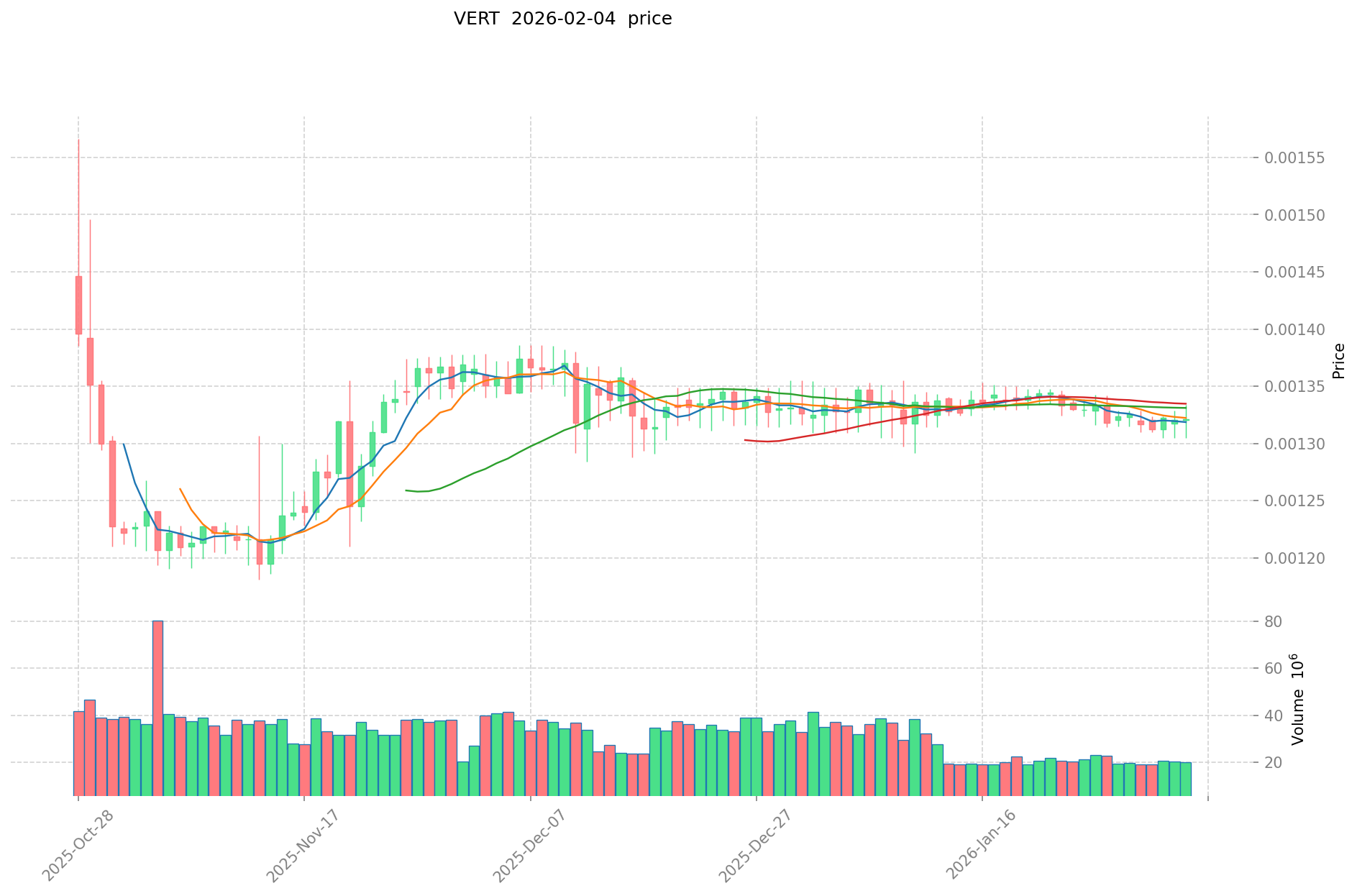
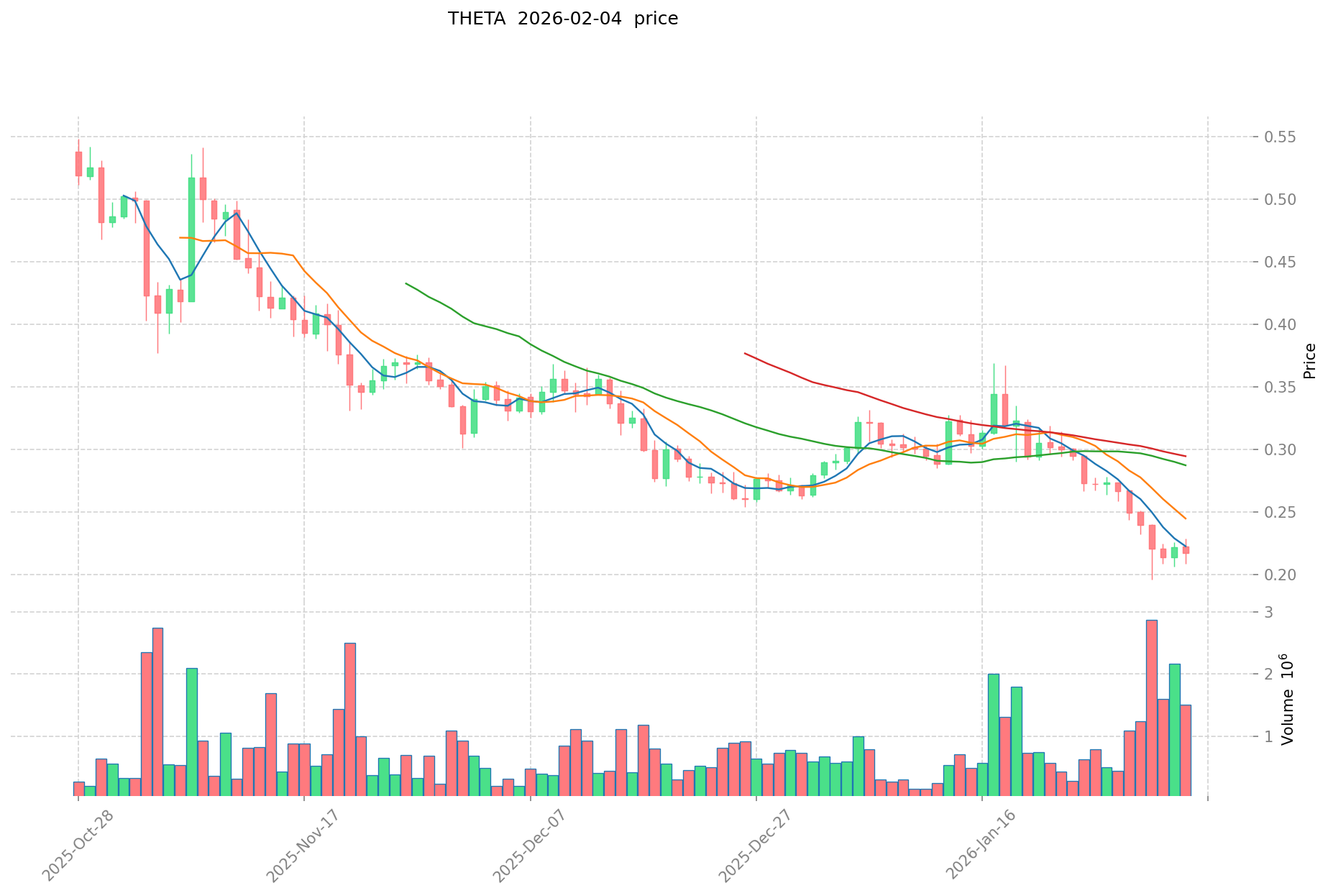
VERT (Coin A) and THETA (Coin B) Historical Price Trends
- 2025: VERT experienced significant price volatility following its launch in January 2025, with the token reaching a price peak of $0.0295 on January 17, 2025, before declining substantially.
- 2021: THETA was influenced by notable market momentum during the broader crypto bull market, with its price reaching $15.72 on April 16, 2021.
- Comparative Analysis: During the recent market cycle, VERT declined from its peak of $0.0295 to a low of $0.00045 recorded on February 25, 2025, representing substantial downward pressure. In contrast, THETA has experienced a prolonged decline from its 2021 peak of $15.72 to current levels around $0.222, reflecting broader market correction trends affecting established tokens.
Current Market Situation (2026-02-04)
- VERT current price: $0.001325
- THETA current price: $0.222
- 24-hour trading volume: VERT $26,137.97 vs THETA $340,410.25
- Market sentiment index (Fear & Greed Index): 14 (Extreme Fear)
View real-time prices:
- Check VERT current price Market Price
- Check THETA current price Market Price
II. Core Factors Influencing VERT vs THETA Investment Value
Supply Mechanism Comparison (Tokenomics)
- VERT: Information regarding VERT's supply mechanism and tokenomics structure is currently limited in available documentation.
- THETA: Specific details about THETA's supply model and token distribution framework require further technical disclosure.
- 📌 Historical Pattern: Token supply mechanisms have historically influenced market cycles through scarcity dynamics and release schedules, though specific correlations vary by project.
Institutional Adoption and Market Applications
- Institutional Holdings: Current institutional positioning data for both assets remains undisclosed in reference materials.
- Enterprise Adoption: VERT has demonstrated application in blockchain-based credit platforms, notably through its collaboration with XRP Ledger for agricultural receivables certification valued at 700 million reais (130 million USD). THETA has shown applications in decentralized network transmission infrastructure.
- Regulatory Environment: Both projects operate within evolving regulatory frameworks that may impact their respective market development trajectories.
Technology Development and Ecosystem Building
- VERT Technical Framework: VERT utilizes XRP Ledger infrastructure to deploy blockchain-based private credit platforms, focusing on tokenization of traditional financial instruments.
- THETA Technical Development: THETA has established presence in decentralized content delivery networks, though specific recent technical upgrades require additional documentation.
- Ecosystem Comparison: Both projects are developing their respective application layers, with VERT focusing on financial services infrastructure and THETA on media and content distribution networks.
Macroeconomic Environment and Market Cycles
- Inflation Environment Performance: The relationship between these assets and inflation dynamics requires longer-term market data for meaningful analysis.
- Macroeconomic Monetary Policy: Interest rate fluctuations and currency index movements may influence both assets through broader cryptocurrency market conditions.
- Geopolitical Factors: Cross-border transaction requirements and international developments could affect adoption patterns for blockchain-based financial and content delivery solutions.
III. 2026-2031 Price Forecast: VERT vs THETA
Short-term Forecast (2026)
- VERT: Conservative $0.00119376 - $0.0013264 | Optimistic $0.001379456
- THETA: Conservative $0.115336 - $0.2218 | Optimistic $0.314956
Mid-term Forecast (2028-2029)
- VERT may enter a consolidation phase, with projected price range of $0.0014589299088 - $0.0016994128608 in 2028, potentially reaching $0.001502697806064 - $0.001750395246624 in 2029
- THETA may enter an expansion phase, with projected price range of $0.2048395085 - $0.363518001 in 2028, potentially reaching $0.270590105665 - $0.400994975865 in 2029
- Key drivers: institutional capital inflows, ETF developments, ecosystem growth
Long-term Forecast (2031)
- VERT: Base scenario $0.00133483159928 - $0.001853932776778 | Optimistic scenario $0.002725281181863
- THETA: Base scenario $0.229879661261613 - $0.37077364719615 | Optimistic scenario $0.463467058995187
Disclaimer
VERT:
| Year | Predicted High Price | Predicted Average Price | Predicted Low Price | Price Change |
|---|---|---|---|---|
| 2026 | 0.001379456 | 0.0013264 | 0.00119376 | 0 |
| 2027 | 0.00185351136 | 0.001352928 | 0.00117704736 | 2 |
| 2028 | 0.0016994128608 | 0.00160321968 | 0.0014589299088 | 20 |
| 2029 | 0.001750395246624 | 0.0016513162704 | 0.001502697806064 | 24 |
| 2030 | 0.002007009795044 | 0.001700855758512 | 0.000884444994426 | 28 |
| 2031 | 0.002725281181863 | 0.001853932776778 | 0.00133483159928 | 39 |
THETA:
| Year | Predicted High Price | Predicted Average Price | Predicted Low Price | Price Change |
|---|---|---|---|---|
| 2026 | 0.314956 | 0.2218 | 0.115336 | 0 |
| 2027 | 0.3086347 | 0.268378 | 0.20665106 | 20 |
| 2028 | 0.363518001 | 0.28850635 | 0.2048395085 | 29 |
| 2029 | 0.400994975865 | 0.3260121755 | 0.270590105665 | 46 |
| 2030 | 0.3780437187098 | 0.3635035756825 | 0.22537221692315 | 63 |
| 2031 | 0.463467058995187 | 0.37077364719615 | 0.229879661261613 | 66 |
IV. Investment Strategy Comparison: VERT vs THETA
Long-term vs Short-term Investment Strategies
- VERT: May align with investors seeking exposure to emerging blockchain-based financial infrastructure and tokenization platforms, particularly those interested in early-stage projects with integration into established networks like TON blockchain and XRP Ledger applications.
- THETA: May align with investors focused on established decentralized content delivery infrastructure and video streaming network development, particularly those seeking exposure to mature projects with operational track records since 2017.
Risk Management and Asset Allocation
- Conservative investors: Asset allocation frameworks typically favor established projects with demonstrated market presence; consideration of VERT 20-30% vs THETA 70-80% may reflect risk tolerance preferences for volatility exposure.
- Aggressive investors: Higher risk tolerance portfolios might consider VERT 60-70% vs THETA 30-40% allocation structures, though individual circumstances vary significantly.
- Hedging instruments: Stablecoin allocation for liquidity management, derivatives instruments where available, cross-asset portfolio diversification strategies.
V. Potential Risk Comparison
Market Risks
- VERT: Substantial price volatility evidenced by decline from $0.0295 peak to $0.00045 low within approximately one month following January 2025 launch; limited trading volume of $26,137.97 may present liquidity constraints; market capitalization of $728,538 indicates early-stage development phase with associated uncertainty.
- THETA: Extended price correction from 2021 peak of $15.72 to current levels around $0.222 reflects broader market cycle adjustments; trading volume of $340,410.25 indicates moderate market activity; market capitalization of $222 million suggests established but potentially vulnerable positioning during adverse market conditions.
Technical Risks
- VERT: Integration dependencies on TON blockchain and XRP Ledger infrastructure; limited documentation regarding scalability frameworks and network stability mechanisms; early-stage technical development may present implementation challenges.
- THETA: Decentralized network infrastructure requires ongoing development to maintain content delivery capabilities; specific technical upgrade pathways require additional disclosure; established network architecture may face competition from emerging solutions.
Regulatory Risks
- Both assets operate within evolving regulatory environments that may impact market access, compliance requirements, and institutional adoption trajectories; VERT's focus on financial services tokenization may encounter specific securities regulation considerations; THETA's content delivery network model may face varying jurisdictional frameworks affecting media and data transmission services; cross-border transaction capabilities subject to changing international regulatory coordination.
VI. Conclusion: Which Is the Better Buy?
📌 Investment Value Summary:
- VERT advantages: Early-stage positioning in blockchain-based financial infrastructure; demonstrated application in agricultural receivables certification platforms valued at substantial transaction volumes; integration with established blockchain networks (TON, XRP Ledger) providing technical foundation.
- THETA advantages: Established operational history since 2017 with demonstrated use case in decentralized content delivery; higher trading volume and market capitalization indicating greater market recognition; functional application in video streaming network optimization.
✅ Investment Considerations:
- Novice investors: Focus on understanding fundamental differences between early-stage projects (VERT) and established networks (THETA); prioritize risk assessment relative to portfolio size; consider gradual position building rather than concentrated exposure.
- Experienced investors: Evaluate technical architecture differences and ecosystem development trajectories; assess correlation with broader market cycles and sector-specific trends; implement position sizing consistent with volatility tolerance and time horizons.
- Institutional investors: Conduct comprehensive due diligence on regulatory compliance frameworks; evaluate liquidity profiles relative to allocation requirements; consider ecosystem integration potential and strategic positioning within digital asset portfolios.
⚠️ Risk Disclosure: Cryptocurrency markets exhibit significant volatility characteristics. This analysis does not constitute investment advice. Market conditions change rapidly, and past performance does not indicate future results. Conduct independent research and consult qualified financial professionals before making investment decisions.
VII. FAQ
Q1: What are the fundamental differences between VERT and THETA's technological frameworks?
VERT operates as a custodial wallet on the TON blockchain with integration to XRP Ledger infrastructure, focusing on blockchain-based financial services and tokenization of traditional instruments such as agricultural receivables. THETA, launched in 2017, operates on its own native blockchain infrastructure designed specifically for decentralized video streaming and content delivery networks. VERT's technical approach emphasizes democratizing DeFi access through Telegram integration and user-friendly wallet functionality, while THETA addresses bandwidth optimization by incentivizing users to share network resources for high-quality video distribution.
Q2: How do the market capitalizations and trading volumes of VERT and THETA compare?
As of February 4, 2026, VERT maintains a market capitalization of $728,538 with 24-hour trading volume of $26,137.97, while THETA holds a significantly larger market capitalization of $222 million with trading volume of $340,410.25. This substantial difference reflects THETA's established market presence since 2017 versus VERT's early-stage positioning following its January 2025 launch. The higher trading volume for THETA indicates greater market liquidity and established trading infrastructure, whereas VERT's lower volume may present liquidity constraints for larger position sizes.
Q3: What historical price performance patterns have VERT and THETA exhibited?
VERT experienced extreme volatility following its January 2025 launch, reaching a peak of $0.0295 on January 17, 2025, before declining substantially to $0.00045 by February 25, 2025, representing significant downward pressure within approximately one month. THETA reached its all-time high of $15.72 on April 16, 2021, during the broader crypto bull market, and has undergone an extended correction to current levels around $0.222. These patterns reflect VERT's early-stage price discovery volatility versus THETA's multi-year market cycle adjustment following its 2021 peak.
Q4: What are the projected price ranges for VERT and THETA through 2031?
For 2026, VERT's conservative forecast ranges from $0.00119376 to $0.0013264 with an optimistic scenario of $0.001379456, while THETA's conservative range spans $0.115336 to $0.2218 with optimistic projection of $0.314956. By 2031, VERT's base scenario projects $0.00133483159928 to $0.001853932776778 with optimistic potential of $0.002725281181863, whereas THETA's base scenario forecasts $0.229879661261613 to $0.37077364719615 with optimistic projection of $0.463467058995187. These projections suggest different growth trajectories, with VERT showing potential percentage gains from a lower base and THETA demonstrating recovery potential from its corrected position.
Q5: What asset allocation strategies might suit different investor profiles for VERT versus THETA?
Conservative investors might consider allocation frameworks favoring VERT 20-30% versus THETA 70-80%, reflecting preference for established projects with operational track records and lower volatility exposure. Aggressive investors with higher risk tolerance might evaluate VERT 60-70% versus THETA 30-40% allocation structures, emphasizing early-stage growth potential despite increased volatility risks. These allocation considerations should account for individual circumstances including portfolio size, time horizon, liquidity requirements, and overall risk tolerance. Hedging instruments such as stablecoin allocations for liquidity management and cross-asset diversification strategies may complement either allocation approach.
Q6: What specific risks should investors evaluate when comparing VERT and THETA?
VERT's primary risks include substantial price volatility evidenced by its 98.5% decline from peak to trough within one month, limited trading volume of $26,137.97 presenting liquidity constraints, and early-stage development uncertainty reflected in its $728,538 market capitalization. THETA's risks encompass its extended 98.6% correction from 2021 peak levels, potential vulnerability during adverse market conditions despite its $222 million market capitalization, and competitive pressure from emerging content delivery solutions. Both assets face regulatory risks related to evolving compliance frameworks, with VERT's financial services tokenization potentially encountering securities regulations and THETA's content delivery model subject to varying jurisdictional requirements affecting media and data transmission services.
Q7: How do the ecosystem applications and real-world use cases differ between VERT and THETA?
VERT has demonstrated application in blockchain-based credit platforms through collaboration with XRP Ledger for agricultural receivables certification valued at 700 million reais (approximately 130 million USD), focusing on tokenization of traditional financial instruments and DeFi accessibility through Telegram integration. THETA has established presence in decentralized content delivery networks, addressing infrastructure challenges in high-quality video distribution by incentivizing bandwidth sharing among network participants. VERT's ecosystem development centers on financial services infrastructure and bridging traditional users with web3 technologies, while THETA's ecosystem focuses on media and content distribution network optimization through blockchain-based incentive mechanisms.
Q8: What market conditions might favor investment in VERT versus THETA?
VERT may benefit from market conditions favoring innovation in blockchain-based financial infrastructure, increased institutional interest in tokenization platforms, and growth in Telegram-integrated DeFi applications within the TON blockchain ecosystem. THETA may perform favorably during periods of increased demand for decentralized content delivery solutions, expansion in video streaming network requirements, and broader adoption of bandwidth-sharing incentive models. Market sentiment currently reflects extreme fear (Fear & Greed Index: 14), which historically has presented opportunities for long-term positioning, though timing and risk assessment remain critical considerations for either asset selection.
Share
Content
Introduction: A Comparative Analysis of VERT and THETA Investment Prospects
I. Historical Price Comparison and Current Market Status
II. Core Factors Influencing VERT vs THETA Investment Value
III. 2026-2031 Price Forecast: VERT vs THETA
IV. Investment Strategy Comparison: VERT vs THETA
V. Potential Risk Comparison
VI. Conclusion: Which Is the Better Buy?
VII. FAQ
How to Buy Cryptocurrency


Trending Cryptocurrencies



2025 SUI coin: price, buying guide, and Staking rewards

How to Buy Crypto: A Step-by-Step Guide with Gate.com

HNT Price in 2025: Helium Network Token Value and Market Analysis
What is SwissCheese (SWCH) and How Does It Democratize Investment?
Cardano (ADA) Price Analysis and Outlook for 2025

How to Invest in Metaverse Crypto

What Is a Cryptocurrency Airdrop? Where to Find Opportunities and How to Profit in the Current Landscape
Comprehensive Guide to Phil Konieczny's Cryptocurrency Investment Strategy and Philosophy

What is Raydium: A Complete Overview of the DEX on Solana Blockchain

Six Cryptocurrency Tokens With Total Growth Exceeding 1,000x

When will the Dogecoin ETF receive approval?