What is ALPACA: A Comprehensive Guide to the Innovative Language Model and Its Applications in Modern AI


ALPACA's Position and Significance
In 2021, the Alpaca Finance team launched ALPACA (ALPACA), aiming to address limited leverage options and capital inefficiency in decentralized yield farming. As a leveraged yield farming protocol on Binance Smart Chain, ALPACA plays a key role in DeFi lending and yield optimization.
As of 2026, ALPACA has established itself within the BSC DeFi ecosystem, with over 83,000 token holders and an active community. This article will provide an in-depth analysis of its technical architecture, market performance, and future potential.
Origin and Development History
Birth Background
ALPACA was created by the Alpaca Finance team in 2021, aiming to solve the challenge of accessing leveraged yield farming opportunities in DeFi without requiring large capital. It emerged during the DeFi boom on Binance Smart Chain, with the goal of providing yield farmers with higher returns through leveraged positions while enabling lenders to earn passive income. The launch of ALPACA brought new possibilities to DeFi users seeking enhanced capital efficiency.
Important Milestones
- 2021: Platform launch with core leveraged yield farming functionality on BSC.
- The project was launched as a fair launch initiative with no pre-sale, no investors, and no pre-mining.
- 2021: ALPACA token reached its all-time high of $8.78 in March.
- 2026: The token experienced significant market volatility, with the price declining substantially from historical peaks.
Under community governance and protocol development, ALPACA continues to evolve its platform features and ecosystem partnerships.
How ALPACA Works?
No Central Control
ALPACA operates on the decentralized Binance Smart Chain network, free from control by banks or governments. These nodes collaborate to validate transactions, ensuring system transparency and attack resistance, granting users greater autonomy and enhancing network resilience.
Blockchain Core
ALPACA's blockchain is a public, immutable digital ledger recording every transaction. Transactions are grouped into blocks and linked through cryptographic hashes to form a secure chain. Anyone can view the records, establishing trust without intermediaries. The protocol leverages BSC's architecture for efficient transaction processing.
Ensuring Fairness
ALPACA operates on Binance Smart Chain's Proof of Staked Authority (PoSA) consensus mechanism to validate transactions and prevent fraud such as double-spending. Validators maintain network security through staking BNB and validating blocks, receiving rewards for their participation. The BSC infrastructure provides high throughput and lower transaction costs compared to Ethereum mainnet.
Secure Transactions
ALPACA uses public-private key cryptography to protect transactions:
- Private keys (like secret passwords) are used to sign transactions
- Public keys (like account numbers) are used to verify ownership
This mechanism ensures fund security, with transactions maintaining pseudonymous characteristics. The protocol implements smart contract security measures and regular audits to protect user funds within the lending and farming ecosystem.
ALPACA's Market Performance
Circulation Overview
As of February 8, 2026, ALPACA has a circulating supply of 151,668,641.60 tokens, with a total supply of 151,668,641.60 tokens and a maximum supply of 188,000,000 tokens. The current circulation ratio stands at approximately 80.67% of the maximum supply.
Price Volatility
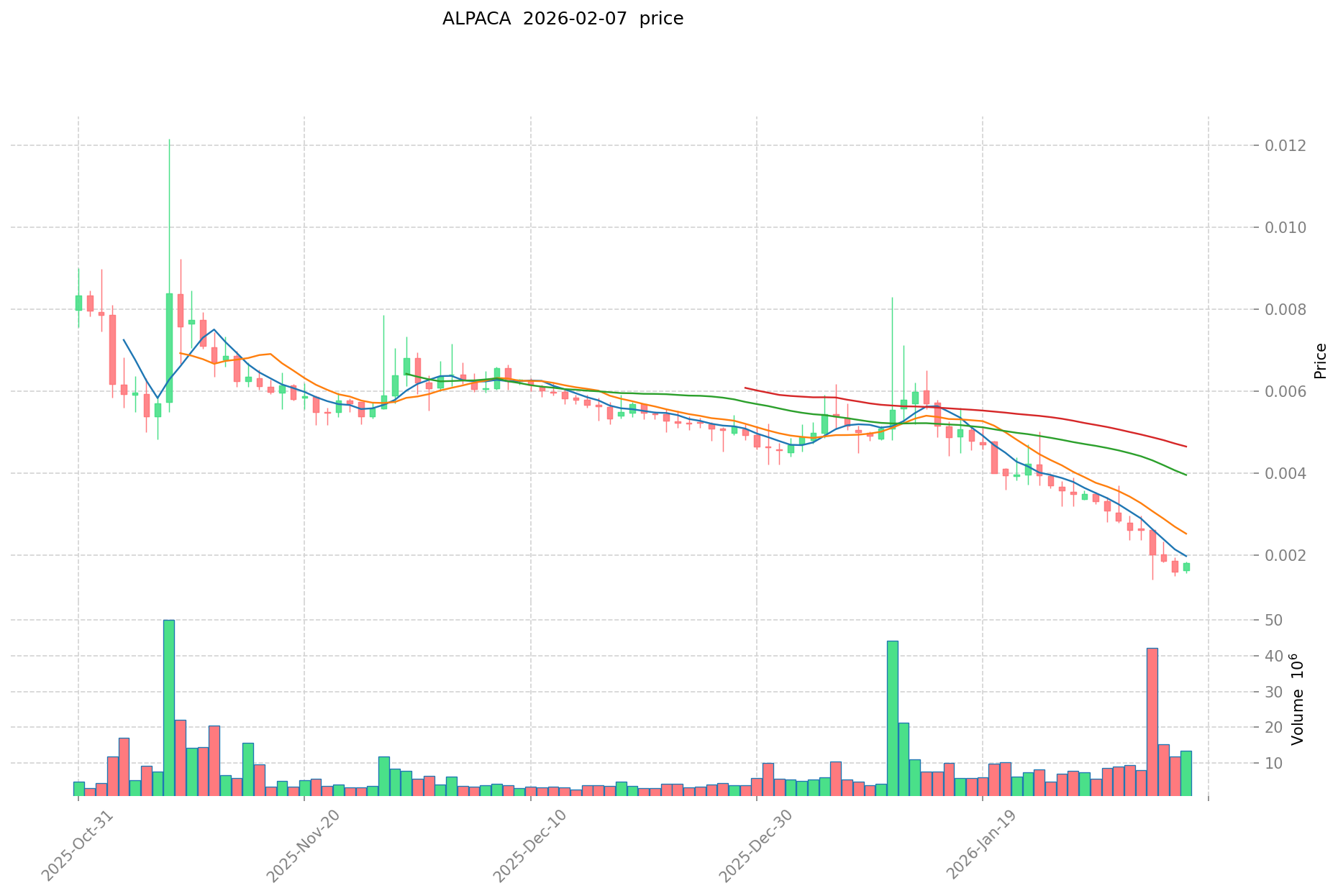
ALPACA reached its highest price of $8.78 on March 6, 2021, during a period of heightened market activity in the decentralized finance sector. Its lowest recorded price was $0.00162486, occurring on February 6, 2026, reflecting broader market corrections and reduced trading activity.
Recent price movements show notable fluctuations:
- 1-hour change: +0.12%
- 24-hour change: -5.42%
- 7-day change: -40.32%
- 30-day change: -65.16%
- 1-year change: -98.18%
The 24-hour trading range was between $0.00163 and $0.001839, with a current price of $0.001692. The 24-hour trading volume reached $26,632.83, with a market capitalization of approximately $256,623.34.
Click to view the current ALPACA market price
On-Chain Metrics
- Token Holders: 83,425 addresses hold ALPACA tokens, indicating a broad distribution across the community
- Contract Address: ALPACA operates on the BSC (BNB Smart Chain) network with the contract address 0x8f0528ce5ef7b51152a59745befdd91d97091d2f
- Market Capitalization to Fully Diluted Valuation Ratio: 80.67%, suggesting a significant portion of the maximum supply is already in circulation
ALPACA Ecosystem Applications and Partners
Core Use Cases
ALPACA's ecosystem supports multiple applications:
- DeFi: Alpaca Finance serves as a leveraged yield farming protocol on BSC, providing leveraged position opening for yield farmers to achieve enhanced returns through strategic borrowing and farming mechanisms.
- Liquidity Provision: The platform enables users to participate as lenders, supplying assets to earn passive interest income while supporting the protocol's lending infrastructure.
Strategic Partnerships
As a fair-launch project without pre-sale or institutional investors, ALPACA has built its ecosystem through organic community growth and integration within the BSC ecosystem. The protocol's development focuses on technical capabilities and user adoption through decentralized governance mechanisms.
Challenges and Controversies
ALPACA faces several challenges:
- Market Volatility: The token has experienced significant price fluctuations, with a 98.18% decline over the past year, reflecting broader market conditions and specific protocol dynamics.
- Competition Pressure: The DeFi landscape on BSC includes numerous yield optimization protocols, creating competitive pressure for user acquisition and capital retention.
- Price Performance: Recent downward trends with a 40.32% decline over 7 days and 65.16% over 30 days have raised concerns among community members about short-term market sentiment.
These challenges have sparked discussions within the community and continue to drive protocol innovation and adaptation.
ALPACA Community and Social Media Atmosphere
Community Engagement
ALPACA's community demonstrates sustained activity with 83,425 token holders across its ecosystem. The protocol maintains presence through its official channels, where community members actively discuss farming strategies, governance proposals, and protocol developments. Platform metrics show consistent community participation in protocol governance and liquidity provision.
Social Media Sentiment
Sentiment on social platforms presents mixed perspectives:
- Supporters praise ALPACA's fair-launch mechanism, leveraged farming innovation, and commitment to decentralized governance, viewing it as a pioneer in accessible yield optimization strategies.
- Critics focus on price volatility, market performance challenges, and competitive pressures within the DeFi sector.
Recent trends reflect cautious sentiment aligned with broader market conditions and DeFi sector dynamics.
Popular Topics
Community discussions center on ALPACA's governance decisions, yield farming strategies, token economics, highlighting both its innovative approach to leveraged farming and the challenges of maintaining competitiveness in an evolving DeFi landscape.
More Information Sources for ALPACA
- Official Website: Visit Alpaca Finance Official Site for features, use cases, and latest developments.
- Blockchain Explorer: ALPACA on BscScan provides on-chain data, transaction history, and token metrics.
- Social Media: Follow ALPACA on X platform via @AlpacaFinance for updates covering protocol upgrades, community activities, governance proposals, generating community engagement through regular communications.
ALPACA Future Roadmap
- Ongoing Development: Focus on protocol optimization and governance enhancements to improve platform efficiency and user experience
- Ecosystem Goals: Expand DeFi utility within the BSC ecosystem while maintaining sustainable yield farming mechanisms
- Long-term Vision: Establish position as a trusted leveraged yield farming infrastructure for BSC users
How to Participate in ALPACA?
- Purchase Channels: Acquire ALPACA on Gate.com and other supporting exchanges
- Storage Solutions: Use compatible BSC wallets such as MetaMask or hardware wallets supporting BSC network for secure storage
- Participate in Governance: Engage in community decisions through ALPACA's governance mechanisms
- Build Ecosystem: Visit official documentation to explore DeFi strategies or contribute to protocol development
Summary
ALPACA represents innovation in leveraged yield farming through blockchain technology, offering transparency, decentralized governance, and enhanced farming opportunities. Its fair-launch approach, active community of 83,425 holders, and focus on accessible DeFi solutions distinguish it within the cryptocurrency sector. Despite facing market volatility and competitive pressures, ALPACA's commitment to decentralized principles and protocol optimization positions it as a noteworthy participant in DeFi's evolution. Whether you're a newcomer or experienced DeFi participant, ALPACA offers opportunities for engagement in leveraged yield strategies.
FAQ
What is Alpaca Finance and what does it do?
Alpaca Finance is a decentralized finance platform built on Binance Smart Chain offering lending, staking, and leveraged yield farming services. It enables users to earn returns and access financial services without intermediaries.
How can I buy and trade ALPACA tokens?
You can buy ALPACA tokens on major cryptocurrency exchanges that support the token. First, create an account and complete verification. Deposit fiat currency or stablecoins like USDT, then place buy orders. Once purchased, you can trade ALPACA against other cryptocurrencies on supported trading pairs.
What are the main risks and benefits of investing in ALPACA?
Benefits: ALPACA offers agricultural utility, potential yield farming rewards, and ecosystem growth prospects. Risks: market volatility, liquidity fluctuations, and regulatory uncertainties in crypto agriculture sector.
What is the tokenomics and supply of ALPACA?
ALPACA has a maximum supply of 188,000,000 tokens. It features a deflationary model with burning mechanisms that reduce the circulating supply over time, making it a sustainable and value-appreciating token structure.
How does Alpaca Finance differ from other DeFi platforms?
Alpaca Finance stands out with lower fees, higher yield farming returns, and a unique incentive model rewarding users with additional tokens. This approach maximizes profit potential compared to traditional DeFi platforms.
What blockchain network does ALPACA operate on?
ALPACA operates on the Solana blockchain network, providing users with fast and cost-effective transactions within the Solana ecosystem.
Share
Content
ALPACA's Position and Significance
Origin and Development History
How ALPACA Works?
ALPACA's Market Performance
ALPACA Ecosystem Applications and Partners
Challenges and Controversies
ALPACA Community and Social Media Atmosphere
More Information Sources for ALPACA
ALPACA Future Roadmap
How to Participate in ALPACA?
Summary
FAQ
How to Buy Cryptocurrency


Trending Cryptocurrencies



What will be the market capitalization of USDC in 2025? Analysis of the stablecoin market landscape.

How is DeFi different from Bitcoin?

What is DeFi: Understanding Decentralized Finance in 2025
USDC stablecoin 2025 Latest Analysis: Principles, Advantages, and Web3 Eco-Applications
Development of Decentralized Finance Ecosystem in 2025: Integration of Decentralized Finance Applications with Web3

2025 USDT USD Complete Guide: A Must-Read for Newbie Investors
Top 6 Bitcoin ATMs for Low Fees and Privacy
Comprehensive Guide to Cryptocurrency Market Cap

RSI Usage and Calculation Methods in Cryptocurrency Trading
Comprehensive Guide to Wyckoff Pattern for Bitcoin Trading

What Are Governance Tokens? An Easy-to-Understand Guide to Their Features and Important Considerations