This comprehensive guide explores Average True Range (ATR), a critical technical indicator for measuring market volatility in cryptocurrency trading. ATR helps traders identify price fluctuation intensity, set appropriate stop-loss levels, and determine optimal position sizing. The article covers ATR calculation methods, period settings, and practical applications across different market conditions. Additionally, it examines Artrade (ATR), the pioneering art Real World Asset marketplace built on Solana blockchain, enabling fractional ownership and transparent trading of tokenized artworks. The guide details Artrade's technical architecture leveraging Proof of History consensus, market performance metrics showing 12,777 token holders, ecosystem applications connecting traditional art with digital assets, and community engagement strategies. Readers discover how to use ATR indicators for enhanced risk management, integrate Artrade into their portfolio on Gate, and navigate the evolving art tokenization landscap
Artrade (ATR)'s Positioning and Significance
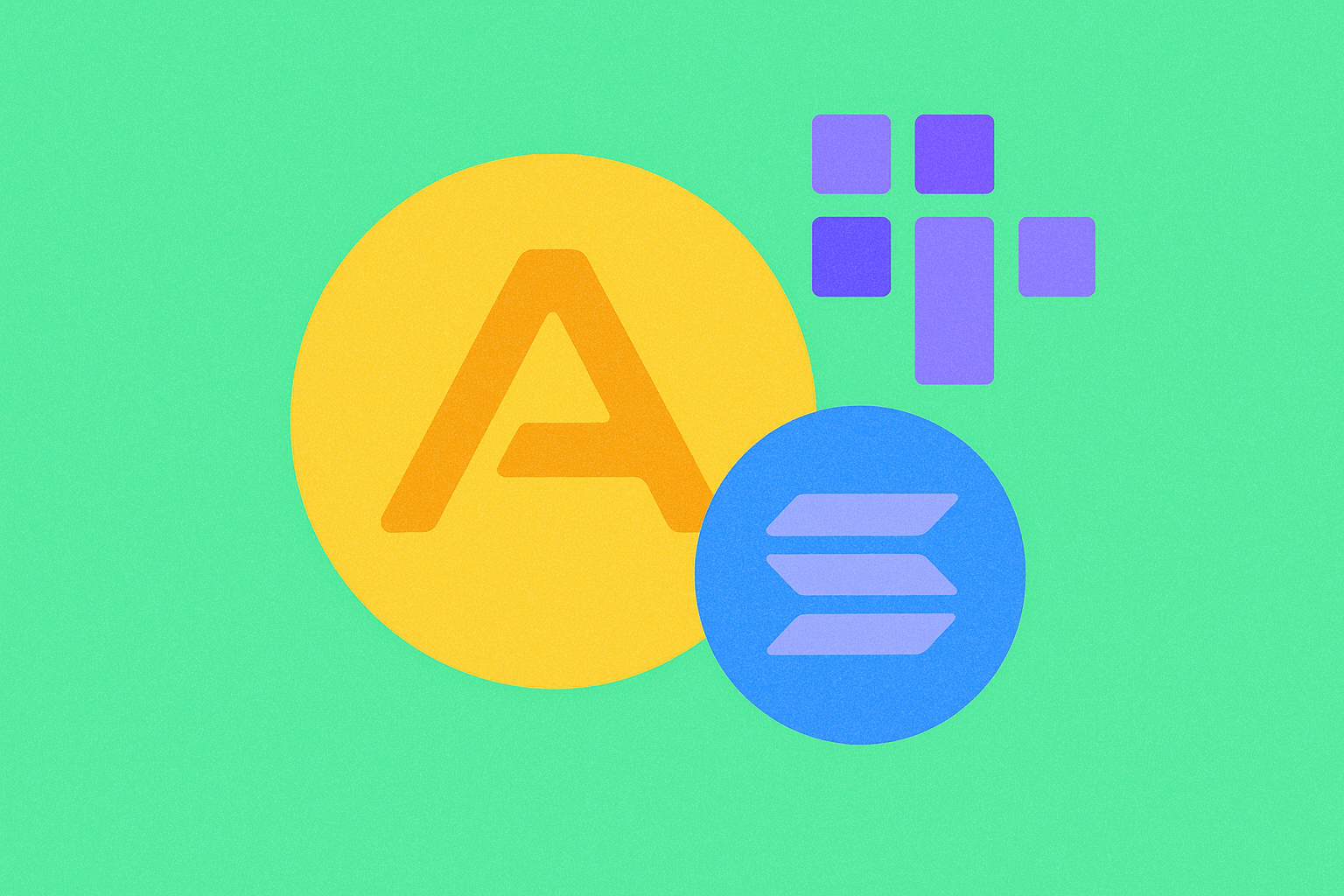
Launched in 2022, Artrade introduced ATR, aiming to address the challenges of accessibility and liquidity in the traditional art market.
As the first marketplace for art RWA (real world assets), Artrade plays a key role in bridging physical art with blockchain technology and digital asset trading.
As of 2026, Artrade has become an emerging platform in the art tokenization sector, with an active community of art collectors and blockchain enthusiasts.
This article will provide an in-depth analysis of its technical architecture, market performance, and future potential.
Origin and Development History
Background
Artrade was created in 2022, aiming to solve the problems of limited accessibility, high barriers to entry, and poor liquidity in traditional art markets.
It emerged during the rise of NFTs and real-world asset tokenization, with the goal of democratizing art investment and enabling fractional ownership of physical artworks to change the status quo.
The launch of Artrade brought new possibilities for art collectors, investors, and creators.
Key Milestones
- 2022: Platform launch with ATR token on Solana blockchain, introducing art tokenization functionality.
- 2024: Reached all-time high price of $0.104 in April, demonstrating market interest in art RWA.
- 2026: Expanded holder base to over 12,777 addresses, reflecting growing community adoption.
With the support of its community and development team, Artrade continues to optimize its platform, security features, and real-world applications.
How Artrade (ATR) Works
No Central Control
Artrade operates on the Solana blockchain, a decentralized network of computers (nodes) distributed globally, free from control by banks or governments.
These nodes collaborate to validate transactions, ensuring the system remains transparent and attack-resistant, granting users greater autonomy and enhancing network resilience.
Blockchain Core
Artrade's underlying Solana blockchain is a public, immutable digital ledger that records every transaction.
Transactions are grouped into blocks and linked through cryptographic hashes to form a secure chain.
Anyone can view the records, establishing trust without intermediaries.
Solana's high-performance architecture with parallel transaction processing further enhances performance and scalability.
Ensuring Fairness
Artrade leverages Solana's Proof of History (PoH) combined with Proof of Stake (PoS) consensus mechanism to validate transactions and prevent fraud such as double-spending.
Validators maintain network security through staking SOL tokens and validating transaction sequences, earning rewards for their participation.
Its innovation includes high throughput exceeding 65,000 TPS and sub-second transaction finality.
Secure Transactions
Artrade uses public-private key cryptography to protect transactions:
- Private key (similar to a secret password) is used to sign transactions
- Public key (similar to an account number) is used to verify ownership
This mechanism ensures fund security, while transactions maintain pseudonymous privacy.
The platform implements additional security features through smart contract audits and multi-signature wallet support for institutional users.
Circulation Overview
As of February 02, 2026, Artrade (ATR) has a circulating supply of 1,260,104,055.33 tokens, with a total supply of 1,794,232,613.33 tokens. The maximum supply is capped at 1,800,000,000 tokens, establishing a fixed supply model. With approximately 70.01% of the total supply currently in circulation, the token distribution reflects a substantial portion already available in the market. The circulating supply impacts the supply-demand dynamics as new tokens gradually enter circulation through the existing distribution mechanisms.
Price Volatility
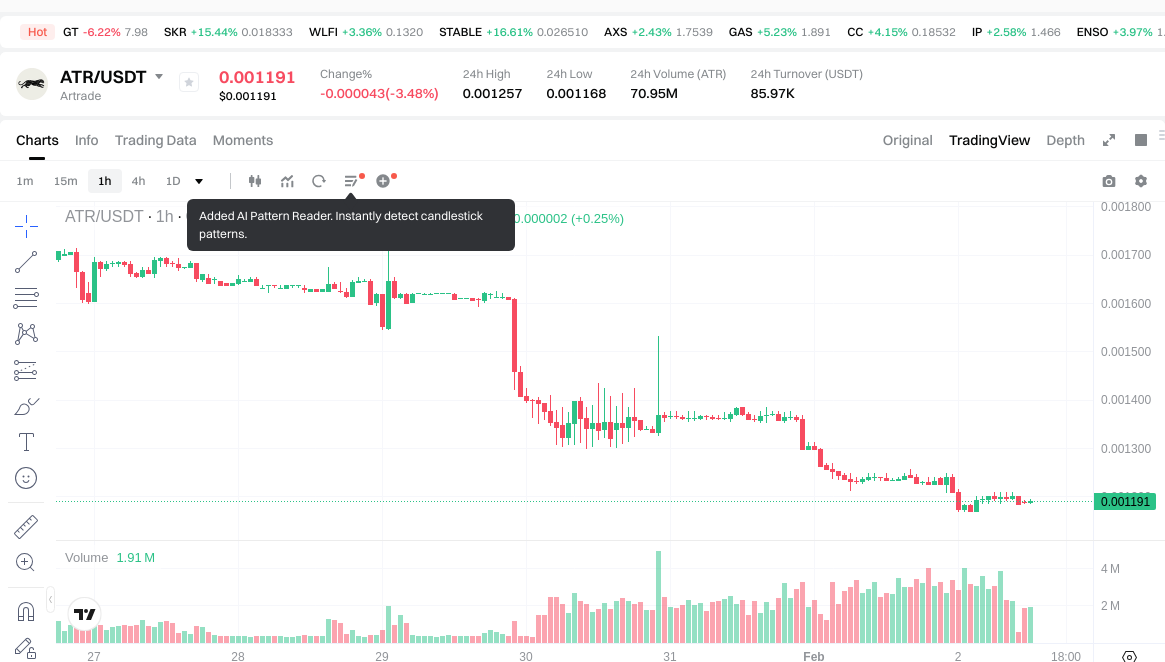
ATR reached its all-time high of $0.104 on April 03, 2024, driven by favorable market conditions during that period. The token recorded its all-time low of $0.001168 on February 01, 2026, reflecting recent market pressures. As of February 02, 2026, ATR is trading at $0.001192, representing a significant decline from its historical peak. The token has experienced notable volatility, with a -3.4% change over the past 24 hours, -29.88% over the past 7 days, and -43.45% over the past 30 days. Over the past year, ATR has declined by -96.04%, illustrating the challenging market environment and evolving adoption trends.
Click to view the current ATR market price
On-chain Metrics
- 24-hour Trading Volume: $85,949.57 (indicating current market activity levels)
- Token Holders: 12,777 addresses (reflecting community participation)
- Market Capitalization: $1,502,044.03 (representing the current market valuation of circulating tokens)
Artrade Ecosystem Applications and Partners
Core Use Cases
Artrade's ecosystem centers on art tokenization and trading:
- Art RWA Marketplace: Artrade operates as the first marketplace for art Real World Assets, enabling fractional ownership and trading of physical artworks through blockchain technology.
- Digital Art Trading: The platform facilitates secure transactions of tokenized art pieces, bridging traditional art markets with digital asset infrastructure.
Strategic Partnerships
Based on available information, Artrade leverages the Solana blockchain infrastructure for its operations.
These technical foundations support the platform's art tokenization capabilities and transaction efficiency.
Challenges and Considerations
Artrade faces several industry-wide challenges:
- Technical Aspects: Maintaining platform stability and user experience in a competitive NFT and RWA marketplace environment
- Market Dynamics: The token has experienced significant price volatility, declining approximately 96.04% over the past year, with current trading at $0.001192
- Competition Pressure: Operating in an evolving space with emerging art tokenization platforms and established NFT marketplaces
These factors continue to shape the project's development trajectory and market positioning.
Artrade maintains an active presence across digital platforms, with 12,777 token holders as of February 2026.
The project's circulating supply represents approximately 70% of the total supply, indicating substantial distribution among participants.
The community engages through various channels:
- Supporters highlight Artrade's innovative approach to art asset tokenization and accessibility, viewing it as a bridge between traditional art markets and blockchain technology.
- Market observers note the price performance challenges and market cap metrics, with current fully diluted valuation around $2.14 million.
Recent trading patterns show the token experienced a 3.4% decline over 24 hours and a 29.88% decrease over the past week.
Discussion Topics
Community discussions often center on art market digitalization, RWA tokenization standards, and platform development progress,
reflecting both the transformative potential and the practical challenges of mainstream art tokenization adoption.
- Official Website: Visit Artrade Official Site for platform features, use cases, and latest updates.
- X Platform: Follow Artrade on X at @artradeapp for updates on platform developments, community activities, and market announcements.
- Blockchain Explorer: Track ATR token activity on Solana Explorer.
How to Participate in Artrade?
- Purchase Options: ATR is available on Gate.com and select cryptocurrency exchanges
- Storage Solutions: Use Solana-compatible wallets such as Phantom or Solflare for secure token storage
- Platform Engagement: Visit the official Artrade marketplace to explore tokenized art offerings
- Development Contribution: Access the GitHub repository to review smart contract implementations
Summary
Artrade represents an innovative approach to art asset digitalization, offering transparency, fractional ownership, and blockchain-secured transactions in the art marketplace.
Its focus on Real World Asset tokenization and active development community position it within the evolving intersection of traditional art markets and digital assets.
Despite facing market volatility and competitive pressures, Artrade's specialized focus on art RWA creates a distinct niche in the tokenization landscape.
Whether you're an art enthusiast or blockchain participant, Artrade offers a unique perspective on digital asset applications in creative markets.
FAQ
What is the ATR indicator? What is its role in cryptocurrency trading?
ATR (Average True Range) is a technical analysis tool measuring market volatility. In crypto trading, it helps traders gauge price fluctuation intensity, identify breakout points, and set appropriate stop-loss levels for better risk management.
How to use the ATR indicator to judge market volatility in cryptocurrency trading?
ATR measures price volatility by analyzing average price ranges over periods. High ATR indicates strong volatility and larger price swings, suitable for trend trading. Low ATR suggests stable prices with smaller movements, ideal for range trading. Use ATR to set stop-loss levels and position sizing based on current market conditions.
What is the calculation method of the ATR indicator? What period setting is more suitable?
ATR measures volatility by calculating the average range of price movements over a specific period. It considers the total range of each candlestick including wicks. A 14-period ATR is the standard setting, meaning it analyzes the past 14 trading days' price ranges. This period works well for most traders and provides reliable volatility measurements.
What is the difference and connection between ATR indicator and other technical indicators such as Bollinger Bands and RSI?
ATR measures volatility magnitude, while RSI shows trend strength and Bollinger Bands display price ranges. ATR identifies breakout potential; RSI confirms momentum; Bollinger Bands signal overbought/oversold levels. Combined use provides comprehensive market analysis for improved trading decisions.
What are the advantages, disadvantages, and risks of using the ATR indicator for cryptocurrency trading?
ATR measures market volatility effectively and helps optimize position sizing and dynamic stop-losses. However, it lacks trend direction signals, so combine it with trend indicators like MACD or moving averages for better accuracy. High ATR indicates increased volatility and potential breakouts.
* The information is not intended to be and does not constitute financial advice or any other recommendation of any sort offered or endorsed by Gate.