Aura Network is a scalable Layer 1 blockchain designed to address NFT adoption challenges through comprehensive infrastructure and ecosystem solutions. This guide examines its technical architecture, including decentralized consensus mechanisms and secure transaction protocols, alongside current market metrics with 2,847 holders and $638,999.53 market capitalization. The article analyzes AURA token performance, trading activity, and on-chain data while exploring core use cases in NFT infrastructure and blockchain solutions. It evaluates ecosystem partnerships, community engagement across social platforms, and addresses market volatility concerns amid competitive pressures. The guide provides practical pathways for participation, from acquiring AURA on Gate to exploring NFT development opportunities, making it essential for developers, collectors, and blockchain enthusiasts interested in NFT infrastructure solutions.
Aura Network's Positioning and Significance
In recent years, the Aura Network team launched Aura Network (AURA), aiming to address challenges in NFT adoption, scalability, and accessibility across global markets.
As a scalable, agile, and effortless Layer 1 blockchain with a comprehensive ecosystem, Aura Network plays a pivotal role in NFT infrastructure and digital asset management.
As of 2026, Aura Network has established itself within the blockchain ecosystem, with 2,847 holders and an active development community.
This article will provide an in-depth analysis of its technical architecture, market performance, and future potential.
Origin and Development History
Birth Background
Aura Network was created to solve barriers to global NFT adoption, including scalability limitations and user experience challenges.
It emerged during the expansion of blockchain technology and growing interest in NFT applications, with the goal of providing a comprehensive, user-friendly infrastructure for NFT creation, management, and trading.
Aura Network's launch has brought new possibilities for NFT creators, collectors, and ecosystem builders.
Important Milestones
- The mainnet launch enabled scalable NFT infrastructure with enhanced transaction efficiency.
- Ecosystem development saw growth in NFT-related applications and developer tools.
- The project continues to evolve with ongoing technical optimizations and community support.
With support from its development team and community, Aura Network continues to refine its technology, security, and real-world applications.
How Aura Network Operates
Decentralized Control
Aura Network runs on a decentralized network of computers (nodes) distributed globally, operating independently of centralized control.
These nodes collaborate to validate transactions, ensuring system transparency and resistance to attacks, granting users greater autonomy and enhancing network resilience.
Blockchain Core
Aura Network's blockchain is a public, immutable digital ledger that records every transaction.
Transactions are grouped into blocks and linked through cryptographic hashing to form a secure chain.
Anyone can view the records, establishing trust without intermediaries.
The network's design focuses on scalability and efficiency to support NFT operations.
Ensuring Fairness
Aura Network employs a consensus mechanism to validate transactions and prevent fraudulent activities such as double-spending.
Network participants maintain security through their involvement in validation processes and receive AURA rewards.
The innovation includes optimized performance for NFT-specific use cases.
Secure Transactions
Aura Network uses public-private key cryptography to protect transactions:
- Private keys (similar to secret passwords) are used to sign transactions
- Public keys (similar to account numbers) are used to verify ownership
This mechanism ensures fund security while maintaining transaction integrity.
The network implements additional security features to protect user assets and data.
Circulation Overview
As of February 05, 2026, Aura Network (AURA) has a circulating supply of 415,744,649.29 tokens, with a total supply of 1,000,000,000 tokens under a fixed supply model.
The current circulation rate stands at approximately 41.57% of the total supply, with tokens entering the market through controlled release mechanisms that influence supply-demand dynamics.
Price Fluctuations
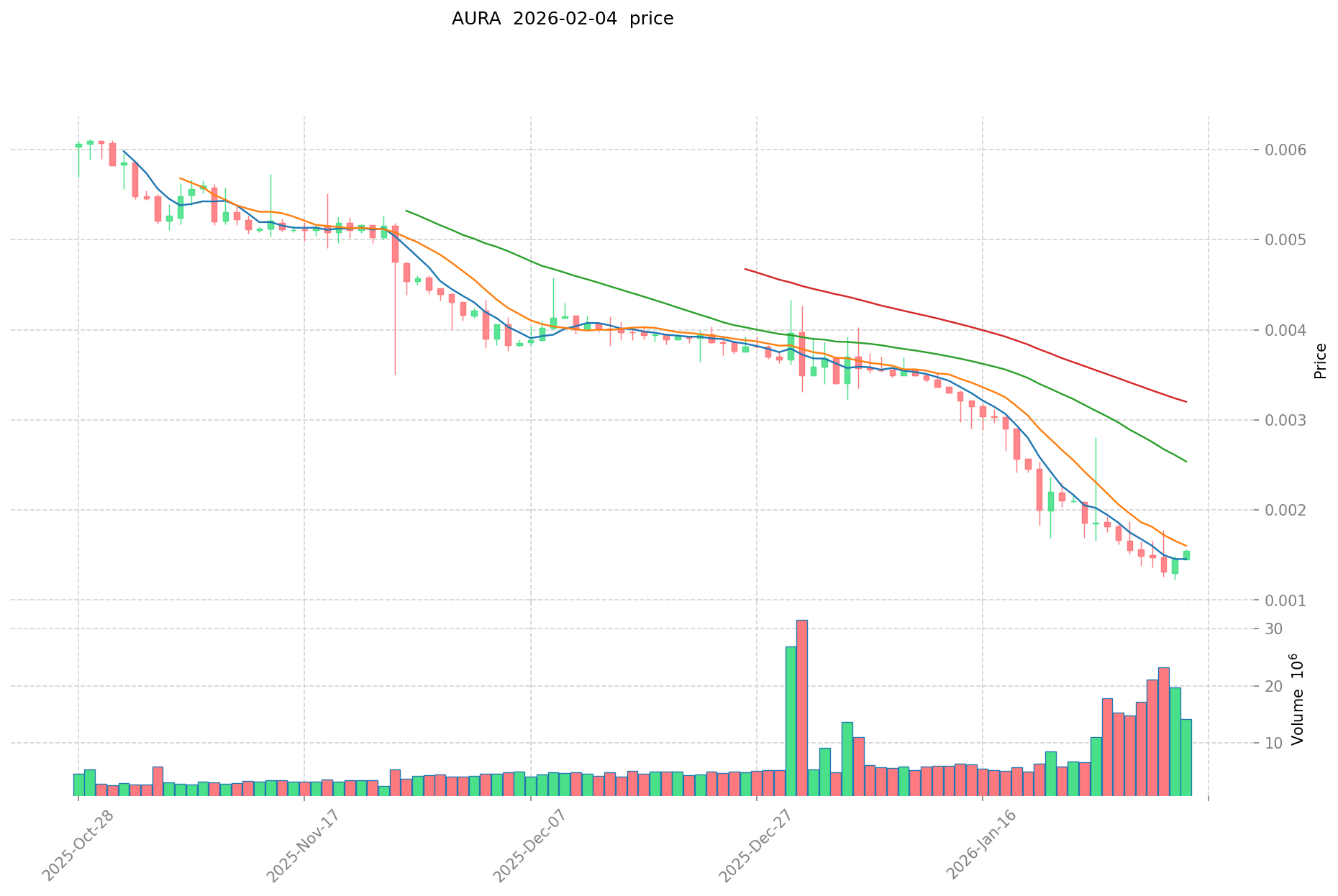
AURA reached a notable price point of $0.06798 on January 06, 2024, driven by favorable market conditions and increased adoption of NFT-focused blockchain solutions.
The token experienced its lower price level of $0.001225 on February 02, 2026, influenced by broader market adjustments and sector-wide valuation reassessments.
These price movements reflect evolving market sentiment, adoption trends, and external factors affecting the Layer 1 blockchain and NFT ecosystem sectors.
Click to view current AURA market price
On-Chain Metrics
- Holder Count: 2,847 addresses (indicating user distribution and community participation)
- 24-Hour Trading Volume: $41,547.60 (reflecting current market activity)
- Market Capitalization: $638,999.53 (representing current network valuation)
- Fully Diluted Valuation: $1,537,000.00 (projected at maximum supply circulation)
Aura Network Ecosystem Applications and Partners
Core Use Cases
Aura Network's ecosystem supports multiple applications:
- NFT Infrastructure: The platform provides comprehensive NFT tooling and infrastructure, enabling creators and developers to build, deploy, and manage digital collectibles with enhanced scalability.
- Blockchain Solutions: Aura Network facilitates efficient and agile layer 1 operations, designed to accelerate global NFT adoption through streamlined processes.
Strategic Partnerships
Aura Network continues to build strategic collaborations to enhance its technical capabilities and expand market reach.
These partnerships provide a solid foundation for Aura Network's ecosystem expansion.
Challenges and Considerations
Aura Network faces several challenges:
- Market Volatility: The token has experienced significant price fluctuations, with a one-year decline of approximately 81%
- Competitive Landscape: Operating in an increasingly competitive blockchain space with established layer 1 networks
- Adoption Hurdles: Achieving widespread NFT adoption requires continued ecosystem development and user acquisition
These issues have sparked discussions within the community and market, while also driving Aura Network's continuous innovation.
Aura Network maintains an active community presence with approximately 2,847 token holders.
On X platform, community discussions around Aura Network and related NFT topics generate regular engagement.
The community demonstrates interest in ecosystem developments and NFT technology advancements.
Sentiment on X presents a mixed perspective:
- Supporters praise Aura Network's focus on NFT infrastructure and layer 1 scalability, viewing it as a specialized solution for digital collectibles.
- Observers note price performance concerns and the competitive nature of the blockchain space.
Recent trends indicate cautious interest as the project continues to develop its ecosystem.
Popular Topics
X users discuss Aura Network's NFT infrastructure capabilities, ecosystem development, and market positioning,
reflecting both its potential in the NFT space and the challenges of achieving mainstream adoption.
- Official Website: Visit Aura Network Official Site for features, use cases, and latest updates.
- X Updates: On X platform, Aura Network actively engages using @AuraNetworkHQ,
sharing posts covering technical updates, community activities, and ecosystem developments.
- Block Explorer: Access Aurascan to track network activity and transactions.
- GitHub Repository: Review technical developments at Aura Network GitHub.
Aura Network Future Roadmap
- Ecosystem Expansion: Continue building comprehensive NFT infrastructure and tooling
- Adoption Goals: Accelerate global NFT adoption through enhanced scalability and developer-friendly solutions
- Long-term Vision: Establish itself as a leading layer 1 blockchain infrastructure for NFT applications
How to Participate in Aura Network?
- Purchase Options: Acquire AURA on Gate.com
- Storage Solutions: Store tokens securely using compatible cryptocurrency wallets
- Ecosystem Participation: Explore NFT development opportunities using Aura Network's infrastructure
- Community Engagement: Follow official channels and participate in ecosystem discussions
Summary
Aura Network leverages blockchain technology to advance NFT infrastructure, offering scalability, agility, and developer-friendly tools.
Its focus on NFT adoption, active community, and technical resources position it within the specialized blockchain space.
Despite facing market volatility and competitive pressures, Aura Network's commitment to NFT infrastructure and clear focus on this sector provide a foundation for potential growth.
Whether you're a developer, collector, or blockchain enthusiast, Aura Network represents an interesting project in the NFT infrastructure landscape.
FAQ
What is Crypto AURA and what does it do?
AURA is the native token of Aura Finance, a protocol optimizing yield farming on Balancer. It boosts rewards for liquidity providers, enhancing earnings while promoting active DeFi participation and governance.
How do I buy or obtain AURA tokens?
Create an account on a crypto exchange, deposit funds using your preferred payment method, search for AURA, and place a buy order. You can purchase directly with fiat currency or trade other cryptocurrencies for AURA tokens.
What are the main risks and security considerations for AURA?
AURA implements strong security measures including data encryption, restricted access controls, and secure web gateways. Customer data is protected using industry-recognized standards, with annual policy reviews covering access control, incident response, and vulnerability management to ensure comprehensive protection.
How does AURA differ from other cryptocurrency projects?
AURA is a Solana-based token focused on viral social media culture and TikTok trends. It features a unique meme generator for creating '+Aura' content and rewards users for viral social activities, distinguishing itself by targeting specific trending cultural movements rather than broad internet culture like other memecoins.
What is the tokenomics and supply of AURA?
AURA has a total supply of 5 billion tokens created at token generation event. Detailed tokenomics breakdown includes allocation across team, community, and ecosystem development phases.
* The information is not intended to be and does not constitute financial advice or any other recommendation of any sort offered or endorsed by Gate.