This comprehensive guide explores BarnBridge (BOND), a pioneering DeFi protocol launched in 2020 that revolutionizes risk management through volatility derivatives and tokenized risk tranching. The article examines BOND's decentralized governance mechanisms, blockchain infrastructure built on Ethereum, and current market performance, including its circulating supply of 9.78M tokens and market capitalization of $706,138. Readers will discover how BarnBridge enables users to manage yield volatility and interest rate risks through innovative smart contracts while maintaining transparency and community-driven decision-making. The guide covers technical architecture, on-chain metrics showing 16,684 active holders, ecosystem applications, and strategic partnerships. Despite facing market volatility with an 80.55% annual decline, BarnBridge remains relevant for investors seeking DeFi innovation. Learn how to purchase BOND on Gate, participate in governance, and explore BarnBridge's potential within the Web3 ecosyste
BarnBridge's Position and Significance
In 2020, the BarnBridge team launched BarnBridge (BOND), aiming to address volatility risks in decentralized finance (DeFi) through risk tokenization and derivatives.
As a pioneering DeFi protocol focused on volatility derivatives, BarnBridge plays a key role in DeFi risk management and yield optimization.
As of 2026, BarnBridge has developed an active community with 16,684 holders, although it faces significant market challenges reflected in its current price position.
This article will provide an in-depth analysis of its technical architecture, market performance, and future potential.
Origins and Development History
Birth Background
BarnBridge was created by its founding team in 2020, aiming to solve the lack of structured financial products and risk management tools in the DeFi ecosystem.
It emerged during the DeFi Summer boom, with the goal of enabling users to tokenize and trade risk through innovative smart contracts to transform traditional risk management approaches.
The launch of BarnBridge brought new possibilities for DeFi users seeking to manage yield volatility and interest rate risks.
Key Milestones
- 2020: Project launch with an initial price of $85, introducing the volatility derivatives protocol concept.
- The protocol implemented risk tranching mechanisms allowing users to customize their risk exposure levels.
- BOND token was established as the governance token, enabling community-driven protocol development.
- The project expanded its ecosystem with various DeFi integrations supporting its risk management framework.
Under the support of the BarnBridge DAO and community, BarnBridge continues to develop its technology, security, and real-world applications.
How BarnBridge Works
Decentralized Control
BarnBridge operates on a decentralized network of computers (nodes) distributed globally, free from control by banks or governments.
These nodes collaborate to validate transactions, ensuring system transparency and attack resistance, granting users greater autonomy and enhancing network resilience.
Blockchain Foundation
BarnBridge's blockchain infrastructure is built on Ethereum, utilizing a public, immutable digital ledger that records protocol transactions.
Transactions are grouped into blocks and linked through cryptographic hashes to form a secure chain.
Anyone can view the records, establishing trust without intermediaries.
The protocol leverages the ERC-20 token standard, ensuring broad compatibility with Ethereum wallets and exchanges.
Governance Mechanism
BarnBridge employs community governance through the BOND token, allowing token holders to vote on protocol updates and decisions.
Token holders participate by staking BOND tokens and engaging in governance proposals to maintain network security and direction, earning participation rewards.
The innovative aspect includes implementation of the Diamond Standard (EIP-2535), enabling protocol upgrades without requiring users to migrate to new versions.
Secure Transactions
BarnBridge uses public-private key cryptography to protect transactions:
- Private keys (similar to secret passwords) are used to sign transactions
- Public keys (similar to account numbers) are used to verify ownership
This mechanism ensures fund security while transactions maintain transparency appropriate for DeFi applications.
The protocol incorporates smart contract security measures and DAO-controlled upgradability to enhance protection.
Circulation Overview
As of February 04, 2026, BarnBridge (BOND) has a circulating supply of 9,781,670.51 tokens, with a total supply of 10,000,000 BOND. The token follows a fixed supply model with a maximum cap of 10,000,000 tokens.
BOND tokens entered the market through an initial distribution mechanism and serve as the governance token for the BarnBridge protocol. The circulating supply represents approximately 97.82% of the total supply, indicating a high proportion of tokens already in circulation.
Price Volatility
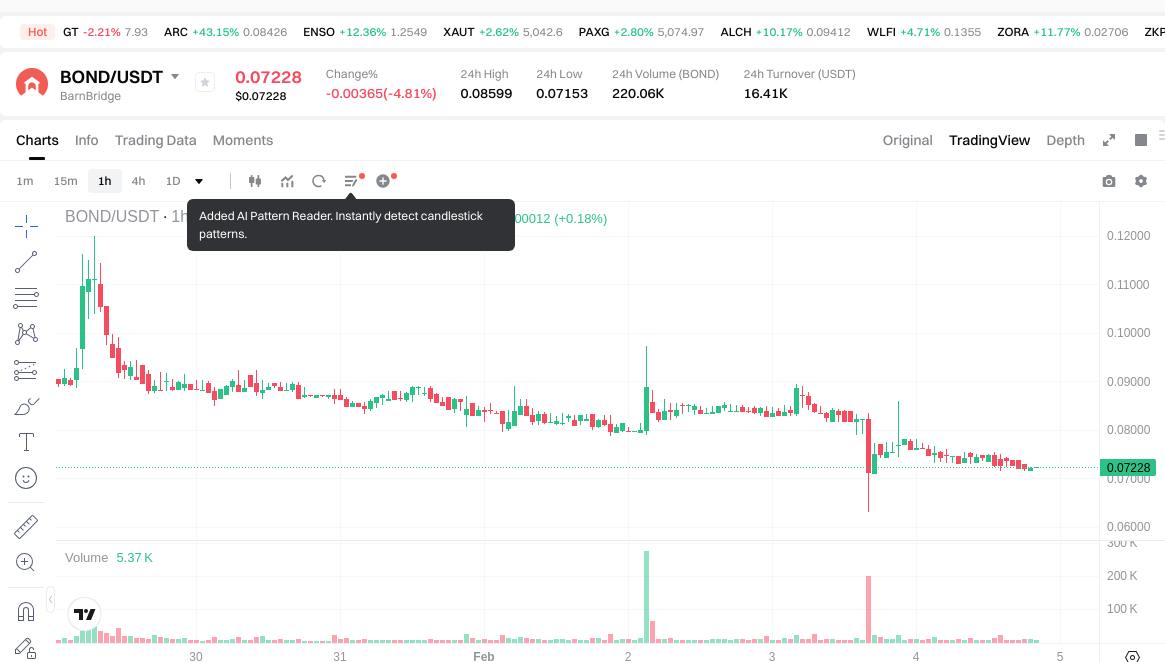
BOND reached its all-time high of $185.69 on October 27, 2020, during a period of strong interest in decentralized finance (DeFi) protocols and volatility derivative products.
The token experienced its all-time low of $0.071852 on February 04, 2026, reflecting broader market conditions and reduced trading activity. Over the past year, BOND has declined by approximately 80.55%, demonstrating significant price volatility influenced by market sentiment, adoption trends, and external factors affecting the DeFi sector.
Recent price movements show:
- 1-hour change: +0.37%
- 24-hour change: -4.95%
- 7-day change: -18.36%
- 30-day change: -34.98%
- 1-year change: -80.55%
These fluctuations reflect evolving market dynamics, participant engagement levels, and the broader cryptocurrency market environment.
Click to view current BOND market price
On-Chain Metrics
- Holder Count: Approximately 16,684 addresses hold BOND tokens, indicating the distribution of token ownership across the community
- 24-Hour Trading Volume: $16,391.33, reflecting current market liquidity and trading activity
- Market Capitalization: $706,138.79, representing the total value of circulating BOND tokens
- Market Cap to FDV Ratio: 97.82%, showing that nearly all tokens are already in circulation
BarnBridge Ecosystem Applications and Partners
Core Use Cases
BarnBridge's ecosystem supports multiple applications:
- DeFi: As a volatility derivatives protocol, BarnBridge provides risk management and yield optimization through tokenized risk tranches.
- Governance: The BOND token enables decentralized governance, allowing holders to vote on protocol updates and strategic decisions.
Strategic Partnerships
BarnBridge operates within the broader Ethereum ecosystem, leveraging ERC-20 standard compatibility to ensure accessibility across exchanges and wallets.
These technical foundations provide a solid basis for BarnBridge's ecosystem expansion.
Controversies and Challenges
BarnBridge faces the following challenges:
- Technical Challenges: As a DeFi protocol, scalability and gas fee optimization on Ethereum remain ongoing considerations
- Market Volatility: The token has experienced significant price fluctuations, with current trading levels substantially below historical peaks
- Competitive Pressure: The emergence of alternative DeFi protocols and risk management solutions creates a dynamic competitive landscape
These issues have sparked discussions within the community and market, driving BarnBridge's continued innovation.
BarnBridge's community demonstrates active participation, with the protocol maintaining 16,684 token holders as of February 2026.
On X platform, discussions around BarnBridge and the hashtag #BOND contribute to ongoing conversations about DeFi innovation.
Community interest is influenced by protocol developments and governance proposals.
Sentiment on X presents varied perspectives:
- Supporters highlight BarnBridge's innovative approach to risk management and decentralized governance, viewing it as a valuable tool for DeFi participants.
- Critics focus on price performance and market conditions, expressing concerns about volatility.
Recent trends reflect the broader market environment affecting DeFi protocols.
Popular Topics
X users discuss BarnBridge's governance mechanisms, risk tranching innovations, and role in the evolving DeFi landscape,
showcasing both its potential for financial innovation and the challenges facing decentralized protocols.
- Official Website: Visit BarnBridge Official Site for features, use cases, and latest updates.
- X Updates: On X platform, BarnBridge maintains an active presence through @barn_bridge, sharing updates on protocol developments, governance initiatives, and community activities.
BarnBridge Future Roadmap
- Ongoing Development: Enhancement of governance mechanisms and protocol security to improve user experience and risk management capabilities
- Ecosystem Goals: Expansion of DeFi applications and integration with emerging blockchain infrastructure
- Long-term Vision: Establishing a robust decentralized risk management framework within the Web3 ecosystem
How to Participate in BarnBridge?
- Purchase Channels: Acquire BOND on Gate.com and other supporting exchanges
- Storage Solutions: Use compatible Ethereum wallets for secure storage
- Participate in Governance: Engage in community decisions through the BarnBridge DAO voting system
- Build Ecosystem: Visit BarnBridge GitHub to contribute code or develop applications
Summary
BarnBridge leverages blockchain technology to redefine risk management in DeFi, offering transparency, decentralized governance, and innovative financial solutions.
Its active community, technical resources, and governance framework position it distinctively within the cryptocurrency landscape.
Despite facing market volatility and competitive pressures, BarnBridge's innovative approach and commitment to decentralization secure its relevance in the future of Web3 technology.
Whether you're a newcomer or experienced participant, BarnBridge presents an interesting case study in DeFi innovation worth following.
FAQ
What is a crypto bond and how does it work?
A crypto bond is a debt security denominated in cryptocurrency, offering higher yields than traditional bonds. Investors lend funds to issuers and receive periodic interest payments in crypto, earning returns on their investment.
What are the differences between crypto bonds and traditional bonds?
Crypto bonds are blockchain-based digital assets offering higher yields but greater volatility and less regulation. Traditional bonds are debt securities from governments or corporations providing stable, fixed returns with established regulatory frameworks and lower risk profiles.
How do you buy and stake crypto bonds?
First, purchase a proof-of-stake cryptocurrency through your preferred platform. Transfer it to a compatible wallet. Then join a staking pool or staking platform to earn rewards. Complete the staking process and start generating passive income from your holdings.
What are the risks and benefits of investing in crypto bonds?
Crypto bonds offer high yield potential and portfolio diversification benefits. However, they carry significant volatility risk, liquidity concerns, and issuer credit risk. Suitable for high-risk tolerance investors seeking enhanced returns.
Which are the most popular crypto bond projects (like Olympus DAO, BarnBridge)?
Popular crypto bond projects include Olympus DAO, BarnBridge, Aave, Compound, and Stargate Finance. These platforms offer decentralized lending, borrowing, and bond mechanisms for cryptocurrency assets and yield generation.
What is the future potential and use cases of crypto bonds in DeFi?
Crypto bonds will enable decentralized lending, borrowing, and yield generation without intermediaries. Future use cases include tokenizing real-world assets, facilitating fractional ownership, and providing liquidity. They will drive financial inclusion and efficiency across DeFi ecosystems.
* The information is not intended to be and does not constitute financial advice or any other recommendation of any sort offered or endorsed by Gate.