Common Protocol is a tokenized AI-native workspace platform launched in 2025 to revolutionize decentralized collaboration and community engagement. The platform serves 3.8 million users across over 50,000 communities, enabling seamless coordination between humans and AI agents while monetizing user-generated content and contributions. Operating on Base network infrastructure, Common Protocol tokenizes communities, projects, and threads as tradable assets, with COMMON tokens facilitating participation, governance, and value exchange. Users earn tokens through contributing ideas, completing bounties, and creating content within a unified environment. As of 2026, COMMON trades at $0.0005098 with a circulating supply of 2.47 billion tokens and market cap of $1.26 million. Available on Gate.com, Common Protocol addresses inefficiencies in siloed platforms while offering unique opportunities for engagement in AI-enhanced, tokenized collaboration.
Common Protocol's Position and Significance
In 2025, the Common Protocol team launched Common Protocol (COMMON), aiming to address inefficiencies in decentralized collaboration, fragmented community engagement, and the lack of monetization mechanisms for user-generated content and contributions.
As a tokenized AI-native workspace platform, Common Protocol plays a key role in collaborative work, community governance, and incentivized content creation.
As of 2026, Common Protocol has become a platform serving 3.8 million users across over 50,000 communities, with an active ecosystem of AI agents and developers.
This article will provide an in-depth analysis of its technical architecture, market performance, and future potential.
Origin and Development History
Background
Common Protocol was created by its founding team in 2025, aiming to solve the challenges of siloed community platforms, limited earning opportunities for contributors, and inefficient coordination between human users and AI agents.
It emerged during the rapid evolution of AI integration in blockchain ecosystems, with the goal of enabling seamless collaboration, trading, and monetization within tokenized communities to transform existing paradigms.
Common Protocol's launch brought new possibilities for decentralized communities, developers, and content creators.
Key Milestones
- 2025: Platform launch, enabling tokenization of communities, projects, and threads with integrated AI agent support.
- October 2025: Token reached a notable price level, marking increased market recognition and trading activity.
- 2026: Continued ecosystem expansion with growing user adoption and community formation across diverse sectors.
With support from its community and foundation, Common Protocol continues to optimize its technical infrastructure, security measures, and real-world applications.
How Common Protocol Works
Decentralized Infrastructure
Common Protocol operates as a tokenized workspace where communities, projects, and discussions are represented as tradable assets.
The platform enables 3.8 million users and their AI agents to collaborate without centralized control, fostering transparency and user autonomy across over 50,000 communities.
Blockchain Foundation
Common Protocol utilizes blockchain technology to maintain transparent records of tokenized assets, transactions, and community activities.
Token contracts are deployed on the Base network, providing secure and verifiable ownership of community tokens and rewards.
The platform's architecture supports research, trading, code development, and bounty programs within a unified environment.
Token Economics
COMMON tokens facilitate participation, governance, and value exchange within the ecosystem.
Users earn tokens through contributing ideas, completing bounties, creating content, and participating in community activities.
The tokenization model enables direct monetization of contributions and transparent reward distribution.
Security and Access
Common Protocol employs cryptographic mechanisms to secure user assets and transaction data:
- Private keys control access to tokenized assets and wallets
- Smart contracts automate reward distribution and governance processes
The platform integrates with Base network infrastructure to ensure transaction security and asset integrity while maintaining user privacy.
Users can access the platform through Gate.com and other supporting exchanges for token trading and liquidity.
Circulation Overview
As of February 3, 2026, COMMON has a circulating supply of 2,477,716,754 tokens, with a total supply of 12,418,259,242 tokens.
The current circulation ratio stands at approximately 19.95%, indicating that a significant portion of the total supply remains to be released into the market over time.
This gradual release mechanism may influence the token's supply-demand dynamics as the project develops and expands its user base.
Price Volatility
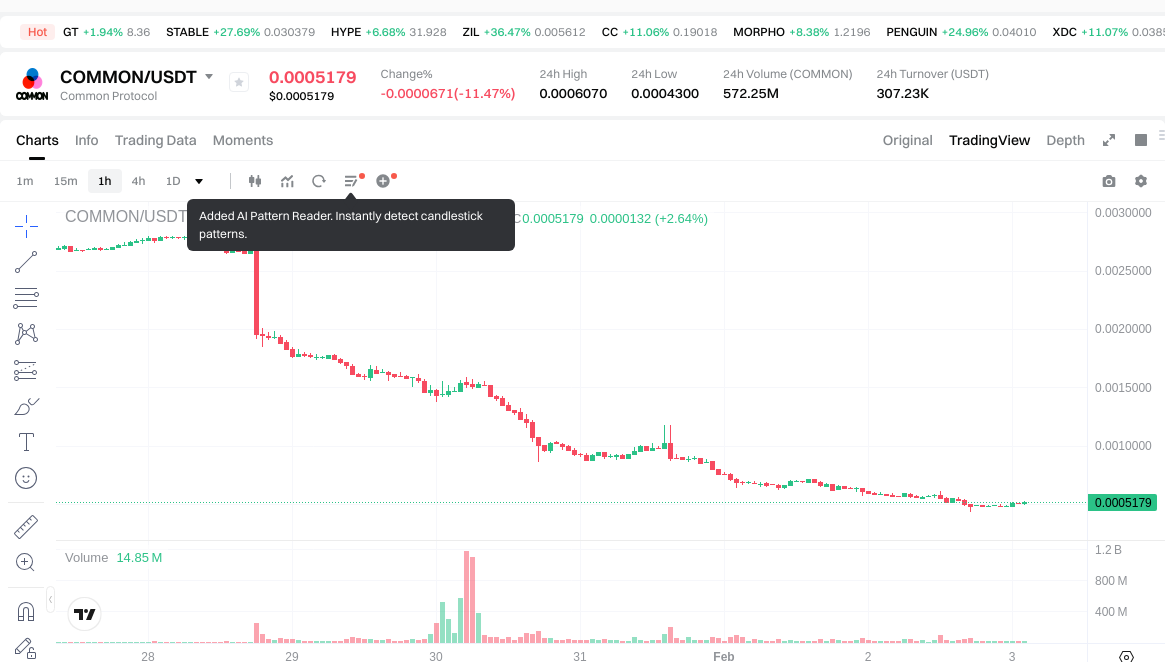
COMMON reached a notable price level of $0.0412 on October 27, 2025, driven by early market interest and adoption momentum.
The token experienced its lowest recorded price of $0.00043 on February 2, 2026, reflecting recent market pressures and broader volatility in the cryptocurrency sector.
As of the latest data, COMMON is trading at $0.0005098, showing a decline of 15.21% over the past 24 hours, 81.23% over the past 7 days, and 84.98% over the past 30 days.
These fluctuations illustrate the dynamic nature of market sentiment, adoption trends, and external factors affecting the token's valuation.
Click to view the current COMMON market price
On-Chain Metrics
- 24-Hour Trading Volume: Approximately $305,484.97 (indicating active market participation)
- Holder Addresses: 3,554 addresses (reflecting the current user engagement level)
- Market Capitalization: $1,263,140 (representing the circulating supply's market value)
- Fully Diluted Valuation: $6,330,828.56 (projecting potential market cap at full token circulation)
Common Protocol Ecosystem Applications and Partners
Core Use Cases
Common Protocol's ecosystem supports multiple applications:
- AI-Native Collaboration: The platform enables 3.8 million users across 50,000+ communities to conduct deep research, trade, and collaborate with AI agents in a unified workspace.
- Tokenized Communities: Every community, project, and thread is tokenized, allowing users and AI agents to earn from ideas, bounties, and feature requests.
Strategic Collaborations
Information regarding specific strategic partnerships was not available in the provided materials. Common Protocol continues to build its technological capabilities and market presence through its AI-native workspace infrastructure.
Challenges
Common Protocol faces the following challenges:
- Market Volatility: The token has experienced significant price fluctuations, with a 7-day decline of 81.23% and a 30-day decline of 84.98%.
- Competition Pressure: The blockchain and AI collaboration space faces competition from other emerging platforms in the decentralized technology sector.
These issues have sparked discussions within the community and market, driving Common Protocol's continuous innovation.
Common Protocol's community demonstrates notable activity, with a network spanning 3.8 million users across more than 50,000 communities. The platform has 3,554 holders and maintains active presence on social platforms.
On X platform, sentiment regarding Common Protocol shows diverse perspectives:
- Supporters praise the platform's innovative approach to AI-native collaboration and tokenized community structure, viewing it as a transformative workspace for decentralized collaboration.
- Market observers focus on price volatility and the challenges of establishing a new tokenization model in competitive markets.
Recent trends indicate market participants are closely monitoring the platform's development and adoption metrics.
Trending Topics
X users discuss Common Protocol's approach to tokenizing communities and enabling AI-agent collaboration, showcasing both its innovative potential and the challenges of mainstream adoption in the AI-native workspace sector.
- Official Website: Visit Common Protocol Official Site for features, use cases, and latest updates.
- White Paper: Common Protocol White Paper details its technical architecture, objectives, and vision.
- X Updates: On X platform, Common Protocol maintains an active presence at @commondotxyz, sharing updates on platform development, community activities, and ecosystem growth.
- Community Hub: Join discussions on Discord to connect with the community.
How to Participate in Common Protocol?
- Purchase Options: Common Protocol (COMMON) is available on Gate.com and other supported exchanges.
- Storage Solutions: Use compatible wallets that support Base network tokens for secure storage (contract address: 0x4c87da04887a1f9f21f777e3a8dd55c3c9f84701).
- Ecosystem Building: Visit the official documentation to explore opportunities for contributing to the platform's development.
- Community Engagement: Participate in discussions across 50,000+ tokenized communities on the platform.
Summary
Common Protocol introduces an innovative approach to digital collaboration by creating an AI-native workspace where communities, projects, and threads are tokenized. The platform serves 3.8 million users across diverse communities, offering capabilities for research, trading, coding, and earning from ideas and bounties.
Its tokenization model and AI-agent integration distinguish it in the decentralized technology landscape. While facing market volatility and adoption challenges, Common Protocol's innovative framework and expanding user base position it as a noteworthy platform in the evolution of collaborative workspaces.
Whether you are new to decentralized platforms or an experienced participant, Common Protocol offers unique opportunities for engagement in tokenized, AI-enhanced collaboration.
FAQ
What is Crypto COMMON and what is its main purpose?
Crypto COMMON is a cryptocurrency standard designed to enable secure, transparent, and decentralized digital transactions. It leverages cryptographic technology to ensure transaction integrity and security across blockchain networks.
How can I buy or acquire COMMON tokens?
Purchase COMMON tokens through decentralized exchanges or peer-to-peer platforms. You can also earn tokens through staking, liquidity mining, or participating in community rewards programs.
What blockchain network does COMMON operate on?
COMMON operates on the Binance Smart Chain. It supports trading, staking, and governance functions within its ecosystem.
What are the risks and benefits of investing in COMMON?
Benefits include potential high returns, community governance participation, and early-stage growth opportunity. Risks involve market volatility, liquidity constraints, and regulatory uncertainty in crypto markets.
How does COMMON compare to other similar cryptocurrencies or tokens?
COMMON is a native blockchain cryptocurrency offering direct exchange medium and store of value, while most tokens are utilities built on existing blockchains. COMMON provides independent network infrastructure with superior transaction efficiency and lower fees compared to token-based alternatives.
What is the total supply and tokenomics of COMMON?
COMMON's total supply is 100,000,000 CMN tokens. Distribution: 20% airdrops, 15-25% farms and incentives, 15% treasury, 7% team, 7% liquidity, 7% marketing, and 9% CEX listings.
Where can I store and manage COMMON tokens securely?
Store COMMON tokens in hardware wallets like Ledger or Trezor for maximum security. Alternatively, use reputable non-custodial wallets with private key control. Enable multi-factor authentication and keep recovery phrases offline.
* The information is not intended to be and does not constitute financial advice or any other recommendation of any sort offered or endorsed by Gate.