What is CREDI: A Comprehensive Guide to Credit Risk Assessment and Management Systems


Credefi's Positioning and Significance
In 2021, the Credefi team launched Credefi (CREDI), aiming to address the financing gap faced by small and medium-sized enterprises (SMEs) in the real economy and the underutilization of crypto liquidity. As an alternative lending FinTech solution bridging Traditional Finance (TradFi) and Decentralized Finance (DeFi), Credefi plays a key role in connecting crypto lenders with SME borrowers backed by real-world assets.
As of 2026, Credefi has established itself as a pioneering platform in the alternative financing sector, with an active community of 3,647 holders and ongoing development. This article will provide an in-depth analysis of its technical architecture, market performance, and future potential.
Origin and Development Journey
Genesis Background
Credefi was created by its founding team in 2021, aiming to solve the persistent financing challenges faced by one-third of SMEs in the EU despite abundant unutilized crypto liquidity. It emerged during the expansion of decentralized finance and growing interest in real-world asset (RWA) integration, with the goal of providing stable and predictable returns to crypto lenders while offering reliable loans to SME borrowers through real-world asset backing to transform the status quo. Credefi's launch brought new possibilities for SMEs in Europe, where 99% of businesses fall into this category.
Important Milestones
- 2021: Platform launch and token deployment on Ethereum, establishing the connection between crypto lenders and real economy borrowers.
- Ongoing: Expansion of loan portfolio backed by various real-world assets including real estate and future receivables.
- Development: Continued platform optimization to facilitate lending processes between Traditional Finance and Decentralized Finance ecosystems.
With support from its development team and community, Credefi continues to refine its technology, security measures, and real-world applications.
How Does Credefi Work?
No Central Control
Credefi operates on a decentralized network utilizing blockchain technology, removing reliance on traditional financial intermediaries. The platform facilitates direct connections between crypto lenders and SME borrowers, ensuring transparency through smart contract execution and reducing counterparty risk by leveraging real-world asset collateral.
Blockchain Core
Credefi's infrastructure is built on the Ethereum blockchain, utilizing an ERC20 token standard for the CREDI token. Transactions and lending agreements are recorded on this public, immutable digital ledger, providing transparency and verifiability. Anyone can audit the on-chain activities, establishing trust without intermediaries through the contract address 0xae6e307c3fe9e922e5674dbd7f830ed49c014c6b. This architecture ensures that all lending operations maintain cryptographic security and transparency.
Ensuring Fairness
Credefi leverages Ethereum's Proof of Stake consensus mechanism to validate transactions and maintain network integrity. Ethereum validators secure the network through staking ETH and validating blocks, ensuring that all CREDI transactions are processed securely. The platform's innovation includes bridging traditional finance with DeFi through real-world asset backing, creating a symbiotic relationship that addresses deficiencies in both segments.
Secure Transactions
Credefi utilizes public-private key cryptography to protect transactions:
- Private keys (similar to secret passwords) are used to sign and authorize transactions
- Public keys (similar to account numbers) are used to verify ownership and receive tokens
This mechanism ensures fund security while transactions maintain pseudonymous characteristics typical of blockchain systems. The platform incorporates additional security measures through smart contract auditing and real-world asset verification processes to protect both lenders and borrowers.
Credefi's Market Performance
Circulating Supply Overview
As of February 03, 2026, Credefi's circulating supply is 748,573,880 tokens, with a total supply of 939,978,336 tokens and a maximum supply capped at 1,000,000,000 tokens. The current circulating supply represents approximately 74.86% of the total supply, indicating a substantial portion of tokens are already in circulation. The token follows a fixed supply model with a predetermined maximum cap, which may influence long-term scarcity dynamics.
Price Volatility
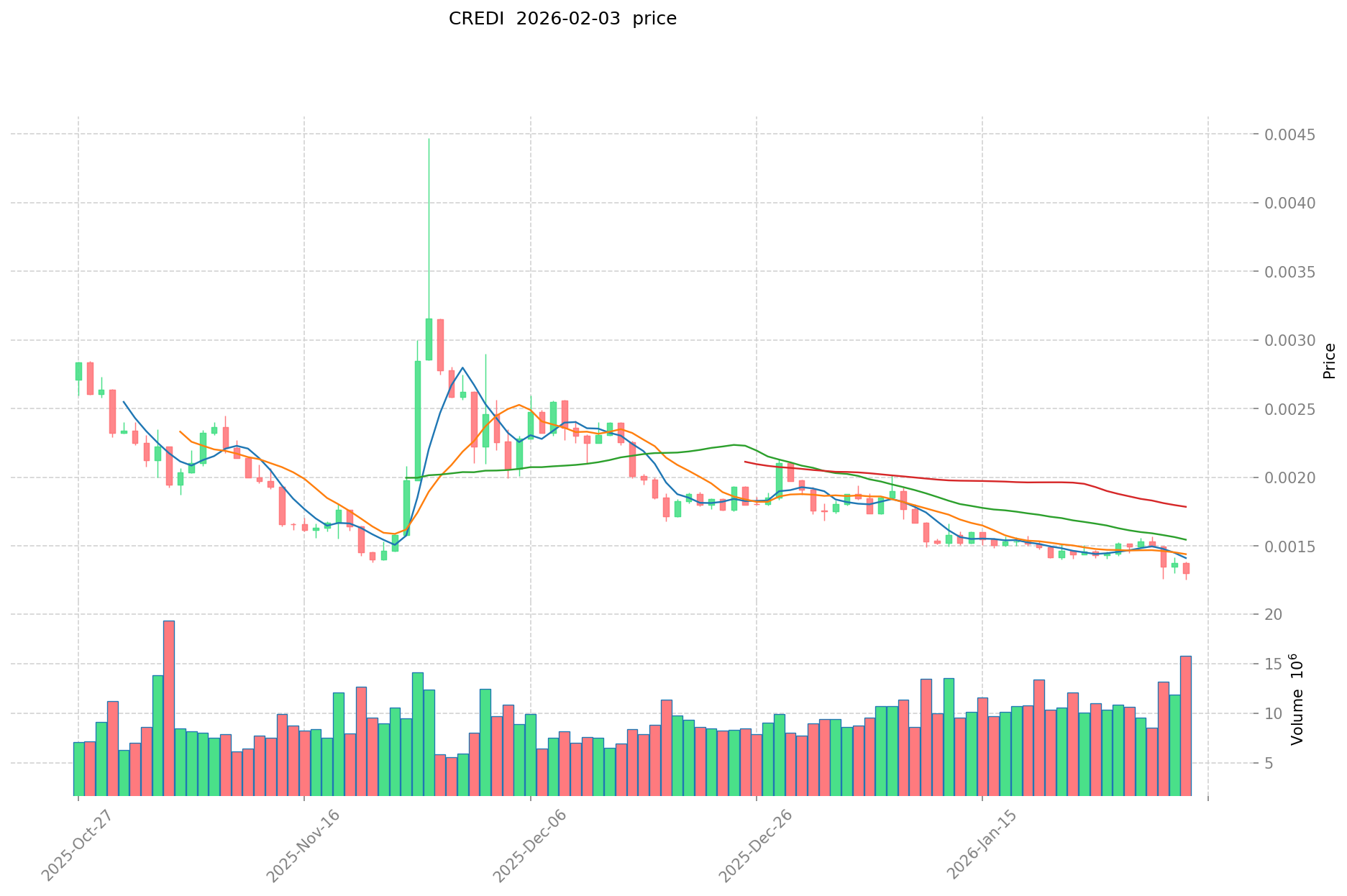
Credefi reached its all-time high price of $0.03456 on May 22, 2024, driven by favorable market conditions during that period. Its lowest price of $0.001255 occurred on February 02, 2026, reflecting recent market pressures and broader cryptocurrency sector challenges. Over the past year, the token has experienced an 84.28% decline, with a 30-day decrease of 28.83% and a 7-day drop of 9.82%. These fluctuations reflect evolving market sentiment, adoption trends, and external factors affecting the alternative lending and DeFi sectors.
Click to view the current CREDI market price
On-Chain Metrics
- Holder Count: 3,647 addresses (indicating community distribution and engagement)
- Market Capitalization: $991,111.82 (reflecting current market valuation)
- 24-Hour Trading Volume: $21,185.48 (showing active trading activity)
Credefi Ecosystem Applications and Partners
Core Use Cases
Credefi's ecosystem supports multiple applications:
- Alternative Lending: Credefi platform provides decentralized lending services connecting crypto lenders with SME borrowers, offering loans backed by real-world assets including real estate and future receivables.
- Real Economy Integration: The platform enables stable and predictable returns for lenders generated from the real economy, addressing financing gaps for small and medium-sized enterprises.
Strategic Partnerships
Credefi focuses on bridging Traditional Finance (TradFi) and Decentralized Finance (DeFi) through its innovative lending platform. These partnerships and collaborations provide a solid foundation for Credefi's ecosystem expansion.
Challenges and Controversies
Credefi faces the following challenges:
- Market Volatility: Price declined approximately 84.28% over the past year, with trading at $0.001324 as of February 03, 2026
- Regulatory Considerations: Operating in the alternative lending space requires navigating regulatory frameworks across different jurisdictions
- Competition Pressure: The emergence of other blockchain-based lending platforms in the DeFi space
These issues have sparked discussions within the community and market, while also driving Credefi's continuous innovation.
Credefi Community and Social Media Atmosphere
Community Engagement
Credefi's community shows notable activity, with approximately 3,647 token holders. The platform maintains an active presence on social media, particularly on X (formerly Twitter), where discussions about bridging crypto liquidity with real economy financing needs generate interest. Developments in alternative lending and DeFi-TradFi integration continue to engage the community.
Social Media Sentiment
Sentiment on X demonstrates diverse perspectives:
- Supporters praise Credefi's innovative approach to connecting unused crypto liquidity with SME financing needs, recognizing its potential to address funding gaps for European small and medium-sized enterprises.
- Critics focus on price volatility and market performance concerns, particularly given the significant price decline from the all-time high.
Recent trends reflect mixed sentiment influenced by broader market conditions and project developments.
Trending Topics
X users actively discuss Credefi's alternative lending model, real-world asset backing, and the challenge of bridging traditional and decentralized finance, showcasing both its transformative potential and the obstacles in achieving mainstream adoption.
Credefi Additional Information Sources
- Official Website: Visit Credefi Official Website for features, use cases, and latest updates.
- Whitepaper: Credefi Whitepaper details its technical architecture, objectives, and vision.
- X Platform: Credefi maintains an active presence on X at @credefi_finance, with posts covering platform developments, community activities, and lending ecosystem updates, generating engagement from the community.
Credefi Future Roadmap
- Ongoing Development: Continuing to enhance the alternative lending platform, improving connections between crypto lenders and SME borrowers
- Ecosystem Goals: Expanding the range of real-world assets available for loan collateralization and increasing SME participation
- Long-term Vision: Becoming a leading bridge between traditional finance and decentralized finance in the alternative lending sector
How to Participate in Credefi?
- Purchase Options: Buy CREDI on Gate.com and other supported exchanges
- Storage Solutions: Use compatible Ethereum wallets such as MetaMask or hardware wallets to securely store CREDI tokens
- Platform Engagement: Explore lending and borrowing opportunities through the Credefi platform
- Community Involvement: Follow official channels and participate in community discussions about platform development
Summary
Credefi is redefining alternative lending through blockchain technology, offering transparent, secure, and efficient financing solutions for SMEs backed by real-world assets. Its innovative approach to bridging TradFi and DeFi, combined with focus on addressing European SME financing gaps, positions it uniquely in the cryptocurrency space. Despite facing market volatility and regulatory considerations, Credefi's innovative model and clear mission to connect unused crypto liquidity with real economy needs make it a noteworthy project in decentralized finance. Whether you are new to crypto lending or an experienced participant, Credefi offers an interesting approach to alternative financing worth exploring.
FAQ
What is CREDI token and how does it work?
CREDI token is a blockchain-based digital asset designed to facilitate decentralized credit and lending services. It operates on smart contracts, enabling peer-to-peer transactions, collateralized borrowing, and yield generation. CREDI holders can participate in governance decisions and earn rewards through staking mechanisms.
What are the main use cases and features of CREDI?
CREDI enables decentralized credit scoring, lending protocols, and financial verification on blockchain. Key features include transparent credit assessment, peer-to-peer lending, smart contract automation, and access to decentralized finance opportunities without traditional intermediaries.
How can I buy and store CREDI tokens?
Purchase CREDI tokens by swapping other cryptocurrencies using decentralized exchange tools. Store them securely in a compatible Web3 wallet that supports the token's blockchain network. Confirm transactions on-chain before completion.
What is the tokenomics and total supply of CREDI?
CREDI has a total supply of 1 billion tokens. The tokenomics are designed to support sustainable growth and value distribution within the ecosystem.
What are the risks and security considerations for CREDI?
CREDI faces risks including smart contract vulnerabilities, wallet security threats, and market volatility. Users should employ strong password protection, enable two-factor authentication, use hardware wallets, and conduct thorough research before transactions to mitigate potential security concerns effectively.
Which exchanges support CREDI trading?
CREDI is available on major cryptocurrency platforms including Coinbase, Binance.com, and KuCoin. Additional exchanges may also support CREDI trading.
What is the team and project background behind CREDI?
CREDI is a credit data management project focused on enhancing financial transparency and accuracy. It aims to streamline credit reporting processes and improve data integrity within the financial ecosystem.
Share
Content
Credefi's Positioning and Significance
Origin and Development Journey
How Does Credefi Work?
Credefi's Market Performance
Credefi Ecosystem Applications and Partners
Challenges and Controversies
Credefi Community and Social Media Atmosphere
Credefi Additional Information Sources
Credefi Future Roadmap
How to Participate in Credefi?
Summary
FAQ
How to Buy Cryptocurrency


Trending Cryptocurrencies



What will be the market capitalization of USDC in 2025? Analysis of the stablecoin market landscape.

How is DeFi different from Bitcoin?
What is DeFi: Understanding Decentralized Finance in 2025

USDC stablecoin 2025 Latest Analysis: Principles, Advantages, and Web3 Eco-Applications

Development of Decentralized Finance Ecosystem in 2025: Integration of Decentralized Finance Applications with Web3
2025 USDT USD Complete Guide: A Must-Read for Newbie Investors
Best Crypto Trading Bots for Automated Trading

Top 5 Tokens Recommended for DeFi Investment

What is Crypto? How to Explain Cryptocurrency to a Child

What Is a Crypto Scam? Common Fraud Schemes and How to Protect Yourself

How do derivatives market signals like funding rates and open interest predict crypto price movements in 2026?