What is CSPR: A Comprehensive Guide to Casper Network's Native Cryptocurrency

Casper (CSPR) Research Report
Casper's Positioning and Significance
Casper (CSPR) is a Proof-of-Stake Layer-1 blockchain designed to bring real-world assets on-chain. Launched on mainnet in March 2021, Casper provides infrastructure for tokenized assets, featuring upgradable smart contracts, protocol-level access control, and native support for multiple virtual machines (VMs).
As a Layer-1 blockchain prioritizing enterprise adoption and developer accessibility, Casper plays a crucial role in enabling real-world asset tokenization and enterprise workflows. The network addresses critical challenges in bringing regulated assets and traditional business processes onto blockchain infrastructure while maintaining regulatory compliance and operational efficiency.
As of December 2025, Casper has established itself as an emerging infrastructure project with a market capitalization of approximately $64.5 million, 13.68 billion circulating tokens, and presence across 13 exchanges including Gate.com. The project maintains an active developer community focused on building production-grade blockchain applications for enterprise use cases.
This report provides a comprehensive analysis of Casper's technical architecture, consensus mechanism, market performance, and strategic positioning within the broader blockchain ecosystem.
Origin and Development History
Founding Background
Casper was created to address the fundamental challenge of bringing real-world assets onto blockchain infrastructure while maintaining the security, finality guarantees, and governance structures required by financial institutions and regulated enterprises. The project emerged during a period of growing blockchain maturity, when the industry recognized that pure decentralization needed to be balanced with practical requirements for institutional adoption, regulatory compliance, and enterprise workflows.
The network's launch reflected a strategic vision to move beyond purely speculative cryptocurrency use cases toward infrastructure supporting tokenized assets, financial transactions, and regulated digital economies. Casper aimed to provide the technical foundation that traditional finance and enterprises required to securely participate in blockchain networks.
Major Milestones
-
March 2021: Mainnet launch, establishing Casper as a functional Layer-1 blockchain with core consensus mechanisms and smart contract capabilities.
-
Ongoing Development: Continuous optimization of the Zug Consensus protocol to enhance finality guarantees and transaction throughput for enterprise applications.
-
Multi-VM Architecture: Implementation of native support for multiple virtual machines operating in parallel, allowing diverse applications to run on the same chain without requiring rollups or Layer-2 solutions.
-
Developer Ecosystem Growth: Expansion of SDK support across mainstream programming languages including Rust, WebAssembly (WASM), JavaScript, Python, and Go, enabling broader developer adoption.
Under the guidance of its development team and community, Casper continues to optimize its technical infrastructure, security mechanisms, and real-world application potential.
How Casper Works?
Decentralized Network Architecture
Casper operates on a globally distributed network of independent validator nodes, eliminating dependence on centralized intermediaries such as banks or financial institutions. These validators collaborate to verify and record transactions, ensuring the system remains transparent, resistant to censorship, and inherently resistant to single points of failure. This decentralized structure empowers users with greater autonomy while simultaneously enhancing the network's overall resilience and security.
Blockchain Foundation
Casper's blockchain functions as a public, immutable digital ledger that permanently records all transactions on the network. Transactions are grouped into blocks, which are cryptographically linked together through secure hash functions, creating an unbreakable chain of records. This transparent design allows any participant to independently verify the complete transaction history without relying on intermediaries or trusted third parties, thereby establishing verifiable consensus.
Zug Consensus Mechanism
Casper operates on Zug Consensus, a deterministic consensus protocol that provides instant finality for transactions. This mechanism is particularly crucial for:
- Financial transactions requiring immediate settlement certainty
- Regulated assets necessitating precise transaction finality guarantees
- Enterprise workflows where transactional certainty is non-negotiable
The protocol ensures that once a transaction is confirmed, it cannot be reversed or altered, providing the immutability guarantees essential for institutional and regulatory compliance scenarios.
Security Through Cryptography
Casper employs advanced cryptographic technologies to secure all transactions:
- Private Key: Functions as a secret credential used to digitally sign transactions and authorize asset transfers
- Public Key: Operates as a publicly shareable identifier used to verify transaction authenticity and receive funds
- Cryptographic Verification: Ensures that only the legitimate owner of private keys can authorize transactions, preventing unauthorized access or double-spending
This cryptographic architecture ensures that user funds remain secure while enabling transparent, verifiable transaction validation across the decentralized network.
Multi-Virtual Machine Support
Casper distinguishes itself as among the first Layer-1 networks to natively support multiple virtual machines operating in parallel on the same chain. This architecture enables:
- Application diversity: Programs with different technical requirements can operate natively without architectural compromises
- Interoperability: Different execution environments can interact directly on the base layer
- Scalability: Parallel VM execution improves overall network throughput
This design eliminates the need for rollups or separate Layer-2 solutions for applications with specific technical needs.
Market Performance and Token Data
Current Market Metrics (December 18, 2025)
Price and Valuation:
- Current Price: $0.004553
- Market Capitalization: $62.30 million
- Fully Diluted Valuation: $64.50 million
- Circulating Supply: 13.68 billion CSPR (96.59% of total supply)
- Total Supply: 14.17 billion CSPR
- Market Ranking: #442 by market capitalization
24-Hour Trading Activity:
- 24-Hour Volume: $144,530.48
- 24-Hour Price Change: -6.12%
- 24-Hour High: $0.004858
- 24-Hour Low: $0.004501
Historical Price Performance
- All-Time High (ATH): $1.3633 (May 12, 2021)
- All-Time Low (ATL): $0.004526 (December 18, 2025)
- 1-Hour Change: -1.02%
- 7-Day Change: -16.93%
- 30-Day Change: -30.18%
- 1-Year Change: -75.97%
- Launch Price: $0.0094 (March 2021)
Network Adoption Metrics
- Total Token Holders: 344,824 addresses
- Exchange Listing: Available on 13 exchanges including Gate.com
- Market Dominance: 0.0020% of total cryptocurrency market
Risk Factors and Market Challenges
The current market data reflects significant challenges facing the Casper network:
-
Declining Price Momentum: Year-to-date performance shows a -75.97% decline from initial launch levels, indicating substantial headwinds in investor sentiment and market adoption.
-
Limited Trading Volume: The 24-hour volume of $144,530 relative to market capitalization suggests relatively low liquidity and trading activity.
-
Competitive Pressure: The Layer-1 blockchain ecosystem remains highly competitive, with established networks commanding substantially larger market capitalizations and developer communities.
-
Regulatory Uncertainty: The enterprise and regulated asset focus requires ongoing adaptation to evolving regulatory frameworks globally.
Technical Advantages and Differentiators
Developer-First Approach
Casper prioritizes developer accessibility by supporting mainstream programming languages through comprehensive SDKs in Rust, WebAssembly (WASM), JavaScript, Python, and Go. This approach enables millions of developers—not exclusively Web3 specialists—to build production-grade blockchain applications without requiring mastery of obscure or domain-specific tools.
Enterprise-Ready Infrastructure
The combination of Zug Consensus, protocol-level access control, and upgradable smart contracts positions Casper specifically for enterprise and regulated asset applications where institutional trust and compliance requirements are paramount.
Parallel Multi-VM Architecture
Unlike many Layer-1 networks requiring rollups or Layer-2 solutions for diverse application requirements, Casper's native multi-VM support enables heterogeneous execution environments to coexist and interact natively on the base layer.
Conclusion
Casper represents a Layer-1 blockchain specifically architected for enterprise adoption and real-world asset tokenization. Its Zug Consensus mechanism, multi-VM support, and developer-centric design position it distinctly within the blockchain landscape. However, current market metrics indicate the project faces substantial adoption and competitive challenges. Success will depend on demonstrating real-world utility in regulated asset markets and enterprise workflows while building sufficient developer momentum to populate its ecosystem with production applications.
Investors and developers interested in Casper can trade CSPR on Gate.com and explore the ecosystem at https://casper.network/.
Casper's Market Performance
Overview
Casper (CSPR) is a Proof-of-Stake Layer-1 blockchain designed to bring real-world assets on-chain. Launched on mainnet in March 2021, Casper provides infrastructure for tokenized assets with upgradable smart contracts, protocol-level access control, and native support for multiple virtual machines (VMs).
Trading Volume and Market Activity
24-Hour Trading Dynamics
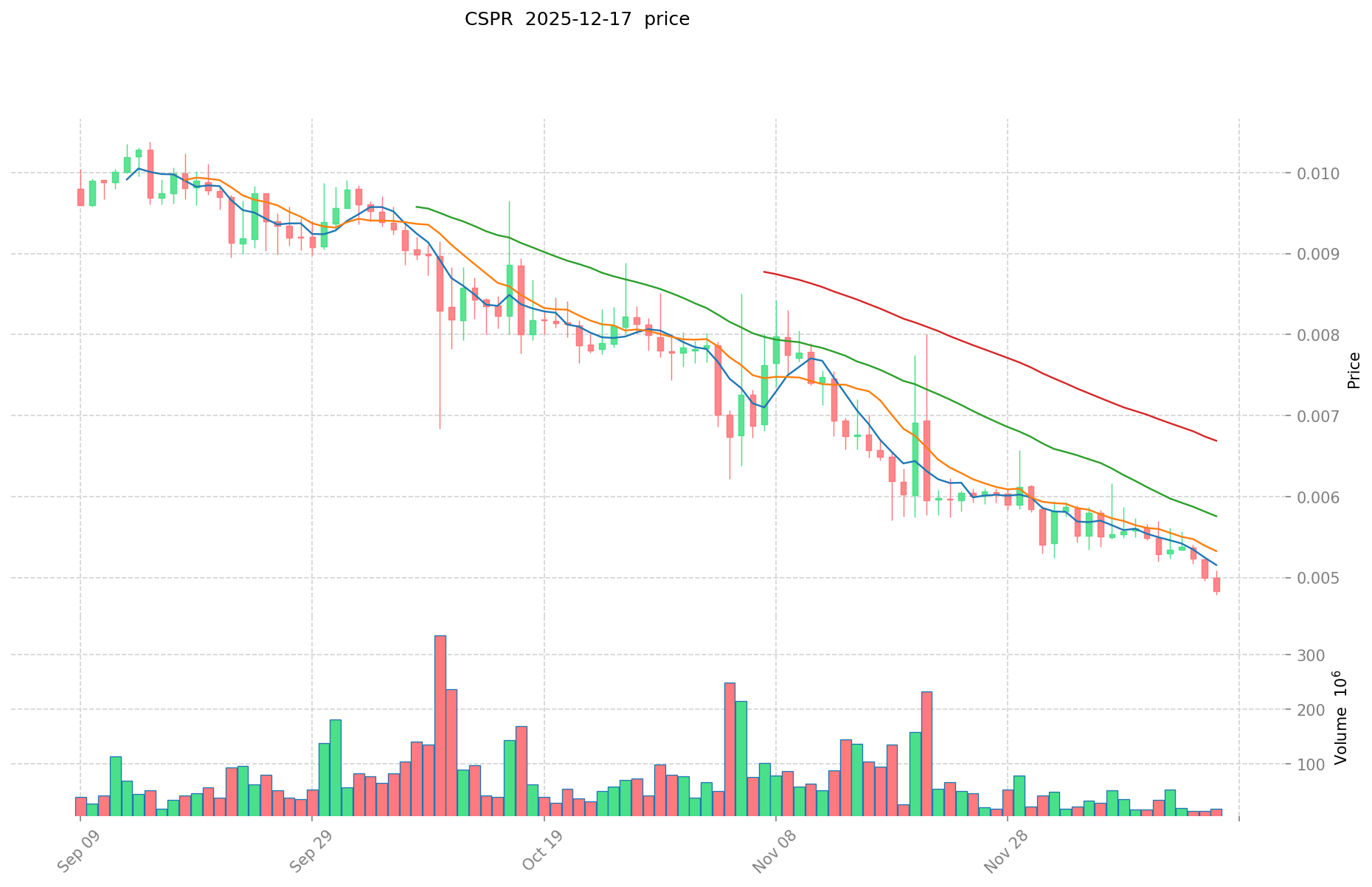
As of December 18, 2025, Casper's 24-hour trading volume stands at $144,530.48, indicating moderate market activity. The token experienced a -6.12% price decline over the past 24 hours, with trading ranging between $0.004501 (24H low) and $0.004858 (24H high).
Price Trends
Casper's recent performance shows significant downward pressure across multiple timeframes:
| Timeframe | Price Change | Amount Change |
|---|---|---|
| 1 Hour | -1.02% | -$0.000047 |
| 24 Hours | -6.12% | -$0.000297 |
| 7 Days | -16.93% | -$0.000928 |
| 30 Days | -30.18% | -$0.001968 |
| 1 Year | -75.97% | -$0.014394 |
Circulating Supply Overview
As of December 18, 2025, Casper's circulating supply is 13,683,040,211 CSPR tokens, representing 96.59% of the total supply of 14,166,419,281 tokens. The maximum supply is infinite, indicating an inflationary model where new tokens enter circulation through network operations and rewards mechanisms.
Check the current CSPR market price
Price Volatility and Historical Context
All-Time High
Casper reached its all-time high of $1.36330943 on May 12, 2021, shortly after the mainnet launch. This peak was driven by early market enthusiasm and institutional interest in Layer-1 blockchain infrastructure solutions.
Current Market Position
The token's current price of $0.004553 represents a -75.97% decline from its all-time high over the past year, reflecting challenging market conditions and competitive pressures within the Layer-1 blockchain ecosystem.
All-Time Low
Casper's all-time low of $0.004526448412133182 was recorded on December 18, 2025 (today), indicating the token has approached historic lows amid broader market volatility.
Market Capitalization and Valuation
- Market Cap (Circulating): $62,298,882.08
- Fully Diluted Valuation (FDV): $64,499,706.99
- Market Cap to FDV Ratio: 96.59%
- Market Dominance: 0.0020%
- Current Ranking: #442 by market capitalization
Network Activity and Community Metrics
- Token Holders: 344,824 addresses
- Listed on Exchanges: 13 trading venues
- Current Status on Gate.com: Active trading pair available
Community and Resources
- Official Website: https://casper.network/
- Block Explorer: https://cspr.live/
- Twitter: https://twitter.com/Casper_Network
- Reddit Community: https://reddit.com/r/CasperCSPR
- GitHub Repository: https://github.com/casper-network/
- Developer Documentation: https://casper.network/network/developers/getting-started
Casper (CSPR) - Comprehensive Research Report
Executive Summary
Casper is a Proof-of-Stake Layer-1 blockchain designed to bring real-world assets on-chain. Launched on mainnet in March 2021, Casper provides infrastructure for tokenized assets with upgradable smart contracts, protocol-level access control, and native support for multiple virtual machines (VMs). As of December 18, 2025, CSPR trades at $0.004553 with a market capitalization of $62.30 million and a fully diluted valuation of $64.50 million.
Technical Architecture & Key Features
Consensus Mechanism
Casper operates on Zug Consensus, a deterministic protocol offering instant finality. This is crucial for financial transactions, regulated assets, and enterprise workflows, differentiating Casper from other Layer-1 solutions that may experience delayed confirmation times.
Multi-VM Support
Casper is among the first Layer-1 networks to support multiple virtual machines running in parallel. This architecture allows applications with different technical requirements to operate natively on the same chain without relying on rollups or Layer-2 solutions, providing genuine scalability at the base layer.
Developer Experience
Casper prioritizes developer accessibility through:
- Support for Rust and WebAssembly (WASM)
- SDKs in mainstream languages: JavaScript, Python, and Go
- Familiar and modern development environment
- Production-grade blockchain application capabilities without requiring specialized blockchain expertise
Core Infrastructure
- Upgradable smart contracts
- Protocol-level access control
- Native multi-VM architecture
- Focus on enterprise and regulated asset workflows
Market Performance & Tokenomics
Current Pricing & Market Metrics (as of December 18, 2025)
| Metric | Value |
|---|---|
| Current Price | $0.004553 |
| 24-Hour Change | -6.12% |
| 7-Day Change | -16.93% |
| 30-Day Change | -30.18% |
| 1-Year Change | -75.97% |
| Market Capitalization | $62.30 million |
| Fully Diluted Valuation | $64.50 million |
| 24-Hour Volume | $144,530.48 |
| Market Rank | #442 |
Supply Information
| Supply Type | Amount |
|---|---|
| Circulating Supply | 13,683,040,211 CSPR |
| Total Supply | 14,166,419,281 CSPR |
| Maximum Supply | Unlimited |
| Circulation Ratio | 96.59% |
Price History
- All-Time High: $1.36 (May 12, 2021)
- All-Time Low: $0.004526 (December 18, 2025)
- 24-Hour High: $0.004858
- 24-Hour Low: $0.004501
The significant decline from ATH to current price reflects broader market conditions and project-specific challenges that warrant careful analysis.
Token Distribution
Casper maintains 344,824 token holders across 13 exchanges, indicating a decentralized distribution pattern, though the concentration metrics and top holder percentages would require additional analysis to fully assess centralization risks.
Use Cases & Ecosystem
Primary Focus Areas
Real-World Asset Tokenization: Casper's infrastructure is specifically designed for tokenizing real-world assets, making it particularly suited for:
- Regulated financial assets
- Enterprise workflows
- Compliant token issuance
- Cross-border asset transfer
Developer-Centric Applications: The multi-language SDK support and familiar development environment enable rapid deployment of:
- Production-grade blockchain applications
- Cross-VM compatible decentralized solutions
- Enterprise integration applications
Community & Market Sentiment
Active Community
Casper maintains an engaged community across multiple platforms:
- 344,824 CSPR token holders demonstrating genuine network participation
- Active presence on social media platforms including X (formerly Twitter)
- Regular community discussions and development updates
Social Media Presence
- Official Website: https://casper.network/
- X (Twitter): https://twitter.com/Casper_Network
- Reddit: https://reddit.com/r/CasperCSPR
- Explorer: https://cspr.live/
- GitHub: https://github.com/casper-network/
Market Positioning
Market sentiment reflects the challenges the project has faced:
- The 75.97% decline over one year indicates significant headwinds
- Recent downward momentum (-6.12% in 24 hours, -16.93% in 7 days) suggests continued pressure
- Community members balance recognition of technical innovation against price performance concerns
Challenges & Considerations
Market Challenges
Significant Price Decline: The substantial decrease from all-time highs ($1.36 to $0.004553) reflects broader market challenges and potential concerns about competitive positioning or adoption velocity.
Low Trading Volume: Daily trading volume of approximately $144,530 is relatively modest for a Layer-1 blockchain, suggesting limited liquidity and potential difficulties for larger participants.
Competitive Pressure: Casper competes in a crowded Layer-1 landscape with established alternatives offering their own unique value propositions and larger developer communities.
Technical & Operational Considerations
Adoption Uncertainty: While Casper offers distinctive features, achieving significant developer and enterprise adoption remains an open question.
Market Positioning: As a Layer-1 with specific focus on real-world assets and enterprise workflows, Casper must differentiate effectively in a market with numerous alternatives.
How to Access Casper (CSPR)
Trading & Purchasing
CSPR is available for trading on Gate.com and 12 other cryptocurrency exchanges worldwide, providing multiple pathways for market participation.
For current trading pairs, market data, and real-time price information, visit:
Gate.com: https://www.gate.com/ - Offering competitive trading options and market access for CSPR
Information & Resources
-
Official Website: https://casper.network/ - Comprehensive information on project vision, technical specifications, and updates
-
Developer Documentation: https://casper.network/network/developers/getting-started - Technical guides for building on Casper
-
Block Explorer: https://cspr.live/ - On-chain data, validator information, and network statistics
-
Community Engagement:
- X: https://twitter.com/Casper_Network
- Reddit: https://reddit.com/r/CasperCSPR
- GitHub: https://github.com/casper-network/ - Open-source code and developer resources
Investment Considerations
Strengths
- Innovative Architecture: Multi-VM support and Zug Consensus provide technical differentiation
- Developer Focus: Comprehensive language support (Rust, JavaScript, Python, Go) lowers barriers to entry
- Enterprise Positioning: Specific design for regulated assets and enterprise workflows addresses real market needs
- Active Development: Ongoing GitHub activity and community engagement
Risk Factors
- Significant Losses: 75.97% decline over one year requires careful consideration
- Liquidity Constraints: Modest trading volume relative to market cap
- Adoption Questions: Real-world asset tokenization potential remains largely unproven at scale
- Competitive Landscape: Numerous Layer-1 alternatives with established ecosystems
- Market Sentiment: Recent price deterioration may indicate declining investor confidence
Summary
Casper represents an ambitious effort to create a Layer-1 blockchain specifically optimized for real-world asset tokenization and enterprise workflows. Its technical innovations, particularly multi-VM support and Zug Consensus, demonstrate thoughtful architectural design. The commitment to developer accessibility through multi-language SDK support addresses a genuine need in blockchain development.
However, the project faces significant challenges. The dramatic 75.97% annual decline and current modest market capitalization suggest that technical merit alone has not translated into market adoption. Liquidity remains limited, and competitive pressures from established Layer-1 platforms continue.
For Prospective Participants:
- Technical enthusiasts should examine Casper's developer documentation and architectural innovations
- Enterprise stakeholders interested in asset tokenization should evaluate Casper's specific compliance features
- Conservative investors should carefully assess adoption metrics and adoption timeline before participation
- All participants should conduct thorough due diligence given current market performance metrics
Casper's long-term success will depend on demonstrating tangible adoption in enterprise and regulated asset use cases, expanding its developer ecosystem, and effectively differentiating from competitors in an increasingly crowded Layer-1 market.
Report Date: December 18, 2025
Data Source: Gate.com market data and official Casper Network documentation
Disclaimer: This report is for informational purposes only and does not constitute investment advice. Cryptocurrency markets are highly volatile. Conduct your own research before making any investment decisions.
FAQ
What does CSPR coin do?
CSPR powers the Casper blockchain, enabling smart contracts, decentralized applications, and secure network validation. It facilitates transactions, staking, and governance on the Casper platform while providing transaction transparency and distributed ledger functionality.
What is the purpose of CSPR?
CSPR (Casper) enables scalable blockchain infrastructure with proof-of-stake consensus, facilitating secure smart contract deployment and decentralized applications while maintaining network security and reducing energy consumption.
Is CSPR a good investment?
CSPR demonstrates strong potential as a long-term investment. With its innovative blockchain technology and growing ecosystem development, Casper offers compelling opportunities for investors seeking exposure to scalable, proof-of-stake infrastructure with solid fundamentals.
What does CSPR stand for?
CSPR stands for Casper, which is a blockchain platform using a proof-of-stake consensus mechanism. It's designed to provide secure, scalable smart contract functionality for decentralized applications.
Share
Content
Casper's Positioning and Significance
Origin and Development History
How Casper Works?
Market Performance and Token Data
Risk Factors and Market Challenges
Technical Advantages and Differentiators
Conclusion
Overview
Trading Volume and Market Activity
Circulating Supply Overview
Price Volatility and Historical Context
Market Capitalization and Valuation
Network Activity and Community Metrics
Community and Resources
Executive Summary
Technical Architecture & Key Features
Market Performance & Tokenomics
Use Cases & Ecosystem
Community & Market Sentiment
Challenges & Considerations
How to Access Casper (CSPR)
Investment Considerations
Summary
FAQ
How to Buy Cryptocurrency


Trending Cryptocurrencies



XZXX: A Comprehensive Guide to the BRC-20 Meme Token in 2025

Bitcoin Fear and Greed Index: Market Sentiment Analysis for 2025

Top Crypto ETFs to Watch in 2025: Navigating the Digital Asset Boom

5 ways to get Bitcoin for free in 2025: Newbie Guide

Bitcoin Market Cap in 2025: Analysis and Trends for Investors

2025 Bitcoin Price Prediction: Trump's Tariffs' Impact on BTC
Marina Protocol Daily Quiz Answer December 18, 2025

What is ONT: A Comprehensive Guide to Optical Network Terminals and Ontology Blockchain

What is USDP: Understanding the USD Coin Stablecoin and Its Role in Decentralized Finance

What is TRB: A Comprehensive Guide to The Republic of the Blockchain Token
What is BAND: A Comprehensive Guide to Understanding the Decentralized Social Platform