What is DUSK: A Comprehensive Guide to the Emerging Blockchain Platform and Its Native Token
DUSK Network (DUSK) — Comprehensive Analysis Report
DUSK Network's Positioning and Significance
DUSK Network (DUSK) is a decentralized blockchain protocol engineered to provide privacy and transparency solutions for payment, communication, and asset ownership transfer. As a privacy-oriented blockchain platform, DUSK addresses critical pain points in traditional and existing blockchain systems by introducing innovative consensus mechanisms and secure transaction protocols.
Distinguished by its Byzantine-based consensus algorithm (SBA) and Secure Tunnel Switching (STS) mechanism, DUSK Network occupies a unique position within the privacy-focused blockchain ecosystem. The platform enables truly private, fast, and secure transactions while maintaining network transparency and security.
As of December 2025, DUSK Network commands a market capitalization of approximately $20.4 million USD with 500 million tokens in circulation (50% of total supply). The token has garnered support from 15 major cryptocurrency exchanges, including Gate.com, demonstrating institutional recognition of its technological innovations and market viability.
This comprehensive report examines DUSK Network's technical architecture, token economics, market performance, and future potential within the evolving cryptocurrency landscape.
Origin and Development History
Birth and Motivation
DUSK Network was conceived to address fundamental limitations in existing blockchain systems, particularly the insufficient balance between privacy protection and transparent transaction verification. Unlike conventional consensus mechanisms such as Proof of Work (PoW) or Proof of Stake (PoS), DUSK introduced a privacy-oriented Byzantine protocol designed to enable both confidential transactions and network-wide consensus verification.
The project emerged in response to growing demand for blockchain solutions that could serve payment systems, communication networks, and asset ownership verification without requiring centralized intermediaries or sacrificing user privacy. DUSK's architecture reflects a deliberate technological approach to reconcile transparency requirements with individual privacy rights—a fundamental challenge in blockchain adoption.
Technological Foundations
DUSK Network distinguishes itself through two core technological innovations:
-
Byzantine Agreement (SBA): A privacy-oriented consensus mechanism that enables validators to achieve agreement on transaction validity without exposing transaction details to the entire network, departing significantly from traditional consensus approaches.
-
Secure Tunnel Switching (STS): A streaming media mechanism providing truly private transaction channels while maintaining the fast and secure characteristics essential for production blockchain systems.
Key Development Milestones
-
Initial Launch (July 2019): DUSK Network tokens became publicly available, establishing market presence and enabling early community participation.
-
Token Integration: DUSK achieved listing across 15 major cryptocurrency exchanges, broadening accessibility and trading opportunities for market participants.
-
Ecosystem Maturation: Continuous protocol refinement and community expansion solidified DUSK's position as a viable privacy-centric blockchain alternative.
How DUSK Network Operates?
Decentralized Infrastructure
DUSK Network operates on a globally distributed network of independent nodes that maintain the blockchain ledger cooperatively. This decentralized architecture eliminates single points of failure and removes dependency on centralized institutions such as banks or governments. Network participants validate transactions through the Byzantine consensus mechanism, ensuring system integrity without requiring trust in any individual entity.
The distributed nature of DUSK's infrastructure provides enhanced resilience against censorship, technical failures, and regulatory intervention, fundamentally empowering users with greater sovereignty over their financial transactions.
Blockchain Architecture
DUSK Network employs a public, immutable distributed ledger recording every transaction on the network. Transactions are bundled into blocks, with each new block cryptographically linked to its predecessor through hash functions, creating an unbreakable chronological chain. This structure ensures that:
- Transparency: All network participants can independently verify the complete transaction history
- Immutability: Historical records cannot be altered without invalidating all subsequent blocks
- Auditability: Complete transaction audits are possible without reliance on central authorities
The blockchain architecture supports complex transactions and smart contracts, enabling decentralized applications (dApps) deployment while maintaining privacy protections.
Consensus and Network Validation
DUSK Network employs a Byzantine Agreement (SBA) consensus mechanism, fundamentally departing from traditional Proof of Work or Proof of Stake models. Under this system:
- Validators: Network participants operating full nodes participate in consensus procedures
- Consensus Process: Validators cooperatively determine transaction validity and block confirmation without requiring computational proof-of-work or stake-based voting exclusively
- Privacy Preservation: The Byzantine protocol architecture enables validators to verify transactions while protecting transaction confidentiality
- Reward Distribution: Successfully validated blocks generate DUSK token rewards distributed to participating validators
This consensus approach prioritizes both security and privacy, enabling validators to maintain the network's integrity while preserving user transaction confidentiality.
Transaction Security and Privacy
DUSK Network implements cryptographic security measures ensuring transaction integrity and user privacy:
Cryptographic Foundations:
- Private Keys: Cryptographic credentials enabling users to authorize transactions, analogous to unforgeable digital signatures
- Public Keys: Public identifiers enabling other network participants to verify transaction authenticity without accessing private key material
- Digital Signatures: Cryptographic proofs confirming transaction authorization and preventing repudiation
Privacy Mechanisms:
- Transactions employ encryption protocols protecting transaction details from public visibility
- The platform provides enhanced privacy compared to traditional public blockchains while maintaining validator ability to verify transaction legitimacy
- Zero-knowledge proof technologies (as reflected in platform repositories) enable transaction verification without revealing underlying transaction data
This architecture creates a security model balancing transparency requirements with user privacy expectations, addressing fundamental challenges in blockchain adoption for sensitive financial applications.
Token Economics and Use Cases
DUSK Token Utility
The DUSK token functions as the native currency powering the DUSK Network ecosystem with multiple critical roles:
Consensus Participation:
- Network validators stake DUSK tokens to participate in Byzantine consensus procedures
- Staked tokens represent validator commitment to network security and honest behavior
- Validators receive DUSK token rewards proportional to their consensus participation
Transaction Fees:
- Users pay transaction fees in DUSK tokens for payment operations
- Gas fees denominate computational costs for deploying and executing decentralized applications (dApps)
- Fee mechanisms create economic incentives for efficient smart contract design
Governance:
- DUSK token holders will participate in on-chain governance procedures determining protocol evolution and network parameter adjustments
- Governance enables community-driven decision-making regarding platform development priorities
Cross-Chain Exchange:
- DUSK tokens support atomic swap mechanisms enabling exchange with XSC-based tokens
- This interoperability facilitates integration with complementary blockchain systems
Monetary Policy and Supply Structure
DUSK Network implements a carefully calibrated monetary policy designed to sustainably fund network development:
Supply Distribution:
- Total Supply: 1,000,000,000 DUSK tokens
- Circulating Supply: 500,000,000 DUSK tokens (50% of maximum supply)
- Token Release: New tokens are emitted through block rewards as defined by protocol specifications
Reward Allocation:
- Consensus Rewards: The substantial majority of newly emitted DUSK tokens are distributed to consensus validators maintaining network security
- Development Fund: A smaller allocation supports the Technology Development Fund, creating autonomous financing mechanisms for long-term research and development initiatives
- Sustainable Growth: This dual allocation structure enables perpetual network maintenance while funding continuous protocol innovation
This monetary design aligns validator incentives with network security while ensuring adequate resources for technological advancement and competitive feature development.
Market Performance and Valuation Metrics
Current Market Position (As of December 20, 2025)
| Metric | Value |
|---|---|
| Current Price | $0.04085 USD |
| Market Capitalization | $20,425,000 USD |
| Fully Diluted Valuation | $20,425,000 USD |
| Circulating Supply | 500,000,000 DUSK |
| Market Capitalization Rank | #862 |
| 24-Hour Trading Volume | $14,191.12 USD |
| Active Token Holders | 19,282 |
Price Performance and Volatility
Short-Term Movements:
- 1-Hour Change: -1.45% (slight bearish pressure)
- 24-Hour Change: +4.84% (moderate positive momentum)
- 7-Day Change: -11.12% (downward trend)
- 30-Day Change: -43.05% (significant monthly decline)
- 52-Week Range: -78.97% annual decline
Historical Price Extremes:
- All-Time High: $1.09 USD (December 30, 2021)
- All-Time Low: $0.01113274 USD (March 13, 2020)
- Current 24-Hour Range: $0.0388 - $0.04158 USD
Market Analysis
The current price of $0.04085 USD represents approximately 96.25% depreciation from the all-time high of $1.09 USD achieved during the December 2021 cryptocurrency market peak. This significant decline reflects broader market corrections affecting privacy-focused tokens and lower-cap cryptocurrency assets.
However, the token maintains:
- Sustainable trading activity across 15 major exchanges
- A stable holder base of over 19,000 addresses
- Consistent presence on institutional trading platforms including Gate.com
The fully diluted valuation remains equal to market capitalization, indicating that token release schedules have largely completed, with 50% of maximum supply currently in circulation.
Technical Resources and Community
Development Infrastructure
DUSK Network maintains active open-source development initiatives:
Primary Repositories:
- Main Blockchain: dusk-blockchain (Core protocol implementation)
- Cryptographic Libraries: dusk-zerocaf (Zero-knowledge proof and advanced cryptographic implementations)
These repositories enable community audit, contribution, and verification of protocol security and functionality.
Community and Information Resources
- Official Website: https://dusk.network/
- Whitepaper: Available at official DUSK Network documentation portal (v3.0.0)
- Social Media: Active presence on Twitter (@duskfoundation) and Reddit (/r/dusknetwork)
- Blockchain Explorer: Full transaction transparency via Ethereum network explorer (0x940a2db1b7008b6c776d4faaca729d6d4a4aa551)
- Trading Availability: Listed on Gate.com and 14 additional cryptocurrency exchanges
Contract Information
Ethereum Network Integration:
- Token Address: 0x940a2db1b7008b6c776d4faaca729d6d4a4aa551
- Chain: Ethereum (ETH)
- Standard: ERC-20 compatibility enabling integration with Ethereum ecosystem applications
Conclusion
DUSK Network represents a technologically sophisticated approach to reconciling blockchain transparency with user privacy protection through innovative Byzantine consensus mechanisms and secure transaction protocols. The platform's focus on practical privacy solutions, combined with sustainable token economics and active development efforts, positions it as a meaningful contributor to the privacy-focused blockchain ecosystem.
While current market valuations remain significantly below historical highs—reflecting broader cryptocurrency market corrections and competitive pressures within the privacy-focused segment—DUSK Network maintains active development, community engagement, and exchange listing presence. The protocol's technical innovations in Byzantine consensus design and zero-knowledge proofs provide meaningful differentiation from competing privacy platforms.
Investors and users should remain cognizant of the highly volatile nature of cryptocurrency markets, the competitive dynamics within the privacy-focused blockchain space, and the continued regulatory uncertainty surrounding privacy technologies. However, DUSK Network's fundamental technological contributions and commitment to long-term development through its Technology Development Fund suggest meaningful potential for future ecosystem expansion and protocol adoption across financial and communication applications requiring enhanced privacy protection.
DUSK Network Market Performance Report
DUSK Network's Market Performance
Circulation Overview
As of December 20, 2025, DUSK Network has a circulating supply of 500,000,000 DUSK tokens, with a maximum supply capped at 1,000,000,000 tokens. This represents a 50% circulation ratio, indicating that half of the total token supply is currently in circulation.
New tokens enter the market through block rewards distributed by the protocol. According to the tokenomics design, most newly issued DUSK tokens are awarded to consensus participants, while a smaller portion is allocated to the technology development fund, creating an independent funding mechanism for long-term research and development.
Price Volatility
DUSK Network reached its all-time high of $1.09 on December 30, 2021, during the peak of the 2021 cryptocurrency bull market. Conversely, the token hit its lowest price of $0.01113274 on March 13, 2020, during the early crypto market downturn.
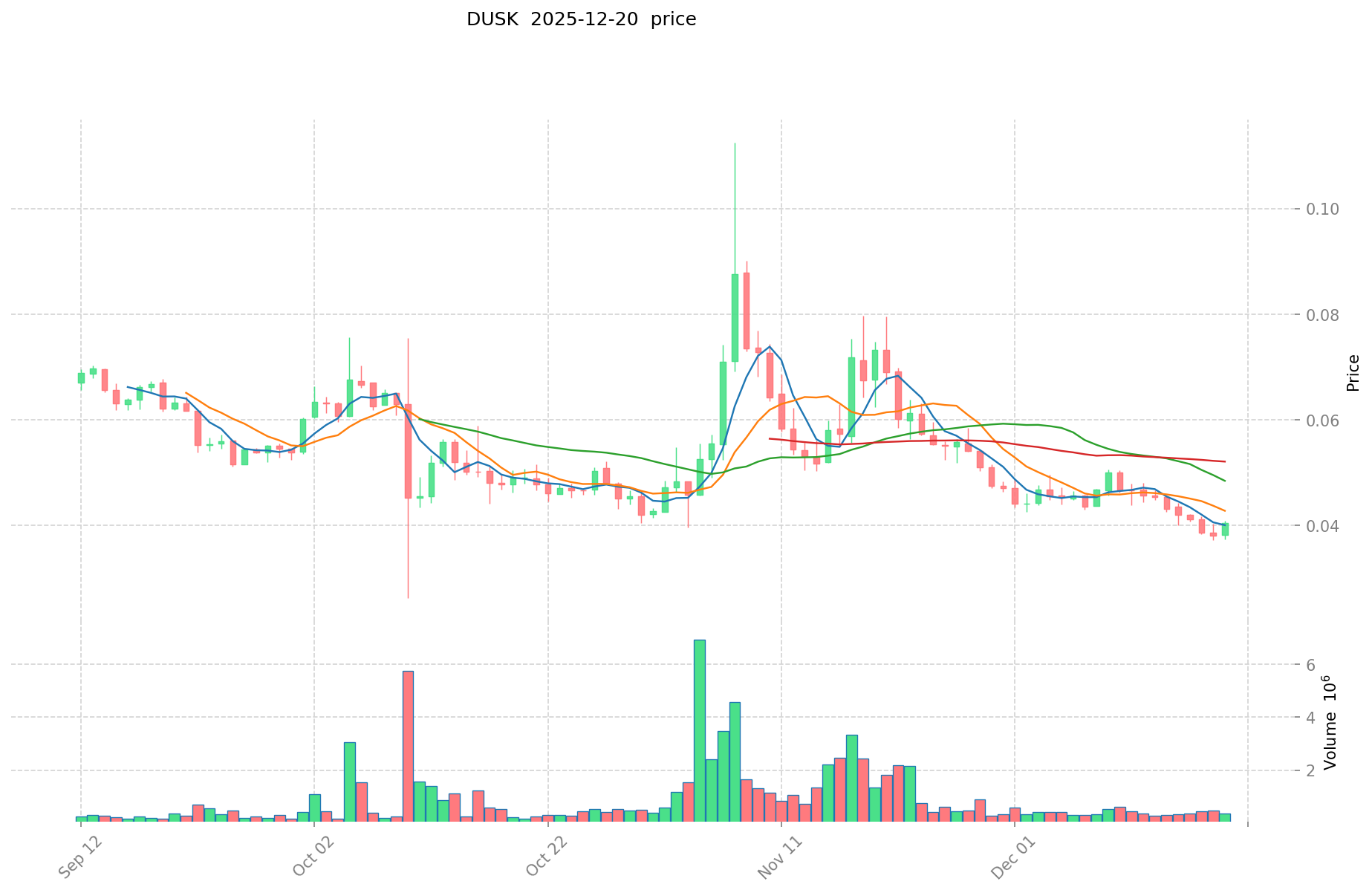
As of the latest update on December 20, 2025, DUSK is trading at $0.04085. Over the past year, the token has experienced significant depreciation of -78.97%, reflecting broader market headwinds and competition within the privacy-focused blockchain sector. More recently, the token declined -43.05% over the past 30 days and -11.12% over the past 7 days, indicating sustained downward pressure.
Check current DUSK market price
Key Market Metrics
| Metric | Value |
|---|---|
| Current Price | $0.04085 |
| 24H Trading Volume | $14,191.12 |
| Market Capitalization | $20,425,000 |
| Fully Diluted Valuation | $20,425,000 |
| Market Dominance | 0.00063% |
| 24H Price Change | +4.84% |
| 1H Price Change | -1.45% |
| Token Holders | 19,282 |
Market Position
DUSK Network ranks #862 by market capitalization among all cryptocurrencies. With a market cap of approximately $20.4 million and a fully diluted valuation of the same amount, the project maintains a modest position in the broader cryptocurrency ecosystem. The token is currently listed on 15 exchanges, including Gate.com, providing reasonable liquidity for traders and investors interested in privacy-focused blockchain solutions.
DUSK Network: Comprehensive Analysis Report
Overview
DUSK Network is a decentralized blockchain protocol that provides privacy and transparency solutions for payment, communication, and asset ownership transfer. As of December 20, 2025, DUSK token is trading at $0.04085, with a market capitalization of $20,425,000 and a circulating supply of 500,000,000 tokens out of a total supply of 1,000,000,000 tokens.
Key Metrics
| Metric | Value |
|---|---|
| Current Price | $0.04085 |
| 24H Change | +4.84% |
| 7D Change | -11.12% |
| 30D Change | -43.05% |
| 1Y Change | -78.97% |
| Market Cap | $20,425,000 |
| 24H Volume | $14,191.12 |
| All-Time High | $1.09 (December 30, 2021) |
| All-Time Low | $0.01113274 (March 13, 2020) |
| Market Rank | #862 |
| Holders | 19,282 |
Technical Architecture
Core Consensus Mechanism
DUSK Network distinguishes itself from conventional blockchain protocols by introducing a privacy-oriented consensus mechanism called Byzantine Secure Agreement (SBA). This approach differs fundamentally from traditional Proof-of-Work (PoW) or Proof-of-Stake (PoS) models, prioritizing privacy and security in the consensus process.
Privacy Infrastructure
The protocol implements Secure Tunnel Switching (STS), a fast and secure streaming mechanism that ensures true privacy for transactions. This technical innovation positions DUSK Network as a privacy-focused blockchain infrastructure.
DUSK Token Utility
The DUSK token serves multiple critical functions within the ecosystem:
- Staking & Consensus Participation: Users can stake DUSK tokens to participate in network consensus and earn block rewards.
- Transaction Fees: DUSK is used for payment of transaction costs.
- Smart Contract Deployment: Developers use DUSK to deploy decentralized applications (dApps) and pay for computational gas.
- Governance: Once activated, DUSK tokens will facilitate on-chain governance within the Xelis Smart Contracts (XSC) framework.
- Rewards Distribution: Consensus participants receive newly issued DUSK tokens as block rewards, with the majority of emissions directed to network validators and a portion allocated to the Technology Development Fund for long-term research and development initiatives.
Ecosystem Integration
Token Economics
DUSK Network implements a sustainable emission model where:
- The majority of newly issued DUSK tokens are allocated to consensus participants as block rewards
- A portion is directed to the Technology Development Fund, creating an autonomous funding mechanism for long-term research and development
- Token holders can exchange DUSK for XSC-based tokens through both unidirectional and atomic swap mechanisms
On-Chain Governance
DUSK tokens enable decentralized governance within the Xelis Smart Contracts ecosystem, allowing token holders to participate in protocol decision-making and network evolution.
Market Performance Analysis
Price Trends
DUSK token has experienced significant volatility since its inception:
- Peak Performance: Reached an all-time high of $1.09 on December 30, 2021
- Current Position: Trading at $0.04085, representing an 83.94% decline from ATH
- Recent Volatility: The token shows a -1.45% change in the last hour and -11.12% decline over the past week
Market Sentiment
Current market metrics indicate modest trading activity with a 24-hour trading volume of approximately $14,191. The token's long-term performance shows a -78.97% annual decline, reflecting broader market conditions and investor sentiment challenges.
Project Fundamentals
| Parameter | Details |
|---|---|
| Launch Date | July 12, 2019 |
| Initial Price | $0.0404 |
| Total Holders | 19,282 |
| Listed Exchanges | 15 platforms |
| Dominance | 0.00063% |
| Circulating Supply Ratio | 50% of max supply |
Network Infrastructure
Blockchain Integration
DUSK Network operates with Ethereum (ETH) integration:
- Smart Contract Address (Ethereum): 0x940a2db1b7008b6c776d4faaca729d6d4a4aa551
- Verification: Available on Etherscan for transparent transaction tracking and contract interaction
Community & Information Resources
Official Channels
- Official Website: https://dusk.network/ - Provides detailed information on features, use cases, and latest developments
- Whitepaper: Dusk Network Whitepaper v3.0.0 - Comprehensive technical documentation outlining architecture, objectives, and vision
- Twitter/X: @duskfoundation - Active community engagement and project updates
- Reddit: r/dusknetwork - Community discussions and support
- GitHub Repositories:
How to Participate in DUSK Network
1. Token Acquisition
Purchase DUSK tokens on Gate.com, which provides reliable trading pairs and liquidity for DUSK trading activities.
2. Network Participation
- Staking: Lock DUSK tokens to participate in network consensus and earn block rewards
- Development: Contribute to the ecosystem by building dApps or improving protocol infrastructure through the GitHub repositories
- Governance: Participate in on-chain decision-making once governance mechanisms are fully activated
3. Information & Support
- Review the comprehensive whitepaper for technical understanding
- Engage with the community through official channels
- Monitor GitHub for protocol updates and development progress
Investment Considerations
Strengths
- Privacy-Focused Architecture: Unique Byzantine Secure Agreement consensus mechanism differentiates it from standard blockchain protocols
- Comprehensive Tokenomics: Clear utility across staking, governance, transaction fees, and dApp deployment
- Active Development: Ongoing GitHub activity and infrastructure development
- Established Community: 19,282+ token holders indicating growing adoption
Challenges
- Market Position: Ranked #862 by market cap, indicating niche positioning
- Price Volatility: Significant decline from all-time high reflects market challenges
- Limited Trading Volume: Relatively modest 24-hour volume suggests liquidity constraints
- Competitive Landscape: Operating in a saturated privacy-focused blockchain market
Conclusion
DUSK Network represents an innovative approach to decentralized blockchain infrastructure through its privacy-oriented consensus mechanism and comprehensive tokenomics. The project offers genuine utility for privacy-conscious users and developers seeking to build privacy-preserving applications.
While facing significant market challenges reflected in its long-term price performance, DUSK Network's technical architecture, active development community, and clear governance framework position it as a meaningful contributor to the privacy-focused blockchain ecosystem.
Prospective participants should conduct thorough due diligence, understand the technical fundamentals, and consider the project's position within the competitive blockchain landscape before making investment decisions. The project's success depends on continued development, ecosystem expansion, and broader adoption of privacy-focused blockchain solutions in mainstream applications.
FAQ
What time does dusk mean?
Dusk refers to the period between sunset and nightfall when the sky gradually darkens. The exact timing varies by geographic location and season. It typically lasts from sunset until complete darkness arrives.
What time is dusk considered?
Dusk is the darkest stage of twilight, occurring when the Sun is 18° below the horizon. The exact time varies by location and season, marking the end of astronomical twilight just before nightfall.
What is dusk and dawn?
Dawn is the period before sunrise when the sky begins to lighten. Dusk is the period after sunset when the sky gradually darkens. Both represent transitional times between day and night in the daily cycle.
Is sunset the same as dusk?
No, sunset and dusk are different. Sunset is when the sun disappears below the horizon, while dusk is the twilight period after sunset until complete darkness. Sunset is a moment, dusk is a duration.
Share
Content
DUSK Network's Positioning and Significance
Origin and Development History
How DUSK Network Operates?
Token Economics and Use Cases
Market Performance and Valuation Metrics
Technical Resources and Community
Conclusion
DUSK Network's Market Performance
Overview
Technical Architecture
DUSK Token Utility
Ecosystem Integration
Market Performance Analysis
Project Fundamentals
Network Infrastructure
Community & Information Resources
How to Participate in DUSK Network
Investment Considerations
Conclusion
FAQ
How to Buy Cryptocurrency


Trending Cryptocurrencies



Viction's Whitepaper Logic: Driving 75.6% Growth with Zero-Gas Innovations in 2025
Best Crypto Wallet For Australians Beginners

Prove coin

Why Is Cosmos Staking So High? Full Explanation for ATOM Holders

What Is Zcash (ZEC)? Beginner's Guide to the Privacy Coin

What is XTZ: Understanding Tezos Cryptocurrency and Its Role in the Blockchain Ecosystem
Understanding the Key Differences Between Ethereum and Ethereum Classic
Guide to Lending and Borrowing Digital Assets
Exploring the Benefits of Forward Contracts Compared to Futures Contracts
What is NOS: Understanding Nitrous Oxide Systems and Their Applications in Automotive Performance
What is SAUCE: A Comprehensive Guide to Understanding This Essential Condiment and Its Global Culinary Applications