What is FRAG: A Comprehensive Guide to Fragment Shaders and Real-Time Graphics Rendering
Fragmetric's Positioning and Significance
In 2025, the Fragmetric team launched Fragmetric (FRAG), aiming to address inefficiencies in DeFi asset management and the complexity of accessing sophisticated yield strategies on Solana.
As Solana's first native liquid (re)staking protocol that evolved into the FRAG-22 asset management standard, Fragmetric plays a key role in DeFi and decentralized asset management.
As of 2026, Fragmetric has established itself within the Solana ecosystem, with 15,276 holders and an active development community.
This article will provide an in-depth analysis of its technical architecture, market performance, and future potential.
Origin and Development History
Birth Background
Fragmetric was created by its development team in 2025, aiming to solve the fragmentation of DeFi yield strategies and barriers to efficient liquid staking on Solana.
It emerged during the expansion of Solana's DeFi ecosystem, with the goal of providing seamless multi-asset management and modular yield sourcing to transform the status quo.
Fragmetric's launch brought new possibilities for developers and users seeking sophisticated DeFi strategies.
Important Milestones
- July 2025: Mainnet launch on Solana, implementing liquid (re)staking functionality.
- 2025: Evolution into the FRAG-22 asset management standard, introducing multi-asset deposits, precise reward distribution, and modular yield sourcing.
- 2025: Token listed on Gate.com, expanding market accessibility.
- 2026: Ecosystem growth with 15,276 holders participating in the protocol.
With support from the Fragmetric community and development team, FRAG continues to optimize its technology, security, and real-world applications.
How Does Fragmetric Work?
No Central Control
Fragmetric operates on Solana's decentralized network of globally distributed nodes, free from control by banks or governments.
These nodes collaboratively validate transactions, ensuring system transparency and attack resistance, granting users greater autonomy and enhancing network resilience.
Blockchain Foundation
Fragmetric's infrastructure leverages Solana's blockchain, a public, immutable digital ledger recording every transaction.
Transactions are grouped into blocks and linked through cryptographic hashes to form a secure chain.
Anyone can view the records, establishing trust without intermediaries.
The FRAG-22 standard further enhances performance by enabling efficient multi-asset management and modular yield integration.
Ensuring Fairness
Fragmetric operates on Solana's Proof of History (PoH) combined with Proof of Stake (PoS) consensus mechanism to validate transactions and prevent fraud such as double-spending.
Validators maintain network security through staking and transaction validation and receive SOL rewards.
Its innovation includes seamless integration of liquid staking with advanced asset management capabilities.
Secure Transactions
Fragmetric uses public-private key cryptography to protect transactions:
- Private keys (like secret passwords) are used to sign transactions
- Public keys (like account numbers) are used to verify ownership
This mechanism ensures fund security, and transactions maintain pseudonymous privacy on the Solana blockchain.
The FRAG-22 standard adds precise reward distribution mechanisms and modular yield sourcing for enhanced security and efficiency.
Fragmetric (FRAG) Market Performance
Circulation Overview
As of 07 February 2026, Fragmetric (FRAG) has a circulating supply of 202,000,000 tokens, with a total supply of 1,000,000,000 tokens and a maximum supply capped at 1,000,000,000 tokens, representing a fixed supply model.
The circulating supply accounts for approximately 20.2% of the total supply, indicating controlled token distribution into the market.
Price Volatility
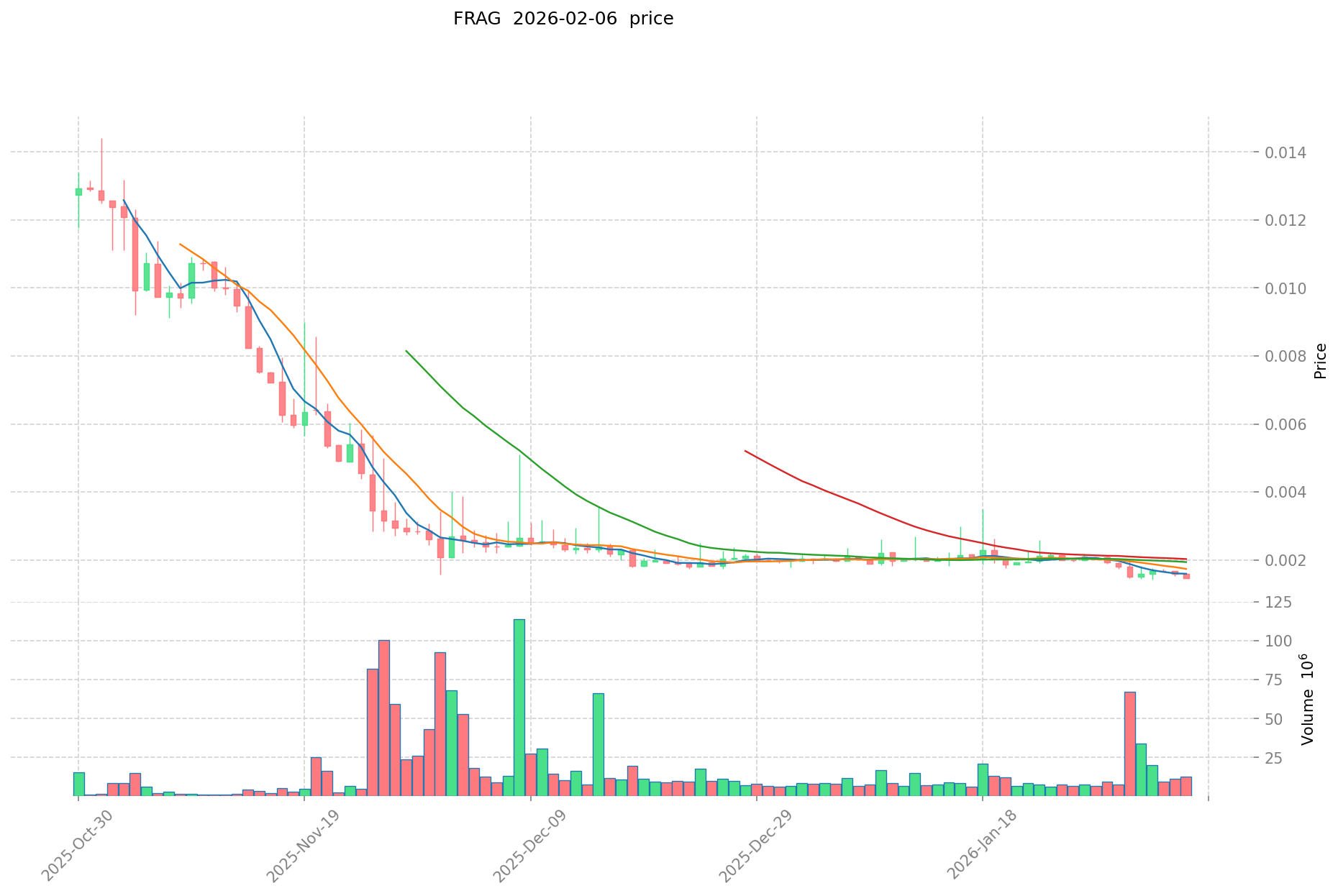
Fragmetric (FRAG) reached a notable price level of $0.189 on 01 July 2025, during a period of heightened market activity.
The token experienced its lowest recorded price of $0.001419 on 02 February 2026, reflecting broader market corrections and volatility.
These price movements illustrate the dynamic nature of market sentiment, adoption trends, and external factors affecting the asset.
Click to view current FRAG market price
On-Chain Metrics
- Holders: 15,276 addresses hold FRAG tokens, indicating a distributed ownership base and community participation.
Fragmetric Ecosystem Applications and Partners
Core Use Cases
Fragmetric's ecosystem supports multiple applications:
- DeFi: As Solana's first native liquid (re)staking protocol, Fragmetric provides decentralized asset management and yield optimization.
- Asset Management: Through the FRAG-22 standard, it enables multi-asset deposits, precise reward distribution, and modular yield sourcing.
Strategic Partnerships
Fragmetric continues to build its ecosystem within the Solana network, enhancing its technical capabilities through integration with DeFi protocols. These partnerships provide a solid foundation for Fragmetric's ecosystem expansion.
Controversies and Challenges
Fragmetric faces the following challenges:
- Technical Challenges: Ensuring seamless integration of complex DeFi strategies and maintaining protocol security
- Market Competition: Competition from other liquid staking protocols in the rapidly evolving DeFi space
- Adoption Barriers: Educating users about the FRAG-22 asset management standard and its benefits
These issues have sparked discussions within the community and market, driving Fragmetric's continuous innovation.
Fragmetric Community and Social Media Atmosphere
Fan Enthusiasm
Fragmetric's community demonstrates growing engagement, with 15,276 holders as of February 2026.
On X platform, related posts and hashtags (such as #Fragmetric) generate consistent engagement.
Protocol launches and yield optimization features have ignited community enthusiasm.
Social Media Sentiment
X platform sentiment shows diverse perspectives:
- Supporters praise Fragmetric's innovative FRAG-22 standard and efficient DeFi strategy access, viewing it as "pioneering asset management infrastructure".
- Critics focus on price volatility and market challenges.
Recent trends indicate cautious optimism during ecosystem development phases.
Hot Topics
X users actively discuss Fragmetric's FRAG-22 standard implementation, yield optimization strategies, and Solana ecosystem integration, showcasing both its transformative potential and the path toward mainstream adoption.
More Information Sources for Fragmetric
- Official Website: Visit Fragmetric Official Website for features, use cases, and latest updates.
- Documentation: Fragmetric Documentation details its technical architecture, FRAG-22 standard, and vision.
- X Updates: On X platform, Fragmetric actively engages through @fragmetric, with posts covering technical upgrades, community activities, and protocol developments.
Fragmetric Future Roadmap
- Ongoing Development: Continuous enhancement of FRAG-22 asset management standard, improving efficiency and user experience
- Ecosystem Goals: Expanding DeFi protocol integrations and user base within Solana ecosystem
- Long-term Vision: Establishing the industry standard for sophisticated DeFi asset management
How to Participate in Fragmetric?
- Purchase Channels: Buy FRAG on Gate.com and other supporting exchanges
- Storage Solutions: Use Solana-compatible wallets for secure storage
- Ecosystem Participation: Explore liquid staking and yield optimization features through the Fragmetric platform
- Building Ecosystem: Visit developer documentation to develop applications or contribute to the protocol
Summary
Fragmetric redefines DeFi asset management through blockchain technology, providing transparency, efficiency, and sophisticated yield strategies. Its active community, comprehensive resources, and innovative FRAG-22 standard distinguish it within the cryptocurrency space. Despite facing market volatility and competitive pressures, Fragmetric's innovative approach and clear development path position it as a notable player in decentralized finance. Whether you're a newcomer or experienced participant, Fragmetric merits attention and engagement.
FAQ
What is FRAG? What kind of cryptocurrency project is it?
FRAG is Fragmint Token, a blockchain-based cryptocurrency project designed to showcase blockchain technology's potential. It represents an emerging digital asset in the crypto ecosystem.
What are the uses of FRAG tokens? What are its main functions?
FRAG tokens serve as governance tokens enabling staking holders to participate in protocol decisions including incentive allocation and node management. They also reward active participants in the ecosystem through staking mechanisms.
How to buy and trade FRAG tokens? Where can I purchase them?
You can buy and trade FRAG tokens on major cryptocurrency exchanges. FRAG is available on multiple platforms including Gate.com, Huobi, Bitget, MEXC, and Bybit. Simply create an account, complete verification, deposit funds, and place your orders to start trading FRAG.
What are the risks of FRAG? What should I pay attention to when investing in FRAG?
FRAG carries high volatility risks with potential significant price fluctuations. Investors may experience substantial losses. Conduct thorough personal assessment before investing. No returns are guaranteed, and you bear full responsibility for investment decisions.
What are the advantages and disadvantages of FRAG compared to other cryptocurrencies?
FRAG's main advantage is its deep integration with Telegram, offering a unique NFT trading platform. Disadvantages include lower market awareness and a relatively smaller user base compared to established cryptocurrencies.
Share
Content
Fragmetric's Positioning and Significance
Origin and Development History
How Does Fragmetric Work?
Fragmetric (FRAG) Market Performance
Fragmetric Ecosystem Applications and Partners
Controversies and Challenges
Fragmetric Community and Social Media Atmosphere
More Information Sources for Fragmetric
Fragmetric Future Roadmap
How to Participate in Fragmetric?
Summary
FAQ
How to Buy Cryptocurrency


Trending Cryptocurrencies



What Is a Phantom Wallet: A Guide for Solana Users in 2025

Solana Price in 2025: SOL Token Analysis and Market Outlook

How Does Solana's Proof of History Work?

Solana (SOL) : Low Fees, Memecoins, and the way to moon

Is Solana a Good Investment?

Solana in 2025: Ecosystem Growth and DeFi Dominance
What Is a Mainnet in Cryptocurrency?

13 Best Penny Cryptocurrencies To Invest In
GetAgent: Crypto AI Agent vs Trading Bots
How to Create an NFT and Sell It Profitably
What Is CFA: Comprehensive Guide and Frequently Asked Questions