League of Traders (LOT) is South Korea's leading social trading platform combining gamified crypto trading with community-driven experiences on the Binance Smart Chain (BSC). Launched in 2024, LOT addresses barriers to entry in cryptocurrency trading by making it accessible and engaging through competitive social features, backed by notable investors including Mirana, C3 Ventures, Cadenza, and Korean gaming company Neowiz. The platform operates with over 11,000 token holders as of February 2026, utilizing BSC's Proof of Staked Authority consensus mechanism to ensure secure, fair transactions with low fees. Currently trading at $0.008846 on Gate.com with a market cap of approximately $1.33 million, LOT has experienced price volatility reflecting broader market dynamics, yet maintains solid community engagement through its innovative gamification model. This guide explores LOT's technical architecture, market performance, ecosystem applications, and investment potential for traders seeking community-driven, com
League of Traders (LOT) Positioning and Significance
In 2024, the League of Traders team launched League of Traders (LOT), aiming to address barriers to entry and lack of engagement in cryptocurrency trading.
As South Korea's No.1 social trading platform, League of Traders plays a key role in gamified crypto trading and social finance.
As of 2026, League of Traders has become an emerging player in the social trading space, with over 11,000 token holders and backing from notable investors including Mirana, C3 Ventures, Cadenza, and Korean gaming company Neowiz.
This article will deeply analyze its technical architecture, market performance, and future potential.
Origin and Development History
Birth Background
League of Traders was created by its founding team in 2024, aiming to solve the complexity and intimidation faced by newcomers in cryptocurrency trading.
It was born during the maturation of blockchain technology and growing interest in gamified finance, with the goal of making crypto trading accessible and engaging through social and game-like experiences.
League of Traders' launch brought new possibilities to retail traders and crypto enthusiasts seeking community-driven trading experiences.
Important Milestones
- October 2024: Token listing on Gate.com, marking its entry into the global market.
- June 2025: Reached all-time high price of $0.04947, demonstrating strong early market interest.
- 2024-2025: Successfully secured backing from Mirana, C3 Ventures, Cadenza (crypto VCs), and Neowiz (Korean gaming company).
- By February 2026: Built a community of over 11,000 token holders.
With support from its diverse investor base and the Korean gaming industry, League of Traders continues to optimize its platform, user experience, and real-world applications.
How League of Traders (LOT) Works
No Central Control
LOT operates on the Binance Smart Chain (BSC) network, a decentralized blockchain infrastructure that removes dependence on traditional financial institutions.
This decentralized architecture ensures that the platform operates transparently and resists centralized control, empowering users with greater autonomy and enhancing network resilience.
Blockchain Foundation
LOT's blockchain foundation on BSC is a public, immutable digital ledger that records every transaction.
Transactions are grouped into blocks and linked through cryptographic hashing to form a secure chain.
Anyone can view the records, establishing trust without intermediaries.
BSC's high throughput and low transaction costs enable efficient operations for the League of Traders platform.
Ensuring Fairness
LOT operates on BSC, which employs Proof of Staked Authority (PoSA) consensus mechanism to validate transactions and prevent fraudulent activities such as double-spending.
Validators maintain network security through staking BNB and validating blocks, receiving rewards for their participation.
This mechanism provides faster transaction speeds and lower fees compared to traditional Proof of Work systems.
Secure Transactions
LOT uses public-private key cryptography to protect transactions:
- Private keys (similar to secret passwords) are used to sign transactions
- Public keys (similar to account numbers) are used to verify ownership
This mechanism ensures fund security while maintaining pseudonymous transaction privacy.
The BEP-20 token standard on BSC provides additional security features and compatibility with the broader BSC ecosystem.
Circulation Overview
As of February 03, 2026, League of Traders (LOT) has a circulating supply of 150,000,000 tokens, with a total supply of 1,000,000,000 tokens and a maximum supply capped at 1,000,000,000 tokens. The current circulating supply represents approximately 15% of the total supply, indicating a controlled token release strategy. The token operates on the BSC (BEP-20) standard.
Price Fluctuations
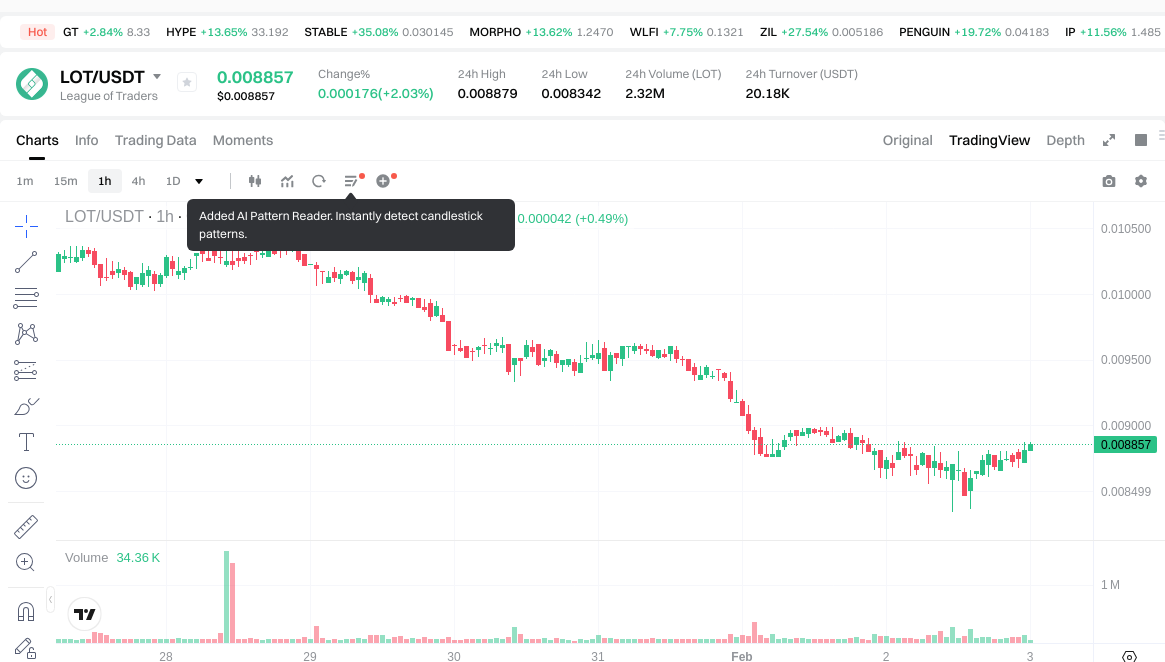
LOT reached its peak price of $0.04947 on June 20, 2025, reflecting positive market sentiment and adoption momentum during that period. The token hit its lowest recorded price of $0.008342 on February 02, 2026, representing a significant correction from its peak. As of the latest data, LOT is trading at $0.008846, showing a 1.28% increase over the past 24 hours. However, the token has experienced a 12.36% decline over the past 7 days and an 18.54% decrease over the past 30 days. Over a one-year timeframe, LOT has seen a 42.83% decline, reflecting broader market fluctuations and evolving trading dynamics.
Click to view the current LOT market price
On-Chain Metrics
- Holder Count: LOT has 11,021 token holders, indicating a growing community base engaging with the platform.
- Market Capitalization: The current market cap stands at approximately $1,326,900, with a fully diluted market cap of $8,846,000.
- 24-Hour Trading Volume: The token recorded a trading volume of approximately $20,128 over the past 24 hours, reflecting active market participation.
League of Traders (LOT) Ecosystem Applications and Partners
Core Use Cases
League of Traders (LOT) ecosystem supports innovative applications in the social trading space:
- Social Trading Platform: League of Traders serves as South Korea's leading social trading platform, providing gamified crypto trading experiences that combine competitive elements with financial markets.
- Community Engagement: The platform enables traders to share strategies and compete, fostering collaborative learning and competitive trading within its ecosystem.
Strategic Partnerships
League of Traders has established collaborations with notable entities including Mirana, C3 Ventures, Cadenza (crypto venture capital firms), and Neowiz (Korean gaming company).
These partnerships provide LOT with strong technical capabilities and market influence, supporting its ecosystem expansion in the competitive social trading landscape.
Controversies and Challenges
League of Traders faces several challenges:
- Market Volatility: The token experienced significant price fluctuations, with a 12.36% decline over 7 days and an 18.54% decrease over 30 days as of February 2026
- Price Performance: LOT trades substantially below its historical high, reflecting broader market pressures and investor sentiment shifts
- Competition Pressure: As a social trading platform, LOT competes with established crypto trading platforms and emerging gamified finance solutions
These challenges have sparked ongoing discussions within the community and markets, while driving continuous innovation in the platform's features and user experience.
League of Traders demonstrates solid community foundation with 11,021 token holders as of February 2026.
The platform leverages its gamification approach to maintain active user participation, creating an engaging environment where traders can compete and learn.
Community interest has been influenced by platform feature updates and the broader social trading trend in the crypto space.
Sentiment on X platform shows varied perspectives:
- Supporters praise LOT's innovative gamification approach and social trading features, viewing it as a fresh take on crypto trading engagement.
- Critics focus on price volatility concerns and the platform's relatively early stage in the competitive landscape.
Recent trends indicate a cautious sentiment, reflecting the token's performance challenges in early 2026.
Hot Topics
X users actively discuss League of Traders' gamification model, partnership developments, and price movements,
showcasing both its potential to revolutionize social trading and the obstacles it faces in achieving mainstream adoption.
- Official Website: Visit League of Traders Official Site for platform features, use cases, and latest updates.
- Documentation: League of Traders Documentation provides detailed information about the platform's technical architecture, goals, and vision.
- X Updates: On X platform, League of Traders uses @leagueoftraders to maintain active engagement,
sharing content about platform updates, community events, and partnership announcements.
- Blockchain Explorer: Track LOT token transactions on BSCScan for transparency and verification.
How to Participate in League of Traders (LOT)?
- Purchase Channels: Acquire LOT tokens on Gate.com and other supporting exchanges
- Storage Solutions: Use compatible BSC wallets to securely store your LOT tokens
- Platform Engagement: Register on the League of Traders platform to participate in social trading competitions and community activities
- Community Involvement: Join the Discord community to connect with other traders and stay updated on platform developments
Summary
League of Traders (LOT) represents an innovative approach to crypto trading by combining gamification, social interaction, and competitive trading experiences.
Its strategic backing from established venture capital firms and gaming industry leaders, along with its position as South Korea's leading social trading platform, distinguishes it in the crypto space.
Despite facing market volatility and competitive pressures, LOT's unique value proposition and growing community demonstrate its potential in the evolving landscape of social finance.
Whether you are new to crypto trading or an experienced trader, League of Traders offers an engaging platform worth exploring and participating in.
FAQ
What is a LOT in cryptocurrency trading and how is it defined?
A lot represents the standard quantity of a digital asset bought or sold in a single trade. For example, 1 BTC or 1 ETH equals one lot. The lot size determines your total trade value and risk exposure in cryptocurrency markets.
How does LOT size affect your crypto trading strategy and profits?
Larger LOT sizes amplify both potential profits and losses, increasing risk exposure. Smaller LOT sizes reduce capital requirements and risk. Your choice depends on risk tolerance, capital availability, and profit objectives.
What is the difference between a micro LOT, mini LOT, and standard LOT in crypto?
A standard LOT equals 100,000 units, a mini LOT equals 10,000 units, and a micro LOT equals 1,000 units. These represent different position sizes for managing trading risk and exposure.
How do you calculate position size using LOT in cryptocurrency trading?
Position size (in lots) = (Risk amount / Stop loss distance) × Account balance. Determine your risk percentage, stop loss in pips, and account balance to calculate the appropriate lot size for your trade.
What are the risks and benefits of trading different LOT sizes in crypto?
Smaller lot sizes reduce risk exposure and allow better portfolio diversification, while larger lots offer higher profit potential. However, larger amounts face greater price volatility impact. Choose based on your risk tolerance and capital.
* The information is not intended to be and does not constitute financial advice or any other recommendation of any sort offered or endorsed by Gate.