What is LRDS: A Comprehensive Guide to Long-Range Delivery Systems and Their Applications
BLOCKLORDS's Position and Significance
In 2024, the BLOCKLORDS development team launched BLOCKLORDS (LRDS), aiming to address the lack of player-driven economies and meaningful decision-making in traditional gaming ecosystems. As a player-driven MMO medieval grand strategy game with blockchain integration, BLOCKLORDS plays a key role in the GameFi and blockchain gaming sectors.
As of 2026, BLOCKLORDS has established itself within the blockchain gaming landscape, with approximately 4,936 token holders and an active development community. This article will provide an in-depth analysis of its technical architecture, market performance, and future potential.
Origin and Development History
Background
BLOCKLORDS was created by its development team and launched in July 2024, aiming to solve the limitations of traditional gaming models where player actions have minimal lasting impact on game worlds and economies. It emerged during the expansion of blockchain gaming and the evolution of play-to-earn models, with the goal of empowering players with true ownership and meaningful influence over game narratives and economies to transform the gaming landscape. The launch of BLOCKLORDS brought new possibilities for blockchain gaming enthusiasts and strategy game players.
Key Milestones
- July 2024: Token launch on Gate.com, introducing blockchain integration to the medieval strategy gaming genre.
- 2024-2025: Platform development, expanding gameplay options including farming, combat, resource management, and governance mechanics.
- 2026: Continued ecosystem growth with active community participation and ongoing feature development.
With support from its development team and gaming community, BLOCKLORDS continues to refine its gameplay mechanics, security features, and real-world applications.
How BLOCKLORDS Works?
No Central Control
BLOCKLORDS operates on blockchain technology deployed on the Ethereum network, eliminating dependence on centralized gaming servers or traditional publishers. The decentralized infrastructure enables player-driven economies and persistent game worlds, ensuring system transparency and resistance to single points of failure, granting users greater autonomy and enhancing network resilience.
Blockchain Foundation
BLOCKLORDS utilizes blockchain technology as a public, immutable digital ledger that records in-game asset ownership and transactions. Transactions are grouped into blocks and linked through cryptographic hashing to form a secure chain. Anyone can verify ownership records without intermediaries, establishing trust through transparency. The system leverages smart contracts to automate in-game economies and enable player-to-player transactions.
Ensuring Fairness
BLOCKLORDS leverages the Ethereum network's Proof of Stake consensus mechanism to validate transactions and prevent fraudulent activities such as asset duplication. Validators on the Ethereum network secure transactions by staking ETH and participating in block validation, maintaining network integrity. The integration with Ethereum provides established security infrastructure and interoperability with the broader blockchain ecosystem.
Secure Transactions
BLOCKLORDS uses public-private key cryptography to protect transactions:
- Private keys (similar to secret passwords) are used to sign transactions and prove ownership
- Public keys (similar to account numbers) are used to verify ownership and receive assets
This mechanism ensures asset security while transactions maintain pseudonymous privacy on the blockchain. The ERC-20 token standard provides compatibility with various wallets and platforms within the Ethereum ecosystem.
BLOCKLORDS's Market Performance
Circulation Overview
As of February 8, 2026, BLOCKLORDS has a circulating supply of 12,286,545 LRDS tokens, with a total supply of 100,000,000 LRDS and a maximum supply capped at 100,000,000 LRDS, indicating a fixed supply model.
The current circulation ratio stands at approximately 12.29% of the total supply, which influences the token's supply and demand dynamics in the market.
Price Volatility
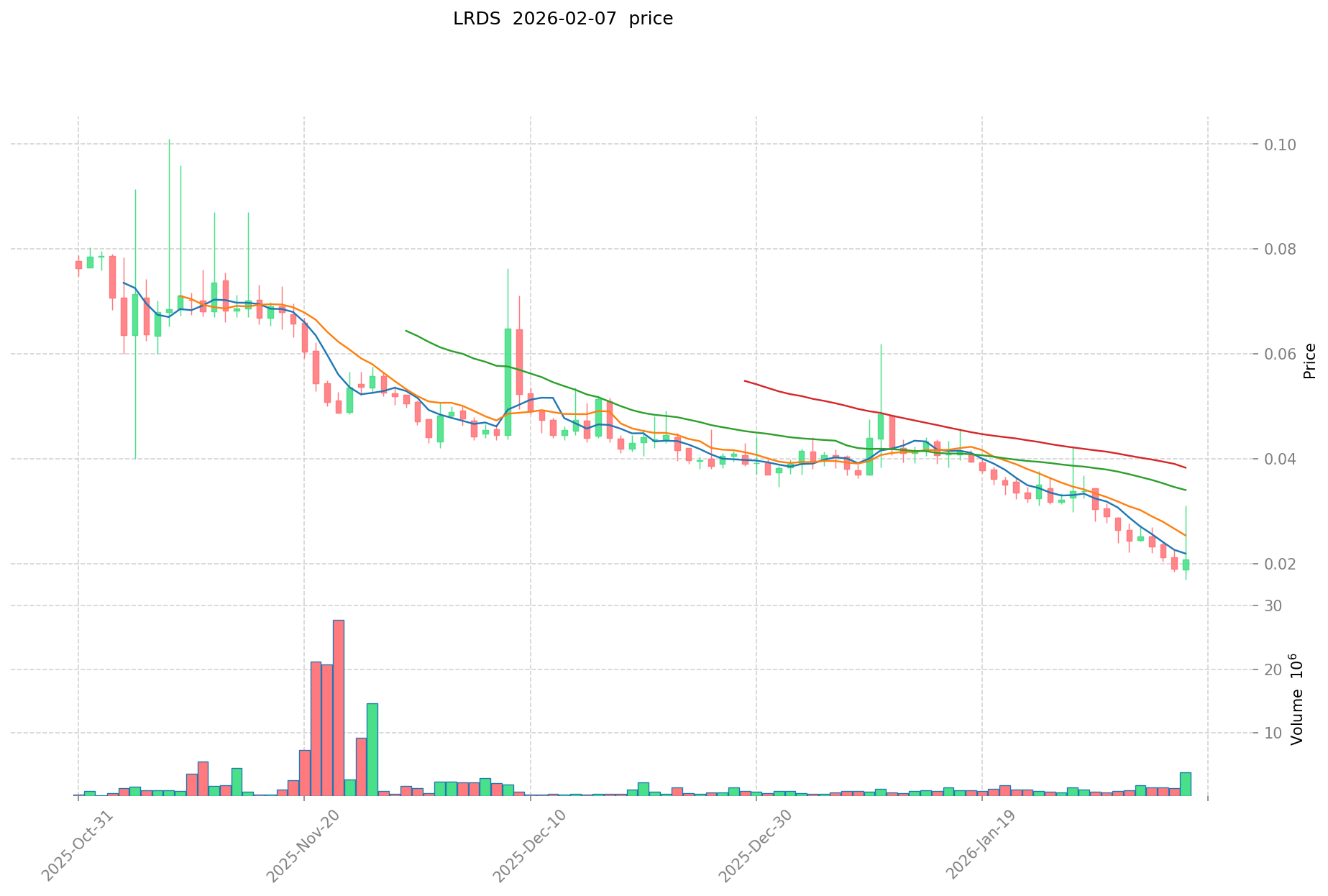
BLOCKLORDS reached a notable price level of $2.625 on July 24, 2024, driven by market dynamics during its initial trading period and early adoption interest.
The lowest recorded price was $0.01698, occurring on February 6, 2026, reflecting recent market corrections and broader cryptocurrency sector volatility.
These price movements demonstrate the token's sensitivity to market sentiment, adoption trends, and external market conditions.
Click to view the current LRDS market price
On-Chain Metrics
- Market Capitalization: Approximately $256,543 (reflecting current circulating supply valuation)
- 24-Hour Trading Volume: $177,529.58 (indicating active trading activity)
- Token Holders: 4,936 addresses (demonstrating community distribution and user participation)
- Fully Diluted Valuation: $2,088,000 (representing potential market cap at maximum supply)
BLOCKLORDS Ecosystem Applications and Partners
Core Use Cases
BLOCKLORDS's ecosystem supports multiple applications:
- GameFi: BLOCKLORDS itself serves as a player-driven MMO medieval grand strategy game, providing immersive gameplay experiences where players can farm, fight, manage resources, and rule.
- Digital Asset Management: The platform enables players to own and trade in-game assets, promoting player-driven economies and decentralized ownership.
Strategic Partnerships
BLOCKLORDS draws inspiration from renowned gaming platforms and strategies. The project positions itself within the realm of successful titles like Total War and EVE Online, which have demonstrated strong player engagement and economic complexity. These influences provide a foundation for BLOCKLORDS's ecosystem expansion.
Controversies and Challenges
BLOCKLORDS faces the following challenges:
- Market Volatility: The token has experienced significant price fluctuations, with a 7-day decline of 19.56% and a 30-day decline of 44.98%
- Competition Pressure: The GameFi sector continues to evolve with numerous blockchain gaming projects competing for player attention and market share
- Adoption Hurdles: Building a sustainable player base and maintaining long-term engagement in the blockchain gaming space remains an ongoing challenge
These issues have sparked discussions within the community and market, while also driving BLOCKLORDS's continuous innovation.
BLOCKLORDS Community and Social Media Atmosphere
Fan Enthusiasm
BLOCKLORDS's community shows engagement with approximately 4,936 token holders. The project maintains an active presence on X (formerly Twitter) where supporters discuss game strategies, token economics, and ecosystem developments.
Social Media Sentiment
Sentiment on X presents varied perspectives:
- Supporters praise BLOCKLORDS's innovative gameplay mechanics and player-driven economy, viewing it as a promising entry in the blockchain gaming sector
- Critics focus on price volatility and market performance concerns, particularly given recent downward trends
Recent trends reflect mixed sentiment as the token navigates market fluctuations.
Popular Topics
X users actively discuss BLOCKLORDS's gameplay features, tokenomics structure, and market performance, showcasing both its potential in the GameFi space and the challenges of establishing mainstream adoption in blockchain gaming.
BLOCKLORDS Additional Information Sources
- Official Website: Visit BLOCKLORDS Official Website for features, use cases, and latest updates.
- Documentation: BLOCKLORDS Wiki provides detailed information about the game's mechanics, strategies, and ecosystem.
- X Platform: BLOCKLORDS maintains an active presence at @BLOCKLORDS, sharing updates about game development, community events, and partnership announcements.
How to Participate in BLOCKLORDS?
- Purchase Channels: Buy LRDS on Gate.com and other supported platforms
- Storage Solutions: Use compatible Ethereum wallets such as MetaMask or hardware wallets to securely store LRDS tokens
- Engage with Gameplay: Visit the official website to explore the game and participate in the BLOCKLORDS universe
- Join the Community: Follow official social channels to stay updated on development progress and community initiatives
Summary
BLOCKLORDS leverages blockchain technology to create an immersive medieval grand strategy gaming experience, offering player-driven narratives, economic systems, and asset ownership. Its positioning within the GameFi sector and connection to successful gaming franchises like Total War and EVE Online demonstrate its ambition in the blockchain gaming space. Despite facing market volatility and competitive pressures, BLOCKLORDS's innovative approach to combining strategy gaming with blockchain technology positions it as a noteworthy project in the decentralized gaming ecosystem. Whether you're a gaming enthusiast or blockchain explorer, BLOCKLORDS presents an interesting intersection of traditional gaming mechanics and Web3 innovation.
FAQ
What is LRDS cryptocurrency? What are its main functions and uses?
LRDS is the native token of BLOCKLORDS, a blockchain-based medieval strategy game. It powers in-game economy, enables transactions, governance participation, and offers investment opportunities for players within the game ecosystem.
How to buy and store LRDS tokens? What wallet do I need?
Create an Ethereum-compatible wallet like MetaMask or Trust Wallet. Connect to a decentralized exchange, swap for LRDS tokens, and store them securely in your wallet for full control and security.
What are the team background, technical features, and development prospects of the LRDS project?
LRDS is developed by BLOCKLORDS team, built on blockchain technology with dynamic economy and governance mechanisms. The strategy-based Web3 game operates in a medieval metaverse, attracting substantial players and investors with strong growth potential ahead.
What are the risks of investing in LRDS? What should I pay attention to?
LRDS investment risks include market volatility, regulatory changes, and liquidity concerns. Monitor price fluctuations, verify project fundamentals, diversify portfolios, and stay informed on blockchain developments for informed decisions.
What are the differences and advantages of LRDS compared to other mainstream cryptocurrencies?
LRDS distinguishes itself through its community-driven mechanism and specialized market positioning. Its key advantages include high community participation, customized trading experience, and innovative tokenomics designed for long-term value creation and ecosystem development.
Share
Content
BLOCKLORDS's Position and Significance
Origin and Development History
How BLOCKLORDS Works?
BLOCKLORDS's Market Performance
BLOCKLORDS Ecosystem Applications and Partners
Controversies and Challenges
BLOCKLORDS Community and Social Media Atmosphere
BLOCKLORDS Additional Information Sources
How to Participate in BLOCKLORDS?
Summary
FAQ
How to Buy Cryptocurrency


Trending Cryptocurrencies



Detailed Analysis of the Best 10 GameFi Projects to Play and Earn in 2025

Popular GameFi Games in 2025

What Are the Key On-Chain Metrics Revealing About Litecoin's Whale Activity in 2025?
What is GameFi and How Does It Work?

What is DeFi: Understanding Decentralized Finance in 2025
How Will Virtuals Protocol's AI Agent Economy Evolve by 2030?
Understanding the Meaning of HODL in Cryptocurrency
How High Will Bitcoin Go? A Deep Dive Into Market Trends

What Are Crypto Trading Patterns? A Basic Introduction
Top 11 Golden Cross Trading Strategies for Investors and Traders
What Is Ethereum PoW and How Does It Work?