What is MDX: A Comprehensive Guide to Markdown and JSX Integration


Mdex's Positioning and Significance
In 2021, the Mdex team launched Mdex (MDX), aiming to address the limitations of single-chain decentralized exchanges and high transaction costs on certain networks. As an automatic market-making decentralized exchange based on a dual-chain model, Mdex plays a key role in the DeFi sector.
As of 2026, Mdex has developed into a DeFi platform on the Heco ecosystem, with an active presence in decentralized token exchange services. This article will provide an in-depth analysis of its technical architecture, market performance, and future potential.
Origin and Development History
Background of Creation
Mdex was created by the Mdex team in 2021, aiming to solve the challenges of high transaction fees on certain blockchain networks and the isolation of liquidity across different chains. It was born during the rapid expansion of the DeFi sector, with the goal of providing users with a more secure, diversified, and cost-effective decentralized token exchange service through innovation. The launch of Mdex brought new possibilities to DeFi users and liquidity providers.
Key Milestones
- 2021: Mainnet launch, implementing a dual-chain DEX model supporting both the Heco and Ethereum ecosystems.
- 2021: Introduction of dual mining mechanisms for liquidity and trading, attracting significant user participation.
- 2021-2022: Ecosystem expansion, with the platform integrating DEX, IMO, and DAO functionalities to form a comprehensive DeFi platform.
With the support of the community and the Mdex team, Mdex continues to optimize its technology, security, and real-world applications.
How Does Mdex Work?
No Central Control
Mdex operates on a decentralized network of computers (nodes) distributed globally, independent of control by banks or governments. These nodes collaborate to validate transactions, ensuring the system is transparent and resistant to attacks, granting users greater autonomy and enhancing network resilience.
Blockchain Core
Mdex's blockchain is a public, immutable digital ledger that records every transaction. Transactions are grouped into blocks and linked through cryptographic hashes to form a secure chain. Anyone can view the records, establishing trust without intermediaries. The platform's dual-chain architecture further enhances performance and reduces costs.
Ensuring Fairness
Mdex adopts an automated market-making mechanism to facilitate token exchanges, preventing issues such as price manipulation. Liquidity providers maintain network functionality by contributing assets to liquidity pools and earn MDX rewards. Its innovation includes low transaction fees on the Heco chain and compatibility with the Ethereum ecosystem.
Secure Transactions
Mdex uses public-private key cryptography to protect transactions:
- Private keys (similar to secret passwords) are used to sign transactions
- Public keys (similar to account numbers) are used to verify ownership
This mechanism ensures the security of funds, and transactions maintain pseudonymity. The platform's smart contract infrastructure provides additional layers of security for decentralized operations.
MDX Market Performance
Circulating Supply Overview
As of February 05, 2026, MDX has a circulating supply of 950,246,937.39 tokens, with a total supply of 1,060,000,000 tokens and an unlimited maximum supply, indicating an inflationary model.
New tokens enter the market through Mdex's dual mining mechanism, which supports both liquidity and trading mining, affecting its supply-demand dynamics.
Price Fluctuations
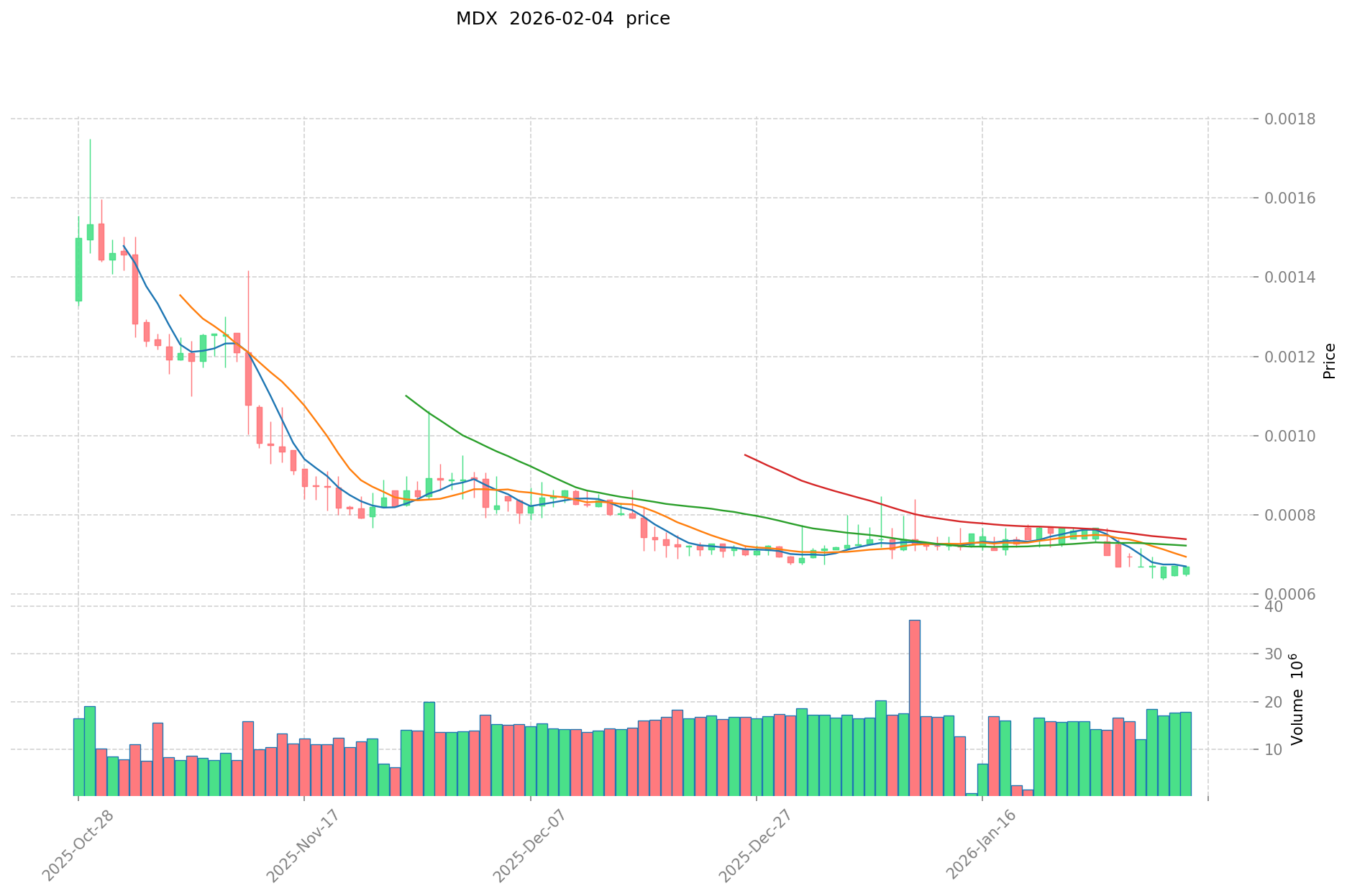
MDX reached a notable price level of $10.06 on February 22, 2021, influenced by favorable market conditions during the broader cryptocurrency market expansion.
The token experienced its lowest price of $0.000629 on February 05, 2026, reflecting challenging market conditions.
These fluctuations demonstrate the impact of market sentiment, adoption trends, and external factors on the token's valuation.
Click to view the current MDX market price
On-Chain Metrics
- Holder Count: 984 addresses (reflecting user participation in the ecosystem)
- 24H Trading Volume: $11,543.52 (indicating current market activity level)
- Market Cap to FDV Ratio: 89.65% (showing the proportion of tokens currently in circulation relative to fully diluted valuation)
Mdex Ecosystem Applications and Partners
Core Use Cases
Mdex's ecosystem supports various DeFi applications:
- Decentralized Trading: Mdex provides an automated market-making mechanism based on liquidity pools, enabling users to swap tokens without intermediaries.
- Liquidity Mining: Users can provide liquidity to trading pairs and earn MDX token rewards through dual mining mechanisms.
- IMO and DAO Integration: The platform aims to incorporate Initial Mdex Offering (IMO) and Decentralized Autonomous Organization (DAO) functionalities for community-driven governance.
Strategic Collaborations
Specific partnership details are not available in the provided materials. The platform's development focuses on building infrastructure within its supported ecosystems.
Controversies and Challenges
Mdex faces several challenges:
- Market Competition: The DEX landscape is highly competitive, with numerous platforms offering similar automated market-making services.
- Price Volatility: MDX has experienced significant price fluctuations, declining approximately 78.60% over the past year.
- Market Capitalization: With a market cap of approximately $628,398 and relatively low trading volume of $11,543.52 over 24 hours, the platform faces liquidity challenges.
These factors have influenced market perception and require ongoing platform development and community engagement.
Mdex Community and Social Media Atmosphere
Community Engagement
Mdex maintains an active presence with 984 holders as of February 5, 2026. The platform's community engages through official channels, though specific engagement metrics are limited in available data.
Social Media Presence
Mdex maintains its official Twitter account at @MdexTech, serving as a primary communication channel for updates and community interaction. The platform's social media presence focuses on platform developments and ecosystem announcements.
Discussion Topics
Community discussions typically center around platform functionality, token economics, and DeFi innovations within the supported blockchain ecosystems.
More Information About Mdex
- Official Website: Visit Mdex official website for features, use cases, and latest updates.
- White Paper: Mdex Lightpaper details its technical architecture, objectives, and vision.
- X Platform: Mdex operates under the handle @MdexTech on X platform, providing updates on technical developments, community activities, and platform news.
Mdex Future Roadmap
Specific future roadmap details are not available in the provided materials. The platform continues to focus on enhancing its DeFi infrastructure and expanding its ecosystem capabilities.
How to Participate in Mdex?
- Purchase Options: MDX can be traded on Gate.com
- Storage Solutions: MDX tokens can be stored in compatible wallets supporting BSC and ETH networks
- Participate in Governance: Engage with platform developments through community channels
- Ecosystem Building: Visit the official documentation to explore development opportunities
Summary
Mdex represents a decentralized exchange platform offering automated market-making services with dual mining mechanisms. The platform operates with contract addresses on both BSC (0x9c65ab58d8d978db963e63f2bfb7121627e3a739) and Ethereum (0xc56725b6430132de775c4e5b48c9b0318ce2fc69) networks. With a circulating supply of approximately 950.25 million tokens out of 1.06 billion total supply, MDX currently trades at $0.0006613.
Despite facing market challenges including price volatility and competition, Mdex continues to maintain its position in the DeFi landscape. The platform's focus on providing low-cost decentralized token exchange services positions it as an option for users seeking alternatives in the automated market-making space. Whether you are new to DeFi or an experienced participant, Mdex offers opportunities for engagement in decentralized finance.
FAQ
What is MDX? What are its main functions?
MDX is a decentralized derivatives trading protocol enabling users to trade synthetic assets with leverage. Its main functions include peer-to-pool trading, dynamic pricing mechanisms, and risk management tools for crypto derivatives markets.
What are the uses of MDX token and how to obtain MDX?
MDX is the native token of MDEX platform, used for trading, fundraising, and rewarding holders. You can obtain MDX by purchasing it through MDEX platform or crypto trading platforms.
What distinguishes MDX from other DeFi projects?
MDX stands out by integrating DEX, IMO, and DAO functionalities as the core platform on Heco ecosystem, serving as a vital bridge connecting CeFi and DeFi markets with unique value exchange capabilities.
What are the risks of MDX? What should I pay attention to when investing in MDX?
MDX is a volatile digital asset with price fluctuations. Investors should conduct thorough research before investing. Market sentiment and liquidity can significantly impact value. Ensure you only invest what you can afford to lose and understand the technology behind the project.
What is MDX's development outlook and roadmap?
MDX demonstrates strong growth potential with focus on DeFi innovation and ecosystem expansion. The project roadmap includes protocol upgrades, cross-chain integration, and enhanced liquidity solutions. Key milestones target increased market adoption and technological advancement through 2026-2027.
How to buy and trade MDX on exchanges or DEX?
Download a Web3 wallet like MetaMask or Trust Wallet, connect it to a DEX platform, deposit cryptocurrency, and swap for MDX tokens. You can also use centralized platforms that support MDX trading for direct purchases.
Share
Content
How to Buy Cryptocurrency


Trending Cryptocurrencies



XZXX: A Comprehensive Guide to the BRC-20 Meme Token in 2025

Survey Note: Detailed Analysis of the Best AI in 2025

Detailed Analysis of the Best 10 GameFi Projects to Play and Earn in 2025
Kaspa’s Journey: From BlockDAG Innovation to Market Buzz

Best Crypto Wallets 2025: How to Choose and Secure Your Digital Assets

Popular GameFi Games in 2025

LABUBU vs BTC: Which Digital Asset Will Dominate the Future of Collectibles and Cryptocurrency?
GOZ vs BTC: Which Cryptocurrency Offers Better Investment Potential in 2024?
GAIN vs NEAR: Which Layer-1 Blockchain Platform Offers Better Scalability and Developer Ecosystem?
3ULL vs NEAR: A Comprehensive Comparison of Two Emerging Blockchain Platforms

13 Cheapest Cryptocurrencies to Invest in for 2025