What is MLN: A Comprehensive Guide to Multi-Layer Networks and Their Applications in Modern Computing

Enzyme (MLN) Comprehensive Analysis Report
Enzyme's Positioning and Significance
Enzyme (MLN) is an Ethereum-based utility token designed to power decentralized asset management within the DeFi ecosystem. Positioned as a protocol facilitating on-chain portfolio management, Enzyme enables users to construct, share, and explore diversified DeFi investment strategies—referred to as "vaults"—while filtering opportunities based on historical performance and risk profiles.
As of December 2025, Enzyme maintains a market capitalization of approximately $13.78 million USD, with a current price of $4.61 USD and a circulating supply of 2,988,368.56 MLN tokens. The token serves a dual-purpose utility function within its ecosystem: compensating users for token utilization and rewarding developers or external contributors through grant submissions.
This report provides a comprehensive analysis of Enzyme's technical architecture, market dynamics, tokenomics, and operational mechanisms.
Origins and Development History
Background and Launch
Enzyme (formerly known as the Melon Protocol) emerged to address a critical gap in the DeFi landscape: the democratization of professional-grade asset management. The protocol was designed to enable retail users and institutions alike to participate in sophisticated investment strategies previously accessible only through traditional finance intermediaries.
The token was initially published on February 14, 2017, at a launch price of $5.80 USD, entering a market hungry for decentralized financial infrastructure. Enzyme's foundational mission centered on creating transparent, auditable, and trustless mechanisms for managing digital assets on-chain.
Notable Milestones
- 2017: MLN token launched on Ethereum mainnet, establishing the foundational infrastructure for decentralized fund management.
- 2018: The protocol reached its all-time high of $258.26 USD on January 4, 2018, reflecting significant early market interest and adoption momentum.
- Ongoing Development: The project has maintained active development through its GitHub repositories (enzymefinance and melonproject/protocol), continuously refining protocol mechanics and expanding ecosystem capabilities.
- Current Status: The project now supports 19 exchange listings, including trading on Gate.com, with 8,826 active token holders maintaining distributed ownership of the protocol.
The Enzyme ecosystem continues to evolve under community governance and developer support, maintaining relevance in the competitive DeFi landscape.
How Enzyme Functions?
Decentralized Infrastructure
Enzyme operates on the Ethereum blockchain as a non-custodial protocol, eliminating intermediaries from the asset management process. The network comprises distributed nodes that validate transactions and enforce protocol rules without reliance on centralized authority. This architecture grants users complete control over their assets while maintaining transparent, verifiable transaction histories.
Core Blockchain Architecture
At its foundation, Enzyme leverages Ethereum's blockchain—a public, immutable ledger recording all transactions and vault activities. Each transaction involving MLN tokens or vault operations is cryptographically secured and permanently recorded across the distributed network. Users can independently verify transaction authenticity and vault performance without requiring permission from any central entity.
Utility Token Mechanism
MLN functions as the protocol's native utility token, governing access to core functionalities throughout the vault creation and investment lifecycle:
Fee Payment: Users pay MLN tokens to:
- Create and deploy new investment vaults
- Execute fund operations and rebalancing activities
- Access advanced portfolio management features
Governance and Incentives: The token aligns ecosystem participants:
- Developers and contributors receive MLN grants for protocol improvements and ecosystem expansion
- Token holders maintain economic interest in protocol success and security
Security Framework
Enzyme inherits Ethereum's robust security model while implementing protocol-level safeguards:
- Cryptographic Verification: All transactions utilize public-key cryptography, enabling secure authorization without exposing private credentials
- Smart Contract Auditing: Vault deployment and fund management functions execute through audited smart contracts, reducing execution risk
- Transparent Record-Keeping: All portfolio transactions and performance metrics remain publicly verifiable on-chain, preventing fraudulent performance claims
This multi-layered security approach ensures user funds remain protected while maintaining the transparency necessary for trustless asset management.
Market Performance and Tokenomics
Price and Market Metrics
| Metric | Value |
|---|---|
| Current Price | $4.61 USD |
| Market Capitalization | $13.78 Million USD |
| 24-Hour Trading Volume | $14,245.07 USD |
| All-Time High | $258.26 USD (January 4, 2018) |
| All-Time Low | $1.79 USD (March 13, 2020) |
| Market Dominance | 0.00043% |
Price Performance Trends
| Timeframe | Change | Amount |
|---|---|---|
| 1 Hour | -0.13% | -$0.006 |
| 24 Hours | -0.77% | -$0.036 |
| 7 Days | -8.89% | -$0.450 |
| 30 Days | -15.17% | -$0.825 |
| 1 Year | -76.34% | -$14.88 |
Token Supply Structure
- Circulating Supply: 2,988,368.56 MLN (99.9985% of total supply)
- Total Supply: 2,988,368.56 MLN
- Maximum Supply: Unlimited (∞)
- Circulation Ratio: 99.9985%
The unlimited maximum supply reflects Enzyme's design as a utility token without predetermined scarcity constraints, allowing ecosystem scaling as protocol adoption expands.
Ecosystem and Community
Active Participation
Enzyme maintains an engaged community with 8,826 token holders distributed across the network, fostering decentralized protocol governance and development. The project sustains active presence across multiple platforms:
- Official Website: https://enzyme.finance/
- GitHub Repositories: enzymefinance and melonproject/protocol
- White Paper: Available at melonooo.gitbook.io/melonpaper/
- Social Presence: Active Twitter (@enzymefinance) and Reddit (/r/enzymefinance) communities
- Contract Address: 0xec67005c4e498ec7f55e092bd1d35cbc47c91892 (Ethereum mainnet)
Trading Access
MLN tokens are available for trading on Gate.com and 18 additional exchange platforms, providing liquidity and accessibility for investors seeking exposure to the Enzyme ecosystem.
Conclusion
Enzyme represents a thoughtfully designed protocol addressing the democratization of decentralized asset management. Through its utility token (MLN) and smart contract infrastructure, it enables permissionless participation in sophisticated DeFi investment strategies. While current market conditions reflect broader cryptocurrency volatility, Enzyme's fundamental value proposition—transparent, trustless, and decentralized portfolio management—remains relevant to the evolving DeFi landscape.
For investors interested in exploring Enzyme's ecosystem, trading opportunities exist on Gate.com and other supported exchanges, though detailed analysis of individual investment merit is recommended before participation.
Enzyme's Market Performance
Circulating Supply Overview
As of December 21, 2025, Enzyme (MLN) has a circulating supply of 2,988,368.56 MLN tokens, with a total supply of 2,988,368.56 MLN tokens. The token operates with an unlimited maximum supply (∞), indicating a non-capped issuance model. MLN is an Ethereum-based utility token that powers the Enzyme protocol ecosystem, with new tokens potentially entering circulation through ecosystem grants and developer contributions.
Price Fluctuations
MLN reached its all-time high of $258.26 on January 4, 2018, during the early DeFi market enthusiasm phase.
The token's lowest price was $1.79, recorded on March 13, 2020, coinciding with broader cryptocurrency market declines during that period. These extreme fluctuations reflect the evolving market conditions, shifting investor sentiment toward DeFi protocols, and changing adoption trends within the Enzyme ecosystem.
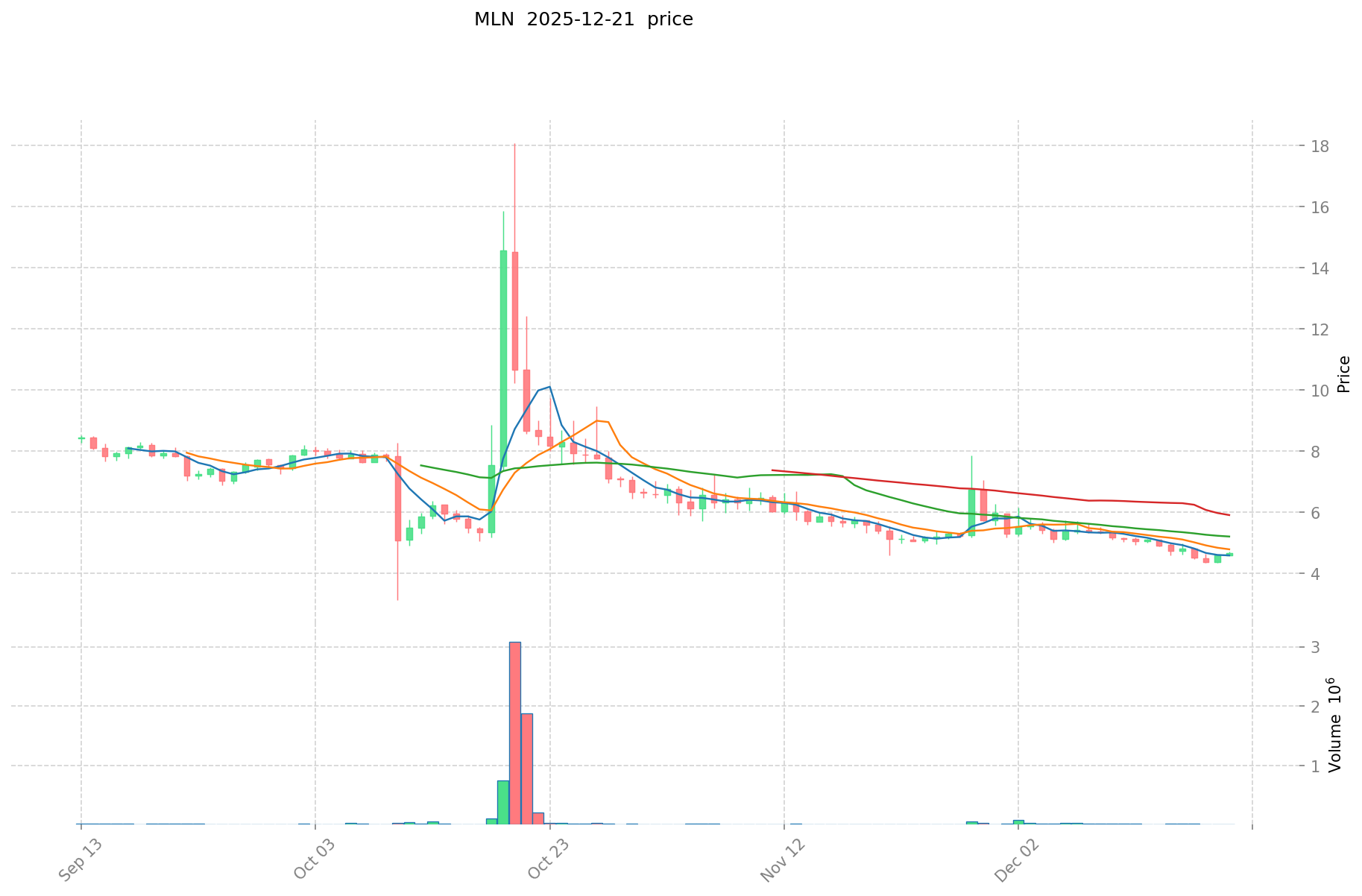
As of December 21, 2025, MLN is trading at $4.612, representing a -76.34% decline over the past year. Over the 30-day period, the token has declined -15.17%, while the 24-hour change stands at -0.77%.
Check current MLN market price
Market Capitalization and Trading Activity
The current market capitalization of MLN stands at $13,782,355.82, with a 24-hour trading volume of $14,245.07. The fully diluted valuation equals the market capitalization due to the token's fully circulating supply. MLN maintains a market dominance of 0.00043% in the overall cryptocurrency market and is listed on 19 exchanges, including Gate.com, demonstrating reasonable liquidity and accessibility for traders.
Enzyme (MLN) Comprehensive Analysis Report
Overview
Enzyme (MLN) is an Ethereum token that powers the Enzyme protocol (formerly known as the Melon protocol), designed to facilitate on-chain asset management within the DeFi ecosystem. As of December 21, 2025, MLN is ranked #1021 in market capitalization with a price of $4.612, down 0.77% in the last 24 hours.
Key Metrics
| Metric | Value |
|---|---|
| Current Price | $4.612 USD |
| Market Capitalization | $13,782,355.82 |
| 24-Hour Volume | $14,245.07 |
| Circulating Supply | 2,988,368.564 MLN |
| All-Time High | $258.26 (January 4, 2018) |
| All-Time Low | $1.79 (March 13, 2020) |
| Market Dominance | 0.00043% |
| Token Holders | 8,826 |
Price Performance
MLN has experienced significant volatility:
- 1-Hour Change: -0.13%
- 24-Hour Change: -0.77%
- 7-Day Change: -8.89%
- 30-Day Change: -15.17%
- 1-Year Change: -76.34%
Ecosystem and Use Cases
Core Functionality
MLN serves multiple critical functions within the Enzyme ecosystem:
- Vault Creation and Management: Users utilize MLN tokens to create and manage investment strategies, known as "vaults," within the DeFi ecosystem.
- Strategy Exploration: MLN enables users to discover and share DeFi investment strategies while filtering options by historical performance and risk profiles.
- Fee Payments: MLN is used to pay for various functions throughout the vault creation process and the entire investment life cycle.
Token Utility
MLN functions as a utility token that powers the ecosystem and aligns stakeholders through two primary mechanisms:
- User Payments: Users pay fees in MLN tokens for platform usage and services.
- Developer Incentives: Developers and external contributors can earn MLN tokens by submitting grants and contributing to the protocol's development.
Network Information
Smart Contract Details
- Chain: Ethereum (ETH)
- Contract Address: 0xec67005c4e498ec7f55e092bd1d35cbc47c91892
- Etherscan Link: https://etherscan.io/token/0xec67005c4e498ec7f55e092bd1d35cbc47c91892
Token Distribution
- Circulating Supply: 2,988,368.564 MLN (99.9985% of total supply)
- Total Supply: 2,988,368.564 MLN
- Maximum Supply: Unlimited (∞)
- Fully Diluted Valuation: $13,782,355.82
How to Participate in Enzyme (MLN)?
1. Purchase Channels
MLN is available for trading on Gate.com and 18 other exchanges, providing multiple access points for investors to acquire tokens.
2. Community Engagement
- Official Website: Visit Enzyme Finance for detailed information about features, use cases, and recent updates.
- Whitepaper: Access the Melon Paper for technical architecture, objectives, and the protocol's vision.
- GitHub Repositories:
- Main Repository: https://github.com/enzymefinance
- Protocol Repository: https://github.com/melonproject/protocol
3. Community Platforms
Connect with the Enzyme community through:
- X (Twitter): @enzymefinance
- Reddit: r/enzymefinance
Summary
Enzyme (MLN) represents an innovative approach to on-chain asset management within the DeFi ecosystem. Through its utility token design and collaborative grant system, MLN aligns stakeholders and incentivizes ecosystem development. The protocol enables users to build, share, and explore diversified investment strategies while maintaining transparency and decentralized governance.
With 8,826 token holders and active development across multiple repositories, Enzyme continues to evolve as a significant player in the DeFi space. Despite experiencing a 76.34% decline over the past year, reflecting broader market conditions, MLN remains a functional utility token for those interested in participating in on-chain asset management strategies.
Whether you are a developer looking to contribute to the protocol, an investor exploring DeFi opportunities, or a user seeking to create custom investment vaults, Enzyme offers a comprehensive platform worth exploring. The project's commitment to open-source development and community participation demonstrates its dedication to building decentralized financial infrastructure.
FAQ
What is the meaning of MLN?
MLN stands for Melon, a decentralized asset management platform built on blockchain. It enables users to create, manage, and invest in digital asset funds using smart contracts and cryptocurrency.
What is mln finance?
MLN is the token for Enzyme Finance, a decentralized protocol on Ethereum enabling users to create, manage, and invest in custom crypto assets. It serves as governance and utility token within the ecosystem.
What is a mln?
MLN is the native token of the Melon protocol, a decentralized asset management platform built on Ethereum. It enables governance and incentivizes participation in the protocol's ecosystem.
What company is mln?
MLN is not a company but a cryptocurrency token. MLN (Melon) is a digital asset built on blockchain technology, designed for decentralized asset management and investment purposes within the web3 ecosystem.
Share
Content
How to Buy Cryptocurrency


Trending Cryptocurrencies



What is TOKE: A Comprehensive Guide to Understanding the Digital Token Revolution

Ethereum to AUD: What Australian Traders Need to Know in 2025

Latest Analysis and Investment Outlook for Chainlink Price in June 2025

1inch Network White Paper: Addressing Critical DeFi Challenges in 2025
2025 ICP Price Prediction: Analyzing Growth Factors and Market Potential in the Post-Halving Cycle
2025 UNIPrice Prediction: Analyzing Key Factors That Will Shape Uniswap's Token Valuation in the Post-Bull Market Era

Comprehensive Guide to WalletConnect: What It Is and How It Works

How to Earn TON on the Fragment Platform

What is SQD: A Comprehensive Guide to Service Quality Dynamics and Its Impact on Business Performance

What is DUCK: A Comprehensive Guide to Understanding Digital Unified Communication Kit and Its Applications in Modern Technology

What is WOLF: A Comprehensive Guide to Understanding This Powerful Machine Learning Framework