What is OVL: A Comprehensive Guide to Decentralized Virtual Worlds and Digital Asset Ownership

Overlay Protocol's Positioning and Significance
In 2025, the Overlay Protocol team launched Overlay Protocol (OVL), aiming to address liquidity constraints in long-tail assets and heterogeneous markets. As the first decentralized data derivatives protocol, Overlay Protocol plays a key role in on-chain derivatives trading.
As of 2026, Overlay Protocol has established itself as an innovative platform enabling counterparty-free trading of real-world metrics, with 2,306 holders and an active development community. This article will provide an in-depth analysis of its technical architecture, market performance, and future potential.
Origin and Development History
Background
Overlay Protocol was created in 2025, aiming to solve liquidity issues plaguing long-tail assets and bilateral liquidity requirements in traditional derivatives markets. It emerged during the expansion of decentralized finance and blockchain technology adoption, with the goal of enabling on-chain trading of diverse real-world metrics without counterparties to transform the current landscape. The launch of Overlay Protocol brought entirely new possibilities for traders and data-driven markets.
Key Milestones
- August 2025: Mainnet launch on BSC, implementing counterparty-free trading through dynamic mint/burn model.
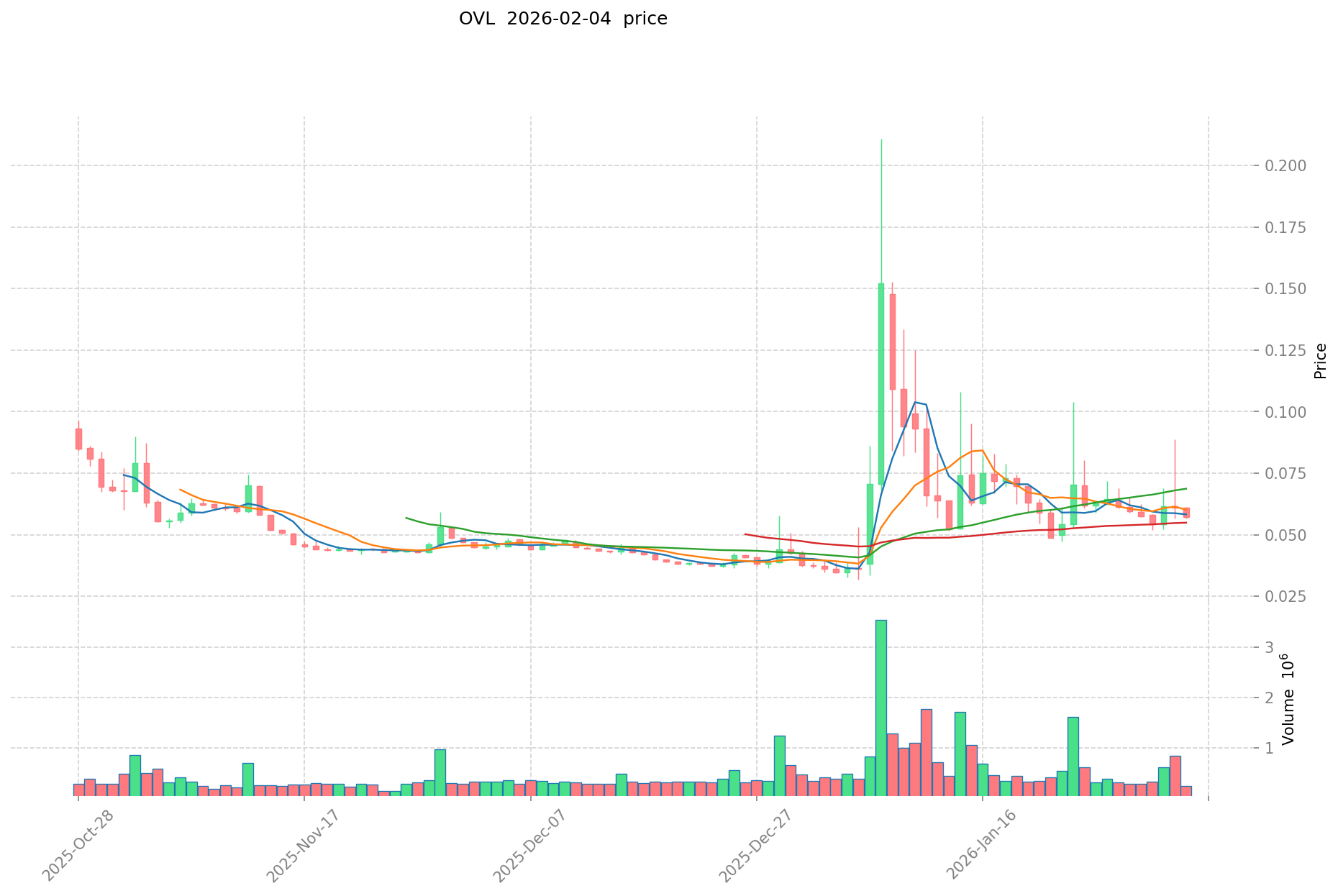
- January 2026: Token reached its lowest price point of $0.03171, followed by recovery phase.
- February 2026: Trading across 7 exchanges, with growing ecosystem adoption.
With support from the protocol's community and development team, Overlay Protocol continues to optimize its technology, security, and real-world applications.
How Does Overlay Protocol Work?
No Central Control
Overlay Protocol operates on a decentralized network of computers (nodes) distributed globally, free from control by banks or governments. These nodes collaborate to validate transactions, ensuring system transparency and attack resistance, granting users greater autonomy and enhancing network resilience.
Blockchain Core
Overlay Protocol's blockchain is a public, immutable digital ledger that records every transaction. Transactions are grouped into blocks and linked through cryptographic hashes to form a secure chain. Anyone can view the records, establishing trust without intermediaries. The protocol utilizes a dynamic mint/burn mechanism based on the $OVL token to achieve counterparty-free trading, further enhancing performance.
Ensuring Fairness
Overlay Protocol employs BEP-20 standard on BSC to validate transactions and prevent fraud such as double-spending. Network participants maintain network security through protocol interaction and trading activities, with the system's innovative design including elimination of bilateral liquidity requirements and enabling trading of diverse real-world metrics.
Secure Transactions
Overlay Protocol uses public-private key cryptography to protect transactions:
- Private keys (similar to secret passwords) are used to sign transactions
- Public keys (similar to account numbers) are used to verify ownership
This mechanism ensures fund security while transactions maintain transparency on-chain. The protocol's architecture enables trading of various metrics from ETH burn rates to streaming platform statistics, gaming data, and other real-world indicators.
Overlay Protocol's Market Performance
Circulation Overview
As of February 04, 2026, Overlay Protocol's circulating supply stands at 14,222,926.02 OVL tokens, with a total supply of 88,888,888 tokens and a maximum supply capped at 100,000,000 tokens. The circulating supply represents approximately 18.12% of the total supply, indicating a controlled token distribution model. The protocol employs a dynamic mint-and-burn mechanism built around the $OVL token, which enables counterparty-free trading while managing token supply based on market activity. This approach addresses liquidity challenges traditionally associated with long-tail assets and heterogeneous markets.
Price Fluctuations
Overlay Protocol reached its peak price of $0.5 on August 14, 2025, during a period of heightened market interest in decentralized derivatives solutions. The token experienced its lowest price of $0.03171 on January 05, 2026, reflecting broader market corrections and adjustments in the DeFi sector. Recent price movements show a -0.21% change over the past hour, -6.2% over 24 hours, and -12.13% over the past week, while demonstrating a notable 55.40% increase over the 30-day period. These fluctuations illustrate the dynamic nature of the protocol's adoption and market positioning within the data derivatives space.
Click to view the current OVL market price
On-Chain Metrics
- Holder Distribution: The token currently has 2,306 holders, reflecting a growing community of users engaged with the protocol's data derivatives platform.
- Market Capitalization: With a market cap of approximately $808,715.57 and a fully diluted valuation of $5,054,222.17, the protocol maintains a market cap to FDV ratio of 18.12%.
- Trading Activity: The 24-hour trading volume stands at $14,367.09, demonstrating ongoing market interest and liquidity in OVL tokens across 7 exchanges.
Overlay Protocol Ecosystem Applications and Partners
Core Use Cases
Overlay Protocol's ecosystem supports innovative applications in decentralized finance:
- Data Derivatives Trading: The protocol enables trading of real-world metrics including ETH burn rates, Twitch statistics, CS2 skins, and various trend indicators, providing counterparty-free on-chain data derivatives trading.
- Dynamic Market Creation: Through its mint/burn model built on the $OVL token, Overlay facilitates liquidity solutions for long-tail assets and heterogeneous markets without requiring bilateral liquidity.
Strategic Partnerships
Overlay Protocol operates as a decentralized protocol focused on data derivatives innovation. The protocol's technical architecture supports integration with various data sources, enabling diverse market creation possibilities.
Challenges and Controversies
Overlay Protocol faces several challenges:
- Technical Complexity: The innovative counterparty-free model requires robust infrastructure to handle diverse data feeds and maintain accurate pricing mechanisms.
- Market Adoption: As a relatively new protocol in the data derivatives space, attracting users and establishing trust in novel market structures presents ongoing challenges.
- Competitive Landscape: The protocol operates in an evolving DeFi derivatives sector where established platforms and new entrants continuously innovate.
These challenges drive the protocol's ongoing development and community engagement efforts.
Overlay Protocol Community and Social Media Atmosphere
Community Engagement
Overlay Protocol maintains an active community presence with 2,306 token holders as of February 2026. The project's Discord server serves as a hub for community discussions, technical support, and ecosystem updates. The protocol's innovative approach to data derivatives has attracted attention from DeFi enthusiasts interested in exploring alternative market structures.
Social Media Sentiment
On X platform, discussions around Overlay Protocol reflect diverse perspectives:
- Supporters highlight the protocol's innovative counterparty-free trading model and ability to create markets for unconventional data streams, viewing it as a breakthrough in derivatives infrastructure.
- Observers discuss the protocol's relatively early stage and the challenges of establishing liquidity in novel market categories.
Recent trends show interest in the protocol's unique value proposition within the broader DeFi derivatives ecosystem.
Key Discussion Topics
X users engage with topics surrounding Overlay Protocol's technical innovation, potential use cases for data derivatives, and the broader implications of counterparty-free trading models, reflecting both enthusiasm for its novel approach and consideration of its practical implementation challenges.
More Information Sources for Overlay Protocol
- Official Website: Visit Overlay Protocol's website for features, use cases, and latest developments.
- Whitepaper: Overlay Protocol Whitepaper details its technical architecture, goals, and vision for decentralized data derivatives.
- X Updates: On X platform, Overlay Protocol maintains an active presence through @OverlayProtocol, sharing updates on protocol developments, market innovations, and community initiatives.
Overlay Protocol Future Roadmap
While specific timeline details require updated information, Overlay Protocol focuses on:
- Protocol Development: Enhancing the data derivatives infrastructure and expanding supported data feeds
- Ecosystem Growth: Building partnerships with data providers and attracting traders to explore innovative market opportunities
- Long-Term Vision: Establishing decentralized data derivatives as a viable alternative to traditional financial instruments
How to Participate in Overlay Protocol?
- Purchase Options: OVL tokens are available on Gate.com and other supported exchanges
- Storage Solutions: Store OVL tokens securely using compatible wallets that support BEP-20 tokens on BSC network
- Community Participation: Join the Discord community to engage with other users and stay updated on protocol developments
- Ecosystem Contribution: Visit the official documentation to explore trading opportunities and understand the protocol's unique mechanisms
Summary
Overlay Protocol introduces an innovative approach to derivatives trading through blockchain technology, offering counterparty-free data derivatives and dynamic liquidity solutions for diverse real-world metrics. Its unique mint/burn model and focus on previously untradable data streams position it as a distinctive project in the DeFi derivatives space. With an active community, clear technical documentation, and presence across multiple platforms, the protocol continues to develop its ecosystem. Despite facing adoption challenges and market establishment requirements, Overlay Protocol's innovative architecture and novel market creation capabilities make it a noteworthy project in decentralized finance. Whether you're exploring new DeFi primitives or interested in data derivatives innovation, Overlay Protocol offers a unique value proposition worth exploring.
FAQ
What is OVL (Overlay Protocol) and how does it work?
Overlay Protocol (OVL) is a decentralized trading platform enabling users to trade any predictable data stream. Users lock OVL tokens as collateral to open positions, while the entire OVL supply provides liquidity and counterparty services. OVL tokens settle trades and enable governance participation.
What are the main features and use cases of OVL crypto?
OVL crypto primarily functions for transaction fees, staking, and governance participation. Users can stake OVL to earn rewards and vote on ecosystem decisions. It powers decentralized finance protocols and enables community-driven protocol management within its network.
How do you buy and store OVL tokens?
Purchase OVL tokens through authorized platforms, then transfer to a secure digital wallet like MetaMask or hardware wallets for long-term storage and security.
What are the risks and security considerations for OVL?
OVL faces risks including smart contract vulnerabilities, market volatility, and unauthorized access threats. Security measures include regular audits, multi-signature wallets, and robust authorization protocols to protect user assets and data integrity.
How does OVL compare to other similar crypto projects?
OVL stands out with strong market performance, outperforming similar DeFi projects by 8.40% over seven days while the sector declined 3.60%. With a market cap of BTC12.6133 and volume-weighted pricing across 11 exchanges, OVL demonstrates robust liquidity and market stability compared to competitors.
Share
Content
Overlay Protocol's Positioning and Significance
Origin and Development History
How Does Overlay Protocol Work?
Overlay Protocol's Market Performance
Overlay Protocol Ecosystem Applications and Partners
Challenges and Controversies
Overlay Protocol Community and Social Media Atmosphere
More Information Sources for Overlay Protocol
Overlay Protocol Future Roadmap
How to Participate in Overlay Protocol?
Summary
FAQ
How to Buy Cryptocurrency


Trending Cryptocurrencies



What will be the market capitalization of USDC in 2025? Analysis of the stablecoin market landscape.

How is DeFi different from Bitcoin?

What is DeFi: Understanding Decentralized Finance in 2025

USDC stablecoin 2025 Latest Analysis: Principles, Advantages, and Web3 Eco-Applications
Development of Decentralized Finance Ecosystem in 2025: Integration of Decentralized Finance Applications with Web3

2025 USDT USD Complete Guide: A Must-Read for Newbie Investors
What is Ethereum's fundamental analysis: how smart contracts, DeFi, and Layer 2 technology drive ETH's $357.8 billion valuation in 2026

How to measure Bitcoin and crypto community activity: Twitter followers, Telegram members, and developer contributions in 2026

10 Ways to Get Cryptocurrency for Free in 2025 (and Avoid Scammers)
Six Cryptocurrencies That Have Achieved Over 1,000x Growth
Cloud Mining: A Comprehensive Review of Leading Platforms for Remote Cryptocurrency Mining