P00LS is a decentralized protocol launched in 2023 to empower creators, artists, and brands by enabling them to launch their own fan tokens and establish direct economic relationships with communities. Built on Ethereum and integrated with the zerozero DEX, P00LS addresses the creator economy gap by providing transparent, decentralized infrastructure for token creation and trading. This guide explores P00LS's technical architecture, market performance with 232.6M circulating tokens, ecosystem applications, and community engagement strategies. Discover how P00LS utilizes blockchain security and smart contracts to ensure fair transactions, examine its current market metrics and price history, and learn how to participate through Gate.com. Whether you're a creator seeking tokenization tools or an investor interested in decentralized fan engagement platforms, P00LS represents an innovative approach to reshaping creator-community relationships through Web3 technology.
P00LS's Position and Significance
In 2023, the P00LS team launched P00LS (00), aiming to address the gap between creators and their communities, as well as the lack of decentralized infrastructure for fan engagement.
As a leading decentralized protocol for fan tokens and creator cryptocurrencies, P00LS plays a key role in creator economy, community engagement, and decentralized social finance.
As of 2026, P00LS has established itself as a pioneering platform enabling artists, creators, and brands to launch their own tokens, with an active ecosystem supported by the zerozero DEX on Ethereum.
This article will provide an in-depth analysis of its technical architecture, market performance, and future potential.
Origin and Development History
Birth Background
P00LS was created by its founding team in 2023, aiming to solve the challenges creators face in monetizing their communities and establishing direct economic relationships with their fans.
It emerged during the expansion of Web3 and the creator economy boom, with the goal of empowering artists and brands to launch decentralized fan tokens and distribute them to their communities to transform the landscape.
The launch of P00LS brought new possibilities to creators, artists, and brands seeking decentralized engagement tools.
Important Milestones
- July 2023: Official token launch on Gate.com, establishing trading infrastructure for the ecosystem.
- The platform enabled deployment and trading of creator tokens on the zerozero DEX, facilitating community-driven token economies on Ethereum.
- P00LS continues to evolve its protocol to support diverse creator communities and fan engagement mechanisms.
With support from its community and development team, P00LS continues to optimize its technology, security, and real-world applications.
How Does P00LS Work?
No Central Control
P00LS operates on a decentralized network built on Ethereum, free from control by traditional intermediaries.
The protocol enables creators to launch and manage their own tokens autonomously, ensuring transparency and giving users greater control over their engagement and economic participation.
Blockchain Foundation
P00LS leverages Ethereum's blockchain as a public, immutable digital ledger that records all token transactions and activities.
Transactions are grouped into blocks and linked through cryptographic hashes to form a secure chain.
Anyone can view the records, establishing trust without intermediaries.
The protocol integrates with the zerozero DEX to enable decentralized trading and earning mechanisms for creator tokens.
Ensuring Fairness
P00LS relies on Ethereum's Proof of Stake (PoS) consensus mechanism to validate transactions and prevent fraudulent activities such as double-spending.
Validators on the Ethereum network maintain security through staking ETH and participating in block validation, earning rewards for their contributions.
The protocol benefits from Ethereum's established security infrastructure and continuous network improvements.
Secure Transactions
P00LS utilizes public-private key cryptography to protect transactions:
- Private keys (similar to secret passwords) are used to sign transactions
- Public keys (similar to account numbers) are used to verify ownership
This mechanism ensures fund security while transactions maintain pseudonymous characteristics.
The integration with Ethereum's smart contract capabilities provides additional layers of programmable security and automated token distribution mechanisms.
Circulation Overview
As of February 3, 2026, P00LS has a circulating supply of 232,688,484.59 tokens, with a total supply of 1,000,000,000 tokens and a maximum supply capped at 1,000,000,000 tokens.
The circulating supply represents approximately 23.27% of the total supply, indicating a controlled release mechanism that affects supply-demand dynamics.
Price Fluctuation
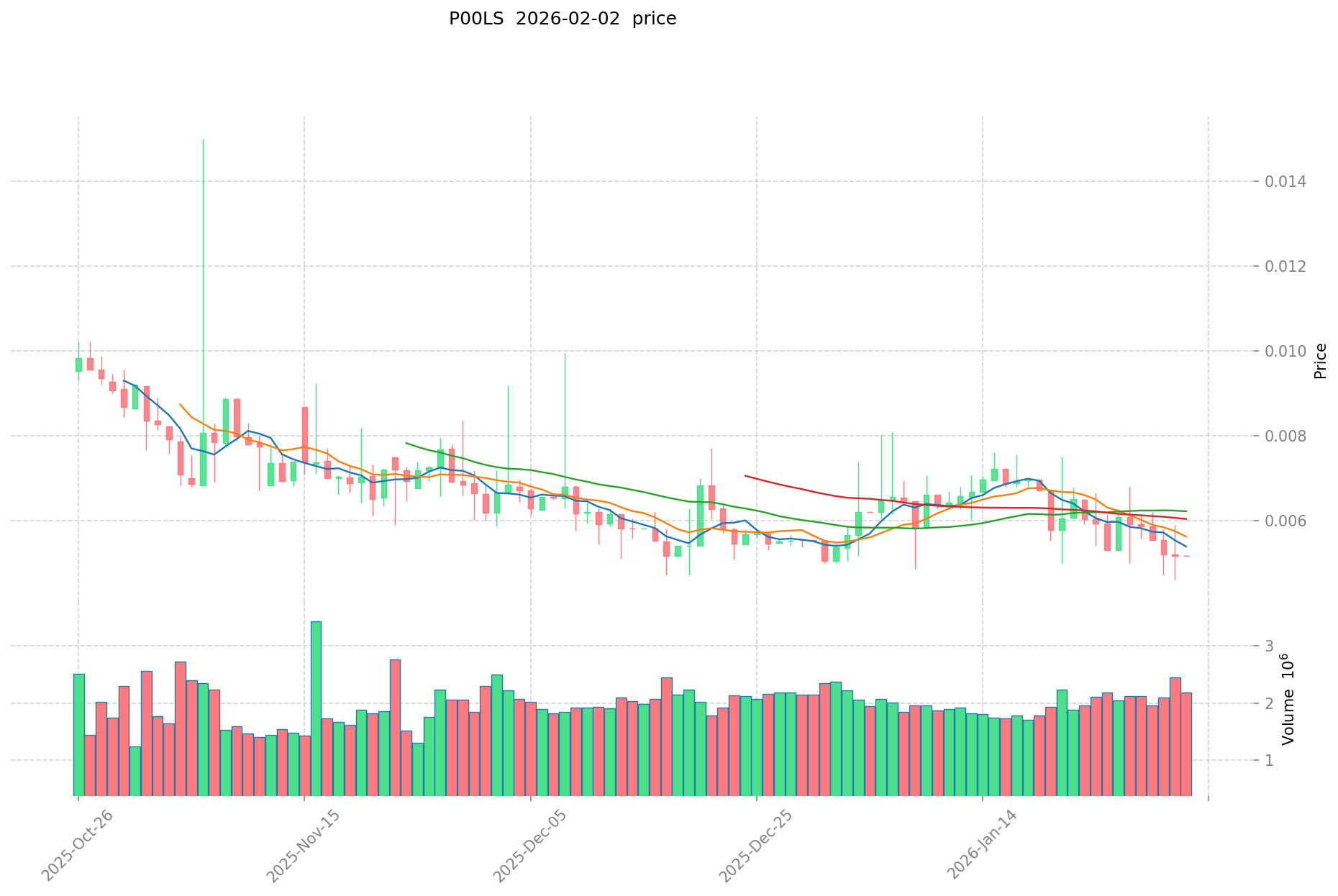
P00LS reached an all-time high of $0.980104 on October 13, 2022, during a period of strong market interest in fan tokens and creator economy platforms.
The token experienced its lowest price of $0.00472959 on February 2, 2026, reflecting broader market corrections and shifting sentiment in the creator token sector.
These fluctuations demonstrate the token's sensitivity to market sentiment, adoption trends, and external factors affecting the creator economy ecosystem.
Click to view current P00LS market price
On-Chain Metrics
- Holder Count: 5,913 addresses (reflecting user participation in the P00LS ecosystem)
- 24-Hour Trading Volume: $13,342.40 (indicating current market activity levels)
- Market Capitalization: $1,210,678.19 (representing the current valuation based on circulating supply)
P00LS Ecosystem Applications and Partners
Core Use Cases
P00LS ecosystem supports multiple applications:
- Creator Economy: P00LS protocol enables artists, creators and brands to launch their own tokens, providing decentralized fan engagement and community building.
- Fan Tokens: zerozero DEX platform facilitates earning and trading of creator cryptocurrencies on Ethereum.
Strategic Partnerships
P00LS collaborates with artists, creators and brands to expand its ecosystem.
These partnerships provide a solid foundation for P00LS ecosystem expansion.
Controversies and Challenges
P00LS faces the following challenges:
- Market Volatility: The token has experienced notable price fluctuations
- Competition Pressure: Other creator economy platforms and fan token protocols in the market
These issues have sparked discussions within the community and market, while also driving P00LS continuous innovation.
Fan Enthusiasm
P00LS community demonstrates engagement with 5,913 token holders.
On X platform, related posts and hashtags (such as #P00LS) generate community discussion.
Sentiment on X shows varied perspectives:
- Supporters praise P00LS decentralized protocol and creator empowerment features, viewing it as innovative infrastructure for the creator economy.
- Critics focus on market performance and adoption challenges.
Hot Topics
X users discuss P00LS protocol development, creator token launches, and zerozero DEX functionality,
showcasing both its transformative potential and path toward mainstream adoption.
- Official Website: Visit P00LS Official Website for features, use cases and latest updates.
- White Paper: P00LS White Paper details its technical architecture, objectives and vision.
- X Updates: On X platform, P00LS uses @p00ls_ account,
posts cover technical updates, community activities, partnership news.
P00LS Future Roadmap
- Ecosystem Goals: Expand creator token adoption and zerozero DEX functionality
- Long-term Vision: Become leading infrastructure for creator economy and fan engagement
How to Participate in P00LS?
- Purchase Channels: Buy P00LS on Gate.com
- Storage Solutions: Use compatible Ethereum wallets like MetaMask to securely store P00LS
- Participate in Governance: Engage with community decisions through P00LS ecosystem
- Build Ecosystem: Visit developer documentation to contribute to the protocol
Summary
P00LS redefines creator-fan relationships through blockchain technology, providing transparency, decentralization, and direct engagement.
Its active community, comprehensive resources and innovative protocol make it distinctive in the cryptocurrency space.
Despite facing market challenges and competition, P00LS innovative approach and clear vision position it prominently in the future of decentralized creator economy.
Whether you are a newcomer or experienced participant, P00LS deserves attention and engagement.
FAQ
What is a cryptocurrency mining pool (Crypto Pools) and how does it work?
A cryptocurrency mining pool combines miners' computational power to increase block discovery chances. Rewards are distributed based on each miner's contribution. It enables small miners to compete against large operations by pooling resources and sharing mining transaction amounts proportionally.
What are the advantages and disadvantages of joining a mining pool?
Advantages: stable rewards, lower technical requirements, and consistent income. Disadvantages: shared profits, pool fees, and less control over mining operations compared to solo mining.
How to choose a suitable cryptocurrency mining pool?
Select a mining pool with strong stability, transparent operations, and competitive fees. Compare payment frequency, reward distribution mechanisms, and network difficulty. Evaluate pool size and historical performance to maximize your mining returns.
How are mining pool profits calculated and distributed?
Mining pool profits are calculated by deducting operational fees, then distributed proportionally based on each miner's contributed hash rate. Your share depends on both your mining power and participation duration in the pool.
What are the risks and security issues in cryptocurrency mining pools?
Mining pools face 51% attack risks where concentrated hashpower becomes a target. Security concerns include data breaches, software vulnerabilities, and potential insider threats. Pool operators must implement robust security protocols to protect miner assets and data integrity.
What is the difference between mining pools and solo mining?
Solo mining allows individual miners to earn full block rewards but faces high volatility and lower success rates. Mining pools combine multiple miners' computing power for stable, consistent rewards, though each miner receives a smaller share. Pool mining provides steadier income with less risk.
What are the mainstream cryptocurrency mining pools?
Major crypto mining pools include Binance Pool, F2Pool, and AntPool. Binance Pool supports multiple cryptocurrencies like BTC, ETC, LTC, and DOGE. F2Pool is another leading platform offering diverse mining options.
* The information is not intended to be and does not constitute financial advice or any other recommendation of any sort offered or endorsed by Gate.