What is PLANCK: A Comprehensive Guide to the Fundamental Unit of Action in Quantum Physics

Planck's Positioning and Significance
In 2025, the Planck team launched Planck (PLANCK), aiming to address challenges in AI computing infrastructure and accessibility for developers. As an emerging AI computing stack provider, Planck plays a role in AI development and deployment across consumer, enterprise, and research sectors.
As of 2026, Planck has established its presence with over 8,200 holders and an active development community focused on AI computing solutions. This article will examine its technical architecture, market performance, and future potential.
Origin and Development History
Background
Planck was created by its founding team in 2025, aiming to solve accessibility barriers in AI computing infrastructure and model training. It emerged during the rapid expansion of AI applications globally, with the goal of empowering consumers, startups, enterprises, and scientists to build AI applications and train models through accessible infrastructure. Planck's launch brought new possibilities for AI developers and researchers seeking scalable computing resources.
Important Milestones
- November 2025: Token listing commenced, establishing initial market presence.
- February 2026: Community growth reached over 8,000 holders, demonstrating ecosystem engagement.
With support from its development team and community, Planck continues to develop its AI computing platforms and expand real-world applications.
How Planck Works
Decentralized Infrastructure
Planck operates on a distributed network infrastructure that supports AI computing workloads across multiple participants. This distributed approach aims to provide accessible AI computing resources without centralized control, potentially enhancing availability and resilience for developers building AI applications.
Blockchain Foundation
Planck's blockchain serves as the underlying ledger for its ecosystem, recording transactions and interactions. Operating on the BSC (BNP-20) standard, the network maintains transparency while enabling ecosystem participants to access and utilize AI computing resources. The blockchain architecture supports the coordination of computing resources and platform interactions.
Token Economics
Planck has a maximum supply of 500 million PLANCK tokens, with approximately 76.55 million tokens currently in circulation (15.31% of total supply). The token serves as the economic mechanism within the Planck ecosystem, facilitating access to AI computing resources and platform services. The distribution model aims to support long-term ecosystem development and participant incentives.
Platform Security
Planck implements standard blockchain security measures to protect ecosystem interactions. The platform's smart contract infrastructure on BSC provides foundational security for token transactions and ecosystem operations. Users maintain control of their assets through standard cryptographic key management, where private keys secure transactions and public addresses enable verifiable ownership.
Planck's Market Performance
Circulation Overview
As of February 07, 2026, Planck's circulating supply is 76,550,000 PLANCK tokens, with a total supply of 500,000,000 tokens (fixed supply model with a maximum cap of 500,000,000 tokens).
The circulating supply represents approximately 15.31% of the total supply, indicating significant token reserves that may enter the market through future distributions or unlocking schedules.
Price Volatility
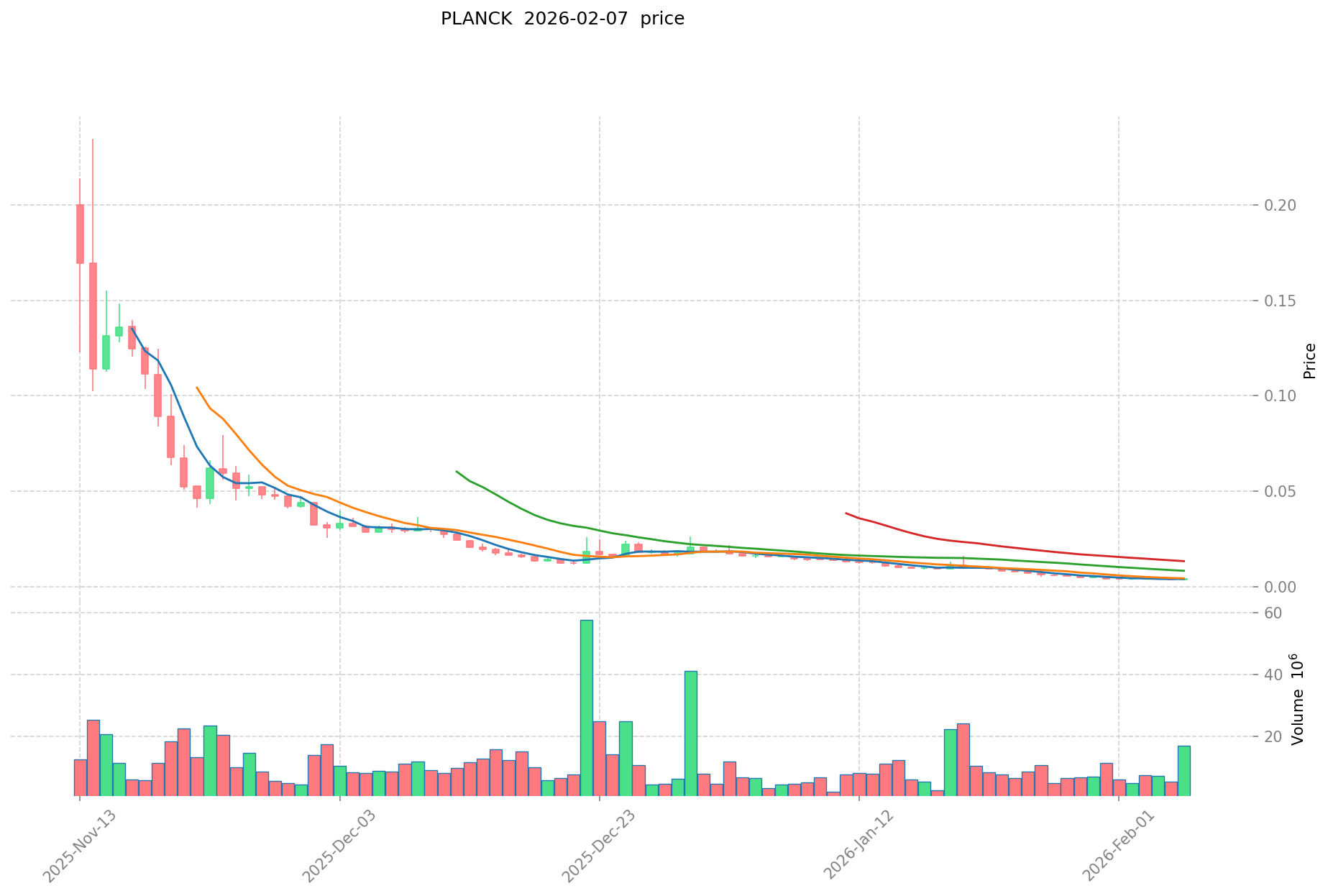
Planck reached its peak price of $0.2348 on November 14, 2025, reflecting early market enthusiasm following its launch and initial trading activity.
The lowest recorded price was $0.003521, occurring on February 06, 2026, representing a substantial decline from its peak. This price movement reflects broader market dynamics and evolving adoption patterns within the AI computing sector.
As of the latest update, PLANCK is trading at $0.003909, showing a 1.77% increase over the past 24 hours, though down 17.53% over the past week and 72.36% over the past 30 days.
Click to view current PLANCK market price
On-chain Metrics
- 24-hour Trading Volume: $66,326.53 (indicating current market activity levels)
- Holder Count: 8,243 addresses (reflecting community distribution)
- Market Capitalization: $299,233.95 (representing current network valuation)
- Fully Diluted Valuation: $1,954,500 (projected valuation at maximum supply)
Planck Ecosystem Applications and Partners
Core Use Cases
Planck's ecosystem supports multiple applications:
- AI Computing Infrastructure: Planck provides state-of-the-art AI computing solutions, offering decentralized AI computing resources.
- AI Cloud Services: Planck develops platforms that enable AI research and development across industry domains.
Strategic Collaborations
Planck aims to empower consumers, startups, enterprises and scientists across the US, Asia and the world to build AI applications and train AI models. These partnerships provide a solid foundation for Planck's ecosystem expansion.
Challenges and Controversies
Planck faces the following challenges:
- Market Volatility: The token has experienced significant price fluctuations, with a 72.36% decrease over 30 days.
- Competition Pressure: The AI computing and blockchain sectors feature numerous competitors vying for market share.
These issues have sparked discussions within the community and market, while also driving Planck's continuous innovation.
Planck Community and Social Media Atmosphere
Community Enthusiasm
Planck's community shows activity, with 8,243 token holders as of the latest data.
On X platform, related posts and hashtags (such as #Planck) generate engagement.
Social Media Sentiment
Sentiment on X presents diverse perspectives:
- Supporters praise Planck's AI computing capabilities and decentralized approach, viewing it as a promising infrastructure for future AI development.
- Critics focus on price volatility and market performance challenges.
Recent trends reflect mixed sentiment following significant price movements.
Hot Topics
X users actively discuss Planck's AI computing stack development, token performance, and ecosystem expansion, showcasing both its transformative potential and the obstacles on its path to mainstream adoption.
More Information Sources about Planck
- Official Website: Visit Planck's official website for features, use cases and latest updates.
- Whitepaper: The Planck whitepaper details its technical architecture, objectives and vision.
- X Updates: On X platform, Planck maintains an active presence at @plancknetwork, with posts covering technology updates, community activities, and ecosystem developments.
Planck Future Roadmap
- Ecosystem Goals: Continue developing AI computing infrastructure and expanding platform capabilities to support AI research and application deployment.
- Long-term Vision: Become a leading AI computing stack that empowers global users to build AI applications and train AI models.
How to Participate in Planck?
- Purchase Channels: Planck (PLANCK) is available on Gate.com and other exchanges.
- Storage Solutions: Use secure wallets compatible with BEP-20 tokens to store PLANCK safely.
- Participate in Ecosystem: Visit the official Discord community at discord.gg/9XnHVw4J7U to engage with the community.
- Build on Ecosystem: Explore development opportunities by accessing official resources and documentation.
Summary
Planck aims to redefine AI computing infrastructure through blockchain technology, providing decentralized AI computing resources, cloud services, and foundational models. Its growing community, available resources and clear technological focus position it within the AI and blockchain intersection. Despite facing market volatility and competitive pressures, Planck's innovative approach and development roadmap establish its presence in the decentralized AI computing space. Whether you are a newcomer or an experienced participant, Planck represents an interesting project to follow and engage with.
FAQ
What is Crypto PLANCK and what is its main purpose?
Crypto PLANCK is a decentralized AI infrastructure stack designed to empower developers and enterprises. Its main purpose is to provide a comprehensive platform for AI development, deployment, and innovation in the Web3 ecosystem.
How can I buy and store PLANCK cryptocurrency?
Create an account on a major cryptocurrency exchange, deposit funds, and purchase PLANCK tokens. Transfer your PLANCK to a secure wallet (hardware or software wallet) for storage and safekeeping.
What is the total supply and current market price of PLANCK token?
PLANCK token has a total supply of 500 million. The current market price is $0.00391, with trading volume reaching $1.44M.
Is PLANCK a safe investment and what are the risks involved?
PLANCK carries inherent cryptocurrency market risks including price volatility and regulatory uncertainty. Success depends on your risk tolerance and research. Potential rewards exist for informed investors willing to accept market fluctuations.
What blockchain network does PLANCK operate on?
PLANCK operates on multiple blockchain networks including Ethereum, Binance Smart Chain, and Polkadot, enabling cross-chain functionality for seamless Web3 integration.
How does PLANCK differ from other cryptocurrencies like Bitcoin or Ethereum?
PLANCK is a decentralized AI compute platform, unlike Bitcoin and Ethereum which focus on blockchain transactions and smart contracts. The PLANCK token grants access to AI computing resources rather than serving as digital currency or transaction settlement layers.
Share
Content
Planck's Positioning and Significance
Origin and Development History
How Planck Works
Planck's Market Performance
Planck Ecosystem Applications and Partners
Challenges and Controversies
Planck Community and Social Media Atmosphere
More Information Sources about Planck
Planck Future Roadmap
How to Participate in Planck?
Summary
FAQ
How to Buy Cryptocurrency


Trending Cryptocurrencies



Survey Note: Detailed Analysis of the Best AI in 2025

What Is the Best AI Crypto in 2025?

What is the Best AI Now?

Why ChatGPT is Likely the Best AI Now?

How Does Solidus Ai Tech's Market Cap Compare to Other AI Cryptocurrencies?

MomoAI: AI-Powered Social Gaming Revolution on Solana

Cryptocurrency theft surpassed $2 billion in 2025—it's time to reconsider how we store digital assets
What is crypto arbitrage and how can you profit from it?

What Is Tokenomics? The Economics of Crypto Asset Tokens
What Is Slippage? How To Avoid It While Trading Cryptocurrencies?
What is Web 3.0? Pros, Cons of Web 3.0, and Its Relationship with Cryptocurrency and Blockchain