What is PoS in Cryptocurrency: Proof-of-Stake Explained for Beginners

Understanding Proof-of-Stake in Cryptocurrency
Proof-of-Stake (PoS) is a consensus algorithm used in blockchain networks. In simpler terms, it represents a set of rules that enables a digital network, such as a cryptocurrency network, to operate efficiently and securely.
The literal translation of Proof-of-Stake refers to "proof of ownership stake." This concept relates to the coins that are under the control of each user within a PoS network. The system requires information about user balances to fairly distribute rewards among network participants.
In the digital asset market, there are two primary consensus algorithms: Proof-of-Work (PoW), which powers the most capitalized cryptocurrency—Bitcoin, and Proof-of-Stake, which emerged as an alternative to PoW. Understanding the distinction between these mechanisms is crucial for anyone interested in blockchain technology and cryptocurrency ecosystems.
The Origins and Development of Proof-of-Stake
The concept of Proof-of-Stake was first introduced on July 11, 2011—nearly three years after the publication of Bitcoin's white paper—by a user with the nickname QuantumMechanic on a popular cryptocurrency forum. The key distinction between PoS and PoW, as highlighted by the author, lies in the principle of reward distribution:
- PoW Reward Distribution Scheme: Those who contribute more computational power to solving network tasks are entitled to a larger share of the income. This creates a competitive environment where mining hardware capabilities directly determine profitability.
- PoS Reward Distribution Scheme: Those who hold more coins of the network they are connected to are entitled to a larger share of the income. This shifts the focus from computational power to stake ownership.
The purpose of creating PoS was to provide an alternative to PoW. The Proof-of-Work mechanism involves a constant arms race in terms of hardware, which leads to increased negative environmental impact. The principles of Proof-of-Stake involve less pressure on the environment, as well as better speed characteristics and energy efficiency. This makes PoS an attractive option for modern blockchain projects seeking sustainability.
How Proof-of-Stake Works: Understanding the Mechanics
PoS networks, like their PoW counterparts, require participants who will process tasks, including conducting transactions. Network nodes that perform such work are called validators or nodes. The requirements to obtain such status may vary across different blockchain implementations.
Typically, to become a validator node in a PoS cryptocurrency network, a user needs to lock up a certain amount of coins. For example, in the case of Ethereum, this involves staking 32 ETH. This locked amount serves as collateral and demonstrates the validator's commitment to the network's security and proper operation.
The locked coins serve as a guarantee of the network node's effective operation. In case of errors or confirmation of invalid transactions, the system can, as compensation, take part of the node owner's deposit. This mechanism, known as "slashing," ensures that validators act honestly and maintain network integrity.
As payment for their work, network nodes receive coins from the cryptocurrency network they service. Part of the income also consists of fees that users pay for conducting operations. The revenue model incentivizes validators to maintain high uptime and process transactions efficiently.
The right to process tasks in a PoS system is distributed depending on the amount of locked coins. For operation, only one computing device is sufficient, such as a computer that will be constantly connected to the network. This represents a significant advantage over PoW mining, which requires substantial hardware investments.
The Connection Between Staking and Proof-of-Stake
Short answer: Staking is the PoS alternative to traditional mining.
The extraction of cryptocurrencies in PoW networks is called mining. The process involves connecting computational power to the cryptocurrency network to solve tasks, including processing transactions. Miners compete to solve complex mathematical puzzles, and the first to succeed adds a new block to the blockchain.
In PoS networks, coins are obtained differently—through staking. The term implies locking cryptocurrency to ensure the stability of its network operation. Staking is more environmentally friendly than traditional mining, as stakers are not forced to use a lot of computing equipment. Instead, they commit their tokens to the network, and the system selects validators based on their stake size and other factors.
Staking has become increasingly popular as it allows cryptocurrency holders to earn passive income while supporting network security. The process is more accessible to average users compared to mining, which often requires specialized hardware and technical expertise.
Varieties and Modifications of Proof-of-Stake
During the existence of Proof-of-Stake, many variations of the algorithm have appeared in the market. Let's examine five popular modifications that have gained traction in various blockchain projects:
1. Effective Proof-of-Stake (EPoS). This variation focuses on achieving optimal decentralization.
- The essence of EPoS: The algorithm ensures network decentralization by encouraging the launch of smaller validators—blockchain nodes that maintain network operability and handle transaction confirmation. This approach prevents the concentration of power among a few large validators. Such an approach is used, for example, in the Harmony project, which aims to balance security with accessibility.
2. Leased Proof-of-Stake (LPoS). This model enables token holders to participate without running their own nodes.
- The essence of LPoS: Network participants lease their cryptocurrency to validators. This mechanism allows users with smaller holdings to participate in staking rewards without meeting the minimum stake requirements. Such a mechanism is used, for example, in the Waves blockchain, which pioneered this approach to democratize staking participation.
3. Nominated Proof-of-Stake (NPoS). This system introduces an additional layer of accountability.
- The essence of NPoS: The system has a special class of participants—nominators. Their task is to ensure the integrity of validators' work. To do this, nominators make deposits for validators, creating a multi-layered security structure. This principle is used, for example, in Polkadot, where nominators actively participate in validator selection and monitoring.
4. Proof-of-Authority (PoA). This hybrid approach combines multiple verification methods.
- The essence of PoA: The scheme combines the principles of proof of ownership stake and proof of validator reputation. Each PoA validator undergoes verification procedures that ensure transparency of the participant's relationship with the project. This includes identity verification and reputation building. Such an approach is used, for example, in the blockchain of a major cryptocurrency exchange platform, where trust and accountability are paramount.
5. Pure Proof-of-Stake (PPoS). This implementation emphasizes randomization and fairness.
- The essence of PPoS: The system automatically and randomly selects validators. The approach ensures democratization of staker earnings by preventing predictable patterns that could be exploited. Such an approach is used, for example, in Algorand, which has developed sophisticated cryptographic methods to achieve true randomness in validator selection.
Cryptocurrencies Operating on Proof-of-Stake
Following a major network upgrade, Ethereum became the most capitalized cryptocurrency operating on PoS. Initially, the project operated on PoW, but after many years of preparation, the developers implemented its transition to Proof-of-Stake. This transition, known as "The Merge," represented one of the most significant events in cryptocurrency history.
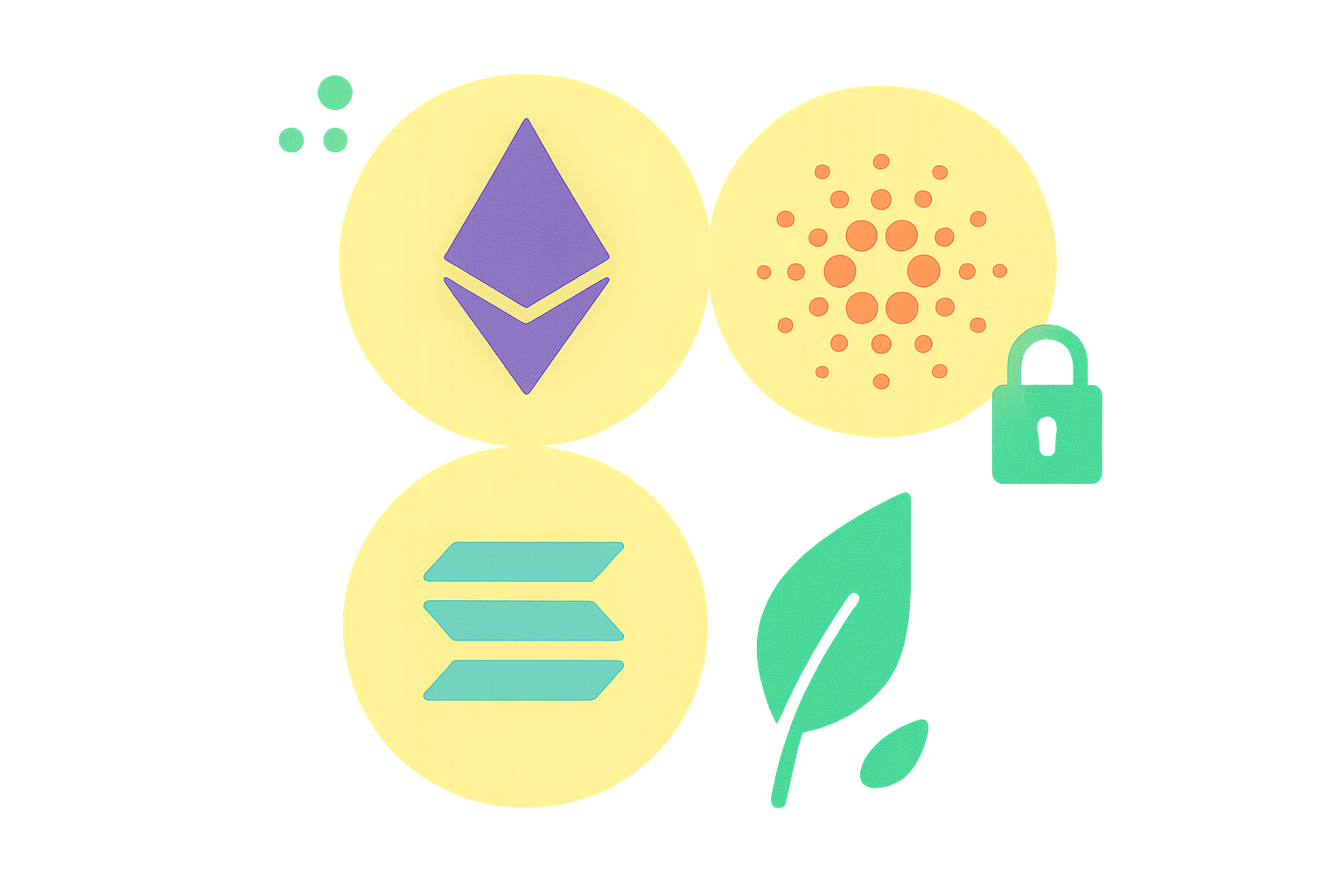
Additionally, cryptocurrencies such as Cardano, Solana, and Algorand operate on PoS and its variants. Each of these projects has implemented unique features and optimizations to their respective PoS mechanisms:
- Cardano employs a research-driven approach with its Ouroboros protocol, which has been peer-reviewed and academically validated
- Solana combines PoS with Proof-of-History (PoH) to achieve high transaction throughput
- Algorand uses Pure Proof-of-Stake to ensure immediate transaction finality and network security
These implementations demonstrate the versatility and adaptability of the Proof-of-Stake consensus mechanism across different blockchain architectures.
Why Ethereum Transitioned to Proof-of-Stake
Ethereum transitioned to Proof-of-Stake for several compelling reasons, including the desire to accelerate network operation and reduce its negative environmental impact. The energy consumption of PoW mining had become a significant concern for the Ethereum community and the broader cryptocurrency ecosystem.
The transition addressed multiple challenges simultaneously:
- Environmental Sustainability: The shift reduced Ethereum's energy consumption by approximately 99.95%, making it significantly more environmentally friendly
- Scalability Improvements: PoS laid the groundwork for future scaling solutions, including sharding, which will further increase transaction throughput
- Economic Efficiency: The lower hardware requirements make network participation more accessible to a broader range of users
- Security Enhancements: The economic penalties for malicious behavior create stronger incentives for honest participation
In the cryptocurrency community, the PoS version of the coin is commonly referred to as ETH 2.0, though the Ethereum Foundation has moved away from this terminology to emphasize that it represents an upgrade rather than a separate cryptocurrency. This transition has set a precedent for other major blockchain projects considering similar upgrades to improve sustainability and efficiency.
FAQ
What is PoS (Proof of Stake) and how does it work?
Proof of Stake is a consensus mechanism where validators are chosen based on the coins they hold and stake as collateral. Unlike Proof of Work, PoS eliminates energy-intensive mining. Validators earn rewards by securing the network through their staked cryptocurrency, making it more energy-efficient and environmentally sustainable.
PoS and PoW (Proof-of-Work) have what differences?
PoS selects validators based on staked cryptocurrency holdings, while PoW uses computational power to mine blocks. PoW is energy-intensive; PoS aims for lower energy consumption. Bitcoin uses PoW, Ethereum uses PoS.
How do I start participating in PoS staking and earning rewards?
Purchase a PoS cryptocurrency like ETH, SOL, or ADA, then stake it on a staking platform or through a wallet. Lock your assets to validate transactions and earn passive rewards proportional to your staked amount.
What are the risks and considerations for PoS staking?
PoS staking risks include slashing penalties for validator misbehavior, third-party security vulnerabilities if using custodial services, and market volatility affecting returns. Staking is only available on specific PoS blockchains. Lock-up periods may limit liquidity.
Which well-known cryptocurrencies use the PoS consensus mechanism?
Ethereum 2.0, Polkadot, Cardano, and Solana are major cryptocurrencies using Proof-of-Stake consensus. These projects are widely recognized in the crypto industry for their energy-efficient validation approaches.
What is the typical annual yield rate for PoS?
PoS annual yields typically range from 2% to 25%, depending on the project and network. Major projects like Tezos offer around 7% annually, while Cosmos and other validators provide varying returns based on participation rates and network conditions.
What environmental advantages does PoS have compared to PoW?
PoS consumes significantly less energy than PoW since it eliminates energy-intensive mining computations. This dramatically reduces carbon emissions and environmental impact, making PoS a more sustainable blockchain consensus mechanism.
Will staked cryptocurrency be frozen? Can I withdraw anytime?
Staked cryptocurrency typically remains accessible and can usually be withdrawn anytime. However, specific withdrawal rules vary by platform, and some may have unstaking periods or minimum lock-up durations. Always check your platform's terms before staking.
Share
Content
Understanding Proof-of-Stake in Cryptocurrency
The Origins and Development of Proof-of-Stake
How Proof-of-Stake Works: Understanding the Mechanics
The Connection Between Staking and Proof-of-Stake
Varieties and Modifications of Proof-of-Stake
Cryptocurrencies Operating on Proof-of-Stake
Why Ethereum Transitioned to Proof-of-Stake
FAQ
How to Buy Cryptocurrency


Trending Cryptocurrencies



Ethereum 2.0 in 2025: Staking, Scalability, and Environmental Impact

2025 best encryption staking platform recommendation: secure and profitable

How to Buy Crypto: A Step-by-Step Guide with Gate.com

Crypto Assets Stake Full Analysis: How to Earn Passive Income Through Tokens
MemeBox Price and Airdrop Guide 2025: What You Need to Know

Can AI Companions (AIC) Reach $0.2729 in Price Prediction?

Is Göztepe S.K. Fan Token (GOZ) a good investment?: A comprehensive analysis of risks, returns, and market potential for football fans and crypto investors

Is Griffin AI (GAIN) a good investment?: A Comprehensive Analysis of the Emerging AI Token's Potential and Risks

Is STEPN Failing to Generate Profits? Exploring the Factors Behind Its Downturn

LABUBU vs BTC: Which Digital Asset Will Dominate the Future of Collectibles and Cryptocurrency?
GOZ vs BTC: Which Cryptocurrency Offers Better Investment Potential in 2024?