This comprehensive guide explores Privasea AI (PRAI), a decentralized infrastructure leveraging Fully Homomorphic Encryption to enable privacy-preserving machine learning and secure AI computation on encrypted data. Launched in 2025, PRAI addresses critical challenges in healthcare, finance, and digital identity verification by allowing sensitive data processing without plaintext exposure. The article examines PRAI's technical architecture, market performance with 29,062 token holders, and ecosystem applications across Web2 and Web3 platforms. It covers current market metrics, competitive challenges, and community sentiment on privacy-focused AI infrastructure. Readers will learn how to purchase PRAI on Gate.com, understand tokenomics with 1 billion total supply, and explore participation opportunities within the growing DePIN sector. Whether you're exploring blockchain AI integration or decentralized computing solutions, this guide provides essential insights into PRAI's role as foundational infrastructure f
Privasea AI's Positioning and Significance
In 2025, the Privasea team launched Privasea AI (PRAI), aiming to address challenges in data privacy and secure AI computation, particularly the inability to process sensitive data without exposing it in plaintext.
As a decentralized infrastructure for confidential AI leveraging Fully Homomorphic Encryption (FHE), Privasea AI plays a critical role in privacy-preserving machine learning, healthcare data processing, and digital identity verification.
As of 2026, Privasea AI has established itself within the DePIN (Decentralized Physical Infrastructure Network) sector, with over 29,000 token holders and an active development community.
This article will provide an in-depth analysis of its technical architecture, market performance, and future potential.
Origin and Development Journey
Birth Background
Privasea AI was created by the Privasea development team in 2025, aiming to solve the critical challenge of enabling AI models to process encrypted data without compromising privacy or requiring plaintext exposure.
It emerged within the growing intersection of blockchain technology and artificial intelligence, with the objective of providing secure computation infrastructure that complies with data protection standards while enabling advanced machine learning applications.
The launch of Privasea AI brought new possibilities to healthcare institutions, financial services providers, and Web3 applications requiring confidential data processing.
Key Milestones
- January 2025: Mainnet launch, implementing Fully Homomorphic Encryption-based secure computation capabilities.
- May 2025: Token reached a notable price level, gaining traction within the DePIN ecosystem.
- 2025-2026: Ecosystem expansion with support for both Web2 and Web3 applications, particularly focusing on machine learning use cases.
With support from the Privasea community and development foundation, Privasea AI continues to optimize its technology, security infrastructure, and real-world applications.
How Privasea AI Works
Decentralized Control
Privasea AI operates on a decentralized network of computing nodes distributed globally, independent of centralized corporate or governmental control.
These nodes collaborate to validate computations and maintain the network, ensuring transparency and resistance to attacks while granting users greater autonomy and enhancing network resilience.
Blockchain Foundation
Privasea AI's blockchain serves as a public, immutable digital ledger recording computational tasks and transactions.
Operations are grouped into blocks and linked through cryptographic hashes to form a secure chain.
Anyone can verify records without intermediaries, establishing trust through transparency.
The platform's architecture supports both Web2 and Web3 applications, enabling seamless integration across different technological ecosystems.
Secure Infrastructure
Privasea AI employs a consensus mechanism appropriate for DePIN networks to validate transactions and prevent fraudulent activities.
Network participants maintain security by operating nodes and contributing computational resources, receiving PRAI token rewards in return.
Its innovation lies in enabling confidential AI through Fully Homomorphic Encryption, allowing computation on encrypted data without decryption.
Privacy-Preserving Technology
Privasea AI utilizes advanced cryptographic techniques to protect data and computations:
- Fully Homomorphic Encryption (FHE) enables AI models to process encrypted data directly
- Privacy-preserving computation ensures sensitive information remains confidential throughout processing
This mechanism ensures data security while maintaining strong privacy guarantees suitable for regulated industries like healthcare and finance.
The FHE-based approach allows organizations to leverage AI capabilities without compromising data confidentiality or violating compliance requirements.
Circulating Supply Overview
As of February 4, 2026, the circulating supply of Privasea AI (PRAI) stands at 206,035,500 tokens, representing approximately 20.6% of the total supply of 1,000,000,000 PRAI. The maximum supply is capped at 1,000,000,000 tokens, establishing a fixed supply model.
The token operates on the BSC (Binance Smart Chain) with the contract address 0x899357e54c2c4b014ea50a9a7bf140ba6df2ec73. The controlled release of tokens into circulation impacts the supply-demand dynamics of the market.
Price Volatility
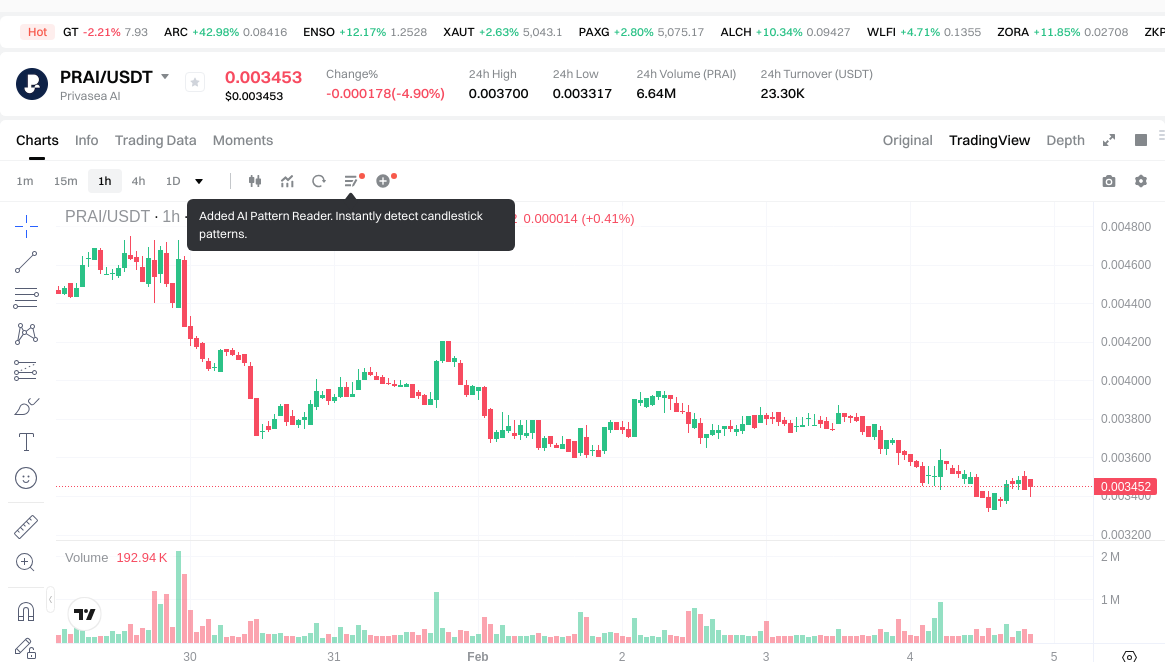
PRAI reached its highest recorded price of $0.425 on May 14, 2025, during a period of increased interest in decentralized AI infrastructure and privacy-focused blockchain solutions. The token's lowest price of $0.003317 was recorded on February 4, 2026, reflecting recent market adjustments.
Over the past year, PRAI has experienced considerable price movement, with a year-to-date change of -97.86%. Recent performance shows:
- 1H: -1.15%
- 24H: -5.96%
- 7D: -23.75%
- 30D: -23.59%
These fluctuations reflect evolving market sentiment, adoption trends, and broader cryptocurrency market dynamics. The current price stands at $0.003423 as of the latest update.
Click to view the current PRAI market price
On-Chain Metrics
- 24H Trading Volume: $23,347.35 (indicating current market activity levels)
- Holder Count: 29,062 addresses (reflecting community distribution and participation)
- Market Capitalization: $705,259.52 (representing the current market valuation)
- Fully Diluted Market Cap: $3,423,000 (potential valuation at maximum supply)
- Market Dominance: 0.00012% (share of the total cryptocurrency market)
The token is currently listed on 13 exchanges, with Gate.com being a primary trading venue. The circulating supply to fully diluted valuation ratio of 20.6% suggests significant token allocation remains for future distribution, which may influence long-term price dynamics and community growth.
Privasea AI Ecosystem Applications and Partners
Core Use Cases
Privasea AI's ecosystem supports multiple applications:
- Confidential AI Infrastructure: The platform enables secure computation on encrypted data using Fully Homomorphic Encryption (FHE), providing privacy-preserving machine learning capabilities.
- Cross-Platform Integration: Privasea supports both Web2 and Web3 applications, promoting decentralized AI solutions across healthcare, finance, and digital identity sectors.
Strategic Partnerships
Privasea AI continues to build its technical capabilities and market presence through ecosystem development.
These relationships provide a solid foundation for Privasea AI's ecosystem expansion.
Challenges and Discussions
Privasea AI faces the following challenges:
- Technical Complexity: Implementing FHE technology while maintaining performance efficiency
- Market Competition: Navigating a competitive landscape in the decentralized AI infrastructure space
- Adoption Barriers: Educating users and developers about confidential computing benefits
These issues have sparked discussions within the community and market, driving Privasea AI's continuous innovation.
Privasea AI's community shows growing activity, with 29,062 token holders as of February 04, 2026.
On X platform, related posts and hashtags (such as #PRAI) generate ongoing discussions.
Community engagement reflects interest in privacy-preserving AI technology and decentralized infrastructure developments.
Sentiment on X presents mixed perspectives:
- Supporters praise Privasea AI's innovative approach to confidential computing and FHE technology, viewing it as essential infrastructure for privacy-preserving AI applications.
- Observers monitor price volatility and early-stage project development as the platform builds its ecosystem.
Recent trends show varying sentiment as the project continues its development phase.
Hot Topics
X users actively discuss Privasea AI's FHE implementation, DePIN infrastructure development, and potential applications in regulated industries,
showcasing both its transformative potential and the challenges of building decentralized AI infrastructure.
- Official Website: Visit Privasea AI Official Website for features, use cases, and latest updates.
- X Updates: On X platform, Privasea AI actively engages using @Privasea_ai,
with posts covering technical developments, community activities, and ecosystem updates.
- Block Explorer: View PRAI on BSC for on-chain data and transaction information.
Privasea AI Future Roadmap
- Ongoing Development: Advancing FHE-based confidential computing infrastructure to enhance privacy-preserving AI capabilities
- Ecosystem Goals: Expanding support for Web2 and Web3 applications across healthcare, finance, and digital identity sectors
- Long-term Vision: Establishing itself as foundational infrastructure for privacy-preserving AI and decentralized machine learning
How to Participate in Privasea AI?
- Purchase Options: Buy PRAI on Gate.com and other supported exchanges
- Storage Solutions: Use compatible BSC wallets to securely store your tokens
- Community Engagement: Follow official channels to stay updated on project developments and participate in discussions
- Ecosystem Building: Explore opportunities to develop applications utilizing Privasea's confidential AI infrastructure
Summary
Privasea AI leverages blockchain and FHE technology to redefine privacy-preserving artificial intelligence, providing secure computation on encrypted data, compliance-friendly solutions, and decentralized infrastructure.
Its growing community, technical innovation, and focus on confidential computing position it uniquely in the DePIN and AI sectors.
While facing adoption challenges and market volatility, Privasea AI's commitment to privacy-preserving technology and clear development focus give it a meaningful role in the future of decentralized AI.
Whether you're new to crypto or an experienced participant, Privasea AI represents an interesting project in the intersection of blockchain and artificial intelligence.
FAQ
What is PRAI cryptocurrency and what problem does it solve?
PRAI is a privacy-focused token powering a decentralized network that enables secure AI computations on encrypted data using Fully Homomorphic Encryption. It solves critical privacy concerns in data processing and analysis, allowing computational operations without exposing sensitive information.
How do I buy and store PRAI tokens?
Purchase PRAI tokens through supported exchanges and transfer them to a secure wallet. Your tokens can be stored in exchange wallets or self-custody solutions like MetaMask for enhanced security and full control.
What are the main features and use cases of the PRAI project?
PRAI transforms natural language prompts into structured, maintainable code for reliable outputs. Main features include code quality improvement, debuggability, and maintainability. Use cases span automated code generation, development efficiency enhancement, and reliable software output production.
Is PRAI safe to invest in? What are the potential risks?
PRAI carries high risk as a small-cap token with limited liquidity. Weak fundamentals and low trading volume make it volatile. Only invest what you can afford to lose. High risk, high reward potential.
How does PRAI differ from other similar cryptocurrency projects?
PRAI distinguishes itself through its specialized focus on decentralized finance integration and Web3 protocol compatibility. Unlike projects emphasizing privacy or scalability alone, PRAI combines efficient transaction processing with robust smart contract functionality, delivering superior interoperability across the Web3 ecosystem.
What is the tokenomics and supply structure of PRAI?
PRAI has a total supply of 1 billion tokens. It is the native utility token of the Privasea ecosystem, powering the DeepSea AI Network and FheID protocol for confidential AI applications.
* The information is not intended to be and does not constitute financial advice or any other recommendation of any sort offered or endorsed by Gate.