PUSH is a pioneering decentralized notification protocol launched in 2021 to revolutionize Web3 communication infrastructure. This comprehensive guide explores how PUSH eliminates reliance on centralized notification services by enabling seamless, permissionless messaging between smart contracts, dApps, and users. The article examines PUSH's technical architecture, governance tokenomics allocating 70% fee rewards to token holders, and market performance with 5,561 active participants. Discover core use cases in DeFi protocols and Web3 applications, community engagement dynamics, and strategic ecosystems partnerships. Learn how to purchase PUSH on Gate and participate in protocol governance, while understanding both innovative potential and adoption challenges facing decentralized communication infrastructure.
PUSH's Position and Significance
In 2021, the EPNS (Ethereum Push Notification Service) team launched PUSH to address the lack of efficient, decentralized communication infrastructure in the blockchain ecosystem.
As a pioneering decentralized notification protocol, PUSH plays a critical role in Web3 communication, DeFi user engagement, and blockchain application interaction.
As of 2026, PUSH has established itself as a key infrastructure component for Web3 notifications, serving 5,561 holders and supporting an active developer community.
This article will provide an in-depth analysis of its technical architecture, market performance, and future potential.
Origin and Development Journey
Birth Background
PUSH was created by the EPNS team in 2021, aiming to solve the absence of a standardized, platform-agnostic notification system for decentralized applications.
It emerged during the rapid expansion of DeFi and Web3 applications, with the goal of enabling seamless, permissionless communication between smart contracts, dApps, and users to transform how blockchain applications engage their audiences.
The launch of PUSH brought new possibilities to Web3 developers and blockchain users seeking reliable notification infrastructure.
Important Milestones
- 2021: Protocol launch on Ethereum mainnet, introducing decentralized push notifications for wallet addresses.
- 2021: Token Generation Event (TGE) at $3.97, establishing PUSH as the native governance token.
- Post-2021: Integration with multiple DeFi protocols and dApps, expanding the notification ecosystem.
- 2026: Maintained active development with 8 exchange listings and continued protocol improvements.
With support from the EPNS Foundation and an engaged community, PUSH continues to enhance its technical capabilities, security features, and real-world applications.
How PUSH Works
Decentralized Communication Layer
PUSH operates on a decentralized notification protocol built on Ethereum, eliminating reliance on centralized notification services or traditional servers.
The protocol enables any smart contract, dApp, or service to send notifications directly to users' wallet addresses in a platform-independent manner, ensuring transparency and censorship resistance while giving users greater control over their communication preferences.
Protocol Architecture
The PUSH protocol functions as a specialized communication layer on the blockchain, creating an immutable record of notification channels and subscriber relationships.
Notifications are delivered through the protocol infrastructure to multiple interfaces including mobile devices, web applications, and wallet integrations.
Users can subscribe to channels of interest, and the protocol ensures reliable delivery across platforms.
The architecture supports scalability through its efficient channel-based system and cross-platform compatibility.
Governance and Incentives
PUSH utilizes its native token for protocol governance and reward distribution, enabling token holders to participate in development decisions.
PUSH holders contribute to network governance through voting mechanisms and benefit from protocol fee distribution.
The tokenomics allocate 70% of fee pool rewards to PUSH holders and 30% to the ecosystem development fund, designed to activate approximately one year after protocol launch.
This model incentivizes long-term participation and sustainable ecosystem growth.
Security and User Control
The PUSH protocol employs cryptographic mechanisms to ensure secure channel creation and notification delivery:
- Channel owners sign notifications to prove authenticity
- User wallets control subscription preferences and notification receipt
This architecture ensures users maintain sovereignty over their communication channels, with notifications remaining verifiable and permission-based.
The protocol's design prioritizes user consent and data ownership throughout the notification process.
Circulation Overview
As of February 03, 2026, PUSH has a circulating supply of 90,236,482 tokens, with a total supply of 100,000,000 tokens and a maximum supply capped at 100,000,000 tokens, indicating a fixed supply model.
The circulating supply represents approximately 90.24% of the total supply, with the circulating market capitalization at $1,221,350.78 and the fully diluted market capitalization at $1,353,500.
Price Fluctuations
PUSH reached its historical high of $8.73 on April 14, 2021, during a period of heightened market activity and broader cryptocurrency market momentum.
The token experienced its lowest price of $0.00961203 on January 21, 2026, reflecting recent market pressures and volatility in the broader cryptocurrency ecosystem.
Recent price performance shows varied trends across different timeframes:
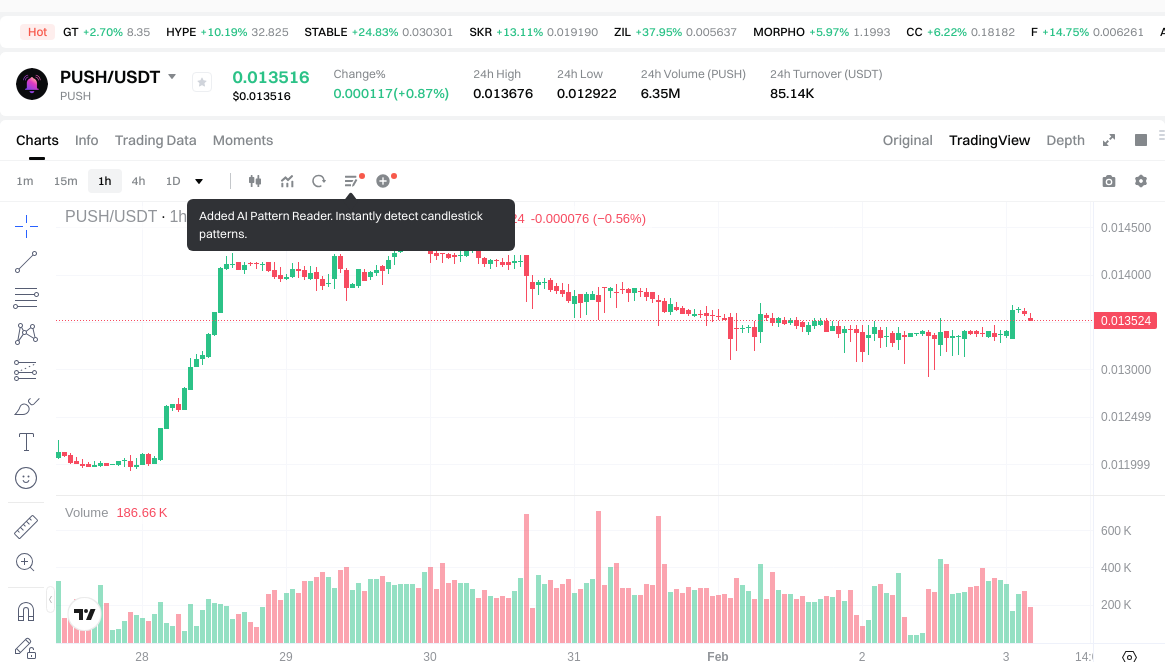
- 1-hour change: -0.57% (price decreased by $0.000078)
- 24-hour change: +1.52% (price increased by $0.000203)
- 7-day change: +14.33% (price increased by $0.001696)
- 30-day change: +8.55% (price increased by $0.001066)
- 1-year change: -81.67% (price decreased by $0.060306)
The current trading price stands at $0.013535 as of the latest update, with a 24-hour high of $0.013676 and a 24-hour low of $0.012922.
These fluctuations reflect changing market sentiment, adoption trends, and external factors affecting the decentralized notification protocol sector.
Click to view current PUSH market price
On-Chain Metrics
- 24-hour trading volume: $85,233.65 (indicating current market activity levels)
- Number of holders: 5,561 addresses (reflecting user participation in the PUSH ecosystem)
- Market dominance: 0.000049% (representing PUSH's share in the overall cryptocurrency market)
PUSH Ecosystem Applications and Partners
Core Use Cases
PUSH's ecosystem supports multiple applications:
- DeFi Protocols: Integration with decentralized finance platforms, providing decentralized notification services for liquidation alerts, governance updates, and protocol changes.
- Web3 Communication: Supporting dApps and smart contracts, enabling platform-independent push notifications across mobile devices, tablets, and user wallets.
Strategic Collaborations
PUSH has established its presence within the Ethereum ecosystem, enhancing its technical capabilities through protocol integrations.
These partnerships provide a solid foundation for PUSH's ecosystem expansion.
Challenges and Controversies
PUSH faces the following challenges:
- Technical Hurdles: Scaling notification delivery across multiple platforms while maintaining decentralization
- Market Competition: Competition from centralized notification services and other Web3 communication protocols
- Adoption Barriers: Educating users and developers about decentralized notification systems
These issues have sparked discussions within the community and markets, while also driving PUSH's continuous innovation.
PUSH's community demonstrates activity with 5,561 holders supporting the protocol.
The protocol serves as infrastructure for Web3 notifications, fostering engagement across decentralized applications.
Community enthusiasm is driven by protocol developments and ecosystem integrations.
Sentiment on X shows diverse perspectives:
- Supporters praise PUSH's decentralized notification infrastructure and governance model, viewing it as essential Web3 communication infrastructure.
- Critics focus on price volatility and adoption challenges.
Recent trends reflect the broader market conditions affecting infrastructure tokens.
Hot Topics
X users discuss PUSH's protocol development, governance participation, and ecosystem reward mechanisms,
showcasing both its transformative potential and the obstacles toward mainstream adoption.
- Official Website: Visit PUSH official website for features, use cases, and latest updates.
- Whitepaper: PUSH Whitepaper details its technical architecture, objectives, and vision for decentralized notifications.
- X Updates: PUSH maintains an active presence on X platform using @PushProtocol,
with posts covering protocol upgrades, community initiatives, and ecosystem developments, generating engagement from the Web3 community.
PUSH Future Roadmap
- Ongoing Development: Enhancement of notification protocol capabilities and cross-chain compatibility
- Ecosystem Goals: Expanding integration with decentralized applications and Web3 services
- Long-term Vision: Becoming the standard for Web3 push notifications and decentralized communication
How to Participate in PUSH?
- Purchase Channels: Buy PUSH on Gate.com and other supported exchanges
- Storage Solutions: Securely store PUSH using compatible Ethereum wallets
- Participate in Governance: Join community decisions through PUSH token governance mechanisms
- Build the Ecosystem: Access developer resources to integrate PUSH protocol into dApps
Summary
PUSH redefines Web3 communication through decentralized notification infrastructure, providing transparency, user sovereignty, and platform-independent messaging.
Its active community, comprehensive resources, and protocol development position it uniquely in the cryptocurrency space.
Despite facing adoption challenges and market volatility, PUSH's innovative approach and clear development direction secure its important role in the future of decentralized technology.
Whether you're a newcomer or experienced participant, PUSH deserves attention and engagement.
FAQ
What is PUSH token and what problem does it solve?
PUSH token enables decentralized push notifications on Web3. It solves the problem of reliable, censorship-resistant communication between protocols and users, replacing traditional centralized notification systems with blockchain-based infrastructure.
How does Push Protocol work in the Web3 ecosystem?
Push Protocol is a decentralized communication network enabling cross-chain notifications and messaging. It connects dapps, wallets, and services without central servers, ensuring secure and transparent user engagement across multiple blockchains.
Where can I buy and store PUSH tokens?
You can buy PUSH tokens on decentralized exchanges like Uniswap or other listed platforms. Store them securely in a Web3 wallet such as MetaMask, Trust Wallet, or hardware wallets for optimal security.
What are the main use cases of PUSH in decentralized applications?
PUSH token serves as protocol fees for service providers delivering notifications and incentivizes network participants. It enables monetization of communication services within decentralized applications through a transparent, token-based fee mechanism.
How is PUSH different from other Web3 communication protocols?
PUSH is a fully decentralized communication protocol prioritizing user empowerment and privacy. Unlike other protocols, it offers non-custodial messaging, direct wallet-to-wallet communication, and native Web3 integration without intermediaries.
What are the risks and security considerations for PUSH token holders?
PUSH token holders benefit from enhanced security through tokenization, which replaces sensitive data with secure tokens, reducing breach and fraud risks. Smart contract audits and decentralized governance further strengthen protection. Users should maintain wallet security and enable two-factor authentication for optimal safety.
* The information is not intended to be and does not constitute financial advice or any other recommendation of any sort offered or endorsed by Gate.