What is QSP: A Comprehensive Guide to Quality System Procedures in Modern Manufacturing

Quantstamp's Positioning and Significance
In 2017, the Quantstamp team launched Quantstamp (QSP), aiming to address smart contract security vulnerabilities and the lack of scalable audit solutions in blockchain ecosystems.
As a scalable security audit protocol designed for Ethereum smart contracts, Quantstamp plays a critical role in blockchain security and DeFi infrastructure.
As of 2026, Quantstamp has established itself as a leading blockchain security auditor, serving major clients including Ethereum 2.0, Binance, MakerDAO, Chainlink, eToro, and the World Economic Forum. With over 33,000 token holders and an active development community, it continues to strengthen blockchain security standards.
This article will provide an in-depth analysis of its technical architecture, market performance, and future potential.
Origin and Development History
Background
Quantstamp was created by its founding team in 2017, aiming to solve the critical security challenges facing smart contracts on Ethereum, particularly the lack of scalable and cost-effective audit mechanisms.
It emerged during the rapid expansion of blockchain technology and growing concerns over smart contract vulnerabilities, with the goal of providing comprehensive security audits for all Ethereum smart contracts through a decentralized verification network.
Quantstamp's launch brought blockchain developers and enterprise clients entirely new possibilities for securing their decentralized applications.
Key Milestones
- 2017: Token launch and establishment of the Quantstamp security audit protocol.
- Ongoing development: Continuous protocol enhancements enabling distributed security verification through a network of participants using QSP tokens.
- Enterprise adoption: Selected by leading blockchain projects and enterprises including Ethereum 2.0, major exchanges, and DeFi protocols to audit their smart contracts.
- Ecosystem growth: Expanded service offerings to cover comprehensive blockchain security solutions beyond smart contract audits.
With support from the blockchain security community and enterprise clients, Quantstamp continues to refine its audit capabilities, security methodologies, and practical applications.
How Quantstamp Works
Decentralized Architecture
Quantstamp operates through a distributed network of security verifiers globally, removing reliance on centralized audit authorities.
These participants collaborate to validate smart contract security, ensuring transparent and reliable audit results while reducing single points of failure and enhancing the overall resilience of blockchain security infrastructure.
Protocol Foundation
The Quantstamp protocol leverages blockchain technology to create a scalable and cost-effective smart contract audit system.
Security assessments are conducted through systematic verification processes, with results recorded transparently on-chain.
Anyone can verify audit outcomes, establishing trust without intermediaries.
The protocol's distributed verification model enhances audit coverage and efficiency compared to traditional centralized approaches.
Verification Mechanism
Quantstamp utilizes a distributed verification network to conduct security audits and prevent fraudulent or incomplete assessments.
Network participants maintain audit quality through verification activities and stake-based accountability, earning QSP token rewards for their contributions.
The protocol's innovation includes scalability that allows auditing all Ethereum smart contracts through automated and human verification layers.
Token Utility
QSP functions as the native utility token within the Quantstamp ecosystem:
- Payment medium for requesting security audits
- Reward mechanism for verifiers who perform audit work
- Service improvement through network participation incentives
This token-based model ensures sustainable protocol operation while maintaining audit quality and accessibility.
The protocol supports both automated vulnerability detection and expert manual review processes to provide comprehensive security coverage.
Quantstamp's Market Performance
Circulation Overview
As of February 04, 2026, Quantstamp's circulating supply stands at 713,801,947 QSP tokens, with a total supply of 976,442,388 QSP tokens, representing a fixed maximum supply model.
The circulating supply accounts for approximately 73.10% of the total supply, indicating a substantial portion of tokens are already in market circulation. The token allocation and distribution mechanisms contribute to the current supply dynamics in the market.
Price Fluctuations
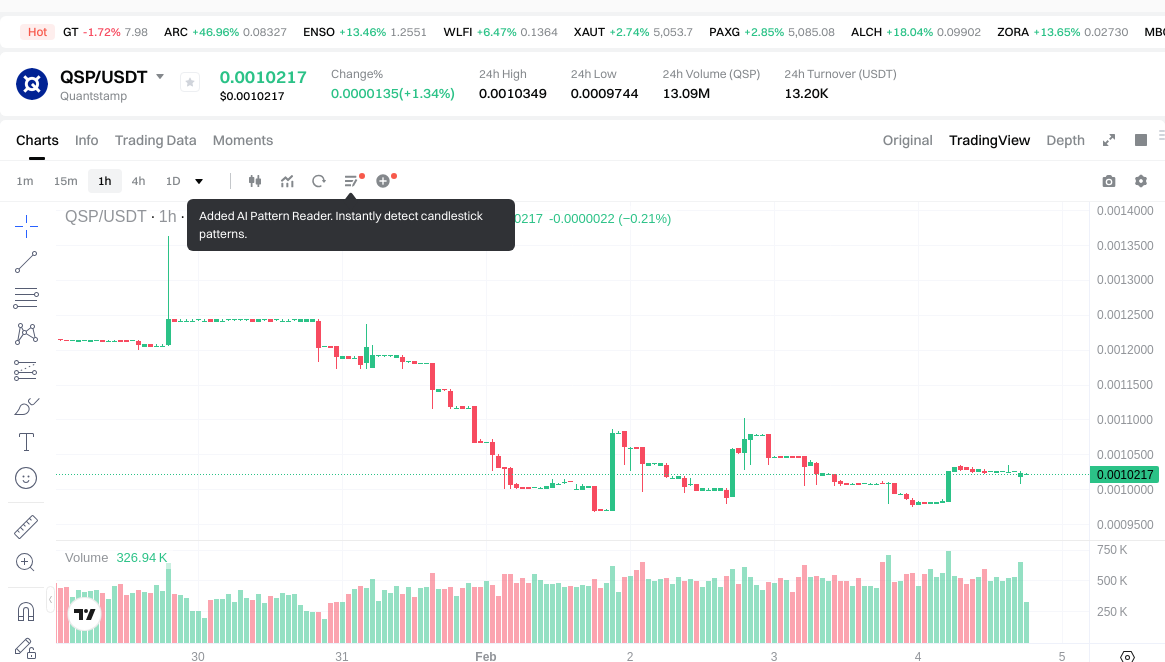
Quantstamp reached its historical peak price of $0.866421 on January 08, 2018, during a period of heightened market activity in the blockchain security sector.
The token recorded its lowest price of $0.003370653149 on August 16, 2025, reflecting market adjustment phases and broader cryptocurrency market conditions.
Recent price movements show mixed trends: a 1-hour change of +0.07%, a 24-hour increase of +1.12%, contrasted with a 7-day decline of -15.54%, a 30-day decrease of -2.36%, and a 1-year drop of -11.43%. These fluctuations demonstrate the token's sensitivity to market sentiment, adoption patterns, and external economic factors.
Click to view current QSP market price
On-Chain Metrics
- Token Holders: 33,315 addresses (indicating user distribution and community adoption)
- Market Capitalization: $730,790.43 (reflecting current valuation based on circulating supply)
- Fully Diluted Valuation: $999,681.72 (representing potential market cap at maximum supply)
Quantstamp Ecosystem Applications and Partners
Core Use Cases
Quantstamp's ecosystem supports multiple applications:
- Smart Contract Security Auditing: Quantstamp provides scalable security audit services for Ethereum smart contracts, offering vulnerability detection and security verification.
- Blockchain Security Solutions: The platform delivers comprehensive security audit protocols, promoting enhanced trust and security in decentralized applications.
Strategic Partnerships
Quantstamp has established collaborations with Ethereum 2.0, Chainlink, MakerDAO, eToro, and the World Economic Forum, enhancing its technical capabilities and market influence. These partnerships provide a solid foundation for Quantstamp's ecosystem expansion.
Controversies and Challenges
Quantstamp faces the following challenges:
- Technical Challenges: Maintaining scalability of the audit protocol while ensuring accuracy and cost-effectiveness
- Market Competition: The emergence of alternative blockchain security solutions and audit platforms
- Adoption Pressure: Encouraging broader adoption of security audits across the rapidly expanding smart contract ecosystem
These issues have sparked discussions within the community and market, while also driving Quantstamp's continuous innovation.
Quantstamp Community and Social Media Atmosphere
Community Engagement
Quantstamp's community demonstrates active participation, with 33,315 token holders as of the latest data.
On X platform, related posts and hashtags (such as #Quantstamp) maintain steady presence.
Security audit announcements and partnership developments have energized community enthusiasm.
Social Media Sentiment
Sentiment on X presents diverse perspectives:
- Supporters praise Quantstamp's focus on smart contract security and established partnerships with major blockchain projects, considering it an essential infrastructure provider in the blockchain space.
- Observers note price volatility and market cap fluctuations as areas requiring attention.
Recent trends show mixed sentiment influenced by broader market conditions.
Popular Topics
X users discuss Quantstamp's role in blockchain security, audit protocol effectiveness, and strategic positioning in the evolving DeFi landscape, showcasing both its transformative potential and the challenges in expanding mainstream adoption.
More Information Sources for Quantstamp
- Official Website: Visit Quantstamp Official Website for features, use cases, and latest updates.
- X Updates: On X platform, Quantstamp maintains an active presence through @Quantstamp, with posts covering security audit updates, partnership announcements, and blockchain security insights.
Quantstamp Future Roadmap
- Ongoing Development: Continued enhancement of the security audit protocol, improving scalability and audit accuracy
- Ecosystem Goals: Expanding audit services across multiple blockchain networks and supporting emerging smart contract platforms
- Long-term Vision: Establishing itself as a standard security infrastructure provider for blockchain applications
How to Participate in Quantstamp?
- Purchase Channels: Acquire QSP on Gate.com
- Storage Solutions: Store securely using compatible Ethereum wallets
- Ecosystem Participation: Explore opportunities to utilize Quantstamp's security audit services for smart contract projects
- Community Engagement: Follow official channels for updates on protocol developments and security insights
Summary
Quantstamp leverages blockchain technology to redefine smart contract security, providing transparency, scalability, and professional audit services. Its established partnerships, experienced team, and market presence position it as a notable player in the blockchain security sector. Despite facing market volatility and competitive pressures, Quantstamp's focus on security infrastructure and clear positioning in the ecosystem give it relevance in the decentralized technology landscape. Whether you are new to blockchain security or an experienced participant, Quantstamp represents an interesting project to monitor and engage with.
FAQ
What is QSP token and what are the main functions of the Quantstamp platform?
QSP is the governance token of Quantstamp platform, rewarding users for smart contract security audits. Quantstamp's main function is providing automated and crowdsourced smart contract security review services to ensure blockchain ecosystem safety.
How to buy and store QSP tokens?
Create an Ethereum wallet like MetaMask or Trust Wallet. Acquire ETH, then exchange it for QSP tokens through reputable platforms. Transfer your QSP to your personal wallet for secure storage and full control of your assets.
What is the specific use of QSP tokens in the Quantstamp ecosystem?
QSP tokens are used to pay for smart contract audit services on the Quantstamp platform and incentivize developers and auditors participating in the ecosystem.
What is the difference between Quantstamp's smart contract audit service and other security audit platforms?
Quantstamp leverages automation and crowdsourced verification to identify vulnerabilities, emphasizing scalability and community-driven security. This proactive approach sets it apart from traditional audit platforms by combining automated scanning with expert analysis for more thorough contract security assessment.
What are the future prospects and risk factors of QSP tokens?
QSP shows strong growth potential driven by increasing blockchain security demand and smart contract auditing adoption. Key risks include regulatory uncertainty, market volatility, and competition from alternative security solutions.
Share
Content
Quantstamp's Positioning and Significance
Origin and Development History
How Quantstamp Works
Quantstamp's Market Performance
Quantstamp Ecosystem Applications and Partners
Controversies and Challenges
Quantstamp Community and Social Media Atmosphere
More Information Sources for Quantstamp
Quantstamp Future Roadmap
How to Participate in Quantstamp?
Summary
FAQ
How to Buy Cryptocurrency


Trending Cryptocurrencies



How to Mine Ethereum in 2025: A Complete Guide for Beginners

Ethereum 2.0 in 2025: Staking, Scalability, and Environmental Impact

What is Ethereum: A 2025 Guide for Crypto Enthusiasts and Investors

How does Ethereum's blockchain technology work?
What are smart contracts and how do they work on Ethereum?
Ethereum Price Analysis: 2025 Market Trends and Web3 Impact
WSI vs FLOW: Comparing Whole Slide Image Analysis and Real-Time Workflow Optimization in Digital Pathology

Comprehensive Guide to Token Generation Events

Comprehensive Guide to Creating and Selling NFTs for Free

How to Profit from Cryptocurrency — Leading Strategies of Recent Years

Best Crypto Trading Bots for Automated Trading