Sensorium (SENSO) is a blockchain-based social VR platform launched in 2020 on Ethereum, designed to deliver immersive entertainment experiences and virtual social interactions through Sensorium Galaxy. As an ERC-20 token, SENSO enables in-platform transactions, user participation, and ecosystem engagement within the VR entertainment space. The project features strategic partnerships with international music festivals, a decentralized architecture utilizing Ethereum's Proof of Stake consensus, and active community engagement across 3,571 token holders. With a current market capitalization of $210,385.77 and circulating supply of 70,269,127 tokens, SENSO operates at $0.002994, reflecting the dynamic nature of the VR entertainment sector. This comprehensive guide explores SENSO's technical foundation, market dynamics, ecosystem applications, and investment considerations for participants interested in blockchain-integrated virtual reality platforms available on Gate.
Sensorium's Positioning and Significance
In 2020, the Sensorium team launched Sensorium (SENSO), aiming to address challenges in immersive entertainment accessibility and virtual social interaction limitations.
As a pioneering social VR media platform integrating blockchain technology, Sensorium plays a key role in virtual reality entertainment and metaverse experiences.
As of 2026, Sensorium has established itself as a notable player in the VR entertainment space, with 3,571 holders and an active development ecosystem.
This article will provide an in-depth analysis of its technical architecture, market performance, and future potential.
Origin and Development History
Birth Background
Sensorium was created by the Sensorium Corporation in 2020, aiming to solve the fragmentation of virtual reality entertainment and lack of accessible immersive social experiences.
It emerged during the growing interest in metaverse concepts and VR technology advancement, with the goal of providing users with comprehensive VR entertainment services through the Sensorium Galaxy virtual world.
Sensorium's launch brought new possibilities for VR entertainment enthusiasts and digital content creators.
Important Milestones
- 2020: Token launch on Ethereum, establishing the SENSO ecosystem foundation.
- 2020-2021: Development of Sensorium Galaxy virtual world, starting with music-focused virtual venues.
- 2021: Partnerships with international music festivals to deliver immersive VR performance experiences.
- 2022-2026: Continuous expansion of the platform's virtual worlds and entertainment offerings.
With the support of Sensorium Corporation and its community, Sensorium continues to refine its technology, security measures, and real-world applications.
How Does Sensorium Work?
No Central Control
Sensorium operates on the Ethereum blockchain, a decentralized network of computers (nodes) distributed globally, free from control by banks or governments.
These nodes collaborate to validate transactions, ensuring system transparency and attack resistance, granting users greater autonomy and enhancing network resilience.
Blockchain Core
Sensorium's blockchain foundation is a public, immutable digital ledger that records every transaction.
Transactions are grouped into blocks and linked through cryptographic hashes to form a secure chain.
Anyone can view the records, establishing trust without intermediaries.
As an ERC-20 token, SENSO benefits from Ethereum's established infrastructure and security mechanisms.
Ensuring Fairness
Sensorium relies on Ethereum's Proof of Stake (PoS) consensus mechanism to validate transactions and prevent fraudulent activities such as double-spending.
Validators maintain network security through staking ETH and running nodes, earning rewards for their contributions.
The innovation includes leveraging Ethereum's energy-efficient PoS system and established security protocols.
Secure Transactions
Sensorium uses public-private key cryptography to protect transactions:
- Private keys (like secret passwords) are used to sign transactions
- Public keys (like account numbers) are used to verify ownership
This mechanism ensures fund security while maintaining pseudonymous transaction privacy.
The ERC-20 standard provides additional compatibility with Ethereum wallets and decentralized applications.
Circulating Supply Overview
As of February 08, 2026, Sensorium's circulating supply is 70,269,127 tokens, with a total supply of 715,280,000 tokens. The maximum supply is capped at 5,915,280,000 tokens, establishing a defined inflation model for the token's long-term distribution. The circulating supply represents approximately 1.19% of the total supply, indicating significant future token allocation potential. SENSO tokens operate within the Sensorium platform framework as an ERC-20 smart contract token, facilitating various platform functionalities and transactions within the Sensorium Galaxy virtual world ecosystem.
Price Fluctuations
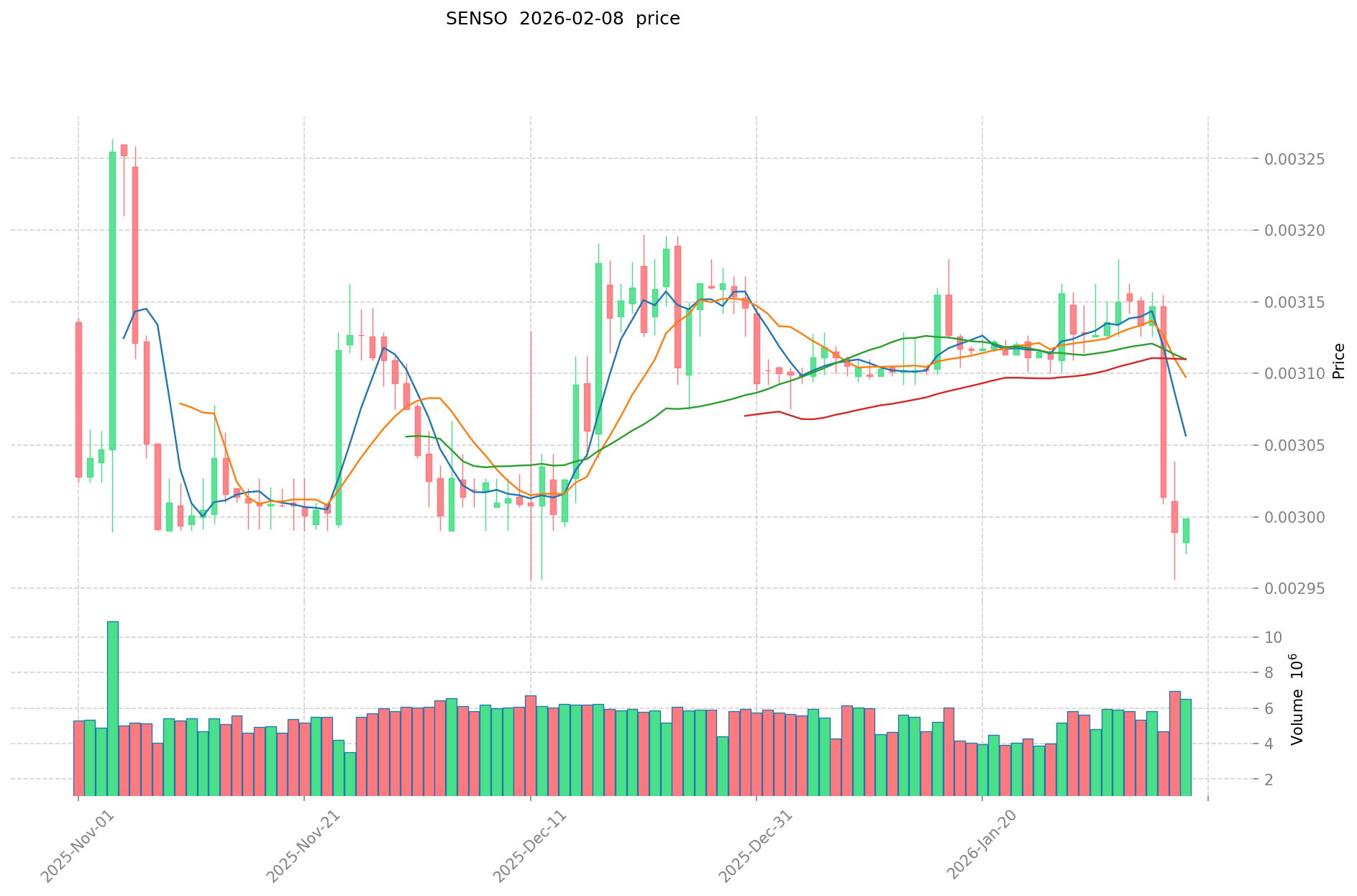
Sensorium reached its peak price of $3.28 on November 21, 2021, during a period of heightened interest in metaverse and VR-related projects. This price level reflected broader market enthusiasm for virtual reality entertainment platforms and blockchain integration in immersive experiences. The token experienced its lowest recorded price of $0.000012 on August 28, 2025, representing a substantial decline from its historical peak. As of the current period, SENSO trades at $0.002994, showing a 0.4% increase over the past 24 hours, though demonstrating a -82.34% decline over the past year. These fluctuations illustrate the volatility inherent in the cryptocurrency market and the evolving perception of VR-focused blockchain projects.
Click to view current SENSO market price
On-Chain Metrics
- Holder Count: 3,571 addresses hold SENSO tokens, indicating the current level of token distribution across the user base
- 24-Hour Trading Volume: $15,056.24, reflecting current market activity and liquidity levels
- Market Capitalization: $210,385.77, representing the total circulating value in the market
Sensorium Ecosystem Applications and Strategic Partners
Core Use Cases
Sensorium's ecosystem supports diverse applications in the virtual reality and entertainment space:
- Virtual Entertainment: Sensorium Galaxy platform provides immersive VR concert experiences and social interactions.
- Music & Performance: Partnership with international music festival representatives enables VR-enhanced live performances and digital entertainment venues.
Strategic Partnerships
Sensorium has established collaborations with major music festival organizers to enhance its content offerings and platform capabilities.
These partnerships provide a solid foundation for Sensorium's ecosystem expansion in the VR entertainment sector.
Controversies and Challenges
Sensorium faces the following challenges:
- Market Competition: Competition from other VR platforms and metaverse projects in the entertainment space
- Technology Adoption: Challenges in mainstream VR technology adoption and user onboarding
- Price Volatility: Significant token price fluctuations, with a one-year decline of 82.34%
These issues have sparked discussions within the community and market, while also driving Sensorium's continued innovation efforts.
Sensorium's community demonstrates active participation, with the token held by 3,571 wallet addresses.
On X platform, related posts and hashtags (such as #SENSO) engage with the VR and entertainment crypto communities.
New feature releases and platform updates have generated community interest.
Sentiment on X shows varied perspectives:
- Supporters praise Sensorium's innovative VR entertainment approach and immersive experience capabilities, viewing it as a pioneer in virtual social experiences.
- Critics focus on price performance concerns and market adoption challenges.
Recent trends reflect cautious optimism about the platform's long-term potential in the VR space.
Trending Topics
X users discuss Sensorium's VR technology integration, entertainment partnerships, and token utility within the platform,
showcasing both its innovative potential and the challenges of achieving mainstream adoption.
- Official Website: Visit Sensorium Official Site and Sensorium Galaxy for features, use cases, and latest updates.
- X Updates: On X platform, Sensorium maintains an active presence through @SensoToken,
posting content about platform developments, VR experiences, and community events.
- Block Explorer: Track SENSO transactions on Etherscan
Sensorium Future Roadmap
- Platform Development: Continued expansion of Sensorium Galaxy virtual world with enhanced VR experiences
- Ecosystem Goals: Attract more content creators and expand entertainment venue offerings
- Long-term Vision: Establish a comprehensive VR social entertainment platform with diverse immersive experiences
How to Participate in Sensorium?
- Purchase Options: Acquire SENSO on Gate.com
- Storage Solutions: Securely store tokens using Ethereum-compatible wallets such as MetaMask or hardware wallets
- Platform Engagement: Participate in Sensorium Galaxy experiences and VR events
- Community Involvement: Follow official channels for updates on platform developments and new features
Summary
Sensorium leverages blockchain technology to create innovative VR entertainment experiences, offering immersive social interactions, live performances, and virtual world exploration.
Its focus on VR entertainment, strategic music industry partnerships, and active development make it a notable project in the metaverse and virtual entertainment sector.
Despite facing market volatility and adoption challenges, Sensorium's innovative approach and clear vision position it as an interesting player in the convergence of blockchain technology and virtual reality entertainment.
Whether you're interested in VR experiences or blockchain-based entertainment platforms, Sensorium presents a unique value proposition worth exploring.
FAQ
What is SENSO crypto token and what is its main purpose?
SENSO is the native token of Sensorium Galaxy, a social VR platform. It powers in-platform transactions, user interactions, and ecosystem participation within the immersive virtual environment.
How can I buy and store SENSO tokens?
Purchase SENSO using debit/credit card or bank transfer on a centralized exchange. After buying, transfer tokens to a personal wallet for secure storage and full control of your assets.
What are the risks and considerations when investing in SENSO?
SENSO investors should consider market volatility, regulatory uncertainty, and competition risks. Operational scaling challenges and potential management resource constraints may impact growth. Technology adoption rates and market adoption timelines are key variables to monitor.
What is the difference between SENSO and other similar cryptocurrency projects?
SENSO distinguishes itself through its focus on real-world IoT sensor data integration and Sensorium ecosystem development. Unlike many competitors, SENSO offers unique applications in data collection and verification, with distinct market capitalization and trading volume metrics that reflect its specialized positioning in the Web3 infrastructure space.
SENSO demonstrates strong market performance with promising growth trajectory. The sensor market is projected to reach $5.41 billion by 2030. SENSO's roadmap focuses on expanding sensor technology applications and enhancing blockchain integration for decentralized IoT solutions.
* The information is not intended to be and does not constitute financial advice or any other recommendation of any sort offered or endorsed by Gate.