What is SPON: A Comprehensive Guide to Sponsored Content and Network Marketing

Spheron Network's Positioning and Significance
In 2025, the Spheron Foundation introduced Spheron Network (SPON) to address inefficiencies in centralized cloud computing, high costs for GPU access, and limited scalability for AI workloads.
As the world's largest community-powered decentralized compute infrastructure, Spheron Network plays a critical role in AI development, decentralized computing, and Web3 infrastructure.
As of 2026, Spheron Network has established itself as a significant player in the decentralized GPU marketplace, boasting over 50,000 active nodes and more than $100 million in available compute capacity with an engaged developer community.
This article will provide an in-depth analysis of its technical architecture, market performance, and future potential.
Origin and Development History
Birth Background
Spheron Network was created by the Spheron Foundation in 2025, aiming to solve the centralization of cloud computing resources, prohibitively expensive GPU access for AI developers, and lack of flexibility in compute infrastructure.
It emerged during the rapid expansion of AI and machine learning applications, with the goal of democratizing access to computing power and creating a permissionless, scalable infrastructure for AI workloads.
Spheron Network's launch brought transformative possibilities for AI developers, Web3 projects, and enterprises seeking cost-effective compute solutions.
Key Milestones
- 2025: Mainnet launch on Base blockchain, achieving integration of both enterprise-grade GPUs (H100, H200, B200) and retail-grade GPUs (RTX 4090, 5090).
- January 2025: Token listing on Gate.com, expanding accessibility for the global crypto community.
- 2025: Ecosystem expansion with the introduction of KlippyAI, Supernoderz, and Agent Marketplace, driving adoption across AI and decentralized application sectors.
- 2026: Network growth surpassing 50,000 active nodes, establishing industry-leading compute capacity.
With support from the Spheron community and foundation, Spheron Network continues to enhance its technology, security features, and real-world applications.
How Spheron Network Operates
No Central Control
Spheron Network operates on a decentralized network of computing nodes distributed globally, eliminating dependence on centralized cloud providers.
These nodes collaborate to provide GPU and CPU resources, ensuring the system remains transparent and resistant to single points of failure, granting users greater autonomy and enhancing network resilience.
Blockchain Foundation
Spheron Network utilizes the Base blockchain as its foundation, leveraging an ERC-20 token standard for the SPON token.
Transactions and network activities are recorded on this public, immutable ledger, ensuring transparency and trust without intermediaries.
Anyone can verify network operations, and the blockchain's cryptographic security protects all interactions.
The platform's architecture enables permissionless access to compute resources, allowing developers to deploy AI workloads seamlessly.
Ensuring Fairness
Spheron Network employs a community-governed model where node operators contribute computing resources to the network.
Node operators maintain network integrity by providing GPU/CPU capacity and validating compute requests, earning SPON token rewards for their contributions.
The platform's innovation includes offering the lowest GPU pricing in the industry while maintaining enterprise-grade quality and reliability.
Secure Transactions
Spheron Network uses public-private key cryptography to protect transactions:
- Private keys (similar to secret passwords) are used to authorize access and transactions
- Public keys (similar to account numbers) are used to verify ownership and receive payments
This mechanism ensures fund security while maintaining pseudonymous privacy for users.
The platform leverages Base blockchain's security features, including robust consensus mechanisms and smart contract auditing, to protect user assets and network operations.
Spheron Network (SPON) Market Performance
Circulating Supply Overview
As of February 5, 2026, Spheron Network (SPON) has a circulating supply of 220,100,000 tokens, with a total supply of 1,000,000,000 tokens. The maximum supply is capped at 1,000,000,000 tokens, establishing a fixed supply model.
The circulating supply represents approximately 22.01% of the total supply, indicating that a significant portion of tokens remains to be released into the market. This gradual release mechanism may influence the token's supply-demand dynamics over time.
Price Volatility
SPON experienced notable price movements since its market debut. The token reached a notable price level of $0.1445 on August 8, 2025, driven by market interest during its initial trading period. However, the token later declined to $0.002304 on January 26, 2026, reflecting broader market adjustments and evolving sentiment toward decentralized computing infrastructure projects.
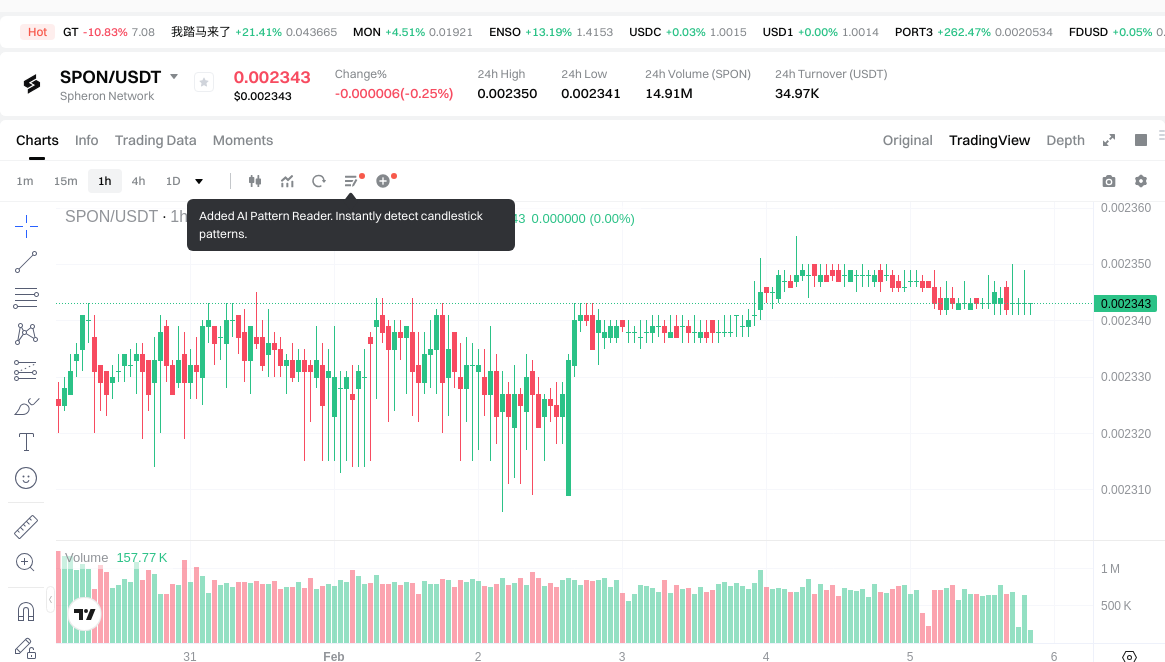
As of February 5, 2026, SPON is trading at $0.002342, showing short-term stability with a 0.09% increase over the past hour and a 0.6% gain over the past week. However, the token has experienced a 24.95% decline over the past 30 days, indicating ongoing market volatility and price discovery.
These fluctuations reflect various factors including market sentiment, adoption trends, and the broader cryptocurrency market environment.
Click to view the current SPON market price
On-Chain Metrics
- 24-Hour Trading Volume: Approximately $35,129 (indicating current market activity levels)
- Token Holders: 4,491 addresses (reflecting user participation and distribution)
- Market Capitalization: $515,474 (representing the current valuation of circulating tokens)
- Fully Diluted Valuation: $2,342,000 (projecting valuation if all tokens were in circulation)
Spheron Network Ecosystem Applications and Partners
Core Use Cases
Spheron Network's ecosystem supports multiple applications:
- Decentralized AI Infrastructure: Spheron provides decentralized computing resources for AI workloads, offering flexible GPU/CPU access for machine learning and training.
- Developer Tools: Products like KlippyAI and Supernoderz enable developers to build and deploy AI applications efficiently.
- Agent Marketplace: The platform facilitates permissionless primitives and agent-based solutions, driving innovation in decentralized AI.
Strategic Partnerships
Spheron Network is building a community-powered infrastructure with over 50,000 active nodes. These partnerships and community contributions provide a solid foundation for Spheron's ecosystem expansion.
Challenges and Controversies
Spheron Network faces the following challenges:
- Technical Hurdles: Scaling decentralized computing infrastructure while maintaining cost-efficiency
- Market Competition: Competition from other decentralized computing platforms in the AI infrastructure space
- Adoption Barriers: Encouraging widespread developer adoption and ecosystem growth
These issues have sparked discussions within the community and market, while driving Spheron's continuous innovation.
Spheron Network Community and Social Media Sentiment
Community Enthusiasm
Spheron Network's community demonstrates strong engagement, with the platform hosting over 50,000 active nodes and more than $100M in available compute capacity.
The ecosystem includes 4,491 token holders as of February 05, 2026.
On X platform, related posts and hashtags (such as #SPON) generate significant interest.
Factors like the platform's low GPU pricing and growing ecosystem products have fueled community enthusiasm.
Social Media Sentiment
Sentiment on X shows diverse perspectives:
- Supporters praise Spheron Network's cost-efficiency, decentralized infrastructure, and comprehensive compute offerings, viewing it as "infrastructure for the future of AI".
- Critics focus on token price volatility and early-stage ecosystem development.
Recent trends indicate growing interest in decentralized AI infrastructure solutions.
Hot Topics
X users actively discuss Spheron Network's decentralized computing approach, GPU pricing advantages, and ecosystem development, showcasing both its transformative potential and the challenges of scaling decentralized AI infrastructure.
More Information Sources for Spheron Network
- Official Website: Visit Spheron Network Official Site for features, use cases, and latest updates.
- Whitepaper: Spheron Network Whitepaper details its technical architecture, objectives, and vision.
- X Updates: On X platform, Spheron Network actively engages through @SpheronFDN, with posts covering technical upgrades, community events, and ecosystem developments, generating significant engagement.
Spheron Network Future Roadmap
- Ongoing Development: Expansion of node network and compute capacity, enhancing platform performance and accessibility
- Ecosystem Goals: Growing the developer ecosystem through products like KlippyAI, Supernoderz, and Agent Marketplace
- Long-term Vision: Becoming the leading community-governed programmable compute economy for AI applications
How to Participate in Spheron Network?
- Purchase Channels: Buy SPON on Gate.com and other supported exchanges
- Storage Solutions: Use compatible Base network wallets to securely store SPON tokens
- Community Engagement: Join the Discord community at Spheron Network Discord to participate in discussions
- Ecosystem Building: Visit developer documentation to explore building on Spheron's infrastructure
Summary
Spheron Network is redefining decentralized computing through blockchain technology, providing cost-efficient, scalable, and flexible AI infrastructure. Its active community, comprehensive product offerings, and significant compute capacity make it notable in the decentralized computing space. Despite facing market competition and adoption challenges, Spheron Network's innovative approach and clear development direction position it as a significant player in the future of decentralized AI infrastructure. Whether you're new to the space or an experienced participant, Spheron Network is worth following and engaging with.
FAQ
What is SPON and how does it work in the crypto ecosystem?
SPON is the native token of Spintop Network, enabling transaction fees, governance, and network participation. It powers the ecosystem's operations and incentivizes user engagement within the blockchain infrastructure.
What are the main use cases and benefits of SPON token?
SPON token powers decentralized finance applications, enabling liquidity provision and governance participation. Users benefit from enhanced control over assets, participation in protocol decisions, and earning rewards through staking and yield mechanisms.
How can I buy and store SPON cryptocurrency safely?
Purchase SPON on reputable exchanges, then transfer to a secure wallet. Use hot wallets like MetaMask for frequent trading, or hardware wallets like Ledger for long-term storage and maximum security.
What are the risks and security considerations when investing in SPON?
SPON investments carry market volatility risks, potential regulatory changes, and smart contract vulnerabilities. Ensure proper due diligence on project fundamentals, team credibility, and audit reports. Monitor network security updates and use secure wallets for asset protection.
How does SPON compare to other similar cryptocurrency projects?
SPON distinguishes itself through higher growth potential due to its lower market cap, while maintaining unique technical advantages. Unlike larger competitors, SPON offers greater volatility opportunities and faster price appreciation prospects for early adopters in the blockchain ecosystem.
What is the tokenomics and supply information for SPON?
SPON has a total supply of 1 billion tokens with a deflationary model featuring a burn mechanism. The token provides utility within the Spheron Network ecosystem for network governance and services.
Share
Content
Spheron Network's Positioning and Significance
Origin and Development History
How Spheron Network Operates
Spheron Network (SPON) Market Performance
Spheron Network Ecosystem Applications and Partners
Challenges and Controversies
Spheron Network Community and Social Media Sentiment
More Information Sources for Spheron Network
Spheron Network Future Roadmap
How to Participate in Spheron Network?
Summary
FAQ
How to Buy Cryptocurrency


Trending Cryptocurrencies



Top 10 DePIN Crypto Projects to Invest in 2025

How to Participate in a DePIN Project
What is DePIN?How Does DePIN Work?
What Does Onyxcoin's DApp Ecosystem Look Like in 2025?

How to Earn with The RWA DePin Protocol in 2025
TrendX (XTTA): An Innovative Investment Platform Integrating AI and DePIN
How does the cryptocurrency bubble form, and how long can it persist?

Miner viruses: What are they and how to remove a miner from your PC

What Is Risk to Reward Ratio and How to Use It Effectively
Comprehensive Guide to Phil Konieczny: Cryptocurrency Education, Investment Solutions, and Financial Freedom
What are NFT games?