This comprehensive guide explores SSV Network, a decentralized validator infrastructure protocol addressing Ethereum staking centralization risks. Launched in 2021, SSV employs Secret Shared Validators technology to split validator keys across multiple operators, enhancing security and fault tolerance. The guide covers SSV's technical architecture, market performance showing current trading at $4.223 with 7,150 token holders, and ecosystem applications. Key benefits include decentralized validator operations, improved security mechanisms, and reduced single-point-of-failure risks. Suitable for Ethereum stakers, validators, and infrastructure participants, this resource examines challenges including technical complexity and market competition. Whether exploring distributed validator solutions or staking alternatives on Gate, this guide provides essential insights into SSV Network's role in Ethereum's evolving staking landscape.
SSV Network's Positioning and Significance
In 2021, the SSV Network team launched SSV Network (SSV), aiming to address the security risks and centralization concerns in Ethereum staking infrastructure.
As a decentralized validator infrastructure protocol based on Secret Shared Validators technology, SSV Network plays a critical role in Ethereum staking and validator operations.
As of 2026, SSV Network has become an important infrastructure component in the Ethereum staking ecosystem, with approximately 7,150 token holders and an active developer community.
This article will provide an in-depth analysis of its technical architecture, market performance, and future potential.
Origin and Development History
Background
SSV Network evolved from Blox (CDT), with the brand upgrade completed in 2021 to solve the validator key management challenges and single point of failure risks in Ethereum staking.
It emerged during the transition period of Ethereum 2.0 and the rapid growth of staking demand, with the goal of providing secure, robust validator key splitting and distribution solutions to transform the status quo.
The launch of SSV Network brought new possibilities for Ethereum validators and staking service providers.
Key Milestones
- 2021: Brand upgrade from Blox to SSV Network, with token conversion at a ratio of 100 CDT = 1 SSV, implementing the Secret Shared Validators technology.
- 2024: The network experienced significant growth in its ecosystem, with increasing adoption among Ethereum staking operators.
- The project maintained continuous technical optimization under the support of the SSV Network foundation and community, with a total supply reaching 14.7 million SSV.
Under the support of the community and foundation, SSV Network continues to optimize its technology, security, and real-world applications.
How SSV Network Works?
No Central Control
SSV Network operates on a decentralized network of nodes distributed globally, independent of control by banks or governments.
These nodes collaborate to validate transactions, ensuring system transparency and attack resistance, granting users greater autonomy and enhancing network resilience.
Blockchain Core
SSV Network's infrastructure is built on Ethereum, utilizing a public, immutable digital ledger that records validator operations.
Operations are verified through cryptographic methods, forming a secure chain.
Anyone can view the records, establishing trust without intermediaries.
The Secret Shared Validators technology splits validator keys across multiple non-trusting nodes, further enhancing security and decentralization.
Ensuring Fairness
SSV Network employs a distributed validator technology (DVT) architecture to manage and validate staking operations, preventing single points of failure.
Operators maintain network security by running distributed validator nodes and managing key shares, earning SSV token rewards.
Its innovation includes improved fault tolerance and reduced centralization risks in validator management.
Secure Operations
SSV Network uses cryptographic key splitting technology to protect validator operations:
- Key shares are distributed across multiple operators, preventing single point compromise
- Threshold signature schemes ensure validator operations remain secure even if some operators fail
This mechanism ensures validator security while maintaining operational resilience and decentralization.
The protocol implements multi-operator consensus and automated failover mechanisms to enhance security.
Circulation Overview
As of January 19, 2026, SSV Network's circulating supply stands at 14,699,173.1 tokens, with a total supply of 14,699,173.1 tokens. The current circulation represents 100% of the total supply, indicating full token distribution in the market. SSV originated from a brand upgrade of Blox (CDT), with tokens distributed at a ratio of 100 CDT = 1 SSV. As a native token of the SSV Network protocol, SSV enters circulation through its initial distribution mechanism, influencing its supply-demand dynamics within the decentralized validator technology ecosystem.
Price Volatility
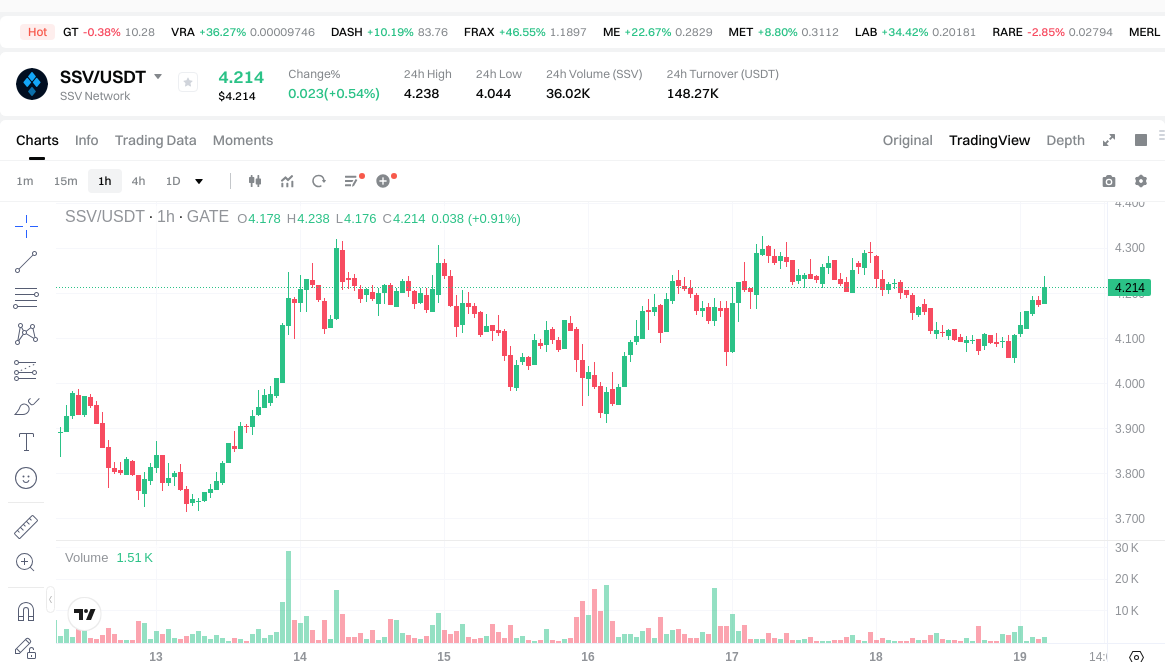
SSV Network reached its peak price of $65.82 on March 25, 2024, during a period of heightened interest in Ethereum staking infrastructure solutions. The token experienced its lowest recorded price of $2.65 on October 11, 2025, reflecting broader market corrections and shifts in staking technology adoption patterns. As of January 19, 2026, SSV trades at $4.223, showing a 24-hour change of +0.83% and a 7-day increase of +6.88%. Over the past 30 days, the token has gained 13.02%, though it remains down 80.77% from its peak over the one-year period. These fluctuations demonstrate the impact of market sentiment cycles, evolving validator infrastructure adoption, and changing dynamics within the Ethereum staking landscape.
Click to view current SSV market price
On-Chain Metrics
- 24-Hour Trading Volume: $146,731.62 (reflecting current market liquidity and trading activity)
- Holder Addresses: 7,150 addresses (indicating the breadth of token distribution across participants)
- Market Capitalization: $62,074,608.00 (representing SSV's position within the validator infrastructure sector)
SSV Network Ecosystem Applications and Partners
Core Use Cases
SSV Network's ecosystem supports multiple applications:
- Ethereum Staking Infrastructure: SSV Network provides a distributed validator technology (DVT) solution, enabling decentralized and fault-tolerant validator key management for ETH staking operations.
- Validator Services: The platform facilitates secure validator operations through its Secret Shared Validators technology, supporting enhanced security and operational resilience for staking providers.
Strategic Partnerships
SSV Network has established collaborations to enhance its technical capabilities and market presence.
These partnerships provide a solid foundation for SSV Network's ecosystem expansion.
Challenges and Considerations
SSV Network faces several considerations:
- Technical Complexity: Integration and operational requirements for distributed validator technology
- Market Competition: The evolving landscape of Ethereum staking solutions
- Adoption Curve: Growing awareness and implementation of distributed validator technology
These factors drive ongoing discussion within the community and motivate continuous innovation for SSV Network.
SSV Network maintains an active community supporting Ethereum staking infrastructure.
On X platform, related posts and hashtags frequently generate discussion around distributed validator technology.
X platform discussions show varied perspectives:
- Supporters highlight SSV Network's decentralized validator infrastructure and enhanced security features, viewing it as an important development for Ethereum staking resilience.
- Observers discuss topics including implementation complexity and adoption timelines.
Trending Topics
X users discuss SSV Network's role in Ethereum staking infrastructure, validator decentralization, and distributed validator technology adoption.
- Official Website: Visit SSV Network Website for features, use cases, and latest updates.
- X Updates: SSV Network maintains an active presence on X platform at @ssv_network, sharing content about technical developments, community initiatives, and ecosystem updates.
SSV Network Future Roadmap
- Ecosystem Goals: Expanding distributed validator technology adoption within the Ethereum staking ecosystem
- Long-term Vision: Supporting decentralized and resilient validator infrastructure for Ethereum
How to Participate in SSV Network?
- Purchase Options: SSV tokens are available on cryptocurrency exchanges including Gate.com
- Storage Solutions: Secure storage options for SSV tokens include compatible wallets
- Governance Participation: Engage in community decisions through governance mechanisms
- Ecosystem Building: Explore development opportunities within the SSV Network ecosystem
Summary
SSV Network provides distributed validator technology for Ethereum staking, offering enhanced security, fault tolerance, and decentralization.
Its focus on validator infrastructure and active development community position it as a contributor to Ethereum's staking ecosystem.
While navigating adoption challenges and market evolution, SSV Network's technological approach addresses important considerations in validator operations.
Whether you are exploring staking solutions or interested in decentralized infrastructure, SSV Network represents a development worth monitoring.
FAQ
What is Crypto SSV (Single Staking Validator) and how does it work?
SSV is a decentralized protocol enabling secure Ethereum staking through distributed validators. It splits validator duties across multiple operators, ensuring fault tolerance and security while allowing users to earn staking rewards on their ETH holdings.
What are the main benefits and use cases of SSV in blockchain staking?
SSV enhances staking decentralization and fault tolerance, enabling distributed validator operations. Key benefits include improved security, reduced downtime risk, and trustless staking infrastructure for secure asset management.
How can I participate in SSV staking and what are the requirements?
To participate in SSV staking, create a validator pool on a supported platform. No full validator node is required. Meet the minimum stake requirement to begin staking and earn rewards.
What are the risks and security considerations when using SSV?
SSV risks include key splitting vulnerabilities and operator trustworthiness concerns. Security requires monitoring operators for potential threats and ensuring robust infrastructure. However, distributed key architecture significantly reduces single point of failure risks compared to traditional validation methods.
How does SSV compare to traditional solo staking and other staking solutions?
SSV enables you to stake your own ETH while others operate the validators, offering greater flexibility than solo staking. It reduces centralization risks and enhances network decentralization compared to alternative solutions.
What is the tokenomics and governance structure of the SSV network?
SSV network operates under decentralized DAO governance with no single entity in control. The tokenomics include a DAO treasury for continuous funding, while governance decisions are made by SSV token holders through democratic voting.
* The information is not intended to be and does not constitute financial advice or any other recommendation of any sort offered or endorsed by Gate.