What is TRC: A Comprehensive Guide to Token and Resource Control in Blockchain Technology
Terrace's Positioning and Significance
In 2025, the Terrace team launched Terrace (TRC), aiming to address fragmented liquidity across centralized and decentralized trading platforms. As the first platform to aggregate liquidity from CEX, DEX, market makers, and OTC desks, Terrace plays a pivotal role in crypto trading and portfolio management.
As of 2026, Terrace has established itself as an innovative self-custodial trading terminal, with 708 holders and an active community. This article will provide an in-depth analysis of its technical architecture, market performance, and future potential.
Origin and Development Journey
Background
Terrace was created by its founding team and officially launched in January 2025, aiming to solve inefficiencies in crypto trading caused by liquidity fragmentation and lack of comprehensive analytics. It emerged during the maturation phase of DeFi and institutional crypto adoption, with the goal of providing better pricing, deeper liquidity, and broader asset coverage through aggregation to transform the trading experience. Terrace's launch brought new possibilities for professional traders and crypto investors.
Important Milestones
- January 2025: Platform launch, enabling liquidity aggregation from multiple sources with proprietary analytics.
- March 2025: Price reached an all-time high of $0.03089, reflecting early market enthusiasm.
- April 2025: Continued platform development and ecosystem expansion.
With support from its community and development team, Terrace continues to optimize its technology, security, and real-world applications.
How Terrace Works?
No Central Control
Terrace operates as a self-custodial platform, meaning users maintain full control over their assets without relying on centralized intermediaries. This decentralized approach eliminates single points of failure, ensuring that users retain sovereignty over their funds while accessing aggregated liquidity from multiple sources.
Blockchain Foundation
Terrace's native token TRC is deployed on the Base blockchain as an ERC-20 token, leveraging Ethereum's security and Base's scalability. The blockchain serves as a transparent, immutable ledger that records all token transactions. Transactions are grouped into blocks and cryptographically linked to form a secure chain. Anyone can verify records without intermediaries, establishing trustless interactions.
Platform Mechanics
Terrace aggregates liquidity from centralized exchanges, decentralized exchanges, market makers, and OTC desks into a unified trading interface. The platform combines this aggregation with proprietary analytics, portfolio management, order management, and execution management to deliver an all-in-one trading experience. This innovation enables improved price discovery, reduced slippage, and access to broader asset coverage compared to single-venue trading.
Secure Transactions
Terrace utilizes public-private key cryptography to protect transactions:
- Private keys (like secret passwords) are used to sign transactions
- Public keys (like account numbers) are used to verify ownership
This mechanism ensures fund security while maintaining pseudonymous transaction privacy. As a self-custodial platform, users retain complete control over their private keys, eliminating custodial risk.
Terrace's Market Performance
Circulation Overview
As of February 2, 2026, Terrace's circulating supply is 180,000,000 TRC, with a total supply of 1,000,000,000 TRC. The circulating supply represents approximately 18% of the total supply. The maximum supply is capped at 1,000,000,000 TRC, establishing a fixed supply model.
Price Volatility
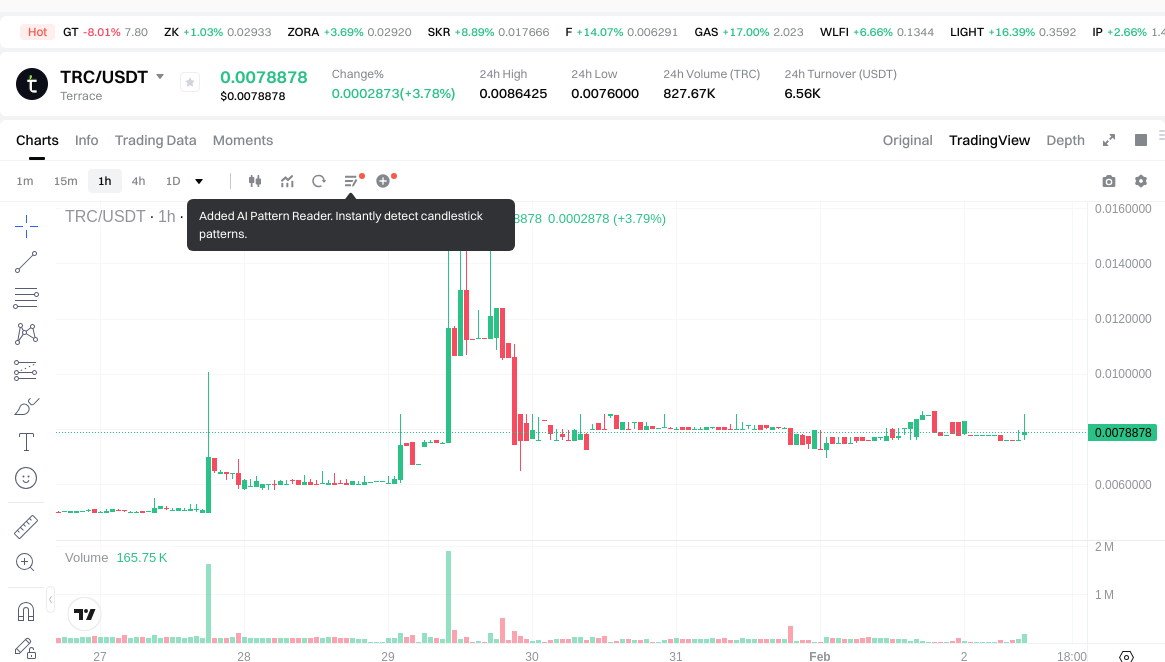
Terrace reached its peak price of $0.03089 on March 12, 2025. Its lowest recorded price was $0.001399 on April 11, 2025. These fluctuations reflect market sentiment, adoption trends, and external factors impacting the cryptocurrency sector.
Click to view the current TRC market price
On-Chain Metrics
- Holder Count: 708 addresses (reflecting user participation)
- 24-Hour Trading Volume: $6,746.85 (indicating current market activity)
- Market Capitalization: $1,539,810 (representing circulating supply valuation)
Terrace Ecosystem Applications and Partners
Core Use Cases
Terrace's ecosystem supports multiple applications:
- Trading Infrastructure: Terrace platform provides aggregated liquidity across centralized exchanges, decentralized exchanges, market makers, and OTC desks.
- Portfolio Management: Terrace offers proprietary analytics and execution management tools for optimized trading experiences.
Strategic Partnerships
Terrace has built its foundation on aggregating liquidity from various market participants, enhancing its technical capabilities and market reach. These partnerships provide a solid foundation for Terrace's ecosystem expansion.
Controversies and Challenges
Terrace faces the following challenges:
- Technical Challenges: Integration complexity across multiple liquidity sources
- Regulatory Risks: Evolving regulatory frameworks for crypto trading platforms
- Competitive Pressure: Competition from established trading terminals and aggregation platforms
These issues have sparked discussions within the community and market, also driving Terrace's continuous innovation.
Terrace Community and Social Media Atmosphere
Community Enthusiasm
Terrace's community shows growing activity, with 708 token holders as of February 02, 2026.
On X platform, related posts and hashtags (such as #Terrace) generate engagement.
Recent developments and platform features have ignited community enthusiasm.
Social Media Sentiment
Sentiment on X shows diverse perspectives:
- Supporters praise Terrace's liquidity aggregation capabilities and self-custodial features, viewing it as an innovative solution for crypto trading.
- Critics focus on market volatility and platform adoption challenges.
Recent trends indicate growing interest in the platform's unique value proposition.
Hot Topics
X users discuss Terrace's liquidity aggregation technology, pricing advantages, and broader asset coverage, showcasing both its transformative potential and the challenges in achieving mainstream adoption.
More Information Sources for Terrace
- Official Website: Visit Terrace Official Website for features, use cases, and latest updates.
- X Updates: On X platform, Terrace maintains an active presence using @terrace_fi, with posts covering technical updates, community events, and platform developments.
Terrace Future Roadmap
- Ecosystem Goals: Expand liquidity sources and enhance trading analytics capabilities
- Long-term Vision: Become a leading self-custodial trading infrastructure for crypto markets
How to Participate in Terrace?
- Purchase Channels: Buy TRC on Gate.com
- Storage Solutions: Use compatible wallets supporting Base and ERC-20 tokens for secure storage
- Engage with Platform: Explore the trading terminal features at the official website
- Build Ecosystem: Access developer resources to integrate with Terrace's trading infrastructure
Summary
Terrace leverages blockchain technology to redefine crypto trading, providing aggregated liquidity, better pricing, and comprehensive portfolio management. Its innovative approach and growing community make it a noteworthy player in the crypto trading space. Despite facing regulatory uncertainties and competitive pressures, Terrace's innovative platform and clear value proposition position it as an important development in decentralized trading technology. Whether you are a newcomer or experienced trader, Terrace deserves attention and participation.
FAQ
What is TRC and how does it differ from other token standards like ERC-20?
TRC-20 is a token standard on the TRON blockchain, while ERC-20 operates on Ethereum. TRC-20 offers faster transactions and lower fees compared to ERC-20, making it more efficient for token transfers and smart contracts on TRON.
What are the main differences between TRC20 and TRC10 tokens?
TRC10 offers low-cost, instant transactions on TRON network. TRC20 provides higher throughput and advanced protocol features, better suited for large transaction volumes and smart contract compatibility.
How do I store and transfer TRC tokens securely?
Store TRC tokens in a hardware wallet or reputable digital wallet. Transfer via the TRC-20 contract address. Always verify recipient addresses before sending to prevent loss.
What are the advantages of using TRON (TRX) and TRC tokens compared to Ethereum?
TRON offers faster transaction speeds, lower fees, and higher scalability. TRC tokens process thousands of transactions quickly with minimal costs, making them ideal for high-volume DeFi and payments.
Can I convert TRC tokens to other cryptocurrencies, and how?
Yes, you can convert TRC tokens to other cryptocurrencies using bridge or swap services that support the TRON network. These third-party platforms enable seamless token conversion while ensuring security and efficiency.
Share
Content
Terrace's Positioning and Significance
Origin and Development Journey
How Terrace Works?
Terrace's Market Performance
Terrace Ecosystem Applications and Partners
Controversies and Challenges
Terrace Community and Social Media Atmosphere
More Information Sources for Terrace
Terrace Future Roadmap
How to Participate in Terrace?
Summary
FAQ
How to Buy Cryptocurrency


Trending Cryptocurrencies



XZXX: A Comprehensive Guide to the BRC-20 Meme Token in 2025

Survey Note: Detailed Analysis of the Best AI in 2025
Detailed Analysis of the Best 10 GameFi Projects to Play and Earn in 2025

Kaspa’s Journey: From BlockDAG Innovation to Market Buzz

Best Crypto Wallets 2025: How to Choose and Secure Your Digital Assets

Popular GameFi Games in 2025

MMT Surge Behind Market Mania to Longterm Test
What is Web3 Marketing: Everything You Need to Know
Satoshi Nakamoto Bitcoin Founder Technology and Mystery
A Complete Guide to the 1inch Swap
Free Money for App Registration: Crypto Platform Welcome Bonuses