ZND is a cryptocurrency token operating on the Ethereum blockchain, launched by the zondacrypto team as the primary settlement unit within a fully regulated financial ecosystem. Established in 2014 and officially expanded in December 2023, ZND integrates exchange, payment solutions, and DeFi services to simplify crypto market access for both beginners and experienced users. The token functions with ERC-20 standard, utilizing secure public-private key cryptography for transactions while maintaining compliance frameworks. As of February 2026, ZND has 183.6 million circulating tokens, trading at $0.008769 with a market cap of $1.6 million and 2,205 active holders. The ecosystem supports trading fee discounts, exclusive rewards, and earning opportunities through zondacrypto's comprehensive platform. Despite market volatility and competitive pressures, ZND continues expanding its utility through partnerships and ecosystem development, offering accessible pathways for digital asset management on Gate and other supp
ZND's Positioning and Significance
In 2014, the team behind zondacrypto launched ZND (ZND), aiming to address the complexity of cryptocurrency adoption and the lack of integrated financial solutions for both beginners and experienced users.
As a fully regulated financial ecosystem integrating exchange, payment, and DeFi services, ZND plays a key role in simplifying crypto market access and fostering user engagement through a unified platform.
As of 2026, ZND has established itself as an integrated ecosystem built around the zondacrypto exchange, one of Central Europe's leading crypto platforms, with over 2,205 token holders and an active development roadmap.
This article will provide an in-depth analysis of its technical architecture, market performance, and future potential.
Origin and Development Journey
Birth Background
ZND was developed by the zondacrypto team, with its foundation platform launched in 2014, aiming to solve the barriers to cryptocurrency adoption and the fragmentation of crypto financial services.
It emerged during the early growth phase of the cryptocurrency industry, with the goal of providing a seamless, compliant pathway for users to trade, earn, borrow, and explore digital assets.
The launch of ZND brought accessible and integrated crypto financial solutions to both newcomers and seasoned cryptocurrency users.
Major Milestones
- 2014: zondacrypto exchange was established, becoming a leading cryptocurrency platform in Central Europe.
- December 2023: The ZND platform officially launched, introducing integrated Trade, Earn, Borrow, and Explore functionalities.
- 2025: ZND Token was introduced as the primary settlement unit, unlocking rewards and exclusive benefits across the ecosystem.
- 2026: The ecosystem continues to expand with zondacrypto Pay enabling businesses to accept cryptocurrency payments.
Supported by the zondacrypto team and its growing community, ZND continues to enhance its platform functionality, compliance framework, and real-world applications.
How Does ZND Work?
No Central Control
ZND operates within the zondacrypto ecosystem, which leverages decentralized blockchain infrastructure to reduce reliance on traditional financial intermediaries.
The platform emphasizes user autonomy while maintaining full regulatory compliance, providing transparency and enhanced user control over digital assets.
Blockchain Foundation
ZND is based on ERC-20 standard, utilizing the Ethereum blockchain as its underlying infrastructure.
The blockchain serves as a public, immutable digital ledger that records all transactions involving ZND tokens.
Transactions are grouped into blocks and cryptographically linked to form a secure chain.
Anyone can view the transaction records, establishing trust without requiring intermediaries.
Token Utility
The ZND Token functions as the primary settlement unit within the ecosystem, facilitating:
- Trading fee discounts on the zondacrypto platform
- Access to exclusive rewards and benefits
- Enhanced earning opportunities through the platform's Earn features
- Participation in the borrowing and lending mechanisms
The token is designed to foster trust, loyalty, and active engagement across the integrated financial ecosystem.
Secure Transactions
ZND utilizes public-private key cryptography to protect transactions:
- Private keys (similar to secret passwords) are used to authorize token transfers
- Public keys (similar to account numbers) are used to verify ownership and receive tokens
This mechanism ensures fund security while maintaining transaction transparency on the Ethereum blockchain.
The platform also implements additional security measures including compliance protocols and user verification systems to ensure a safe trading environment.
Circulation Overview
As of 02 February 2026, ZND's circulating supply is 183,634,940.72 tokens, with a total supply of 694,349,223 tokens. The circulating supply represents approximately 26.45% of the total supply, indicating a significant portion remains locked or unreleased. The circulation ratio of 12.63% reflects the current market cap to fully diluted market cap relationship. New tokens enter the market through the ecosystem's distribution mechanism, which influences supply and demand dynamics.
Price Fluctuations
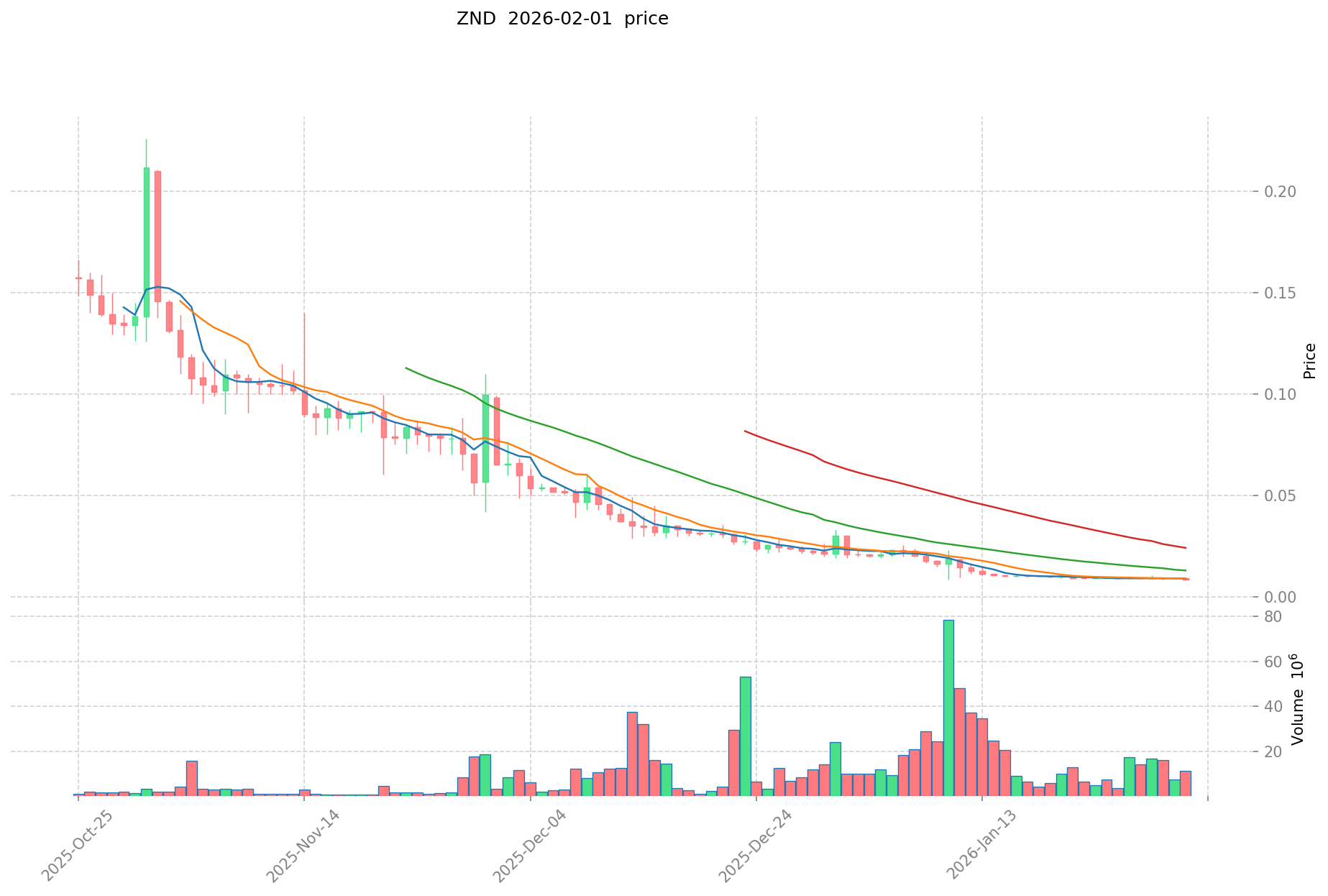
ZND reached its peak price of $0.55 on 03 March 2025, driven by initial market enthusiasm following the platform's launch and early adoption momentum. The token experienced its lowest price of $0.007473 on 01 February 2026, reflecting broader market corrections and significant downward pressure. As of 02 February 2026, ZND trades at $0.008769, showing a marginal recovery from its recent low. These fluctuations demonstrate the volatility inherent in emerging crypto assets, influenced by market sentiment, adoption trends, and trading dynamics.
Click to view current ZND market price
On-Chain Metrics
- 24-Hour Trading Volume: $102,725.12 (indicating current market activity levels)
- Market Capitalization: $1,610,294.80 (reflecting current valuation based on circulating supply)
- Token Holders: 2,205 addresses (demonstrating community distribution and engagement)
- Fully Diluted Market Cap: $6,088,748.34 (representing potential valuation at maximum supply)
- Market Dominance: 0.00022% (indicating ZND's position within the broader crypto market)
ZND Ecosystem Applications and Partnerships
Core Use Cases
ZND's ecosystem supports multiple applications:
- Crypto Exchange: zondacrypto, a leading Central European crypto exchange since 2014, provides secure digital asset trading.
- Payment Solutions: zondacrypto Pay enables businesses to accept cryptocurrency payments, expanding ZND's utility in commercial transactions.
- DeFi Platform: The ZND platform launched in December 2023 offers Trade, Earn, Borrow, and Explore functionalities, delivering a seamless experience for users across different expertise levels.
Strategic Cooperation
ZND has established itself as the primary settlement unit within its ecosystem, fostering trust, loyalty, and engagement while unlocking rewards and exclusive benefits.
These partnerships and integrations provide a solid foundation for ZND's ecosystem expansion.
Controversies and Challenges
ZND faces the following challenges:
- Market Volatility: The token has experienced significant price fluctuations, with a 30-day decline of 56.64%.
- Competitive Pressure: Operating in a highly competitive crypto market with established players.
- Limited Exchange Availability: Currently listed on only 5 exchanges, which may affect liquidity.
These issues have sparked discussions within the community and markets, while also driving ZND's continued innovation.
Fan Enthusiasm
ZND's community demonstrates growing engagement, with 2,205 holders as of the latest data.
On X platform, related posts and hashtags (such as #ZND) generate discussions around the project's development.
Factors such as platform feature launches and ecosystem expansion have ignited community enthusiasm.
Sentiment on X shows mixed perspectives:
- Supporters praise ZND's fully regulated status and comprehensive financial ecosystem, viewing it as an accessible entry point for both beginners and experienced users.
- Critics focus on price volatility and relatively low market capitalization.
Recent trends indicate cautious optimism as the project continues to develop its ecosystem.
Hot Topics
X users actively discuss ZND's regulatory compliance, ecosystem development, and token utility,
showcasing both its transformative potential and the challenges it faces in achieving mainstream adoption.
- Official Website: Visit ZND Official Website for features, use cases, and latest updates.
- White Paper: ZND White Paper details its technical architecture, goals, and vision.
- X Updates: On X platform, ZND maintains an active presence at @ZND_co,
sharing updates on technical developments, community activities, and partnership news.
ZND Future Roadmap
- Ongoing Development: Continuous enhancement of the ZND platform's Trade, Earn, Borrow, and Explore functionalities.
- Ecosystem Goals: Expanding the financial ecosystem to serve diverse user needs from beginners to experienced traders.
- Long-term Vision: Simplifying access to the crypto market while maintaining full regulatory compliance.
How to Participate in ZND?
- Purchase Channels: Buy ZND on Gate.com and other supported exchanges.
- Storage Solutions: Use compatible ERC-20 wallets to securely store ZND tokens.
- Participate in Ecosystem: Explore the ZND platform's features including trading, earning, and borrowing.
- Track Contract: View ZND's smart contract at Etherscan.
Summary
ZND redefines digital finance through blockchain technology, offering a fully regulated financial ecosystem with comprehensive services.
Its growing community, rich resources, and clear development focus distinguish it in the cryptocurrency space.
Despite facing market volatility and competitive pressures, ZND's innovative approach and clear roadmap position it as a noteworthy project in the decentralized technology landscape.
Whether you're a newcomer or experienced player, ZND merits attention and participation.
FAQ
What is ZND crypto and what is its purpose?
ZND is a cryptocurrency designed to simplify digital finance management on the Zonda platform. It facilitates transactions and enables users without specialized knowledge to easily trade and manage their digital assets in the crypto ecosystem.
How can I buy and store ZND tokens?
Purchase ZND tokens on Uniswap using ETH or stablecoins. Store them securely in a Web3 wallet like MetaMask or hardware wallets for maximum security and control.
What is the total supply and current market price of ZND?
ZND has a market cap of $714,500 with a current market price of $1.00. The exact total supply figure is not publicly specified, but the circulating supply reflects the current market valuation.
Is ZND safe and what are the potential risks?
ZND operates within a regulated framework offering long-term potential. Short-term risks include market volatility and regulatory changes. Safety depends on market conditions and your risk tolerance. Conduct thorough research before participating.
What blockchain network does ZND operate on?
ZND operates on the Ethereum blockchain, utilizing a decentralized network of nodes to ensure secure and transparent transactions.
* The information is not intended to be and does not constitute financial advice or any other recommendation of any sort offered or endorsed by Gate.